1999 TOYOTA SOLARA stop start
[x] Cancel search: stop startPage 169 of 244

SOLARA_U169
Make sure the engine oil viscosity is
suitable for the cold weather.
See Chapter 7- 2 for recommended viscos-
ity. Leaving a heavy summer oil in your
vehicle during winter months may cause
harder starting. If you are not sure about
which oil to use, call your Toyota deal-
erÐhe will be pleased to help.
Keep the door locks from freezing.
Squirt lock de- icer or glycerine into the
locks to keep them from freezing.
Use a washer fluid containing an anti-
freeze solution.
This product is available at your Toyota
dealer and most auto parts stores. Follow
the manufacturer 's directions for how
much to mix with water.
NOTICE
Do not use engine antifreeze or any
other substitute because it may dam-age your vehicle's paint.
Do not use your parking brake when
there is a possibility it could freeze.
When parking, put the transmission into
ºPº (automatic) or into first or reverse
(manual) and block the rear wheels. Do
not use the parking brake, or snow or
water accumulated in and around the
parking brake mechanism may freeze,
making it hard to release.
Keep ice and snow from accumulating
under the fenders.
Ice and snow built up under your fenders
can make steering difficult. During bad
winter driving, stop and check under the
fenders occasionally.
Depending on where you are driving,
we recommend you carry some emer-
gency equipment.
Some of the things you might put in the
vehicle are tire chains, window scraper,
bag of sand or salt, flares, small shovel,
jumper cables, etc. Trailer towing
Your vehicle is designed primarily as a
passenger- carrying vehicle. Towing a
trailer will have an adverse effect on
handling, performance, braking, durab
ility
and driving economy (fuel consumption,
etc.). Your safety and satisfaction depend
on the proper use of correct equipment
and cautious driving habits. For your
safety and the safety of others, you must
not overload your vehicle or trailer. Toyota
warranties do not apply to damage or
malfunction caused by towing a trailer for
commercial purposes. Ask your local
Toyota dealer for further details before
towing.
NOTICE
When towing a trailer, be sure to con-
sult your Toyota dealer for further in-formation on additional requirements such as a towing kit, etc.
WEIGHT LIMITS
Before towing, make sure the total trailer
weight, gross vehicle weight, gross axle
weight and trailer tongue load are all with-
in the limits.
Page 173 of 244

SOLARA_U173
TRAILER TOWING TIPS
When towing a trailer, your vehicle will
handle differently than when not tow-
ing. The three main causes of vehicle-
trailer accidents are driver error, exces-
sive speed and improper trailer loading.
Keep these in mind when towing:
Before starting out, check operation of
the lights and all vehicle- trailer connec-
tions. After driving a short distance,
stop and recheck the lights and con-
nections. Before actually towing a trail-
er, practice turning, stopping and back-
ing with a trailer in an area away from
traffic until you learn the feel.
Backing with a trailer is difficult and
requires practice. Grip the bottom of
the steering wheel and move your hand
to the left to move the trailer to the
left. Move your hand to the right to
move the trailer to the right. (This pro-
cedure is generally opposite to that
when backing without a trailer). Also,
just turn the steering wheel a little at
a time, avoiding sharp or prolonged
turning. Have someone guide you when
backing to reduce the risk of an acci-
dent.
Because stopping distance may be in-
creased, vehicle- to- vehicle distance
should be increased when towing a
trailer. For each 16 km/h (10 mph) of
speed, allow at least one vehicle and
trailer length between you and the ve-
hicle ahead. Avoid sudden braking as
you may skid, resulting in jackknifing
and loss of control. This is especially
true on wet or slippery surfaces.
Avoid jerky starts or sudden accelera-
tion. If your vehicle has a manual
transmission, prevent excessive clutch
slippage by keeping engine rpm low
and not racing the engine. Always start
out in first gear.
Avoid jerky steering and sharp turns.
The trailer could hit your vehicle in a
tight turn. Slow down before making a
turn to avoid the necessity of sudden
braking.
Remember that when making a turn,
the trailer wheels will be closer than
the vehicle wheels to the inside of the
turn. Therefore, compensate for this by
making a larger than normal turning
radius with your vehicle.
Crosswinds and rough roads will ad-
versely affect handling of your vehicle
and trailer, causing sway. Pay attention
to the rear from time to time to pre-
pare yourself for being passed by large
trucks or buses, which may cause your
vehicle and trailer to sway. If swaying
happens, firmly grip the steering wheel
and reduce speed immediately but
gradually. Never increase speed. Steer
straight ahead. If you make no extreme
correction with the steering or brakes,
the vehicle and trailer will stabilize.
Be careful when passing other ve-
hicles. Passing requires considerable
distance. After passing a vehicle, do
not forget the length of your trailer and
be sure you have plenty of room be-
fore changing lanes.
In order to maintain engine braking effi-
ciency do not use fifth gear (manual
transmission) or overdrive (automatic
transmission).
Page 174 of 244
![TOYOTA SOLARA 1999 Owners Manual SOLARA_U
174
Because of the added load of the trail-
er, your vehicles engine may overheat
on hot days (at temperatures over 30C [85 F]) when going up a long or
steep grade with a trailer. If th](/manual-img/14/68782/w960_68782-173.png "TOYOTA SOLARA 1999 Owners Manual SOLARA_U
174
Because of the added load of the trail-
er, your vehicles engine may overheat
on hot days (at temperatures over 30C [85 F]) when going up a long or
steep grade with a trailer. If th")
SOLARA_U
174
Because of the added load of the trail-
er, your vehicle's engine may overheat
on hot days (at temperatures over 30C [85 F]) when going up a long or
steep grade with a trailer. If the engine
coolant temperature gauge indicates
overheating, immediately turn off the air
conditioning (if in use), pull off the road
and stop in a safe spot. Refer to ºIf
your vehicle overheatsº in Part 4 of
this manual.
Always place wheel blocks under both
the vehicle and trailer wheels when
parking. Apply the parking brake firmly.
Put the transmission in ºPº (automatic)
or in first or reverse (manual). Avoid
parking on a slope with a trailer, but
if it cannot be avoided, do so only
after performing the following: 1. Apply the brakes and hold.
2. Have someone place wheel blocks un-
der both the vehicle and trailer wheels.
3. When the wheel blocks are in place, release your brakes slowly until the
blocks absorb the load.
4. Apply the parking brake firmly.
5. Shift into first or reverse (manual) or ºPº (automatic) and turn off the engine.
When restarting out after parking on a
slope: 1. With the transmission in ºPº position (automatic) or the clutch pedal de-
pressed (manual), start the engine.
(With an automatic transmission, be
sure to keep the brake pedal de-
pressed.)
2. Shift into gear.
3. Release the parking brake (also foot brake on automatic transmission ve-
hicles) and slowly pull or back away
from the wheel blo cks. Stop and apply
your brakes.
4. Have someone retrieve the blo cks.
CAUTION
Do not exceed 72 km/h (45 mph) or
the posted towing speed lim-
it,whichever is lower. Because insta-
bility (swaying) of a towing vehicle-
trailer combination usually in-
creases as the speed increases,ex-
ceeding 72 km/h (45 mph) may
cause loss of control.
Slow down and downshift before
descending steep or long downhill
grades. Do not make sudden down-
shifts.
Avoid holding the brake pedal down
too long or too frequently. This
could cause the brakes to overheat
and result in reduced braking effi-
ciency.
Page 175 of 244
SOLARA_U175
Getting more kilometers/mileage from a
liter/gallon of fuel is easy±just take it
easy. It will help make your vehicle last
longer, too. Here are some specific tips
on how to save money on both fuel and
repairs:
Keep your tires inflated at the cor-
rect pressure. Underinflation causes
tire wear and wastes fuel. See Chapter
7- 2 for instructions.
Do not carry unneeded weight in
your vehicle. Excess weight puts a
heavier load on the engine, causing
greater fuel consumption.
Avoid lengthy warm- up idling. Once
the engine is running smoothly, begin
drivingÐbut gently. Remember, howev-
er, that on cold winter days this may
take a little longer.
Accelerate slowly and smoothly.
Avoid jackrabbit starts. Get into high
gear as quickly as possible.
Avoid long engine idling. If you have
a long wait and you are not in traffic,
it is better to turn off the engine and
start again later.
Avoid engine lug or overrevving. Use
a gear position suitable for the road on
which you are travelling.
Avoid continuous speeding up and
slowing down. Stop- and- go driving
wastes fuel.
Avoid unnecessary stopping and
braking. Maintain a steady pace. Try
to time the traffic signals so you only
need to stop as little as possible or
take advantage of through streets to
avoid traffic lights. Keep a proper dis-
tance from other vehicles to avoid sud-
den braking. This will also reduce wear
on your brakes.
Avoid heavy traffic or traffic jams
whenever possible.
Do not rest your foot on the clutch
or brake pedal. This causes needless
wear, overheating and poor fuel econo-
my.
Maintain a moderate speed on high-ways. The faster you drive,the greater
the fuel consumption. By reducing your
speed, you will cut down on fuel con-
sumption.
Keep the front wheels in proper
alignment. Avoid hitting the curb and
slow down on rough roads. Improper
alignment not only causes faster tire
wear but also puts an extra load on
the engine, which, in turn, wastes fuel.
Keep the bottom of your vehicle free
from mud, etc. This not only lessens
weight but also helps prevent corro-
sion.
Keep your vehicle tuned- up and in
top shape. A dirty air cleaner, improp-
er valve clearance, dirty plugs, dirty oil
and grease,brakes not adjusted, etc. all
lower engine performance and contrib-
ute to poor fuel economy. For longer
life of all parts and lower operating
costs, keep all maintenance work on
schedule, and if you often drive under
severe conditions, see that your vehicle
receives more frequent maintenance.
(For scheduled maintenance informa-
tion, please refer to the separate ºOwn-
er 's Manual Supplement/Maintenance
Scheduleº).
CAUTION
Never turn off the engine to coast
down hills. Your power steering and
brake booster will not function with-
out the engine running. Also, the
emission control system operates
properly only when the engine is run-
ning.
How to save fuel and make
your vehicle last longer, too
Page 181 of 244
SOLARA_U181
If you have a flat tireÐ
1. Reduce your speed gradually, keeping a straight line. Move cautiously off the
road to a safe place well away from
the traffic. Avoid stopping on the center
divider of a highway. Park on a level
spot with firm ground.
2. Stop the engine and turn on your emergency flashers.
3. Firmly set the parking brake and put the transmission in ºPº (automatic) or
reverse (manual).
4. Have everyone get out of the vehicle on the side away from traffic.
5. Read the following instructions thor- oughly.
CAUTION
When jacking, be sure to observe the
following to reduce the possibility of
personal injury: Follow jacking instructions.
Do not start or run the engine while
your vehicle is supported by the
jack.
Stop the vehicle on a level firm
ground, firmly set the parking brake
and put the transmission in ºPº
(automatic) or reverse (manual).
Block the wheel diagonally opposite
to the one being changed if neces-
sary.
Make sure to set the jack properly
in the jack point. Raising the ve-
hicle with jack improperly posi-
tioned will damage the vehicle or
may allow the vehicle to fall off the
jack and cause personal injury.
Never get under the vehicle when
the vehicle is supported by the jack
alone.
Use the jack only for lifting your
vehicle during wheel changing.
Do not raise the vehicle with some-
one in the vehicle.
When raising the vehicle, do not
put an object on or under the jack.
Raise the vehicle only high enough
to remove and change the tire.NOTICE
Do not continue driving with a de-
flated tire. Driving even a short dis-tance can damage a tire beyond re- pair.
Page 240 of 244
SOLARA_U241
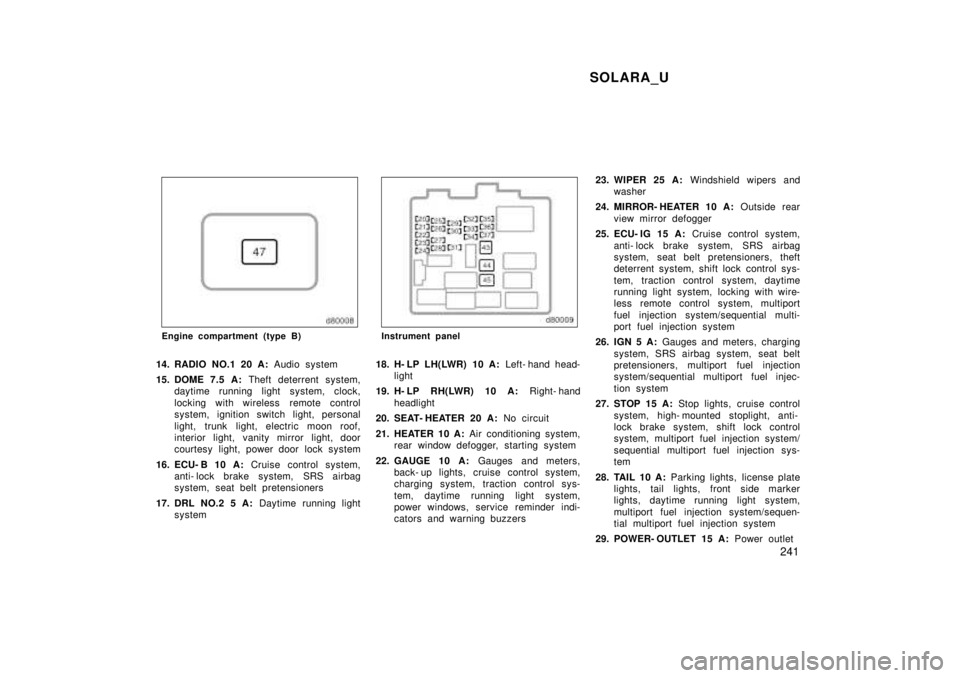
Engine compartment (type B)
14. RADIO NO.1 20 A: Audio system
15. DOME 7.5 A: Theft deterrent system,
daytime running light system, clock,
locking with wireless remote control
system, ignition switch light, pers onal
light, trunk light, electric moon roof,
interior light, vanity mirror light, door
courtesy light, power door lock system
16. ECU- B 10 A: Cruise control system,
anti- lock brake system, SRS airbag
system, seat belt pretensi oners
17. DRL NO.2 5 A: Daytime running light
systemInstrument panel
18. H- LP LH(LWR) 10 A: Left- hand head-
light
19. H- LP RH(LWR) 10 A: Right- hand
headlight
20. SEAT- HEATER 20 A: No circuit
21. HEATER 10 A: Air conditioning system,
rear window defogger, starting system
22. GAUGE 10 A: Gauges and meters,
back- up lights, cruise control system,
charging system, traction control sys-
tem, daytime running light system,
power windows, service reminder indi-
cators and warning buzzers 23. WIPER 25 A:
Windshield wipers and
washer
24. MIRROR- HEATER 10 A: Outside rear
view mirror defogger
25. ECU- IG 15 A: Cruise control system,
anti- lock brake system, SRS airbag
system, seat belt pretensi oners, theft
deterrent system, shift lock control sys-
tem, traction control system, daytime
running light system, locking with wire-
less remote control system, multiport
fuel injection system/sequential multi-
port fuel injection system
26. IGN 5 A: Gauges and meters, charging
system, SRS airbag system, seat belt
pretensioners, multiport fuel injection
system/s equential multiport fuel injec-
tion system
27. STOP 15 A: Stop lights, cruise control
system, high- m ounted stoplight, anti-
lock brake system, shift lock control
system, multiport fuel injection system/
sequential multiport fuel injection sys-
tem
28. TAIL 10 A: Parking lights, license plate
lights, tail lights, front side marker
lights, daytime running light system,
multiport fuel injection system/sequen-
tial multiport fuel injection system
29. POWER- OUTLET 15 A: Power outlet