1999 SUBARU LEGACY change time
[x] Cancel search: change timePage 495 of 1456

24) Set ST1 and ST2. Insert the needle through
transmission oil drain plug hole so that the needle
comes in contact with the tooth surface at a right
angle and check the backlash.
ST1 498247001 MAGNET BASE
ST2 498247100 DIAL GAUGE
ST3 498255400 PLATE
NOTE:
IIf backlash is outside specified range, adjust it
by turning holder in right side case.
IEach time holder rotates one tooth, backlash
changes by 0.05 mm (0.0020 in).
Backlash:
0.13 Ð 0.18 mm (0.0051 Ð 0.0071 in)
B3M1363A
25) Check tooth contact of hypoid gear as follows:
Apply a uniform thin coat of red lead on both tooth
surfaces of 3 or 4 teeth of the hypoid gear. Move
the hypoid gear back and forth by turning the trans-
mission main shaft until a definite contact pattern
is developed on hypoid gear, and judge whether
face contact is correct. If it is incorrect, make the
following correction.
ITooth contact is correct.
B3M0070D
(A) Toe
(B) Coast side
(C) Heel
(D) Drive side
IBacklash is excessive.
To reduce backlash, loosen holder on the upper
side (case right side) and turn in the holder on the
lower side (case left side) by the same amount.
B3M0071
IBacklash is insufficient.
To increase backlash, loosen holder on the lower
side (case left side) and turn in the holder on the
upper side (case right side) by the same amount.
B3M0072
IThe drive pinion shim selected before is too
thick. Reduce its thickness.
B3M0073
27
[W2B2]3-1SERVICE PROCEDURE
2. Transmission Case
Page 585 of 1456
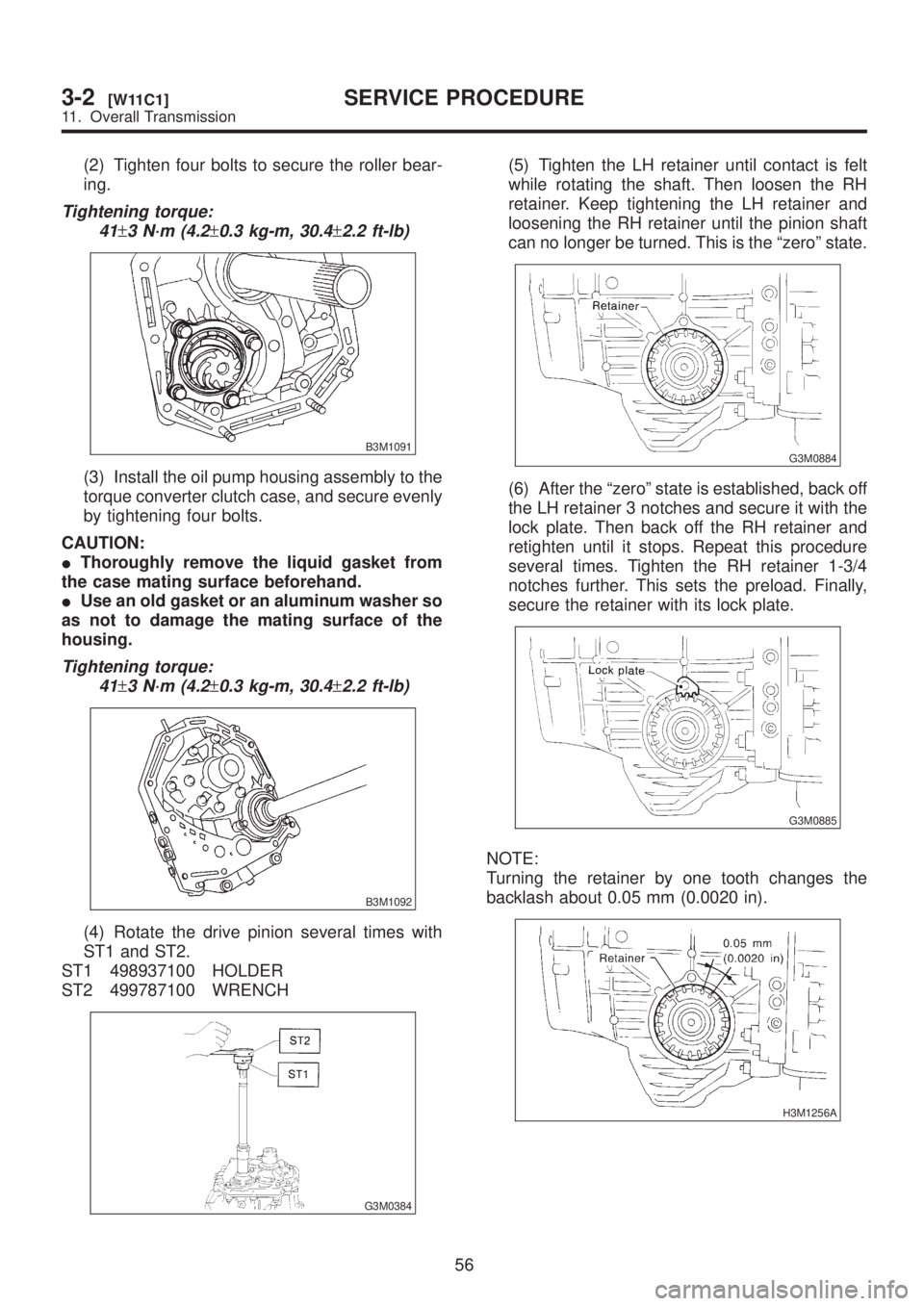
(2) Tighten four bolts to secure the roller bear-
ing.
Tightening torque:
41
±3 N´m (4.2±0.3 kg-m, 30.4±2.2 ft-lb)
B3M1091
(3) Install the oil pump housing assembly to the
torque converter clutch case, and secure evenly
by tightening four bolts.
CAUTION:
IThoroughly remove the liquid gasket from
the case mating surface beforehand.
IUse an old gasket or an aluminum washer so
as not to damage the mating surface of the
housing.
Tightening torque:
41
±3 N´m (4.2±0.3 kg-m, 30.4±2.2 ft-lb)
B3M1092
(4) Rotate the drive pinion several times with
ST1 and ST2.
ST1 498937100 HOLDER
ST2 499787100 WRENCH
G3M0384
(5) Tighten the LH retainer until contact is felt
while rotating the shaft. Then loosen the RH
retainer. Keep tightening the LH retainer and
loosening the RH retainer until the pinion shaft
can no longer be turned. This is the ªzeroº state.
G3M0884
(6) After the ªzeroº state is established, back off
the LH retainer 3 notches and secure it with the
lock plate. Then back off the RH retainer and
retighten until it stops. Repeat this procedure
several times. Tighten the RH retainer 1-3/4
notches further. This sets the preload. Finally,
secure the retainer with its lock plate.
G3M0885
NOTE:
Turning the retainer by one tooth changes the
backlash about 0.05 mm (0.0020 in).
H3M1256A
56
3-2[W11C1]SERVICE PROCEDURE
11. Overall Transmission
Page 713 of 1456
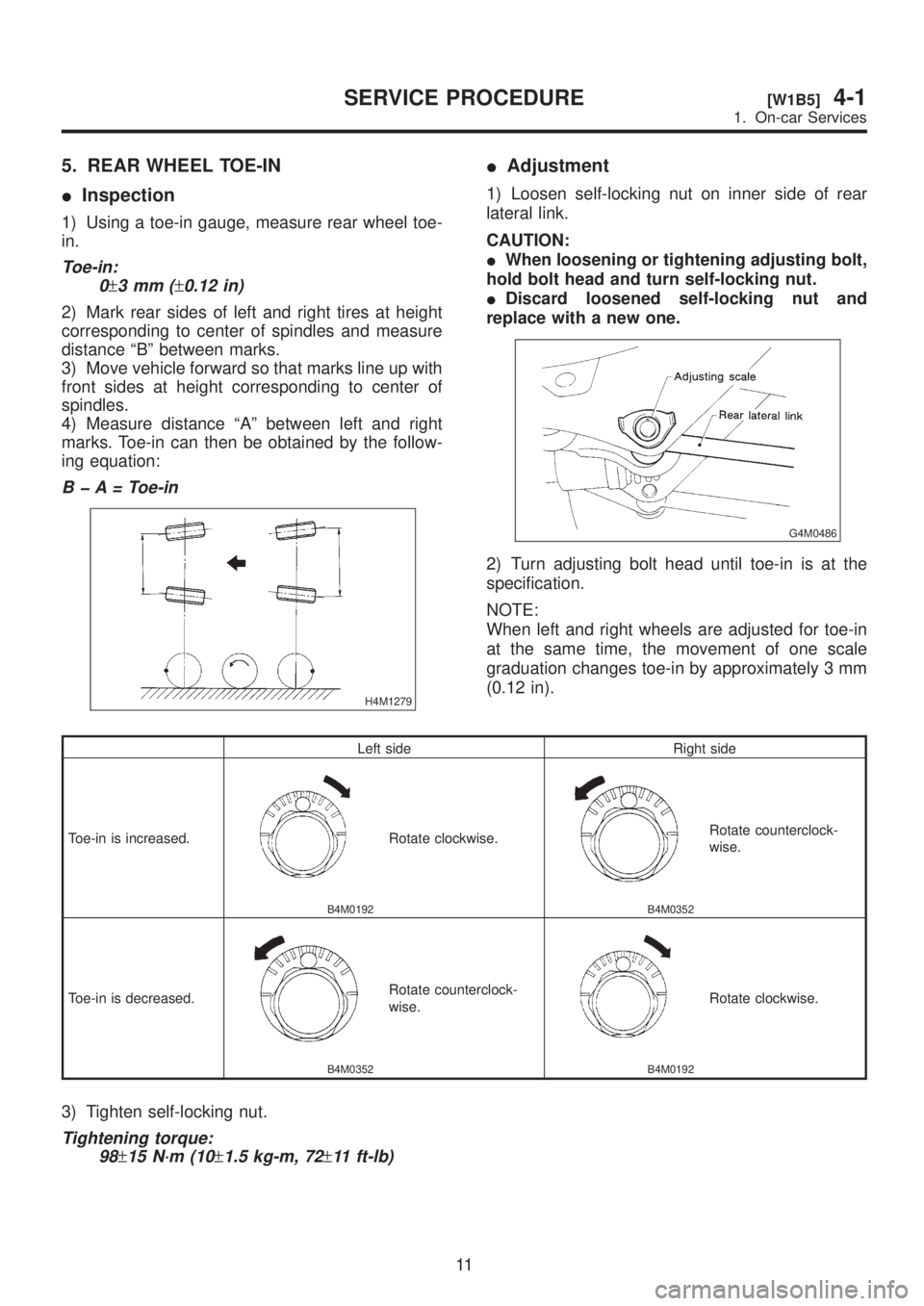
5. REAR WHEEL TOE-IN
IInspection
1) Using a toe-in gauge, measure rear wheel toe-
in.
Toe-in:
0
±3mm(±0.12 in)
2) Mark rear sides of left and right tires at height
corresponding to center of spindles and measure
distance ªBº between marks.
3) Move vehicle forward so that marks line up with
front sides at height corresponding to center of
spindles.
4) Measure distance ªAº between left and right
marks. Toe-in can then be obtained by the follow-
ing equation:
B þ A = Toe-in
H4M1279
IAdjustment
1) Loosen self-locking nut on inner side of rear
lateral link.
CAUTION:
IWhen loosening or tightening adjusting bolt,
hold bolt head and turn self-locking nut.
IDiscard loosened self-locking nut and
replace with a new one.
G4M0486
2) Turn adjusting bolt head until toe-in is at the
specification.
NOTE:
When left and right wheels are adjusted for toe-in
at the same time, the movement of one scale
graduation changes toe-in by approximately 3 mm
(0.12 in).
Left side Right side
Toe-in is increased.
B4M0192
Rotate clockwise.
B4M0352
Rotate counterclock-
wise.
Toe-in is decreased.
B4M0352
Rotate counterclock-
wise.
B4M0192
Rotate clockwise.
3) Tighten self-locking nut.
Tightening torque:
98
±15 N´m (10±1.5 kg-m, 72±11 ft-lb)
11
[W1B5]4-1SERVICE PROCEDURE
1. On-car Services
Page 860 of 1456
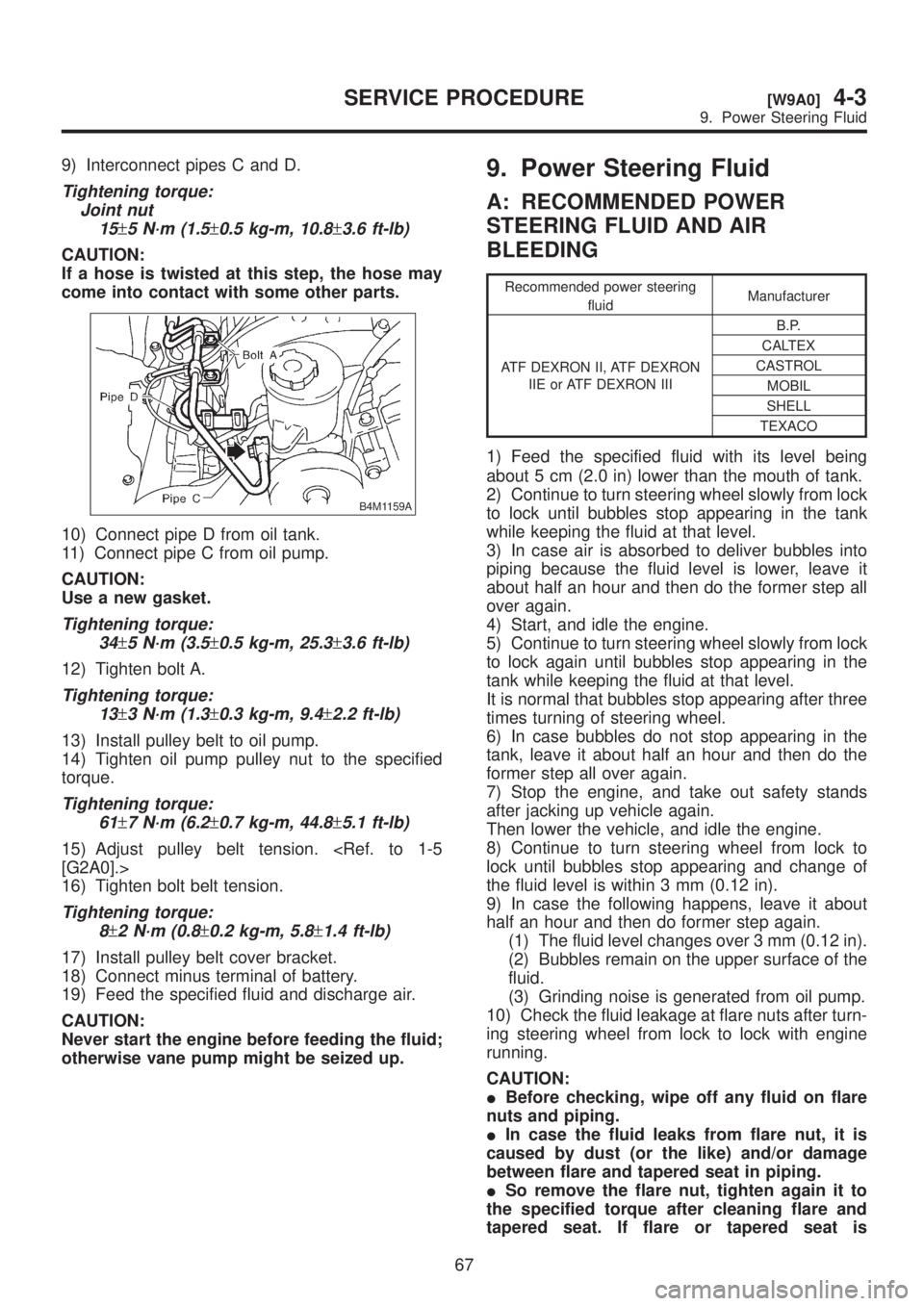
9) Interconnect pipes C and D.
Tightening torque:
Joint nut
15
±5 N´m (1.5±0.5 kg-m, 10.8±3.6 ft-lb)
CAUTION:
If a hose is twisted at this step, the hose may
come into contact with some other parts.
B4M1159A
10) Connect pipe D from oil tank.
11) Connect pipe C from oil pump.
CAUTION:
Use a new gasket.
Tightening torque:
34
±5 N´m (3.5±0.5 kg-m, 25.3±3.6 ft-lb)
12) Tighten bolt A.
Tightening torque:
13
±3 N´m (1.3±0.3 kg-m, 9.4±2.2 ft-lb)
13) Install pulley belt to oil pump.
14) Tighten oil pump pulley nut to the specified
torque.
Tightening torque:
61
±7 N´m (6.2±0.7 kg-m, 44.8±5.1 ft-lb)
15) Adjust pulley belt tension.
16) Tighten bolt belt tension.
Tightening torque:
8
±2 N´m (0.8±0.2 kg-m, 5.8±1.4 ft-lb)
17) Install pulley belt cover bracket.
18) Connect minus terminal of battery.
19) Feed the specified fluid and discharge air.
CAUTION:
Never start the engine before feeding the fluid;
otherwise vane pump might be seized up.
9. Power Steering Fluid
A: RECOMMENDED POWER
STEERING FLUID AND AIR
BLEEDING
Recommended power steering
fluidManufacturer
ATF DEXRON II, ATF DEXRON
IIE or ATF DEXRON IIIB.P.
CALTEX
CASTROL
MOBIL
SHELL
TEXACO
1) Feed the specified fluid with its level being
about 5 cm (2.0 in) lower than the mouth of tank.
2) Continue to turn steering wheel slowly from lock
to lock until bubbles stop appearing in the tank
while keeping the fluid at that level.
3) In case air is absorbed to deliver bubbles into
piping because the fluid level is lower, leave it
about half an hour and then do the former step all
over again.
4) Start, and idle the engine.
5) Continue to turn steering wheel slowly from lock
to lock again until bubbles stop appearing in the
tank while keeping the fluid at that level.
It is normal that bubbles stop appearing after three
times turning of steering wheel.
6) In case bubbles do not stop appearing in the
tank, leave it about half an hour and then do the
former step all over again.
7) Stop the engine, and take out safety stands
after jacking up vehicle again.
Then lower the vehicle, and idle the engine.
8) Continue to turn steering wheel from lock to
lock until bubbles stop appearing and change of
the fluid level is within 3 mm (0.12 in).
9) In case the following happens, leave it about
half an hour and then do former step again.
(1) The fluid level changes over 3 mm (0.12 in).
(2) Bubbles remain on the upper surface of the
fluid.
(3) Grinding noise is generated from oil pump.
10) Check the fluid leakage at flare nuts after turn-
ing steering wheel from lock to lock with engine
running.
CAUTION:
IBefore checking, wipe off any fluid on flare
nuts and piping.
IIn case the fluid leaks from flare nut, it is
caused by dust (or the like) and/or damage
between flare and tapered seat in piping.
ISo remove the flare nut, tighten again it to
the specified torque after cleaning flare and
tapered seat. If flare or tapered seat is
67
[W9A0]4-3SERVICE PROCEDURE
9. Power Steering Fluid
Page 861 of 1456
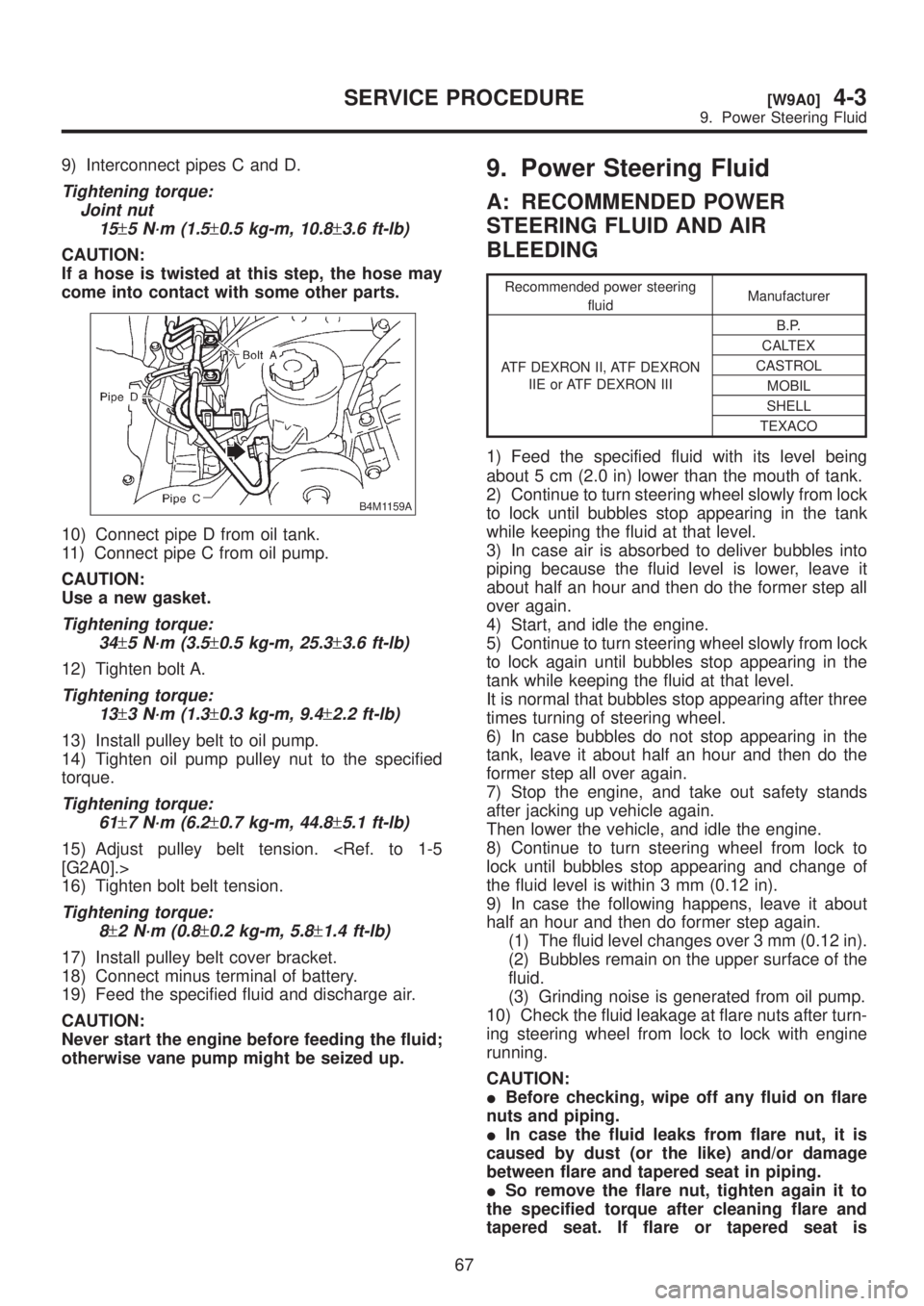
9) Interconnect pipes C and D.
Tightening torque:
Joint nut
15
±5 N´m (1.5±0.5 kg-m, 10.8±3.6 ft-lb)
CAUTION:
If a hose is twisted at this step, the hose may
come into contact with some other parts.
B4M1159A
10) Connect pipe D from oil tank.
11) Connect pipe C from oil pump.
CAUTION:
Use a new gasket.
Tightening torque:
34
±5 N´m (3.5±0.5 kg-m, 25.3±3.6 ft-lb)
12) Tighten bolt A.
Tightening torque:
13
±3 N´m (1.3±0.3 kg-m, 9.4±2.2 ft-lb)
13) Install pulley belt to oil pump.
14) Tighten oil pump pulley nut to the specified
torque.
Tightening torque:
61
±7 N´m (6.2±0.7 kg-m, 44.8±5.1 ft-lb)
15) Adjust pulley belt tension.
16) Tighten bolt belt tension.
Tightening torque:
8
±2 N´m (0.8±0.2 kg-m, 5.8±1.4 ft-lb)
17) Install pulley belt cover bracket.
18) Connect minus terminal of battery.
19) Feed the specified fluid and discharge air.
CAUTION:
Never start the engine before feeding the fluid;
otherwise vane pump might be seized up.
9. Power Steering Fluid
A: RECOMMENDED POWER
STEERING FLUID AND AIR
BLEEDING
Recommended power steering
fluidManufacturer
ATF DEXRON II, ATF DEXRON
IIE or ATF DEXRON IIIB.P.
CALTEX
CASTROL
MOBIL
SHELL
TEXACO
1) Feed the specified fluid with its level being
about 5 cm (2.0 in) lower than the mouth of tank.
2) Continue to turn steering wheel slowly from lock
to lock until bubbles stop appearing in the tank
while keeping the fluid at that level.
3) In case air is absorbed to deliver bubbles into
piping because the fluid level is lower, leave it
about half an hour and then do the former step all
over again.
4) Start, and idle the engine.
5) Continue to turn steering wheel slowly from lock
to lock again until bubbles stop appearing in the
tank while keeping the fluid at that level.
It is normal that bubbles stop appearing after three
times turning of steering wheel.
6) In case bubbles do not stop appearing in the
tank, leave it about half an hour and then do the
former step all over again.
7) Stop the engine, and take out safety stands
after jacking up vehicle again.
Then lower the vehicle, and idle the engine.
8) Continue to turn steering wheel from lock to
lock until bubbles stop appearing and change of
the fluid level is within 3 mm (0.12 in).
9) In case the following happens, leave it about
half an hour and then do former step again.
(1) The fluid level changes over 3 mm (0.12 in).
(2) Bubbles remain on the upper surface of the
fluid.
(3) Grinding noise is generated from oil pump.
10) Check the fluid leakage at flare nuts after turn-
ing steering wheel from lock to lock with engine
running.
CAUTION:
IBefore checking, wipe off any fluid on flare
nuts and piping.
IIn case the fluid leaks from flare nut, it is
caused by dust (or the like) and/or damage
between flare and tapered seat in piping.
ISo remove the flare nut, tighten again it to
the specified torque after cleaning flare and
tapered seat. If flare or tapered seat is
67
[W9A0]4-3SERVICE PROCEDURE
9. Power Steering Fluid
Page 914 of 1456
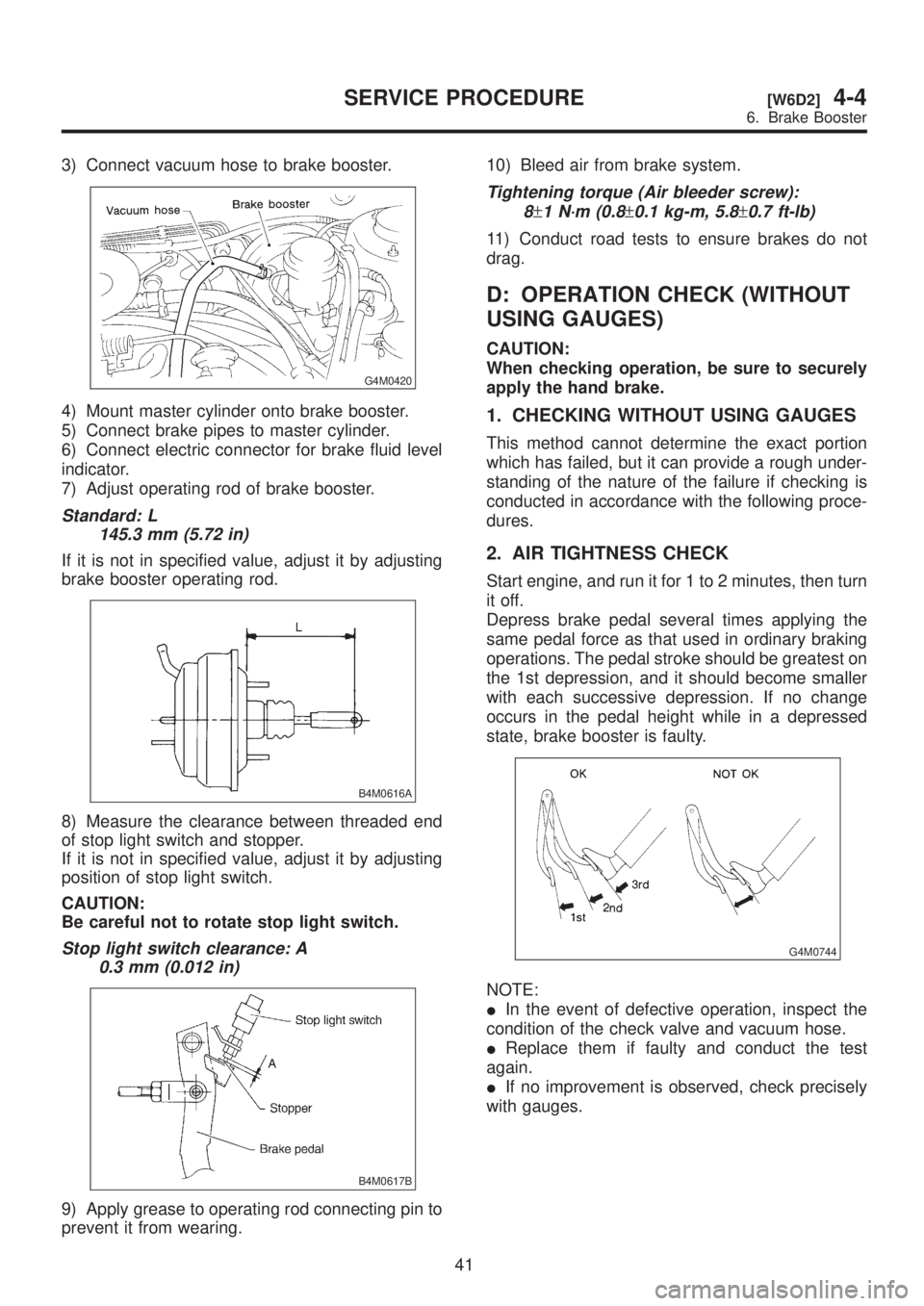
3) Connect vacuum hose to brake booster.
G4M0420
4) Mount master cylinder onto brake booster.
5) Connect brake pipes to master cylinder.
6) Connect electric connector for brake fluid level
indicator.
7) Adjust operating rod of brake booster.
Standard: L
145.3 mm (5.72 in)
If it is not in specified value, adjust it by adjusting
brake booster operating rod.
B4M0616A
8) Measure the clearance between threaded end
of stop light switch and stopper.
If it is not in specified value, adjust it by adjusting
position of stop light switch.
CAUTION:
Be careful not to rotate stop light switch.
Stop light switch clearance: A
0.3 mm (0.012 in)
B4M0617B
9) Apply grease to operating rod connecting pin to
prevent it from wearing.10) Bleed air from brake system.
Tightening torque (Air bleeder screw):
8
±1 N´m (0.8±0.1 kg-m, 5.8±0.7 ft-lb)
11) Conduct road tests to ensure brakes do not
drag.
D: OPERATION CHECK (WITHOUT
USING GAUGES)
CAUTION:
When checking operation, be sure to securely
apply the hand brake.
1. CHECKING WITHOUT USING GAUGES
This method cannot determine the exact portion
which has failed, but it can provide a rough under-
standing of the nature of the failure if checking is
conducted in accordance with the following proce-
dures.
2. AIR TIGHTNESS CHECK
Start engine, and run it for 1 to 2 minutes, then turn
it off.
Depress brake pedal several times applying the
same pedal force as that used in ordinary braking
operations. The pedal stroke should be greatest on
the 1st depression, and it should become smaller
with each successive depression. If no change
occurs in the pedal height while in a depressed
state, brake booster is faulty.
G4M0744
NOTE:
IIn the event of defective operation, inspect the
condition of the check valve and vacuum hose.
IReplace them if faulty and conduct the test
again.
IIf no improvement is observed, check precisely
with gauges.
41
[W6D2]4-4SERVICE PROCEDURE
6. Brake Booster
Page 915 of 1456
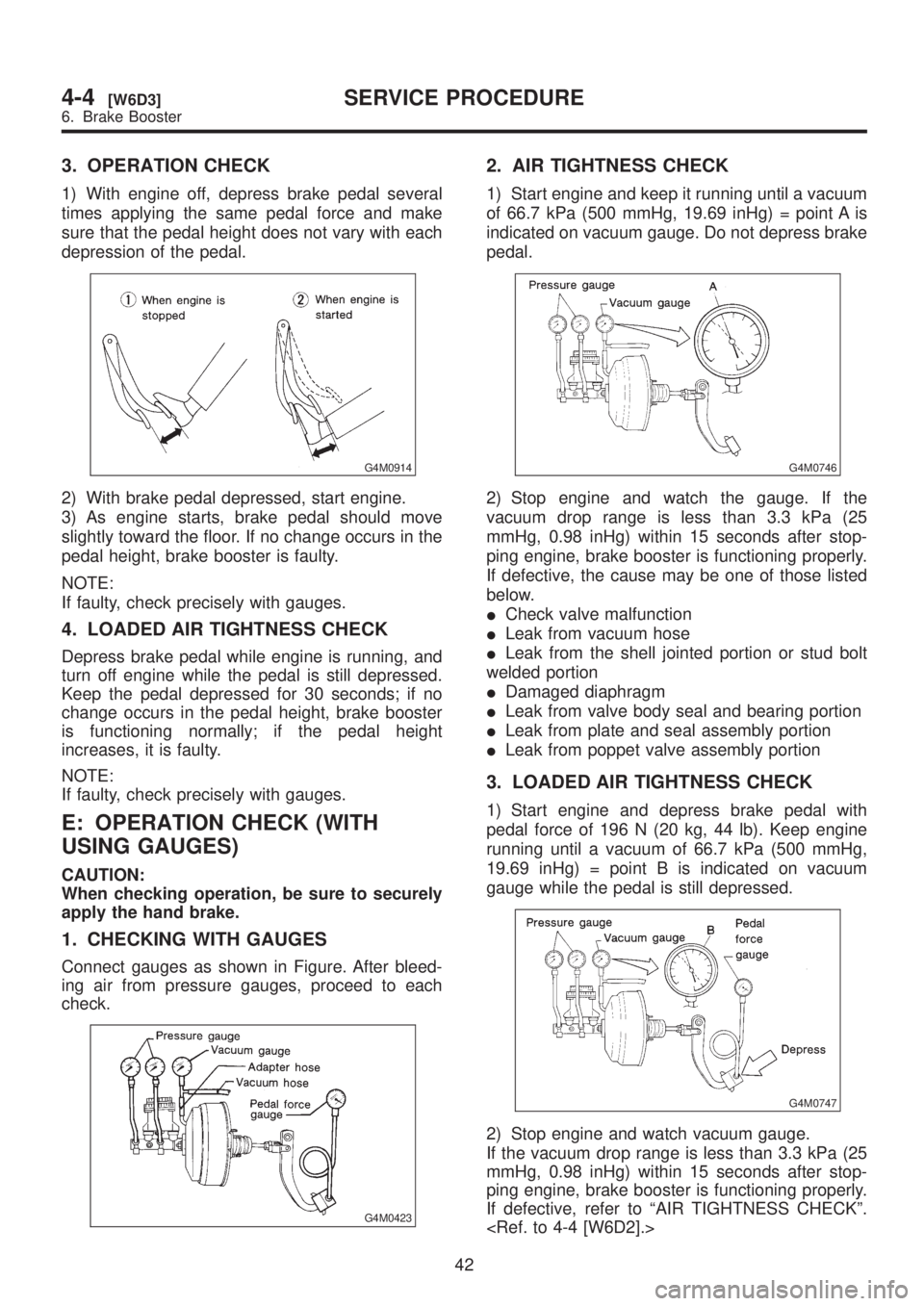
3. OPERATION CHECK
1) With engine off, depress brake pedal several
times applying the same pedal force and make
sure that the pedal height does not vary with each
depression of the pedal.
G4M0914
2) With brake pedal depressed, start engine.
3) As engine starts, brake pedal should move
slightly toward the floor. If no change occurs in the
pedal height, brake booster is faulty.
NOTE:
If faulty, check precisely with gauges.
4. LOADED AIR TIGHTNESS CHECK
Depress brake pedal while engine is running, and
turn off engine while the pedal is still depressed.
Keep the pedal depressed for 30 seconds; if no
change occurs in the pedal height, brake booster
is functioning normally; if the pedal height
increases, it is faulty.
NOTE:
If faulty, check precisely with gauges.
E: OPERATION CHECK (WITH
USING GAUGES)
CAUTION:
When checking operation, be sure to securely
apply the hand brake.
1. CHECKING WITH GAUGES
Connect gauges as shown in Figure. After bleed-
ing air from pressure gauges, proceed to each
check.
G4M0423
2. AIR TIGHTNESS CHECK
1) Start engine and keep it running until a vacuum
of 66.7 kPa (500 mmHg, 19.69 inHg) = point A is
indicated on vacuum gauge. Do not depress brake
pedal.
G4M0746
2) Stop engine and watch the gauge. If the
vacuum drop range is less than 3.3 kPa (25
mmHg, 0.98 inHg) within 15 seconds after stop-
ping engine, brake booster is functioning properly.
If defective, the cause may be one of those listed
below.
ICheck valve malfunction
ILeak from vacuum hose
ILeak from the shell jointed portion or stud bolt
welded portion
IDamaged diaphragm
ILeak from valve body seal and bearing portion
ILeak from plate and seal assembly portion
ILeak from poppet valve assembly portion
3. LOADED AIR TIGHTNESS CHECK
1) Start engine and depress brake pedal with
pedal force of 196 N (20 kg, 44 lb). Keep engine
running until a vacuum of 66.7 kPa (500 mmHg,
19.69 inHg) = point B is indicated on vacuum
gauge while the pedal is still depressed.
G4M0747
2) Stop engine and watch vacuum gauge.
If the vacuum drop range is less than 3.3 kPa (25
mmHg, 0.98 inHg) within 15 seconds after stop-
ping engine, brake booster is functioning properly.
If defective, refer to ªAIR TIGHTNESS CHECKº.
42
4-4[W6D3]SERVICE PROCEDURE
6. Brake Booster
Page 1262 of 1456
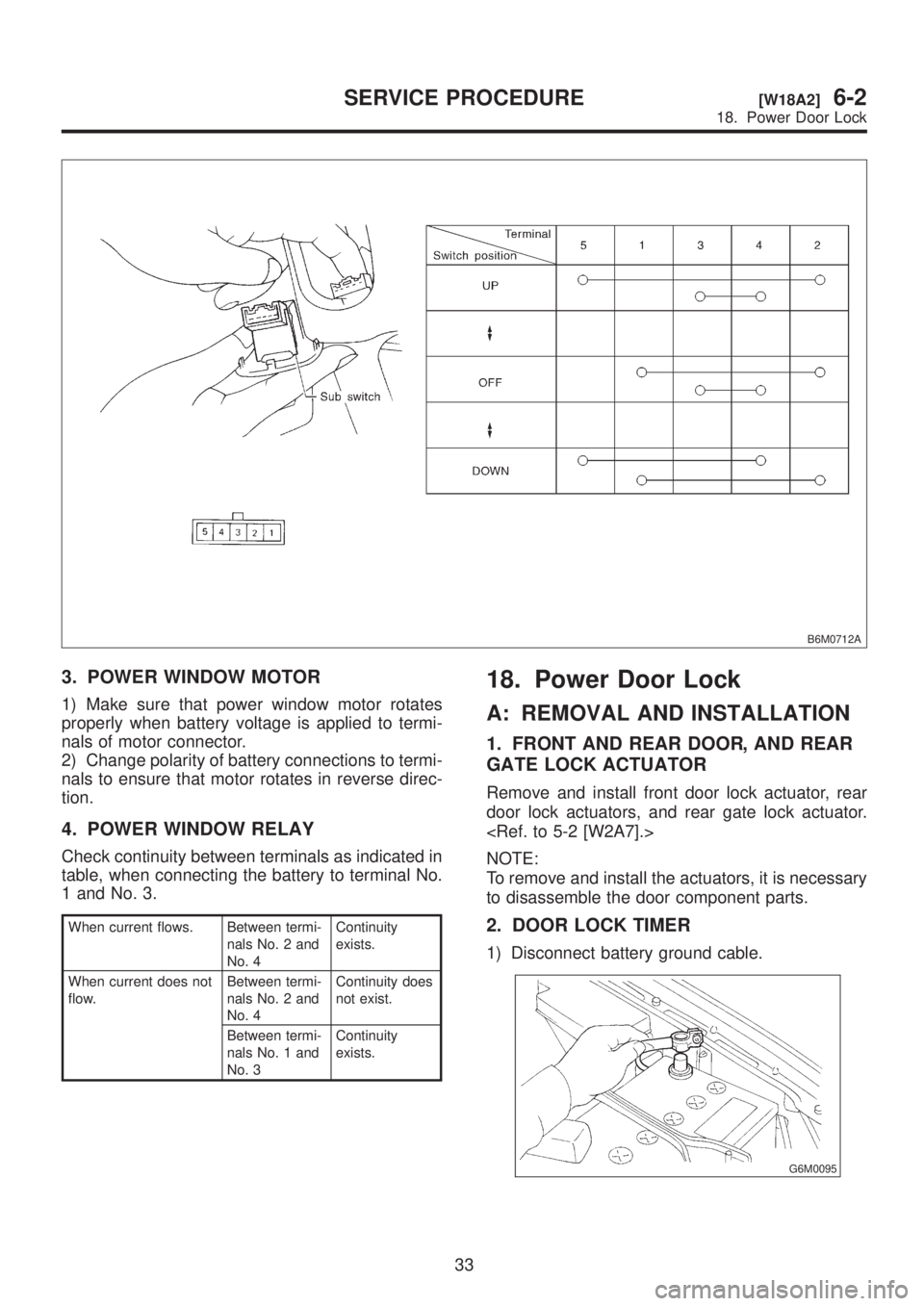
B6M0712A
3. POWER WINDOW MOTOR
1) Make sure that power window motor rotates
properly when battery voltage is applied to termi-
nals of motor connector.
2) Change polarity of battery connections to termi-
nals to ensure that motor rotates in reverse direc-
tion.
4. POWER WINDOW RELAY
Check continuity between terminals as indicated in
table, when connecting the battery to terminal No.
1 and No. 3.
When current flows. Between termi-
nals No. 2 and
No. 4Continuity
exists.
When current does not
flow.Between termi-
nals No. 2 and
No. 4Continuity does
not exist.
Between termi-
nals No. 1 and
No. 3Continuity
exists.
18. Power Door Lock
A: REMOVAL AND INSTALLATION
1. FRONT AND REAR DOOR, AND REAR
GATE LOCK ACTUATOR
Remove and install front door lock actuator, rear
door lock actuators, and rear gate lock actuator.
NOTE:
To remove and install the actuators, it is necessary
to disassemble the door component parts.
2. DOOR LOCK TIMER
1) Disconnect battery ground cable.
G6M0095
33
[W18A2]6-2SERVICE PROCEDURE
18. Power Door Lock