Page 59 of 368

2-
yellowblue
2-1
Section 2 Features and Controls
Here you can learn about the many standard and optional features on your vehicle, and information on starting,
shifting and braking. Also explained are the instrument panel and the warning systems that tell you if everything is
working properly
-- and what to do if you have a problem.
2
-2 Keys
2
-4 Door Locks
2
-6 Keyless Entry System
2
-9 Liftgate/Liftglass
2
-10 Theft
2
-11 Content Theft-Deterrent
2
-12 Passlock�
2-13 New Vehicle ªBreak-Inº
2
-13 Ignition Positions
2
-15 Starting Your Engine
2
-16 Engine Coolant Heater (If Equipped)
2
-17 Automatic Transmission Operation
2
-20 Parking Brake
2
-21 Shifting Into PARK (P)
2
-23 Shifting Out of PARK (P)
2
-24 Parking Over Things That Burn
2
-25 Engine Exhaust
2
-25 Running Your Engine While You're Parked2
-26 Locking Rear Axle
2
-26 All-Wheel Drive
2
-27 Windows
2
-27 Horn
2
-28 Tilt Wheel
2
-28 Turn Signal/Multifunction Lever
2
-35 Exterior Lamps
2
-37 Interior Lamps
2
-39 Mirrors
2
-41 Storage Compartments
2
-48 Ashtrays and Cigarette Lighter
2
-49 Sun Visors
2
-50 Accessory Power Outlets
2
-50 Sunroof (If Equipped)
2
-51 Universal Transmitter
2
-55 Instrument Panel
2
-56 Instrument Panel Cluster
2
-58 Warning Lights, Gages and Indicators
Page 97 of 368
yellowblue
2-39
Mirrors
Electrochromic Day/Night Inside
Rearview Mirror
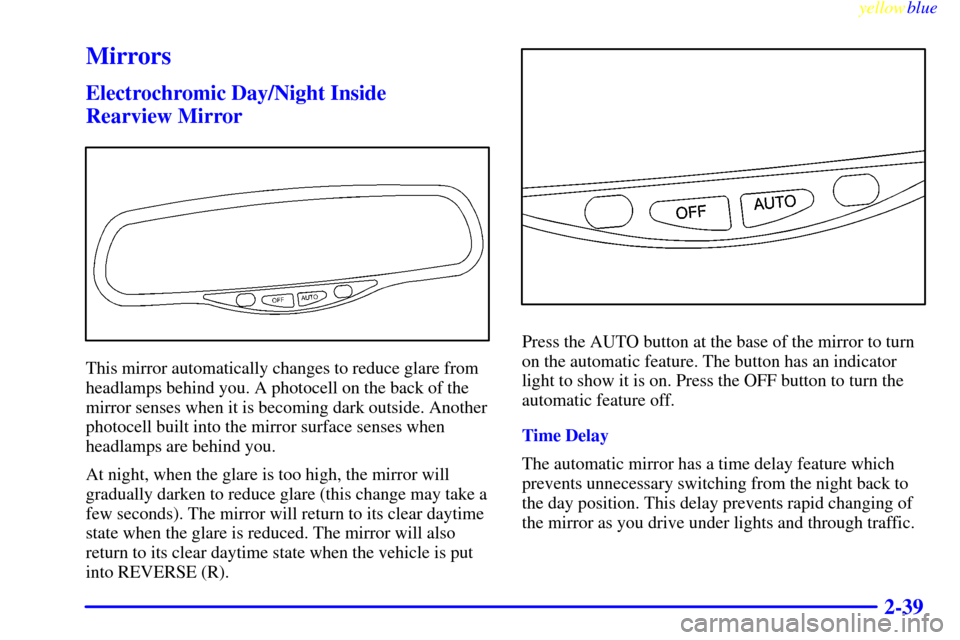
This mirror automatically changes to reduce glare from
headlamps behind you. A photocell on the back of the
mirror senses when it is becoming dark outside. Another
photocell built into the mirror surface senses when
headlamps are behind you.
At night, when the glare is too high, the mirror will
gradually darken to reduce glare (this change may take a
few seconds). The mirror will return to its clear daytime
state when the glare is reduced. The mirror will also
return to its clear daytime state when the vehicle is put
into REVERSE (R).
Press the AUTO button at the base of the mirror to turn
on the automatic feature. The button has an indicator
light to show it is on. Press the OFF button to turn the
automatic feature off.
Time Delay
The automatic mirror has a time delay feature which
prevents unnecessary switching from the night back to
the day position. This delay prevents rapid changing of
the mirror as you drive under lights and through traffic.
Page 98 of 368

yellowblue
2-40
Cleaning the Photocells
Use a cotton swab and glass cleaner to clean the
photocells when necessary.
Power Remote Control Mirror
The control is located on the
driver's door armrest.
Move the top control to the left or right to choose the
mirror, then press the arrows on the control pad to adjust
the mirror.
Convex Outside Mirror
Your passenger's side mirror is convex. A convex
mirror's surface is curved so you can see more from the
driver's seat.
CAUTION:
A convex mirror can make things (like other
vehicles) look farther away than they really are.
If you cut too sharply into the right or left lane,
you could hit a vehicle. Check your inside mirror
or glance over your shoulder before changing
lanes.
Heated Outside Rearview Mirrors
When you operate the rear window defogger, a defogger
also warms the heated driver's and passenger's outside
rearview mirrors to help clear them of ice, snow and
condensation. See ªRear Window Defoggerº in the
Index for more information.
Page 99 of 368
yellowblue
2-41 Electrochromic Rearview Outside Mirror
(If Equipped)
If you have this feature, the driver's side outside mirror
will adjust for the glare of the headlamps behind you.
See ªElectrochromic Day/Night Inside Rearview
Mirrorº earlier in this section.
Storage Compartments
Glove Box
To open your glove box, lift the lever on the front of the
glove box and lower the door. The glove box should not
be open while driving.
Overhead Console
The overhead console includes reading lamps, a driver
information system, a storage compartment for
sunglasses and a universal transmitter.
Page 107 of 368
yellowblue
2-49
Sun Visors
To block out glare, you can move down the top and
bottom visors (if your vehicle has one). You can also
move the bottom visor from side
-to-side. Your visors
may have an extension that can be pulled out for
additional glare protection and a strap for holding small
items, such as maps.
Visor Vanity Mirror
Pull the sun visor down and lift the cover to expose the
vanity mirror.
Illuminated Visor Vanity Mirror
Pull the sun visor down and lift the mirror cover to turn
on the lamps.
Page 134 of 368

yellowblue
3-6 Rear Window Defogger
The rear window has lines that warm the glass. For best
results, clear the window of as much snow or ice as
possible before using the rear window defogger.
To turn on the rear window
defogger, find the switch
marked REAR with the
defog symbol on the lower
right corner of your climate
control system.
Press the switch until the light in the switch comes on,
then release it. It will only work if the ignition switch is
turned to RUN.The rear window defogger will stay on for five to seven
minutes, then turn off. If you need additional warming
time, turn it on again. You can turn the defogger off at
any time by pressing the switch.
Pressing the REAR button on your climate control
system will also activate your heated outside mirrors (if
equipped). This will help to keep ice, snow and
condensation from collecting on your mirror surfaces.
Do not attach a temporary vehicle license, tape or decals
across the defogger grid on the rear window.
NOTICE:
Don't use a razor blade or something else sharp
on the inside of the rear window. If you do, you
could cut or damage the warming grid, and the
repairs wouldn't be covered by your warranty.
Page 164 of 368

yellowblue
4-12
�Watch for traffic signs, pavement markings and lines.
If you can see a sign up ahead that might indicate a
turn or an intersection, delay your pass. A broken
center line usually indicates it's all right to pass
(providing the road ahead is clear). Never cross a solid
line on your side of the lane or a double solid line,
even if the road seems empty of approaching traffic.
�Do not get too close to the vehicle you want to
pass while you're awaiting an opportunity. For one
thing, following too closely reduces your area of
vision, especially if you're following a larger
vehicle. Also, you won't have adequate space if the
vehicle ahead suddenly slows or stops. Keep back a
reasonable distance.
�When it looks like a chance to pass is coming up,
start to accelerate but stay in the right lane and don't
get too close. Time your move so you will be
increasing speed as the time comes to move into the
other lane. If the way is clear to pass, you will have a
ªrunning startº that more than makes up for the
distance you would lose by dropping back. And if
something happens to cause you to cancel your pass,
you need only slow down and drop back again and
wait for another opportunity.�If other cars are lined up to pass a slow vehicle, wait
your turn. But take care that someone isn't trying to
pass you as you pull out to pass the slow vehicle.
Remember to glance over your shoulder and check
the blind spot.
�Check your mirrors, glance over your shoulder and
start your left lane change signal before moving out
of the right lane to pass. When you are far enough
ahead of the passed vehicle to see its front in your
inside mirror, activate your right lane change signal
and move back into the right lane. (Remember that
your right outside mirror is convex. The vehicle you
just passed may seem to be farther away from you
than it really is.)
�Try not to pass more than one vehicle at a time
on two
-lane roads. Reconsider before passing the
next vehicle.
�Don't overtake a slowly moving vehicle too rapidly.
Even though the brake lamps are not flashing, it may
be slowing down or starting to turn.
�If you're being passed, make it easy for the
following driver to get ahead of you. Perhaps you
can ease a little to the right.
Page 165 of 368

yellowblue
4-13
Loss of Control
Let's review what driving experts say about what
happens when the three control systems (brakes, steering
and acceleration) don't have enough friction where the
tires meet the road to do what the driver has asked.
In any emergency, don't give up. Keep trying to steer and
constantly seek an escape route or area of less danger.
Skidding
In a skid, a driver can lose control of the vehicle.
Defensive drivers avoid most skids by taking reasonable
care suited to existing conditions, and by not ªoverdrivingº
those conditions. But skids are always possible.
The three types of skids correspond to your vehicle's
three control systems. In the braking skid, your wheels
aren't rolling. In the steering or cornering skid, too
much speed or steering in a curve causes tires to slip and
lose cornering force. And in the acceleration skid, too
much throttle causes the driving wheels to spin.
A cornering skid and an acceleration skid are best
handled by easing your foot off the accelerator pedal.If your vehicle starts to slide, ease your foot off the
accelerator pedal and quickly steer the way you want the
vehicle to go. If you start steering quickly enough, your
vehicle may straighten out. Always be ready for a
second skid if it occurs.
Of course, traction is reduced when water, snow, ice,
gravel or other material is on the road. For safety, you'll
want to slow down and adjust your driving to these
conditions. It is important to slow down on slippery
surfaces because stopping distance will be longer and
vehicle control more limited.
While driving on a surface with reduced traction, try
your best to avoid sudden steering, acceleration or
braking (including engine braking by shifting to a lower
gear). Any sudden changes could cause the tires to slide.
You may not realize the surface is slippery until your
vehicle is skidding. Learn to recognize warning
clues
-- such as enough water, ice or packed snow on
the road to make a ªmirrored surfaceº
-- and slow
down when you have any doubt.
Remember: Any anti
-lock brake system (ABS) helps
avoid only the braking skid.

