Page 120 of 328
yellowblue
2-60 Engine Coolant Temperature Gage
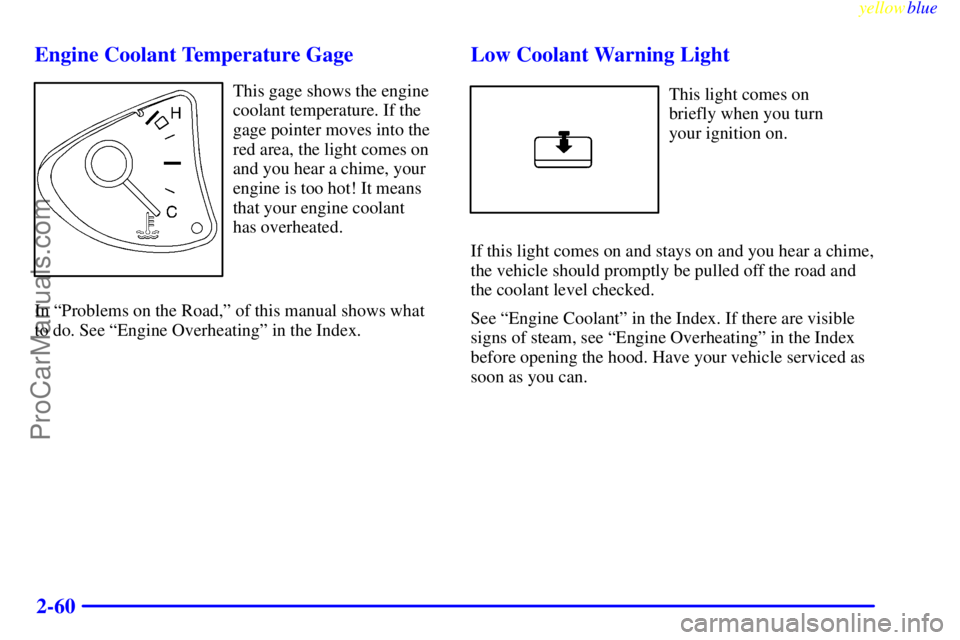
This gage shows the engine
coolant temperature. If the
gage pointer moves into the
red area, the light comes on
and you hear a chime, your
engine is too hot! It means
that your engine coolant
has overheated.
In ªProblems on the Road,º of this manual shows what
to do. See ªEngine Overheatingº in the Index.
Low Coolant Warning Light
This light comes on
briefly when you turn
your ignition on.
If this light comes on and stays on and you hear a chime,
the vehicle should promptly be pulled off the road and
the coolant level checked.
See ªEngine Coolantº in the Index. If there are visible
signs of steam, see ªEngine Overheatingº in the Index
before opening the hood. Have your vehicle serviced as
soon as you can.
ProCarManuals.com
Page 132 of 328
yellowblue
3-4 Heating
On cold days, use FLOOR and the outside air button
with the temperature knob all the way in the red area.
The system will bring in outside air, heat it and send it to
the floor outlets.
Your vehicle has heat ducts that are directed toward the
rear seat. Keep the area under the front seats clear of
obstructions so that the heated air can reach the rear
seat passengers.
If your vehicle has an engine coolant heater, you can use
it to help your system provide warm air faster when it's
cold outside (0�F (
-18�C) or lower). An engine coolant
heater warms the coolant your engine and heating
system use to provide heat. See ªEngine Coolant
Heaterº in the Index.
Defogging and Defrosting Windows
Your system has two settings for clearing the front and
side windows. For each setting, adjust the temperature
control as desired.
To defrost the front window quickly, turn the
temperature control knob all the way in the red area.
Use FRONT DEFROST and adjust the fan to the highest
speed. To warm passengers while keeping the front
window clean, use DEFOG.If you select RECIRCULATION while in the VENT,
BI
-LEVEL or FLOOR modes, humid air can recirculate
inside the vehicle and allow moisture to form on the
windows. If this happens either press the A/C button
to on or select FRONT DEFROSTER or the
DEFOG modes.
Your vehicle is equipped with side window defogger
vents. The side window defogger vents are located on the
outside of the side instrument panel vents. To defrost the
side windows, turn the temperature control knob all the
way in the red area. Use FLOOR and adjust the fan to the
highest speed. To control fogging of the windows, turn
the temperature control knob all the way in the red area.
Use DEFOG and adjust the fan to the highest speed.
To defog the side windows while using air conditioning,
use BI
-LEVEL and adjust the fan to the highest speed
and press the A/C button so that the indicator light is
glowing. For added airflow to the side windows aim
the side vents toward the windows and close the
center vents.
ProCarManuals.com
Page 206 of 328
yellowblue
5-12
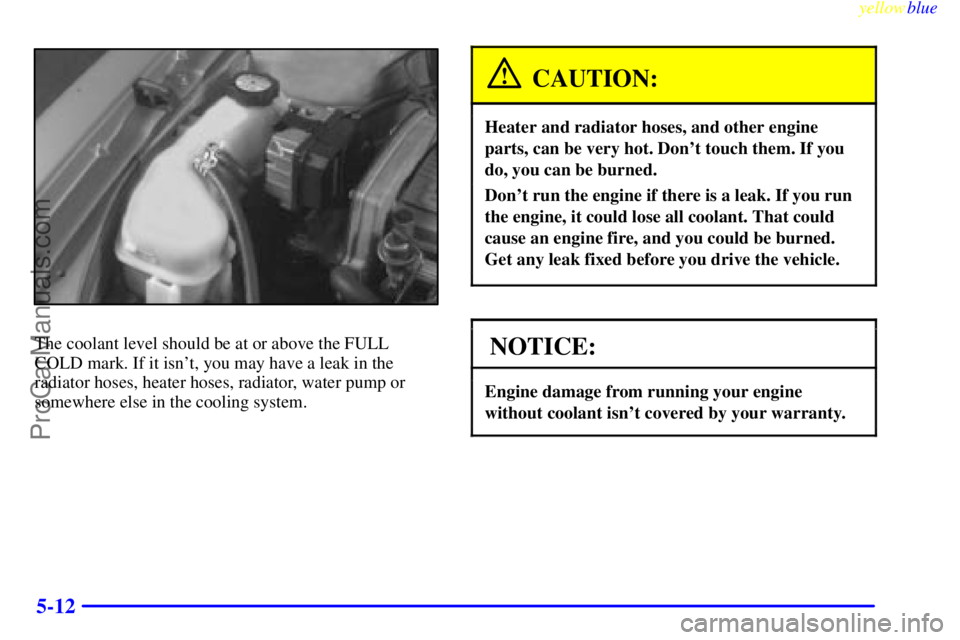
The coolant level should be at or above the FULL
COLD mark. If it isn't, you may have a leak in the
radiator hoses, heater hoses, radiator, water pump or
somewhere else in the cooling system.
CAUTION:
Heater and radiator hoses, and other engine
parts, can be very hot. Don't touch them. If you
do, you can be burned.
Don't run the engine if there is a leak. If you run
the engine, it could lose all coolant. That could
cause an engine fire, and you could be burned.
Get any leak fixed before you drive the vehicle.
NOTICE:
Engine damage from running your engine
without coolant isn't covered by your warranty.
ProCarManuals.com
Page 207 of 328
yellowblue
5-13
NOTICE:
When adding coolant, it is important that you
use only DEX
-COOL� (silicate-free) coolant.
If coolant other than DEX-COOL is added to
the system, premature engine, heater core or
radiator corrosion may result. In addition, the
engine coolant will require change sooner
-- at
30,000 miles (50 000 km) or 24 months,
whichever occurs first. Damage caused by the
use of coolant other than DEX
-COOL� is not
covered by your new vehicle warranty.
If there seems to be no leak, with the engine on, check to
see if the electric engine cooling fans are running. If the
engine is overheating, both fans should be running. If
they aren't, your vehicle needs service.
How to Add Coolant to the Coolant
Surge Tank
If you haven't found a problem yet, but the coolant level
isn't at or above the FULL COLD mark, add a 50/50
mixture of clean, drinkable water and DEX
-COOL�
coolant at the coolant surge tank, but be sure the cooling
system, including the coolant surge tank pressure cap, is
cool before you do it. (See ªEngine Coolantº in the
Index for more information.)
CAUTION:
Steam and scalding liquids from a hot cooling
system can blow out and burn you badly. They are
under pressure, and if you turn the coolant surge
tank pressure cap
-- even a little -- they can come
out at high speed. Never turn the cap when the
cooling system, including the coolant surge tank
pressure cap, is hot. Wait for the cooling system
and coolant surge tank pressure cap to cool if you
ever have to turn the pressure cap.
ProCarManuals.com
Page 211 of 328
yellowblue
5-17
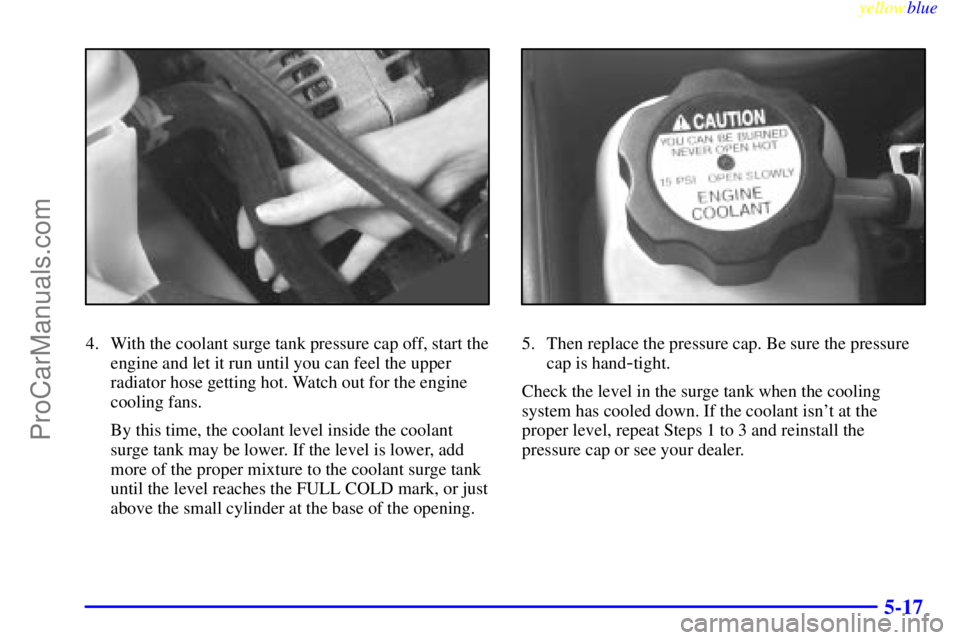
4. With the coolant surge tank pressure cap off, start the
engine and let it run until you can feel the upper
radiator hose getting hot. Watch out for the engine
cooling fans.
By this time, the coolant level inside the coolant
surge tank may be lower. If the level is lower, add
more of the proper mixture to the coolant surge tank
until the level reaches the FULL COLD mark, or just
above the small cylinder at the base of the opening.5. Then replace the pressure cap. Be sure the pressure
cap is hand
-tight.
Check the level in the surge tank when the cooling
system has cooled down. If the coolant isn't at the
proper level, repeat Steps 1 to 3 and reinstall the
pressure cap or see your dealer.
ProCarManuals.com
Page 225 of 328
6-
yellowblue
6-1
Section 6 Service and Appearance Care
Here you will find information about the care of your vehicle. This section begins with service and fuel information,
and then it shows how to check important fluid and lubricant levels. There is also technical information about your
vehicle, and a part devoted to its appearance care.
6
-2 Service
6
-3 Fuel
6
-5 Fuels in Foreign Countries
6
-5 Filling Your Tank
6
-7 Filling a Portable Fuel Container
6
-7 Checking Things Under the Hood
6
-11 Engine Oil
6
-16 Engine Air Cleaner/Filter
6
-17 Automatic Transaxle Fluid
6
-18 Thermostat
6
-18 Engine Coolant
6
-22 Power Steering Fluid
6
-23 Windshield Washer Fluid
6
-24 Brakes
6
-27 Battery6
-28 Bulb Replacement
6
-34 Windshield Wiper Blade Replacement
6
-34 Tires
6
-44 Appearance Care
6
-44 Cleaning the Inside of Your Vehicle
6
-46 Care of Safety Belts
6
-48 Cleaning the Outside of Your Vehicle
6
-50 Finish Damage
6
-51 GM Vehicle Care/Appearance Materials
6
-52 Vehicle Identification Number (VIN)
6
-53 Electrical System
6
-58 Replacement Bulbs
6
-59 Capacities and Specifications
6
-59 Air Conditioning Refrigerants
6
-60 Normal Maintenance Replacement Parts
ProCarManuals.com
Page 245 of 328
yellowblue
6-21
CAUTION:
Turning the surge tank pressure cap when the
engine and radiator are hot can allow steam and
scalding liquids to blow out and burn you badly.
Never turn the surge tank pressure cap
-- even a
little
-- when the engine and radiator are hot.
The vehicle must be on a level surface. When your
engine is cold, the coolant level should be at the
FULL COLD mark, or a little higher.
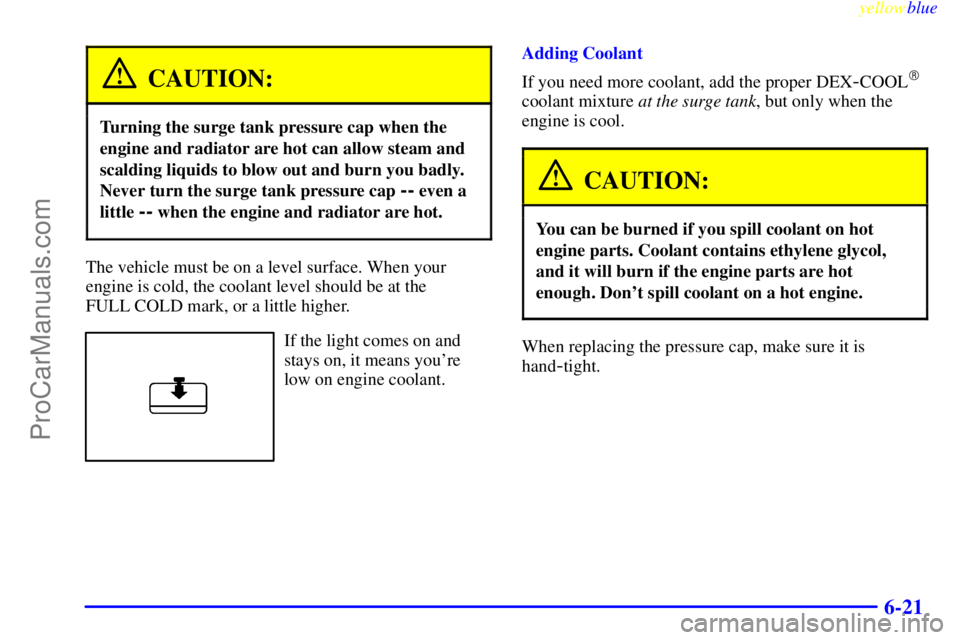
If the light comes on and
stays on, it means you're
low on engine coolant.Adding Coolant
If you need more coolant, add the proper DEX
-COOL�
coolant mixture at the surge tank, but only when the
engine is cool.
CAUTION:
You can be burned if you spill coolant on hot
engine parts. Coolant contains ethylene glycol,
and it will burn if the engine parts are hot
enough. Don't spill coolant on a hot engine.
When replacing the pressure cap, make sure it is
hand
-tight.
ProCarManuals.com
Page 297 of 328
yellowblue
7-13
Part B: Owner Checks and Services
Listed in this part are owner checks and services which
should be performed at the intervals specified to help
ensure the safety, dependability and emission control
performance of your vehicle.
Be sure any necessary repairs are completed at once.
Whenever any fluids or lubricants are added to your
vehicle, make sure they are the proper ones, as shown
in Part D.
At Each Fuel Fill
It is important for you or a service station attendant to
perform these underhood checks at each fuel fill.
Engine Oil Level Check
Check the engine oil level and add the proper oil if
necessary. See ªEngine Oilº in the Index for
further details.Engine Coolant Level Check
Check the engine coolant level and add DEX
-COOL�
coolant mixture if necessary. See ªEngine Coolantº in
the Index for further details.
Windshield Washer Fluid Level Check
Check the windshield washer fluid level in the
windshield washer tank and add the proper fluid if
necessary. See ªWindshield Washer Fluidº in the
Index for further details.
At Least Once a Month
Tire Inflation Check
Make sure tires are inflated to the correct pressures.
See ªTiresº in the Index for further details.
Cassette Deck Service
Clean cassette deck. Cleaning should be done every
50 hours of tape play. See ªAudio Systemsº in the
Index for further details.
ProCarManuals.com