Page 239 of 328

yellowblue
6-15
As shown in the chart, SAE 5W-30 is best for your
vehicle. However, you can use SAE 10W
-30 if it's going
to be 0�F (
-18�C) or above. These numbers on an oil
container show its viscosity, or thickness. Do not use
other viscosity oils, such as SAE 20W
-50.
NOTICE:
Use only engine oil with the American Petroleum
Institute Certified For Gasoline Engines
ªStarburstº symbol. Failure to use the
recommended oil can result in engine damage not
covered by your warranty.
GM Goodwrench� oil meets all the requirements for
your vehicle.
If you are in an area where the temperature falls below
-20�F (-29�C), consider using either an SAE 5W-30
synthetic oil or an SAE 0W
-30 oil. Both will provide
easier cold starting and better protection for your engine
at extremely low temperatures.
Engine Oil Additives
Don't add anything to your oil. Your dealer is ready to
advise if you think something should be added.
When to Change Engine Oil
Your vehicle has a computer that lets you know when to
change your engine oil. This is not based on mileage,
but on engine revolutions and engine operating
temperature. When the computer has calculated that the
oil needs changing, the Oil Life Indicator will indicate
that a change is necessary. The mileage between oil
changes will vary depending on how you drive your
vehicle
-- usually between 3,000 miles (5 000 km) and
7,500 miles (12 500 km) since your last oil change.
Under severe conditions, the indicator may come on
before 3,000 miles (5 000 km). Never drive your vehicle
more than 7,500 miles (12 500 km) or 12 months
(whichever occurs first) without an oil change.
The system won't detect dust in the oil. So, if you drive in
a dusty area, be sure to change your oil every 3,000 miles
(5 000 km) or sooner. Remember to reset the CHANGE
OIL light whenever the oil is changed.
How to Reset the Change Oil Light
After changing the engine oil, the system must be reset.
With the ignition key to ON (engine not running), push
the RESET button located in the driver's side instrument
panel fuse block. The CHANGE OIL light will start to
flash, press and hold the RESET button again. The reset
is complete when you hear the chimes sound and the
CHANGE OIL light goes out.
ProCarManuals.com
Page 261 of 328

yellowblue
6-37
If the anti-lock brake system warning light comes on,
the tire pressure monitor system may not be working.
See your dealer for service. (Also, see ªAnti
-Lock
Brake System Warning Lightº in the Index).
When the LOW TIRE PRESSURE light comes on, you
should stop as soon as you can and check all your tires
for damage. (If a tire is flat, see ªIf a Tire Goes Flatº in
the Index.) Also check the tire pressure in all four tires
as soon as you can. See ªInflation
- Tire Pressureº in
the Index.
The light will come on and stay on until you turn off the
ignition or press the RESET button.
Don't reset the tire pressure monitor system without first
correcting the cause of the problem and checking and
adjusting the pressure in all four tires. If you reset the
system when the tire pressures are incorrect, the system
will not work properly and may not alert you when a
tire is low.
Any time you adjust a tire's pressure, rotate your tires,
or have one or more tires repaired or replaced, you'll
need to reset (calibrate) the tire pressure monitor system.
You'll also need to reset the system whenever you buy
new tires and whenever the vehicle's battery has
been disconnected.To reset (calibrate) the system, turn the ignition switch
to ON (engine not running). The RESET button is
located inside of the driver's side instrument fuse panel.
Press and release the RESET button.
The CHANGE OIL light will begin to flash. Press and
release the RESET button again. The CHANGE OIL
light will go off, and the LOW TIRE PRESSURE light
will start flashing. When the LOW TIRE PRESSURE
light is flashing, press and hold the RESET button until
the chime sounds. If the LOW TIRE PRESSURE light
doesn't go off then, see your dealer for service.
The system completes the calibration process
during driving.
The system normally takes 15 to 20 minutes of driving
in each of three speed ranges to ªlearnº tire pressures.
The speed ranges are 15 to 40 mph (25 to 65 km/h),
40 to 65 mph (65 to 105 km/h) and above 65 mph
(105 km/h). When learning is complete, the system will
alert you after 2
-8 minutes if a tire is 12 psi (83 kPa)
different from the other three tires. Detection thresholds
may be higher and detection times may be longer on
rough roads, curves and at high speeds. The system is
not capable of detection at speeds greater than 75 mph
(120 km/h).
ProCarManuals.com
Page 277 of 328
yellowblue
6-53
Electrical System
Add-On Electrical Equipment
NOTICE:
Don't add anything electrical to your vehicle
unless you check with your dealer first. Some
electrical equipment can damage your vehicle
and the damage wouldn't be covered by your
warranty. Some add
-on electrical equipment can
keep other components from working as
they should.
Your vehicle has an air bag system. Before attempting to
add anything electrical to your vehicle, see ªServicing
Your Air Bag
-Equipped Vehicleº in the Index.
Windshield Wipers
The windshield wiper motor is protected by a circuit
breaker and a fuse. If the motor overheats due to heavy
snow, etc., the wiper will stop until the motor cools. If
the overload is caused by some electrical problem, have
it fixed.
Power Windows
A circuit breaker in the fuse panel protects the power
windows. When the current load is too heavy, the circuit
breaker opens and closes, protecting the circuit until the
problem is fixed.
Fuses and Circuit Breakers
The wiring circuits in your vehicle are protected from
short circuits by a combination of fuses, circuit breakers
and fusible links. This greatly reduces the chance of
damage caused by electrical problems.
Look at the silver
-colored band inside the fuse. If the
band is broken or melted, replace the fuse. Be sure to
replace a bad fuse with a new one of the identical size
and rating.
There are three fuse blocks in your vehicle: two
instrument panel fuse blocks and the engine
compartment fuse block.
There are four spare fuses located in the left instrument
panel fuse block for your use.
Instrument Panel Fuse Blocks
There are two fuse panels for your vehicle. One is
located on the driver's side of the instrument panel and
the other is located on the passenger's side.
ProCarManuals.com
Page 278 of 328
yellowblue
6-54
Driver's Side
Fuse Usage
RADIO SW Steering Wheel Radio Switches
RADIO ACC Radio
WIPER Windshield Wiper Motor,
Washer Pump
TRUNK
REL/RFA/RADIO
AMPTrunk Release Relay/Motor,
RKE, Audio AmplifierFuse Usage
TURN LPS Turn Signal Lamps
PWR MIRROR Power Mirrors
AIR BAG Air Bags
BFC BATT Body Computer (BFC)
PCM ACC PCM
DR LOCK Door Lock Motors
IPC/BFC ACC Cluster, Body Computer (BFC)
STOP LPS Stop Lamps
HAZARD LPS Hazard Lamps
IPC/HVAC BATT HVAC Head, Cluster,
Data Link Connector
Circuit Breaker Usage
PWR SEAT Power Seats
ProCarManuals.com
Page 279 of 328
yellowblue
6-55
Passenger's Side
Fuse Usage
INST LPS Interior Lamp Dimming
CRUISE SW
LPSSteering Wheel Cruise Control
Switch Lamps
CRUISE SW Steering Wheel Cruise Control
SwitchesFuse Usage
HVAC
BLOWERHVAC Blower Motor
CRUISE Cruise Control
FOG LPS Fog Lamps
INT LPS Interior Courtesy Lamps
RADIO BATT Radio
SUNROOF Power Sunroof
Circuit Breaker Usage
PWR WNDW Power Windows
ProCarManuals.com
Page 280 of 328
yellowblue
6-56
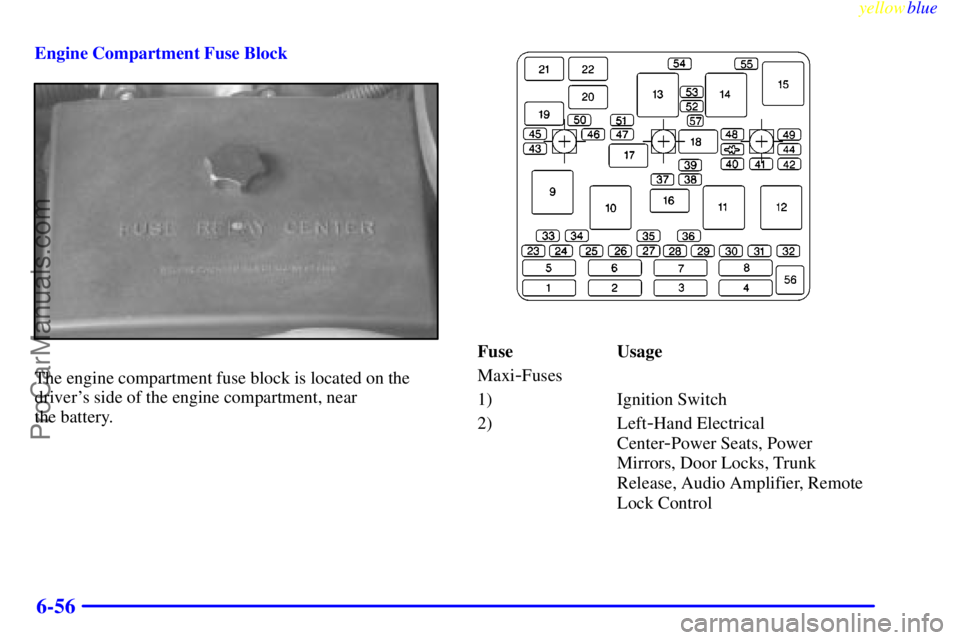
Engine Compartment Fuse Block
The engine compartment fuse block is located on the
driver's side of the engine compartment, near
the battery.
Fuse Usage
Maxi
-Fuses
1) Ignition Switch
2) Left
-Hand Electrical
Center
-Power Seats, Power
Mirrors, Door Locks, Trunk
Release, Audio Amplifier, Remote
Lock Control
ProCarManuals.com
Page 281 of 328
yellowblue
6-57
Fuse Usage
Maxi
-Fuses
3) Left
-Hand Electrical Center-Stop
Lamps, Hazard Lamps, Body
Function Control Module, Cluster,
Climate Control System
4) Right
-Hand Electrical Center-Fog
Lamps, Radio, Body Function
Control Module, Interior Lamps
5) Ignition Switch
6) Not Used
7) Anti
-Lock Brakes
8) Cooling Fan #1
Mini
-Relays
9) Rear Defog
10) Not Used
11) Anti
-Lock Brakes
12) Cooling Fan #1
13) HVAC Blower (Climate Control)
14) Cooling Fan #2
15) Cooling Fan #2Fuse Usage
Micro
-Relays
16) Air Conditioning Compressor
17) Not Used
18) Fuel Pump
19) Automatic Light Control
20) Automatic Light Control
21) Horn
22) Daytime Running Lamps
Mini
-Fuses
23
- 32) Spare Fuse Holder
33) Rear Defog
34) Accessory Power Outlets,
Cigarette Lighter
35) Anti
-Lock Brakes
36) Anti
-Lock Brakes, Variable Effort
Steering
37) Air Conditioning Compressor,
Body Function Control Module
38) Automatic Transaxle
39) Powertrain Control Module
40) Anti
-Lock Brakes
ProCarManuals.com
Page 282 of 328

yellowblue
6-58
Fuse Usage
Mini
-Fuses
41) Ignition System
42) Back
-Up Lamps, Brake Transaxle
Shift Interlock
43) Horn
44) Powertrain Control Module
45) Parking Lamps
46) Rear Defog, Daytime Running
Lamps, Climate Control System
47) Canister Vent Valve, Exhaust
Oxygen Sensors
48) Fuel Pump, Injectors
49) Generator
50) Right
-Hand Headlamp
51) Left
-Hand Headlamp
52) Cooling Fan
53) HVAC Blower (Climate Control)
54) Not Used
55) Not Used
56) Fuse Puller for Mini Fuses
57) Not Used
Replacement Bulbs
Outside Lamps (Rear) Bulb
Back
-Up Lamps 921. . . . . . . . . . . . . . . . . . . . . . . . . .
Center High
-Mounted Stop Lamp 912. . . . . . . . . . . .
Turn Signal Lamps 3157. . . . . . . . . . . . . . . . . . . . . . .
Stop/Taillamps 3057. . . . . . . . . . . . . . . . . . . . . . . . . .
Outside Lamps (Front) Bulb
Halogen Headlamps
-Low Beam 9006. . . . . . . . . . . .
Halogen Headlamps
-High Beam 9005. . . . . . . . . . . .
Parking/Turn Signal Lamps 3157NA. . . . . . . . . . . . . .
Side Marker Lamps 194. . . . . . . . . . . . . . . . . . . . . . .
Inside Lamps Bulb
Dome (Base) 561. . . . . . . . . . . . . . . . . . . . . . . . . . . .
Dome (Uplevel) 212
-2 . . . . . . . . . . . . . . . . . . . . . . . . .
ProCarManuals.com