1999 NISSAN PATHFINDER engine
[x] Cancel search: enginePage 186 of 274

Always follow the instructions below
exactly. Failure to do so could result in
damage to the charging system and
cause personal injury.1. Position the two vehicles to bring their
batteries into close proximity to each other
if the booster battery is in another vehicle.
Do not allow the two vehicles to touch.
2. Apply parking brakes. Move the shift lever
to Neutral position (On automatic transmis-sion models, move the selector lever to P
(Park)). Switch off all unnecessary electri-
cal systems (light, heater, air conditioner,
etc.).
3. Remove vent caps on the battery (if so
equipped). Cover the battery with an old
cloth to reduce explosion hazard.
4. Connect jumper cables in the sequence as
illustrated.
IAlways connect positive (+) to posi-
tive (+) and negative (þ) to body
ground, (for example, engine lift
bracket, etc. Ð not to the battery).
IMake sure that cables do not touch
any moving parts in the engine com-
partment and that clamps do not con-
tact any other metal.5. Start the engine of the other vehicle and let
it run for a few minutes.
6. Keep the engine speed of the other vehicle
at about 2,000 rpm, and start your engine in
the normal manner.
Do not keep starter motor engaged for
more than 10 seconds. If the engine
does not start right away, turn the key
off and wait 3 to 4 seconds before trying
again.7. After starting your engine, carefully discon-
nect the negative cable and then the posi-
tive cable.
8. Replace the vent caps (if so equipped). Be
sure to dispose of the cloth used to cover
the vent holes as it may be contaminated
with corrosive acid.
SCE0149
In case of emergency
6-9
Z
01.1.22/R50-D/V5
X
Page 187 of 274

IAutomatic transmission models can-
not be push started. This may cause
transmission damage.
IThree way catalyst equipped models
should not be started by pushing
since the three way catalyst may be
damaged.
INever try to start the vehicle by tow-
ing it; when the engine starts, the
forward surge could cause the ve-
hicle to collide with the tow vehicle.
If your vehicle is overheating indicated by an
extremely high temperature gauge reading, or
if you feel a lack of engine power, detect
abnormal noise, etc., take the following steps:IDo not continue to drive if your ve-
hicle overheats. Doing so could
cause a vehicle fire.
ITo avoid the danger of being scalded,
never remove the radiator cap while
the engine is still hot. When the radia-
tor cap is removed, pressurized hot
water will spurt out, possibly causing
serious injury.
IDo not open the hood if steam is
coming out.1. Move the vehicle safely off the road, apply
the parking brake and move the gearshift
lever to the neutral position (automatic
transmission to P (Park)).
Do not stop the engine.
2. Turn off the air conditioner switch. Open all
the windows, move the heater or air condi-
tioner temperature control to maximum hotand fan control to high speed.
3. If engine overheating is caused by climbing
a long hill on a hot day, run the engine at a
fast idle (approximately 1,500 rpm) until the
temperature gauge indication returns to
normal.
4. Get out of the vehicle. Look and listen for
steam or coolant escaping from the radiator
before opening the hood. Wait until no
steam or coolant can be seen before pro-
ceeding.
5. Open the engine hood.
If steam or water is coming from the
engine, stand clear to prevent getting
burned.6. Visually check drive belts for damage or
looseness. Also check if the cooling fan is
running. The radiator hoses and radiator
should not leak water. If coolant is leaking,
the cooling fan belt is missing or loose or
the cooling fan does not run, stop the
engine.
PUSH STARTING IF YOUR VEHICLE OVERHEATS6-10
In case of emergency
Z
01.1.22/R50-D/V5
X
Page 188 of 274

Be careful not to allow your hands, hair,
jewelry or clothing to come into contact
with, or to get caught in, the cooling fan,
or drive belt.7. After the engine cools down, check the
coolant level in the reservoir tank with the
engine running. Add coolant to the reservoir
tank if necessary. Have your vehicle re-
paired at the nearest NISSAN dealer.When towing your vehicle, all State (Provincial
in Canada) and local regulations for towing
must be followed. Incorrect towing equipment
could damage your vehicle. Towing instruc-
tions are available from your NISSAN dealer.
Local service operators will generally be famil-
iar with the applicable laws and procedures for
towing. To assure proper towing and to pre-
vent accidental damage to your vehicle,
NISSAN recommends that you have a service
operator tow your vehicle. It is advisable to
have the service operator carefully read the
following precautions.
TOWING RECOMMENDED BY
NISSANINever ride in a vehicle that is being
towed.
INever get under your vehicle after it
has been lifted by a tow truck.
IWhen towing, make sure that the
transmission, axles, steering system
and power train are in working condi-
tion. If any unit is damaged, dollies
must be used.
IAlways attach safety chains before
towing.
INever tow an automatic transmission
model from the rear (that is back-
ward) with four wheels on the ground
SCE0196
TOWING YOUR VEHICLE
In case of emergency
6-11
Z
01.1.22/R50-D/V5
X
Page 200 of 274

8 Do-it-yourselfMaintenance precautions .......................................... 8-2
Engine compartment check locations ....................... 8-3
Engine cooling system .............................................. 8-4
Checking engine coolant level .................................. 8-4
Changing engine coolant .......................................... 8-5
Engine oil .................................................................. 8-7
Checking engine oil level .......................................... 8-7
Changing engine oil .................................................. 8-8
Changing engine oil filter .......................................... 8-9
Automatic transmission fluid ..................................... 8-9
Temperature conditions for checking ...................... 8-10
Power steering fluid ................................................ 8-11
Brake and clutch fluid ............................................. 8-11
Brake fluid ............................................................... 8-11
Clutch fluid .............................................................. 8-12
Window washer fluid ............................................... 8-12
Window washer fluid reservoir ................................ 8-12
Battery ..................................................................... 8-13
Jump starting........................................................... 8-14
Drive belts ............................................................... 8-14
Spark plugs ............................................................. 8-15
Replacing spark plugs ............................................. 8-15Air cleaner ............................................................... 8-16
Windshield wiper blades ......................................... 8-17
Cleaning .................................................................. 8-17
Replacement ........................................................... 8-17
Parking brake and brake pedal ............................... 8-18
Checking parking brake .......................................... 8-18
Checking brake pedal ............................................. 8-19
Brake booster .......................................................... 8-19
Clutch pedal ............................................................ 8-20
Checking clutch pedal ............................................. 8-20
Fuses....................................................................... 8-20
Engine compartment ............................................... 8-20
Passenger compartment ......................................... 8-21
Lights ....................................................................... 8-22
Headlights ............................................................... 8-23
Tires and wheels ..................................................... 8-26
Tire pressure ........................................................... 8-26
Types of tires .......................................................... 8-27
Tire chains............................................................... 8-28
Changing tires and wheels...................................... 8-28
Clutch housing drain ................................... 8-31
Z
01.1.22/R50-D/V5
X
Page 201 of 274

When performing any inspection or mainte-
nance work on your vehicle, always take care
to prevent serious accidental injury to yourself
or damage to the vehicle. The following are
general precautions which should be closely
observed.IPark the vehicle on a level surface,
apply the parking brake securely and
block the wheels to prevent the ve-
hicle from moving. For a manual
transmission, move the shift lever to
Neutral. For an automatic transmis-
sion, move the selector lever to P
(Park).
IBe sure the ignition key is in the OFF
or LOCK position when performing
any replacement or repair.
IIf you must work with the engine
running, keep your hands, clothing,
hair and tools away from moving fans
and fan belts.
IIt is advisable to remove necktie and
any jewelry, such as rings, watches,
etc. before working on your vehicle.IAlways wear eye protection when-
ever you work on your vehicle.
IIf you must run the engine in an
enclosed space such as a garage, be
sure there is proper ventilation for
exhaust gases.
INever get under the vehicle while it is
supported only by a jack. If it is nec-
essary to work under the vehicle,
support it with safety stands.
IKeep smoking materials, flame and
sparks away from fuel and battery.
IThe fuel filter or fuel lines should be
serviced by a NISSAN dealer because
the fuel lines are under high pressure
even when the engine is off.
IDo not work under the engine hood
while it is hot. Always turn off the
engine and wait until it cools down.
INever connect or disconnect either
the battery or any transistorized com-ponent connector while the ignition
key is on.
IAvoid direct contact with used engine
oil. Improperly disposed motor oil and/
or other vehicle fluids can hurt the
environment. Always conform to lo-
cal regulations for disposal of vehicle
fluid.
This ª8. Do-it-yourselfº section gives instruc-
tions regarding only those items which are
relatively easy for an owner to perform.
You should be aware that incomplete or im-
proper servicing may result in operating diffi-
culties or excessive emissions, and could af-
fect your warranty coverage.If in doubt about
any servicing, have it done by your NISSAN
dealer.
MAINTENANCE PRECAUTIONS8-2
Do-it-yourself
Z
01.1.22/R50-D/V5
X
Page 202 of 274

VG33E engine
SDI0418A
ENGINE COMPARTMENT CHECK
LOCATIONS
Do-it-yourself
8-3
Z
01.1.22/R50-D/V5
X
Page 203 of 274

The engine cooling system is filled at the
factory with a high-quality, year-round, anti-
freeze coolant solution. The anti-freeze solu-
tion contains rust and corrosion inhibitors,
therefore additional cooling system additives
are not necessary.When adding or replacing the coolant,
be sure to use Genuine Nissan Anti-
Freeze Coolant or equivalent with the
proper mixture ratio of 50% anti-freeze
and 50% demineralized water/distilled
water. The use of other types of coolant
solutions may damage your engine
cooling system.Outside temperature
down to
Anti-
freezeDeminer-
alized
water or
distilled
water ÉC ÉF
þ35 þ30 50% 50%
INever remove the radiator cap when
the engine is hot; serious burns
could be caused by high pressure
fluid escaping from the radiator. Wait
until the engine and radiator cool
down. Serious burns could be caused
by high pressure fluid escaping from
the radiator. See ªIf your vehicle over-
heatsº in the ª6. In case of emer-
gencyº section.
IThe radiator is equipped with a pres-
sure cap. Use only a genuine cap as a
replacement.
CHECKING ENGINE COOLANT
LEVELCheck the coolant level in the reservoir tank
when the engine is cold. If the coolant level is
below the MIN level, add coolant to the MAX
level. If the reservoir tank is empty, check the
coolant level in the radiatorwhen the engine
is cold.If there is insufficient coolant in the
radiator, fill the radiator with coolant up to the
filler opening and also add it to the reservoir
tank up to the MAX level.
If the engine cooling system frequently
SDI0378
ENGINE COOLING SYSTEM8-4
Do-it-yourself
Z
01.1.22/R50-D/V5
X
Page 204 of 274
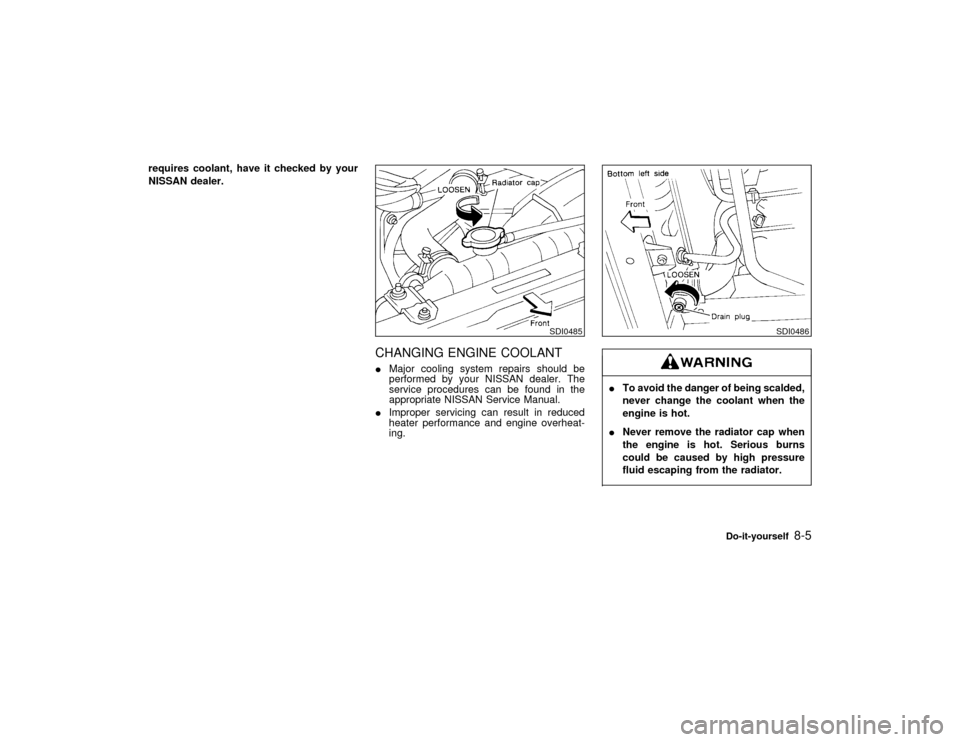
requires coolant, have it checked by your
NISSAN dealer.
CHANGING ENGINE COOLANTIMajor cooling system repairs should be
performed by your NISSAN dealer. The
service procedures can be found in the
appropriate NISSAN Service Manual.
IImproper servicing can result in reduced
heater performance and engine overheat-
ing.
ITo avoid the danger of being scalded,
never change the coolant when the
engine is hot.
INever remove the radiator cap when
the engine is hot. Serious burns
could be caused by high pressure
fluid escaping from the radiator.
SDI0485
SDI0486
Do-it-yourself
8-5
Z
01.1.22/R50-D/V5
X