1999 NISSAN PATHFINDER heater
[x] Cancel search: heaterPage 186 of 274

Always follow the instructions below
exactly. Failure to do so could result in
damage to the charging system and
cause personal injury.1. Position the two vehicles to bring their
batteries into close proximity to each other
if the booster battery is in another vehicle.
Do not allow the two vehicles to touch.
2. Apply parking brakes. Move the shift lever
to Neutral position (On automatic transmis-sion models, move the selector lever to P
(Park)). Switch off all unnecessary electri-
cal systems (light, heater, air conditioner,
etc.).
3. Remove vent caps on the battery (if so
equipped). Cover the battery with an old
cloth to reduce explosion hazard.
4. Connect jumper cables in the sequence as
illustrated.
IAlways connect positive (+) to posi-
tive (+) and negative (þ) to body
ground, (for example, engine lift
bracket, etc. Ð not to the battery).
IMake sure that cables do not touch
any moving parts in the engine com-
partment and that clamps do not con-
tact any other metal.5. Start the engine of the other vehicle and let
it run for a few minutes.
6. Keep the engine speed of the other vehicle
at about 2,000 rpm, and start your engine in
the normal manner.
Do not keep starter motor engaged for
more than 10 seconds. If the engine
does not start right away, turn the key
off and wait 3 to 4 seconds before trying
again.7. After starting your engine, carefully discon-
nect the negative cable and then the posi-
tive cable.
8. Replace the vent caps (if so equipped). Be
sure to dispose of the cloth used to cover
the vent holes as it may be contaminated
with corrosive acid.
SCE0149
In case of emergency
6-9
Z
01.1.22/R50-D/V5
X
Page 187 of 274

IAutomatic transmission models can-
not be push started. This may cause
transmission damage.
IThree way catalyst equipped models
should not be started by pushing
since the three way catalyst may be
damaged.
INever try to start the vehicle by tow-
ing it; when the engine starts, the
forward surge could cause the ve-
hicle to collide with the tow vehicle.
If your vehicle is overheating indicated by an
extremely high temperature gauge reading, or
if you feel a lack of engine power, detect
abnormal noise, etc., take the following steps:IDo not continue to drive if your ve-
hicle overheats. Doing so could
cause a vehicle fire.
ITo avoid the danger of being scalded,
never remove the radiator cap while
the engine is still hot. When the radia-
tor cap is removed, pressurized hot
water will spurt out, possibly causing
serious injury.
IDo not open the hood if steam is
coming out.1. Move the vehicle safely off the road, apply
the parking brake and move the gearshift
lever to the neutral position (automatic
transmission to P (Park)).
Do not stop the engine.
2. Turn off the air conditioner switch. Open all
the windows, move the heater or air condi-
tioner temperature control to maximum hotand fan control to high speed.
3. If engine overheating is caused by climbing
a long hill on a hot day, run the engine at a
fast idle (approximately 1,500 rpm) until the
temperature gauge indication returns to
normal.
4. Get out of the vehicle. Look and listen for
steam or coolant escaping from the radiator
before opening the hood. Wait until no
steam or coolant can be seen before pro-
ceeding.
5. Open the engine hood.
If steam or water is coming from the
engine, stand clear to prevent getting
burned.6. Visually check drive belts for damage or
looseness. Also check if the cooling fan is
running. The radiator hoses and radiator
should not leak water. If coolant is leaking,
the cooling fan belt is missing or loose or
the cooling fan does not run, stop the
engine.
PUSH STARTING IF YOUR VEHICLE OVERHEATS6-10
In case of emergency
Z
01.1.22/R50-D/V5
X
Page 204 of 274

requires coolant, have it checked by your
NISSAN dealer.
CHANGING ENGINE COOLANTIMajor cooling system repairs should be
performed by your NISSAN dealer. The
service procedures can be found in the
appropriate NISSAN Service Manual.
IImproper servicing can result in reduced
heater performance and engine overheat-
ing.
ITo avoid the danger of being scalded,
never change the coolant when the
engine is hot.
INever remove the radiator cap when
the engine is hot. Serious burns
could be caused by high pressure
fluid escaping from the radiator.
SDI0485
SDI0486
Do-it-yourself
8-5
Z
01.1.22/R50-D/V5
X
Page 205 of 274
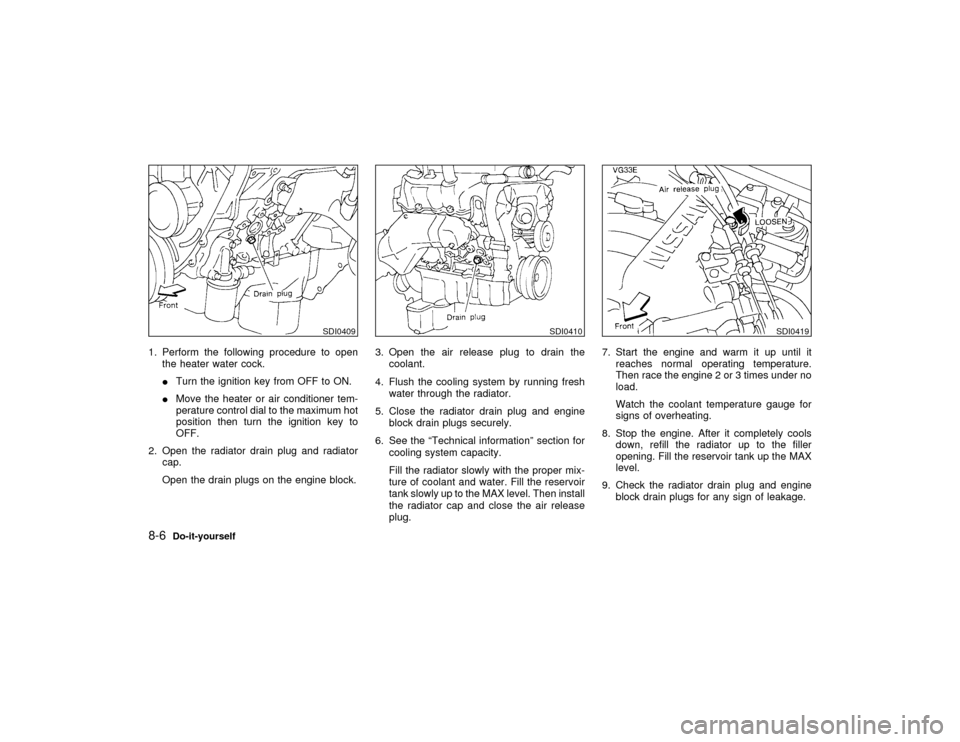
1. Perform the following procedure to open
the heater water cock.
ITurn the ignition key from OFF to ON.
IMove the heater or air conditioner tem-
perature control dial to the maximum hot
position then turn the ignition key to
OFF.
2. Open the radiator drain plug and radiator
cap.
Open the drain plugs on the engine block.3. Open the air release plug to drain the
coolant.
4. Flush the cooling system by running fresh
water through the radiator.
5. Close the radiator drain plug and engine
block drain plugs securely.
6. See the ªTechnical informationº section for
cooling system capacity.
Fill the radiator slowly with the proper mix-
ture of coolant and water. Fill the reservoir
tank slowly up to the MAX level. Then install
the radiator cap and close the air release
plug.7. Start the engine and warm it up until it
reaches normal operating temperature.
Then race the engine 2 or 3 times under no
load.
Watch the coolant temperature gauge for
signs of overheating.
8. Stop the engine. After it completely cools
down, refill the radiator up to the filler
opening. Fill the reservoir tank up the MAX
level.
9. Check the radiator drain plug and engine
block drain plugs for any sign of leakage.
SDI0409
SDI0410
SDI0419
8-6
Do-it-yourself
Z
01.1.22/R50-D/V5
X
Page 234 of 274

Wheel nuts*:
When checking the tires, make sure no nuts
are missing, and check for any loose nuts.
Tighten if necessary.
Tire rotation*:
Tires should be rotated every 7,500 miles
(12,000 km) for 2WD vehicles and 3,750 miles
(6,000 km) for 4WD vehicles. However, the
timing for tire rotation may vary according to
your driving habits and road surface condi-
tions.
Wheel alignment and balance:
If the vehicle should pull to either side while
driving on a straight and level road, or if you
detect uneven or abnormal tire wear, there
may be a need for wheel alignment.
If the steering wheel or seat vibrates at normal
highway speeds, wheel balancing may be
needed.
Windshield wiper blades*:
Check for cracks or wear if they do not wipe
properly.
Doors and engine hood:
Check that all doors and the engine hood,
operate properly. Also ensure that all latches
lock securely. Lubricate hinges, latches, rollersand links if necessary. Make sure that the
secondary latch keeps the hood from opening
when the primary latch is released.
When driving in areas using road salt or other
corrosive materials, check lubrication fre-
quently.
Inside the vehicleLights*:
Make sure that the headlights, stop lights, tail
lights, turn signal lights, and other lights are all
operating properly and installed securely. Also
check headlight aim.INTERIOR MAINTENANCEThe maintenance items listed here should be
checked on a regular basis, such as when
performing periodic maintenance, cleaning the
vehicle, etc.
Warning lights and chimes:
Make sure that all warning lights and chimes
are operating properly.
Windshield wiper and washer*:
Check that the wipers and washer operate
properly and that the wipers do not streak.Windshield defroster:
Check that the air comes out of the defroster
outlets properly and in sufficient quantity when
operating the heater or air conditioner.
Steering wheel:
Check for changes in the steering conditions,
such as excessive freeplay, hard steering or
strange noises.
Seats:
Check seat position controls such as seat
adjusters, seatback recliner, etc. to ensure
they operate smoothly and that all latches lock
securely in every position. Check that the head
restraints move up and down smoothly and
that the locks (if so equipped) hold securely in
all latched positions.
Seat belts:
Check that all parts of the seat belt system
(e.g. buckles, anchors, adjusters and retrac-
tors) operate properly and smoothly, and are
installed securely. Check the belt webbing for
cuts, fraying, wear or damage.
Accelerator pedal:
Check the pedal for smooth operation and
make sure the pedal does not catch or require
Maintenance
9-3
Z
01.1.22/R50-D/V5
X
Page 245 of 274

The following values are approximate capacities. The actual refill capacities may be a little different from them. When refilling, follow the
procedure instructed in the ª8. Do-it-yourselfº section to determine the proper refill capacity.
Capacity (Approximate)
Recommended specifications
US
measureImp
measureLiter
Fuel 21-1/8 gal 17-5/8 gal 80Unleaded gasoline with an octane rating
of at least 87 AKI (RON 91)*1
Engine oil*4
Drain and refill
with oil filter
change3-7/8 qt 3-1/4 qt 3.7IAPI Certification Mark*2 *3
IAPI grade SG/SH, Energy Conserving II
or API grade SJ, Energy Conserving*2
*3
IILSAC grade GF-II*2 *3 without oil filter
change3-5/8 qt 3 qt 3.4
Cooling system
(with heater and
reservoir tank)11-1/4 qt 9-3/8 qt 10.6Genuine Nissan Anti-Freeze Coolant or
equivalent
(Ethylene glycol base 50% demineralized
water or distilled water)
*1: See later in this section for fuel recommendation.
*2: See later in this section for recommended SAE viscosity number.
*3: See later in this section for engine oil and oil filter recommendation.
*4: See ªChanging engine oilº in the ª8. Do-it-yourselfº section for further details.CAPACITIES AND
RECOMMENDED
FUEL/LUBRICANTS10-2
Technical and consumer information
Z
01.1.22/R50-D/V5
X
Page 266 of 274

11 Index
A
ABS (Anti-lock brake system) ......................... 5-25
Air bag
Warning labels........................................... 1-20
Warning light .................................... 1-20, 2-10
Air bag system (See supplemental restraint
system) ........................................................... 1-16
Air bag system, side (See supplemental side air
bag system) .................................................... 1-10
Air cleaner housing filter ................................. 8-16
Air conditioner
Air conditioner operation ...................... 4-3, 4-9
Air conditioner service ................ 4-3, 4-9, 4-11
Air conditioner specification
label .......................................... 4-3, 4-9, 10-13
Air conditioner system refrigerant and
lubrication recommendations ............... 4-3, 4-9
Heater and air conditioner (automatic) (if so
equipped)..................................................... 4-9
Heater and air conditioner controls ............. 4-3
Servicing air conditioner .............................. 4-3
Air conditioning system refrigerant and lubricant
recommendations ........................................... 10-8
Air flow charts ............................................ 4-6, 4-9
Alcohol drugs and driving ................................. 5-4
AM-FM radio with cassette player .................. 4-12
AM-FM radio with cassette player and compact
disc player....................................................... 4-12
AM-FM radio with compact disc player .......... 4-12Anchor point locations
Top tether strap ......................................... 1-40
Antenna
Manual ....................................................... 4-25
Power ........................................................ 4-25
Anti-lock Brake System (ABS) ........................ 5-25
Anti-lock brake warning light........................... 2-11
Appearance care
Exterior appearance care ............................ 7-2
Interior appearance care ............................. 7-3
Armrest ............................................................. 1-9
Ashtray (See cigarette lighter and ashtray) .... 2-25
Audio system .................................................. 4-12
Automatic
Automatic transmission fluid (ATF) ............. 8-9
Sunroof ...................................................... 2-34
Avoiding collision and rollover .......................... 5-4
B
Battery............................................................. 8-13
Battery replacement, (See multi-remote control
system) ............................................................. 3-8
Before starting the engine ................................ 5-8
Belts (See drive belts) .................................... 8-14
Brake
Anti-lock brake system (ABS) ................... 5-25
Brake and clutch fluid................................ 8-11
Brake booster ............................................ 8-19
Brake fluid ................................................. 8-11Brake pedal ............................................... 8-18
Brake pedal check..................................... 8-19
Parking brake check ........................ 5-15, 8-18
Parking brake operation ............................ 5-15
System....................................................... 5-25
Warning light ............................................. 2-11
Break-in schedule ........................................... 5-18
Bulb check/instrument panel ............................ 2-9
Bulb replacement ............................................ 8-22
C
Capacities and recommended
fuel/lubricants .................................................. 10-2
Car phone ....................................................... 4-26
Cassette player (See audio system) .............. 4-16
Cassette tape operation ................................. 4-12
Catalytic converter, Three way catalyst............ 5-3
CB radio or car phone .................................... 4-26
Cellular phone
Steering switch .......................................... 2-50
Switch operation ........................................ 2-51
Child restraints ................................................ 1-31
Installation on front passenger seat .......... 1-41
Installation on rear seat outboard
positions .................................................... 1-35
Installation on rear seat center position .... 1-32
Precautions on child restraints .................. 1-31
Top tether strap anchor point locations .... 1-40
With top tether strap.................................. 1-40
Z
01.1.22/R50-D/V5
X
Page 267 of 274

Child safety ..................................................... 1-24
Child safety rear door lock................................ 3-4
Chimes ............................................................ 2-14
Cigarette lighter (accessory) and ashtray....... 2-25
Circuit breaker, Fusible link ............................ 8-21
Cleaning exterior and interior ........................... 7-3
Clutch
Clutch pedal .............................................. 8-20
Fluid ........................................................... 8-11
Cold weather driving ....................................... 5-27
Compact Disc (CD) player (See audio
system) ........................................................... 4-23
Compact disc (CD) player operation .............. 4-12
Compass display .............................................. 2-7
Console box .................................................... 2-28
Controls
Audio controls............................................ 4-12
Audio controls (rear).................................. 4-12
Audio controls (steering wheel)................. 4-12
Heater and air conditioner controls ............. 4-3
Heater and air conditioner controls
(automatic)................................................... 4-9
Coolant
Capacities and recommended fuel/
lubricants ................................................... 10-2
Changing engine coolant ............................ 8-5
Checking engine coolant level .................... 8-4
Corrosion protection ......................................... 7-4
Cruise control.................................................. 5-16
Cup holders .................................................... 2-26
DDaytime running light system ......................... 2-20Defogger switch, Glass hatch and outside mirror
defogger switch............................................... 2-18
Dimensions and weights ............................... 10-10
Door ajar warning light.................................... 2-10
Drive belts ....................................................... 8-14
Driving
Cold weather driving ................................. 5-27
Driving with manual transmission ............. 5-13
On-pavement and offroad driving ............... 5-3
Precautions when starting and driving ........ 5-2
E
Economy, Fuel ................................................ 5-19
Emission control information label ................ 10-12
Emission control system warranty ................ 10-18
Engine
Before starting the engine ........................... 5-8
Block heater .............................................. 5-28
Capacities and recommended fuel/
lubricants ................................................... 10-2
Changing engine coolant ............................ 8-5
Changing engine oil .................................... 8-8
Changing engine oil filter ............................ 8-9
Checking engine coolant ............................. 8-4
Checking engine oil level ............................ 8-7
Coolant temperature gauge ........................ 2-4
Engine compartment check locations ......... 8-3
Engine cooling system ................................ 8-4
Engine oil..................................................... 8-7
Engine oil and oil filter recommendation... 10-6
Engine oil viscosity .................................... 10-6
Engine serial number .............................. 10-12
Engine specifications................................. 10-9If your engine overheats ........................... 6-10
Starting the engine ...................................... 5-8
Exhaust gas (Carbon monoxide) ...................... 5-2
F
F.M.V.S.S. certification label......................... 10-12
Filter, Air cleaner housing filter ....................... 8-16
Flashers (See hazard warning flasher
switch) ............................................................. 2-22
Flat tire .............................................................. 6-2
Floor mat cleaning ............................................ 7-4
Fluid
Automatic transmission fluid (ATF) ............. 8-9
Brake and clutch fluid................................ 8-11
Brake fluid ................................................. 8-11
Capacities and recommended fuel/
lubricants ................................................... 10-2
Engine coolant............................................. 8-4
Engine oil..................................................... 8-7
Power steering fluid................................... 8-11
Window washer fluid ................................. 8-12
Fog light switch ............................................... 2-22
Four wheel drive (4WD).................................. 5-19
Front manual seat adjustment .......................... 1-2
Fuel
Capacities and recommended fuel/
lubricants ................................................... 10-2
Filler cap .................................................... 3-13
Filler lid ...................................................... 3-12
Filler lid and cap ........................................ 3-12
Filler lid opener lever................................. 3-12
Fuel economy ............................................ 5-19
Fuel octane rating ..................................... 10-4
Z
01.1.22/R50-D/V5
X
11-2