1999 NISSAN MAXIMA oil temperature
[x] Cancel search: oil temperaturePage 160 of 233

8 Do-it-yourselfMaintenance precautions .......................................... 8-2
Engine compartment check locations ....................... 8-4
Engine cooling system .............................................. 8-5
Checking engine coolant level .................................. 8-5
Changing engine coolant .......................................... 8-6
Engine oil .................................................................. 8-7
Checking engine oil level .......................................... 8-7
Changing engine oil .................................................. 8-8
Changing engine oil filter .......................................... 8-9
Automatic transmission fluid ................................... 8-10
Temperature conditions for checking ...................... 8-10
Power steering fluid ................................................ 8-11
Brake and clutch fluid ............................................. 8-12
Window washer fluid ............................................... 8-12
Battery ..................................................................... 8-13
Drive belts ............................................................... 8-15
Spark plugs ............................................................. 8-15
Replacing spark plugs ............................................. 8-16
Air cleaner ............................................................... 8-17Windshield wiper blades ......................................... 8-18
Cleaning .................................................................. 8-18
Replacement ........................................................... 8-19
Parking brake and brake pedal ............................... 8-20
Checking parking brake .......................................... 8-20
Checking brake pedal ............................................. 8-20
Brake booster .......................................................... 8-21
Clutch pedal ............................................................ 8-21
Fuses....................................................................... 8-21
Engine compartment ............................................... 8-22
Passenger compartment ......................................... 8-23
Lights ....................................................................... 8-24
Headlights ............................................................... 8-25
Exterior and interior lights ....................................... 8-26
Tires and wheels ..................................................... 8-31
Tire pressure ........................................................... 8-31
Types of tires .......................................................... 8-32
Tire chains............................................................... 8-33
Changing tires and wheels...................................... 8-33
Z
01.1.22/A32-D/V5.0
X
Page 166 of 233
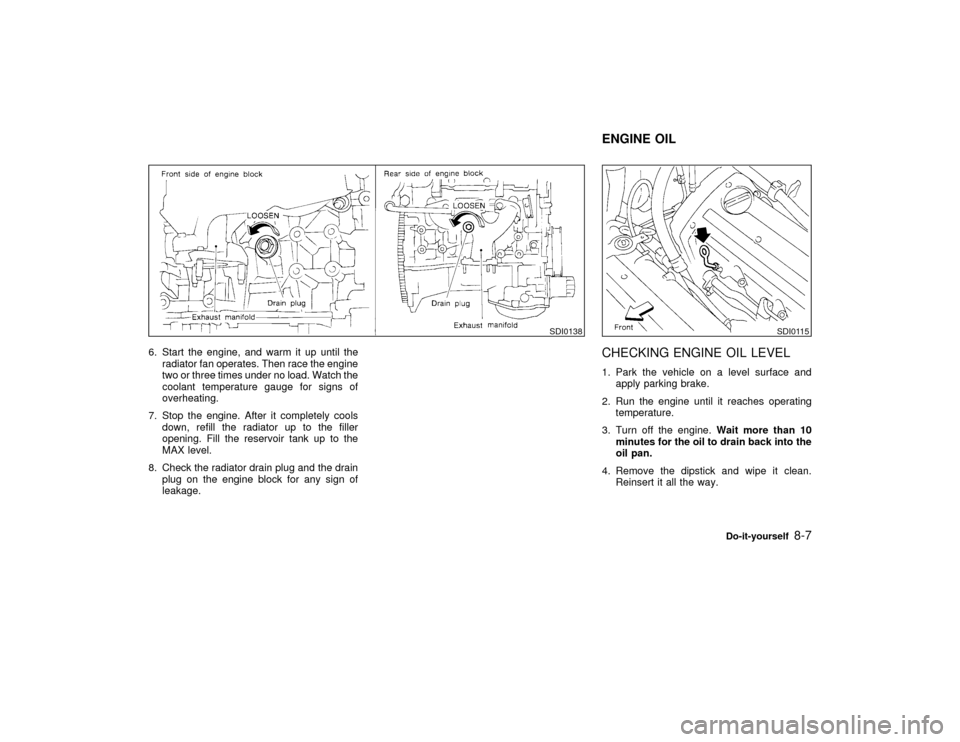
6. Start the engine, and warm it up until the
radiator fan operates. Then race the engine
two or three times under no load. Watch the
coolant temperature gauge for signs of
overheating.
7. Stop the engine. After it completely cools
down, refill the radiator up to the filler
opening. Fill the reservoir tank up to the
MAX level.
8. Check the radiator drain plug and the drain
plug on the engine block for any sign of
leakage.
CHECKING ENGINE OIL LEVEL1. Park the vehicle on a level surface and
apply parking brake.
2. Run the engine until it reaches operating
temperature.
3. Turn off the engine.Wait more than 10
minutes for the oil to drain back into the
oil pan.
4. Remove the dipstick and wipe it clean.
Reinsert it all the way.
SDI0138
SDI0115
ENGINE OIL
Do-it-yourself
8-7
Z
01.1.22/A32-D/V5.0
X
Page 167 of 233

5. Remove the dipstick again and check the
oil level. It should be between the H and L
marks. If the oil level is below the L mark,
remove the oil filler cap and pour recom-
mended oil through the opening.Do not
overfill.
6. Recheck oil level with dipstick.
It is normal to add some oil between oil
maintenance intervals or during the
break-in period, depending on the severity
of operating conditions.
Oil level should be checked regularly.
Operating with insufficient amount of oil
can damage the engine, and such dam-
age is not covered by warranty.
CHANGING ENGINE OIL1. Park the vehicle on a level surface and
apply the parking brake.
2. Run the engine until it reaches operating
temperature.
3. Turn the engine off and wait more than 10
minutes.
4. Place a large drain pan under the drain
plug.
5. Remove the oil filler cap.
SDI0534
SDI0139
8-8
Do-it-yourself
Z
01.1.22/A32-D/V5.0
X
Page 168 of 233

6. Remove the drain plug with a wrench and
completely drain the oil.
If oil filter is to be changed, remove and
replace it at this time. See later in ªEngine
oilº for changing engine oil filter.Be careful not to burn yourself, as the
engine oil is hot.Waste oil must be disposed of properly.
Check your local regulations.
7. Clean and re-install the drain plug and new
washer. Securely tighten the drain plug with
a wrench.
Drain plug tightening torque:
22 to 29 ft-lb
(29 to 39 N×m)
Do not use excessive force.
8. Refill engine with recommended oil and
install the cap securely.
See ªCapacities and recommended
fuel/lubricantsº in the ª10. Technical and
consumer informationº section for drain and
refill capacity. The drain and refill capacitydepends on the oil temperature and drain
time. Use these specifications for reference
only. Always use the dipstick to determine
when the proper amount of oil is in the
engine.
9. Start the engine.
Check for leakage around the drain plug.
Correct as required.
10.Turn the engine off and wait more than 10
minutes. Check the oil level with the dip-
stick. Add engine oil if necessary.
11.Dispose of waste oil in the proper manner.
IProlonged and repeated contact with
used engine oil may cause skin can-
cer.
ITry to avoid direct skin contact with
used oil. If skin contact is made, wash
thoroughly with soap or hand cleaner
as soon as possible.
IKeep used engine oil out of reach of
children.
CHANGING ENGINE OIL FILTER1. Park the vehicle on a level surface and
apply the parking brake.
2. Turn the engine off.
3. Loosen the oil filter with an oil filter wrench.
(Depending on the engine model, a special
cap typewrench may be required. See
your NISSAN dealer if in doubt.) Remove
the oil filter by turning it by hand.
SDI0140
Do-it-yourself
8-9
Z
01.1.22/A32-D/V5.0
X
Page 169 of 233

Be careful not to burn yourself, as the
engine oil may be hot.4. Wipe the engine oil filter mounting surface
with a clean rag.
Be sure to remove any old rubber gasket
remaining on the mounting surface of the
engine.
5. Coat the rubber gasket on the new filter
with clean engine oil.
6. Screw in the oil filter until a slight resistance
is felt, then tighten additionally more than
2/3 turn.
Oil filter tightening torque:
10.85 to 15.19 ft-lb
(14.7 to 20.6 N×m)
7. Start the engine and check for leakage
around the oil filter. Correct as required.
8. Turn the engine off and wait several min-
utes. Check the oil level. Add engine oil if
necessary.
IWhen engine is running, keep hands,
jewelry and clothing away from any
moving parts such as cooling fan and
drive belt.
IAutomatic transmission fluid is poi-
sonous and should be stored care-
fully in marked containers out of the
reach of children.
TEMPERATURE CONDITIONS
FOR CHECKINGIThe fluid level should be checked using the
HOT range on the dipstick after the follow-
ing conditions have been met:
a) the engine should be warmed up to
operating temperature.
b) the vehicle should be driven at least 5
minutes.
c) the automatic transmission fluid should
be warmed to between 122 and 176ÉF
(50 and 80ÉC).
IThe fluid can be checked at fluid tempera-
tures of 86 to 122ÉF (30 to 50ÉC) using the
COLD range on the dipstick after the en-
gine is warmed up and before driving. How-
ever, the fluid should be re-checked using
the HOT range.
1. Park the vehicle on a level surface and set
the parking brake.
2. Start the engine and then move the selector
lever through each gear range. Move the
selector lever to P (Park) position after you
have moved it through all ranges.
SDI0748
AUTOMATIC TRANSMISSION
FLUID
8-10
Do-it-yourself
Z
01.1.22/A32-D/V5.0
X
Page 200 of 233

posed to corrosive substances such as those
used on icy roads or to control dust. It is very
important to remove these substances, other-
wise rust will form on the floor pan, frame, fuel
lines and around the exhaust system. At the
end of winter, the underbody should be thor-
oughly flushed with plain water, being careful
to clean those areas where mud and dirt may
accumulate. For additional information, see
ªCleaning exteriorº in the ª7. Appearance and
careº section.
Fluid leaks:Check under the vehicle for fuel,
oil, water or other fluid leaks after the vehicle
has been parked for a while. Water dripping
from the air conditioner after use is normal. If
you should notice any leaks or if gasoline
fumes are evident, check for the cause and
have it corrected immediately.To ensure smooth, trouble-free, safe and eco-
nomical driving, NISSAN provides two differ-
ent maintenance schedules that may be used,
depending upon the conditions in which you
usually drive. These schedules contain both
distance and time intervals, up to 60,000 miles
(96,000 km)/48 months. For most people, the
odometer reading will indicate when service is
needed. However, if you drive very little, your
vehicle should be serviced at the regular time
intervals shown in the schedule.After 60,000
miles (96,000 km) or 48 months, continue
the periodic maintenance at the same
mileage/time intervals.
SCHEDULE 1Follow Periodic Maintenance Schedule 1 if
your driving habits frequently include one or
more of the following driving conditions:
Irepeated short trips of less than 5 miles
(8 km).
Irepeated short trips of less than 10 miles
(16 km) with outside temperatures re-
maining below freezing.
Ioperating in hot weather in stop-and-go
rush hour traffic.
Iextensive idling and/or low speed driv-
ing for long distances, such as police,taxi or door-to-door delivery use.
Idriving in dusty conditions.
Idriving on rough, muddy, or salt spread
roads.
Itowing a trailer, using a camper or a
car-top carrier.
SCHEDULE 2Follow Periodic Maintenance Schedule 2 if
none of the driving conditions shown in Sched-
ule 1 apply to your driving habits.
PERIODIC MAINTENANCE
SCHEDULES
Maintenance
9-5
Z
01.1.22/A32-D/V5.0
X
Page 201 of 233
![NISSAN MAXIMA 1999 A32 / 4.G Owners Manual Schedule 1Abbreviations: R = Replace I = Inspect. Correct or replace if necessary. [ ]: At the mileage intervals onlyMAINTENANCE OPERATIONMAINTENANCE INTERVAL
Perform at number of miles,
kilometers or](/manual-img/5/633/w960_633-200.png "NISSAN MAXIMA 1999 A32 / 4.G Owners Manual Schedule 1Abbreviations: R = Replace I = Inspect. Correct or replace if necessary. [ ]: At the mileage intervals onlyMAINTENANCE OPERATIONMAINTENANCE INTERVAL
Perform at number of miles,
kilometers or")
Schedule 1Abbreviations: R = Replace I = Inspect. Correct or replace if necessary. [ ]: At the mileage intervals onlyMAINTENANCE OPERATIONMAINTENANCE INTERVAL
Perform at number of miles,
kilometers or months, which-
ever comes first.Miles x 1,000 3.75 7.5 11.25 15 18.75 22.5 26.25 30 33.75 37.5 41.25 45 48.75 52.5 56.25 60
(km x 1,000) (6) (12) (18) (24) (30) (36) (42) (48) (54) (60) (66) (72) (78) (84) (90) (96)
Months 3 6 9 12 15 18 21 24 27 30 33 36 39 42 45 48Emission control system maintenanceDrive belts See NOTE (1)I*
Air cleaner filter See NOTE (2) [R] [R]
EVAP vapor linesI* I*
Fuel linesI* I*
Fuel filter See NOTE (3)*
Engine coolant See NOTE (4)R*
Engine oilRRRRRRRRRRRRRRRR
Engine oil filter (Use part No. 15208-31U00 or equivalent)RRRRRRRRRRRRRRRR
Spark plugs (Use PLATINUM-TIPPED type)[R]
Intake & exhaust valve clearance See NOTE (5)NOTE: (1) After 60,000 miles (96,000 km) or 48 months, inspect every 15,000 miles (24,000 km) or 12 months.
(2) If operating mainly in dusty conditions, more frequent maintenance may be required.
(3) If vehicle is operated under extremely adverse weather conditions or in areas where ambient temperatures are either
extremely low or extremely high, the filters might become clogged. In such an event, replace them immediately.
(4) After 60,000 miles (96,000 km) or 48 months, replace every 30,000 miles (48,000 km) or 24 months.
(5) If valve noise increases, inspect valve clearance.
(6) Maintenance items and intervals with ª*º are recommended by NISSAN for reliable vehicle operation. The owner need not
perform such maintenance in order to maintain the emission warranty or manufacturer recall liability. Other maintenance
items and intervals are required.9-6
Maintenance
Z
01.1.22/A32-D/V5.0
X
Page 203 of 233
![NISSAN MAXIMA 1999 A32 / 4.G Owners Manual Schedule 2Abbreviations: R = Replace I = Inspect. Correct or replace if necessary. [ ]: At the mileage intervals onlyMAINTENANCE OPERATIONMAINTENANCE INTERVAL
Perform at number of miles, kilometers
or](/manual-img/5/633/w960_633-202.png "NISSAN MAXIMA 1999 A32 / 4.G Owners Manual Schedule 2Abbreviations: R = Replace I = Inspect. Correct or replace if necessary. [ ]: At the mileage intervals onlyMAINTENANCE OPERATIONMAINTENANCE INTERVAL
Perform at number of miles, kilometers
or")
Schedule 2Abbreviations: R = Replace I = Inspect. Correct or replace if necessary. [ ]: At the mileage intervals onlyMAINTENANCE OPERATIONMAINTENANCE INTERVAL
Perform at number of miles, kilometers
or months, whichever comes first.Miles x 1,000 7.5 15 22.5 30 37.5 45 52.5 60
(km x 1,000) (12) (24) (36) (48) (60) (72) (84) (96)
Months 6 12 18 24 30 36 42 48Emission control system maintenanceDrive belts See NOTE (1)I*
Air cleaner filter[R] [R]
EVAP vapor linesI* I*
Fuel linesI* I*
Fuel filter See NOTE (2)*
Engine coolant See NOTE (3)R*
Engine oilRRRRRRRR
Engine oil filter (Use part No. 15208-31U00 or equivalent)RRRRRRRR
Spark plugs (Use PLATINUM-TIPPED type)[R]
Intake & exhaust valve clearance See NOTE (4)NOTE: (1) After 60,000 miles (96,000 km) or 48 months, inspect every 15,000 miles (24,000 km) or 12 months.
(2) If vehicle is operated under extremely adverse weather conditions or in areas where ambient temperatures are either
extremely low or extremely high, the filters might become clogged. In such an event, replace them immediately.
(3) After 60,000 miles (96,000 km) or 48 months, replace every 30,000 miles (48,000 km) or 24 months.
(4) If valve noise increases, inspect valve clearance.
(5) Maintenance items and intervals with ª*º are recommended by NISSAN for reliable vehicle operation. The owner need not
perform such maintenance in order to maintain the emission warranty or manufacturer recall liability. Other maintenance
items and intervals are required.9-8
Maintenance
Z
01.1.22/A32-D/V5.0
X