1999 NISSAN FRONTIER ECO mode
[x] Cancel search: ECO modePage 193 of 247
snow traction than All Season tires and may
be more appropriate in some areas.
Summer tires
NISSAN specifies summer tires on some
models to provide superior performance on
dry roads. Summer tire performance in
snow and ice will be substantially reduced.
Summer tires do not have the tire traction
rating ``M&S'' on the tire sidewall.
If you plan to operate your vehicle in snowy
or icy conditions, NISSAN recommends the
use of ``SNOW'' or ``ALL SEASON'' tires on
all four wheels.
Snow tires
If snow tires are needed, it is necessary to
select tires equivalent in size and load rating
to the original equipment tires. If you do not,
it can adversely affect the safety and han-
dling of your vehicle.
Generally, snow tires will have lower speed
ratings than factory equipped tires and may
not match the potential maximum vehicle
speed. Never exceed the maximum speed
rating of the tire.
For additional traction on icy roads, studded
tires may be used. However, some U.S.States and Canadian provinces prohibit
their use. Check local, state and provincial
laws before installing studded tires. Skid
and traction capabilities of studded snow
tires on wet or dry surfaces may be poorer
than that of non-studded snow tires.
Four-wheel drive model
If you install snow tires, they must be the
same size, brand, construction and tread
pattern on all four wheels.
CAUTION
ONLY use spare tires specified for each
four-wheel drive model.
Tire chains
Use of tire chains may be prohibited accord-
ing to location. Check the local laws before
installing tire chains. When installing tire
chains, make sure they are the proper size
for the tires on your vehicle and are installed
according to the chain manufacturer's sug-
gestions.Use only SAE class ``S'' chains.
Other types may damage your vehicle. Use
chain tensioners when recommended by
the tire chain manufacturer to ensure a tight
fit. Loose end links of the tire chain must besecured or removed to prevent the possibil-
ity of whipping action damage to the fenders
or undercarriage. If possible, avoid fully
loading your vehicle when using tire chains.
In addition, drive at a reduced speed. Oth-
erwise, your vehicle may be damaged
and/or vehicle handling and performance
may be adversely affected.
Never install tire chains on a TEMPORARY
USE ONLY spare tire.
Tire chains must be installed only on the
rear wheels and not on the front wheels.
Do not use tire chains on dry roads. Driving
with chains in such conditions can cause
damage to the various mechanisms of the
vehicle due to some overstress. When driv-
ing on clear paved roads, be sure to change
to 2WD.
Do-it-yourself
8-33
ZX
Page 195 of 247
IImproper service for a TEMPORARY
USE ONLY spare tire may result in
serious personal injury. If it is neces-
sary to repair the TEMPORARY USE
ONLY spare tire, contact an autho-
rized NISSAN dealer.
Changing tires and wheels
When replacing a tire, use the same size,
tread design, speed rating and load carrying
capacity as originally equipped. Recom-
mended types and sizes are shown in
``Wheel/tire size'' in the ``Technical and con-
sumer information'' section of this manual.
WARNING
I
The use of tires other than those
recommended or the mixed use of
tires of different brands, construction
(bias, bias-belted or radial), or tread
patterns can adversely affect the ride,
braking, handling, ground clearance,
body-to-tire clearance, snow chain
clearance, speedometer calibration,
headlight aim and bumper height.
Some of these effects may lead to
accidents and could result in serious
personal injury.IIf the wheels are changed for any
reason, always replace with wheels
which have the same offset dimen-
sion. Wheels of a different offset
could cause early tire wear, poor ve-
hicle handling characteristics and/or
interference with the brake discs/
drums. Such interference can lead to
decreased braking efficiency and/or
early brake pad/shoe wear.
IDo not install a deformed wheel or
tire even if it has been repaired. Such
wheels or tires could have structural
damage and could fail without warn-
ing.
IThe use of retread tires is not recom-
mended.
FOUR-WHEEL DRIVE
MODELS
CAUTION
Always use tires of the same size,
brand, construction (bias, bias-belted
or radial), and tread pattern on all four
wheels. A spare tire of same size,
brand, construction and tread pattern
must also be used.Failure to do so may result in a circum-
ference difference between tires on the
front and rear axles which will cause
excessive tire wear and may damage
the transmission, transfer case and dif-
ferential gears.
If excessive tire wear is found, it is recom-
mended that all four tires be replaced with
tires of the same size, brand, construction
and tread pattern. The tire pressure and
wheel alignment should also be checked
and corrected as necessary. Contact an
authorized NISSAN dealer.
Wheel balance
Unbalanced wheels may affect vehicle han-
dling and tire life. Even with regular use,
wheels can get out of balance. Therefore,
they should be balanced as required.
Wheel balance service should be performed
with the wheels off the vehicle. Spin balanc-
ing the front wheels on the vehicle could
lead to transmission damage.
Care of wheels
IWash the wheels when washing the ve-
hicle to maintain their appearance.
Do-it-yourself
8-35
ZX
Page 227 of 247
IDo not place cargo higher than the
seatbacks. In a sudden stop or colli-
sion, unsecured cargo could cause
personal injury.
IDo not load your vehicle any heavier
than the GVWR or the maximum
front and rear GAWR's. If you do,
parts on your vehicle can break, or it
can change the way your vehicle
handles. This could result in loss of
control and cause personal injury.
CAUTION
Overloading can shorten the life of your
vehicle. Failures caused by overloading
are not covered by your warranty.
This information is provided for you to prop-
erly install a slide-in camper and is based on
the National Highway Traffic Safety Admin-
istration regulations. It is recommended
that, before installing the camper, you care-
fully read the following information and en-
sure that the camper meets the specifica-
tions.
This information may not apply to some
Canada model vehicles.
Special body vehicles
Some vehicles are equipped with commer-
cial or camper bodies. However, this Own-
er's Manual does not cover these options.
For further information, please refer to the
body manufacturer's instruction manual.
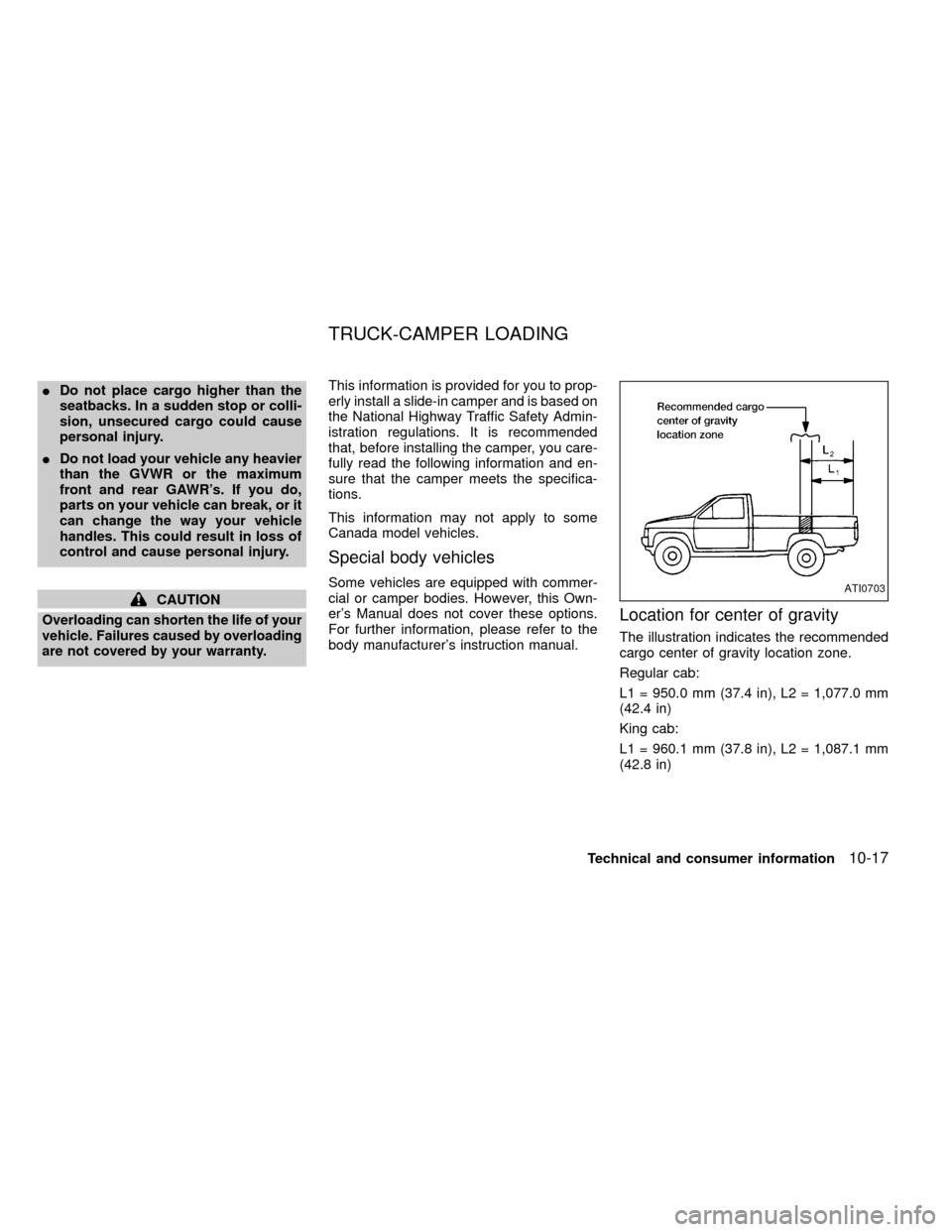
Location for center of gravity
The illustration indicates the recommended
cargo center of gravity location zone.
Regular cab:
L1 = 950.0 mm (37.4 in), L2 = 1,077.0 mm
(42.4 in)
King cab:
L1 = 960.1 mm (37.8 in), L2 = 1,087.1 mm
(42.8 in)
ATI0703
TRUCK-CAMPER LOADING
Technical and consumer information10-17
ZX
Page 233 of 247

Unit: lb (kg)
MODEL
WEIGHT2WD TRUCK 4WD TRUCK
M/T A/T M/T A/T
MAXIMUM
TRAILER
WEIGHT*13,500 (1,588) 2,000 (907) 3,500 (1,588) 5,000 (2,268)
MAXIMUM
TONGUE
LOAD350 (159) 200 (91) 350 (159) 500 (227)
GROSS
COMBINED
WEIGHT
RATING7,000 (3,175) 5,500 (2,495) 7,700 (3,493) 9,500 (4,309)
RECOMMENDED
EQUIPMENT*2Sway Control Device (SCD) Ð Sway Control Device (SCD) Sway Control Device (SCD)
*1: All towing above 1,000 lb (454 kg) requires the use of trailer brakes. NISSAN recommends the use of a tandem axle trailer whenever towing above 3,000
lb (1,361 kg).
*2: A sway control device is recommended for all towing above 2,000 lb (907 kg). Sway control devices are not offered by NISSAN. See a professional
trailer/hitch outlet for a properly designed sway control device for your trailer.
M/T = Manual Transmission
A/T = Automatic Transmission
2WD = 2-wheel drive
4WD = 4-wheel drive
TOWING LOAD/
SPECIFICATION CHART
Technical and consumer information10-23
ZX
Page 235 of 247

prevent load shift while driving.
IBe certain your outside mirrors conform
to all federal, state or local regulations. If
not, install any mirrors required for tow-
ing before driving the vehicle.
Trailer towing tips
In order to gain skill and an understanding
of the vehicle's behavior, you should prac-
tice turning, stopping and backing up in an
area which is free from traffic. Steering,
stability and braking performance will be
somewhat different than under normal driv-
ing conditions.
IAlways secure items in the trailer to
prevent load shift while driving.
I
Avoid abrupt starts, acceleration or
stops.
IAvoid sharp turns or lane changes.
IAlways drive your vehicle at a moderate
speed.
IAlways block the wheels on both vehicle
and trailer when parking. Parking on a
slope is not recommended; however, if
you must do so, and if your vehicle is
equipped with automatic transmission,first block the wheels and apply the
parking brake, and then move the trans-
mission shift selector lever into the P
(Park) position. If you move the shift
lever to the P (Park) position before
blocking the wheels and applying the
parking brake, transmission damage
could occur.
IWhen going down a hill, shift into a lower
gear and use the engine braking effect.
When ascending a long grade, down-
shift the transmission to a lower gear
and reduce speed to reduce chances of
engine overloading and/or overheating.
However, for long steep grades, do not
stay in 1st or 2nd gear when driving
above 35 MPH (56 km/h).
IIf the engine coolant rises to an ex-
tremely high temperature when the air
conditioning system is on, turn off the air
conditioner. Coolant heat can be addi-
tionally vented by opening the windows,
switching the fan control to high and
setting the temperature control to the
HOT position.
ITrailer towing requires more fuel than
normal circumstances.
IAvoid towing a trailer for your vehicle'sfirst 500 miles (805 km).
IHave your vehicle serviced more often
than at intervals specified in the recom-
mended Maintenance Schedule.
IWhen making a turn, your trailer wheels
will be closer to the inside of the turn
than your vehicle wheels. To compen-
sate for this, make a larger than normal
turning radius during the turn.
ICrosswinds and rough roads adversely
affect vehicle/trailer handling, possibly
causing vehicle sway. When being
passed by larger vehicles, be prepared
for possible changes in crosswinds that
could affect vehicle handling. If swaying
does occur, firmly grip the steering
wheel, steer straight ahead, and imme-
diately (but gradually) reduce vehicle
speed. This combination helps to stabi-
lize the vehicle. Never increase speed.
IBe careful when passing other vehicles.
Passing while towing a trailer requires
considerably more distance than normal
passing. Remember the length of the
trailer must also pass the other vehicle
before you can safely change lanes.
Technical and consumer information
10-25
ZX
Page 238 of 247
Due to legal requirements in some states
and Canadian provinces, your vehicle may
be required to be in the ready condition for
an Inspection/Maintenance (I/M) test of the
emission control system.
The vehicle is set to the ready condition
when it is driven through certain driving
patterns. Usually, the ready condition can
be obtained by ordinary usage of the ve-
hicle.
If a powertrain system component is re-
paired or the battery is disconnected, the
vehicle may be reset to a not ready condi-
tion. Before taking the I/M test, drive the
vehicle through the following pattern to set
the vehicle to the ready condition. If you
cannot or do not want to perform the driving
pattern, an authorized NISSAN dealer can
conduct it for you.
WARNING
Always drive the vehicle in a safe man-
ner according to traffic conditions and
obey all traffic laws.1. Start the engine when the engine coolant
temperature gauge needle points to C.
Allow the engine to idle until the gauge
needle points between the C and H (nor-
mal operating temperature).
2. Accelerate the vehicle to 55 mph (88
km/h), then quickly release the accelera-
tor pedal completely and keep it released
for at least 6 seconds.
3. Quickly depress the accelerator pedal for
a moment, then drive the vehicle at a
speed of 53 to 60 mph (85 to 97 km/h) for
at least 5 minutes.
4. Stop the vehicle.
5. Accelerate the vehicle to 35 mph (55
km/h) and maintain the speed for 20
seconds.
6. Repeat steps four through five least three
times.
7. Accelerate the vehicle to 55 mph (88
km/h) and maintain the speed for at least
3 minutes.
8. Stop the vehicle and turn the engine off.
9. Repeat steps one through eight at least
one more time.
If step one through seven interrupted, repeat
the preceding step. Any safe driving mode is
acceptable between steps. Do not stop the
engine until step seven is completed.
READINESS FOR
INSPECTION/MAINTENANCE
(I/M) TEST (US only)
10-28Technical and consumer information
ZX
Page 245 of 247

Ignition switch ......................................... 5-4
Overdrive switch ................................... 5-11
Passenger supplemental air bag ON/OFF
switch and light ..................................... 1-14
Windshield wiper and washer switch ... 2-17
T
Tachometer .................................................. 2-5
Tailgate latch .............................................. 3-10
Theft warning ............................................. 2-13
Three way catalyst....................................... 5-2
Tie down hooks.......................................... 3-12
Tilting steering wheel ................................. 3-13
Tire
Flat tire.................................................... 6-2
Spare tire .............................................. 8-36
Tire chains ............................................ 8-33
Tire placard ......................................... 10-14
Tire pressure......................................... 8-32
Tire rotation........................................... 8-34
Tires of 4-wheel drive ........................... 8-35
Types of tires ........................................ 8-32
Uniform tire quality grading ................ 10-26
Wheels and tires................................... 8-32
Wheel/tire size .................................... 10-10
Towing
2-wheel drive models ........................... 6-12
4-wheel drive models ........................... 6-12
Tow truck towing ................................... 6-11
Towing load/specification chart ........... 10-23
Trailer towing ...................................... 10-21Transfer case ............................................. 5-19
Transmission
Automatic transmission fluid (ATF)....... 8-13
Driving with automatic transmission ....... 5-6
Driving with manual transmission ......... 5-12
Selector lever lock release ................... 5-10
Travel (See registering your vehicle in another
country) .................................................... 10-12
Truck - camper loading ............................ 10-17
Tuning ........................................................ 4-12
Turn signal switch (See headlight and turn
signal switch) ............................................. 2-15
U
Uniform tire quality grading ..................... 10-26
V
Vanity mirror............................................... 3-15
Vehicle dimensions and weights.............. 10-11
Vehicle identification number (VIN) (chassis
number).................................................... 10-12
Vehicle identification number (VIN)
plate ......................................................... 10-12
Vehicle loading information...................... 10-15
Vehicle recovery ........................................ 6-13
Ventilators .................................................... 4-2W
Warning
Air bag warning light............................. 1-17
Hazard warning flasher switch ............. 2-18
Theft warning ........................................ 2-13
Warning labels (for SRS)...................... 1-17
Warning/indicator lights and chimes....... 2-7
Weights (See dimensions and weights) .. 10-11
Wheels and tires ........................................ 8-32
Wheel/tire size ......................................... 10-10
When traveling or registering your vehicle in
another country ........................................ 10-12
Window washer fluid.................................. 8-15
Windows
Manual windows ................................... 2-22
Power windows..................................... 2-22
Rear sliding window ............................. 2-23
Windshield wiper and washer switch ........ 2-17
Wiper
Windshield wiper and washer switch ... 2-17
Wiper blades......................................... 8-23
11-5
ZX