Page 184 of 558

CLUTCH –
General / Service Specifications /
Lubricants / On-vehicle Service21A-2
GENERAL
OUTLINE OF CHANGE
�The service procedures for left-hand drive vehicles have been established as described below.
SERVICE SPECIFICATIONS
ItemsStandard value
Clutch pedal height mm163.5–166.5
Clutch pedal clevis pin play mm1–3
Clutch pedal free play mm6–13
Distance between the clutch pedal and the toeboard when
the clutch is disengaged mm85 or more
LUBRICANTS
ItemsSpecified lubricantsQuantity
Clutch fluidBrake fluid DOT 3 or DOT 4As required
Push rod assemblyRubber grease
Boot
Release cylinder push rodMITSUBISHI genuine grease
Part No. 0101011
ON-VEHICLE SERVICE
CLUTCH PEDAL INSPECTION AND
ADJUSTMENT
1. Turn up the carpet, etc. under the clutch pedal.
2. Measure the clutch pedal height.
Standard value (A): 163.5 – 166.5 mm
3. If the height of the clutch pedal is outside the standard
value, loosen the locking nut and adjust the pedal height
to the standard value using the adjusting bolt or push
rod.
Clutch pedal height
A
Setting nutAdjusting bolt
Locking
nut
13 Nm
Page 242 of 558

BASIC BRAKE SYSTEM – General / On-vehicle Service35A-2
GENERAL
OUTLINE OF CHANGE
�The service procedures for left-hand drive vehicles have been established as described below.
�The service procedures for the front and rear disc brakes have been changed since they had been
replaced by a different type.
ON-VEHICLE SERVICE
BRAKE PEDAL CHECK AND ADJUSTMENT
1. Turn up the carpet, etc under the brake pedal.
2. Measure the brake pedal height as illustrated. If the brake
pedal height is not within the standard value, follow the
procedure below.
Standard value: 163.5 –166.5 mm
(1) Disconnect the stop lamp switch connector.
(2) Adjust the brake pedal height by turning the operating
rod with pliers (with the operating rod lock nut
loosened), until the correct brake pedal height is
obtained.
(3) Secure by tightening the lock nut of the operating
rod.
(4) Push the stop lamp switch in the direction of the
pedal stroke until it stops. (The switch will slide if
it is pushed firmly.)
(5) Lift up the pedal until the operating rod is fully
extended, and then slide the stop lamp switch back
to the required position. Adjust the position of the
switch by turning it until the distance shown in the
illustration is correct.
(6) Connect the connector of the stop lamp switch.
(7) Check that the stop lamp is not illuminated with the
brake pedal unpressed.
3. With the engine stopped, depress the brake pedal two
or three times. After eliminating the vacuum in the power
brake booster, press the pedal down by hand, and confirm
that the amount of movement before resistance is met
(the free play) is within the standard value range.
Standard value: 3 – 8 mmOperating
rod
Operating
rod lock nutStop lamp
switch
Pedal down
Pedal up
Lock nut
Lock nut
Outer case
0.5 – 1.0 mm
Page 281 of 558

BODY – Sunroof42-13
ON-VEHICLE SERVICE
WATER TEST
Check if there are any leaks in the sunroof by the following
procedure.
1. Fully close the roof lid glass.
2. Adjust the water pressure so that water comes out of
the hose to a height of approximately 50 cm when the
hose is held vertically facing upwards.
3. Hold the end of the hose approximatery 30 cm above
the roof and let the water run onto the weatherstrip for
5 minutes or more.
4. While doing this, check if any water leaks through into
the passenger compartment from around the roof lid glass.
SUNROOF FIT ADJUSTMENT
1. Fully close the roof lid glass.
2. Fully open the sunshade.
3. Remove the side decoration cover.
4. To adjust the forward, backward and sideways position
of the roof lid glass, loosen the six roof lid glass assembly
mounting nuts and then adjust the glass forward,
backward or sideways.
NOTE
If the adjustment cannot be made by loosening the
adjustment nuts, the fully closed position of the roof lid
glass may not match that of the motor. If so, adust them
to match their fully closed positions.
5. To adjust the height of the roof lid glass, loosen the four
guide (A) assembly mounting screws and then move the
roof lid glass assembly along the slot in the guide (A)
assembly.
6. After adjustment, check to be sure that the sunroof
operates smoothly.
Hose
Apporox. 30cm
Clip
Side decoration cover
Page 360 of 558

CHASSIS ELECTRICAL – Combination MetersCHASSIS ELECTRICAL – Combination Meters54-22
COMBINATION METERS
SERVICE SPECIFICATIONS
ItemsStandard valueLimit
SpeedometerAllowable indication range km/h
(Speedometer indication error to be
4037 – 45–
(Speedometer indication error to be
with –6% to +10%)8075 – 88–)
120113 – 132–
160150 – 176–
Pointer fluctuation km/h (at vehicle speeds of higher than 35
km/h)–±3
Tachometer indica-
tion error r/min
700All types of tachometer±100–
tion error r/min3,000Meters measurable up to 6,000 rpm and
meters measurable up to 8,000 rpm+ 150–
Meters measurable up to 9,000 rpm and
meters measurable up to 10,000 rpm+ 225
– 100–
4,750Meters measurable up to 6,000 rpm±160–
5,000Meters measurable up to 8,000 rpm±250–
Meters measurable up to 9,000 rpm and
meters measurable up to 10,000 rpm+ 325
– 125–
6,000Meters measurable up to 8,000 rpm±300–
7,000Meters measurable up to 9,000 rpm and
meters measurable up to 10,000 rpm+ 400
– 100–
8,000Meters measurable up to 10,000 rpm+ 400
– 0–
Fuel gauge unit
resistanceΩ
Main tankFloat point F1.8 ±1.2–
resistance ΩFloat point E65.2 ±4–
Sub tankFloat point F1.2 ±0.8–
Float point E44.8 ±3–
Fuel gauge unit
f
loat height mm
Main tankFloat point F16.4–
float height mmFloat point E122.6–
Sub tankFloat point F17.5–
Float point E134.6–
Engine coolant temperature gauge unit resistance (at 70 �C) Ω104 ±13.5–
Fuel gauge resis-
tanceΩ
Power supply and earth192 ±19.2–
tance ΩPower supply and fuel gauge89 ±8.9–
Fuel gauge and earth103 ±10.3–
Engine coolant
temperature gauge
Power supply and earth187 ±18.7–
temperature gauge
resistance ΩPower supply and engine coolant temperature gauge90 ±4.5–
Engine coolant temperature gauge and earth247 ±24.7–
Page 367 of 558
CHASSIS ELECTRICAL – Combination Meters54-29
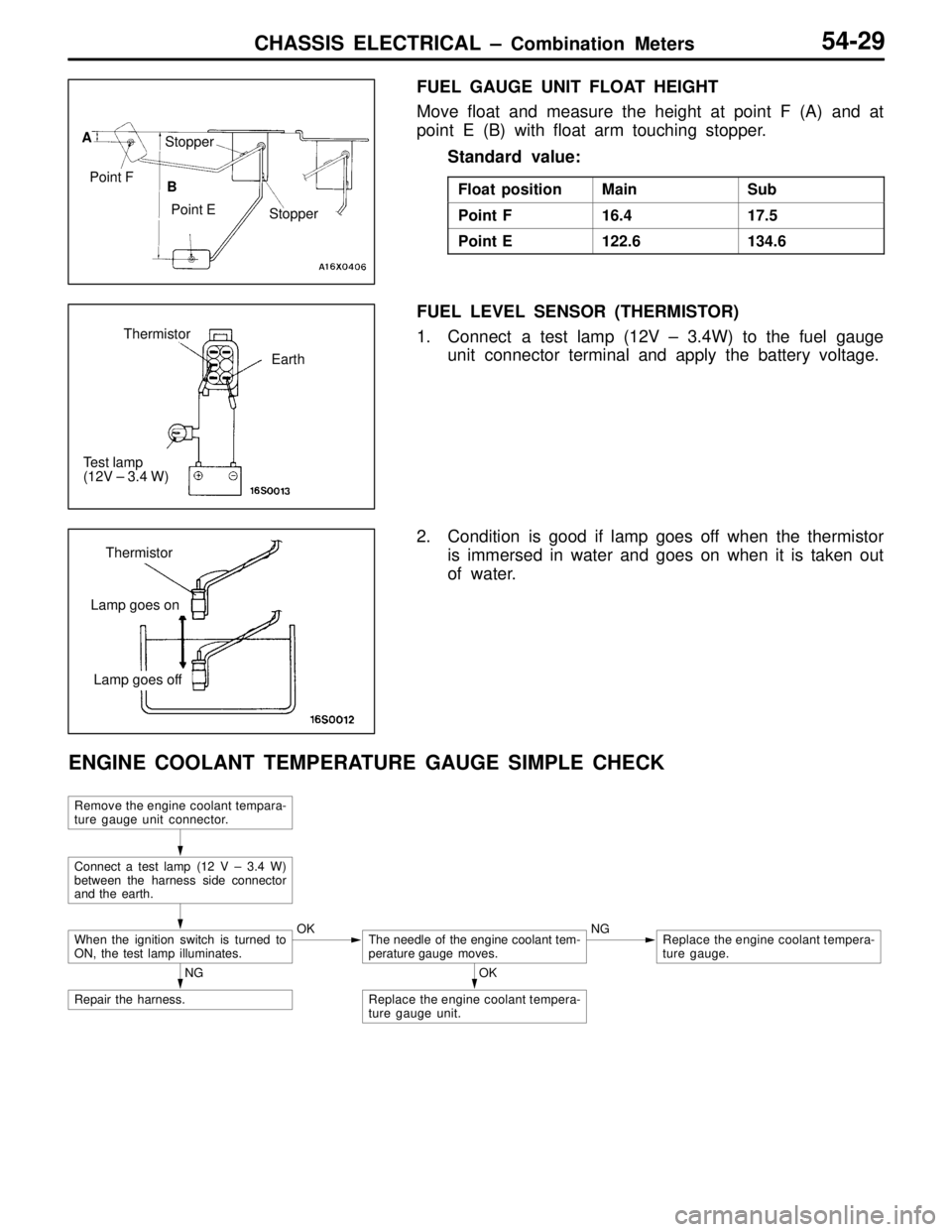
FUEL GAUGE UNIT FLOAT HEIGHT
Move float and measure the height at point F (A) and at
point E (B) with float arm touching stopper.
Standard value:
Float positionMainSub
Point F16.417.5
Point E122.6134.6
FUEL LEVEL SENSOR (THERMISTOR)
1. Connect a test lamp (12V – 3.4W) to the fuel gauge
unit connector terminal and apply the battery voltage.
2. Condition is good if lamp goes off when the thermistor
is immersed in water and goes on when it is taken out
of water.
ENGINE COOLANT TEMPERATURE GAUGE SIMPLE CHECK
Remove the engine coolant tempara-
ture gauge unit connector.
Connect a test lamp (12 V – 3.4 W)
between the harness side connector
and the earth.
When the ignition switch is turned to
ON, the test lamp illuminates.OKThe needle of the engine coolant tem-
perature gauge moves.NGReplace the engine coolant tempera-
ture gauge.
OK
Replace the engine coolant tempera-
ture gauge unit.
NG
Repair the harness.
Point F
Point E
A
B Stopper
Stopper
Test lamp
(12V – 3.4 W)
Earth
Thermistor
Thermistor
Lamp goes on
Lamp goes off