1999 LINCOLN CONTINENTAL warning
[x] Cancel search: warningPage 139 of 208

Fuse/Relay
LocationFuse Amp
RatingDescription
12 10A Lighting Control Module
13 15A Lighting Control Module (LCM): RF Turn
Lamp, Right Turn Indicator (VIC), RR Side
Marker Lamps, Tail Lamps, License Lamps,
LR Stop/Turn Lamps, Clock Illumination
14 20A Cigar Lighter
15 10A ABS Evac and Fill Connector
16 30A Moonroof Switch
17 Ð Not Used
18 10A Lighting Control Module
19 10A Lighting Control Module (LCM): Left
Headlamp, DRL
20 15A Multi-Function Switch: Flash to Pass, and
Hazard Warning Input to LCM
21 Ð Not Used
22 ÐÐ Not Used
23 10A Digital Transmission Range Sensor
24 10A Virtual Image Cluster-LF Turn Indicator, LF
Turn Signal
25 10A Lighting Control Module (LCM): Right
Headlamp
26 10A Virtual Image Instrument Cluster, EATC
Module
27 Ð Not Used
28 10A Shift Lock Actuator, Vehicle Dynamic Module,
Virtual Image Instrument Cluster, Rear
Window Defrost, Heated Seat Switch
Assembly, Low Tire Pressure Module, RESCU
29 10A Radio
30 10A Heated Mirrors
Roadside emergencies
139
Page 159 of 208
If the engine coolant has not been checked at the recommended interval,
the engine coolant reservoir may become empty. If this occurs, a LOW
ENGINE COOLANT warning will illuminate in the message center and
you will need to add engine coolant to the coolant reservoir. For more
information on engine coolant maintenance, refer toAdding engine
coolantin this chapter.
Automotive fluids are not interchangeable; do not use engine coolant,
antifreeze or windshield washer fluid outside of its specified function and
vehicle location.
Adding engine coolant
Do not put engine coolant in the container for the windshield
washer fluid.
Do not mix conventional green coolant, orange coolant or
recycled coolants together in your vehicle. Use only the type of
coolant that your vehicle was originally equipped with. If you are
unsure which type of coolant your vehicle requires, contact your
local dealer.
If sprayed on the windshield, engine coolant could make it difficult to see
through the windshield.
When the engine is cool, add a 50/50 mixture of engine coolant and
water to the engine coolant reservoir-DO NOT ADD DIRECTLY TO THE
RADIATOR. Add straight water only in an emergency, but you should
replace it with a 50/50 mixture of coolant and distilled water as soon as
possible.
Check the coolant level in the coolant reservoir the next few times you
drive the vehicle. If necessary, add enough of a 50/50 mixture of coolant
and water to bring the liquid level to the fill line on the reservoir.
Never remove the coolant reservoir cap while the engine is
running or hot.
If you must remove the coolant reservoir cap, follow these steps to avoid
personal injury:
1. Before you remove the cap, turn the engine off and let it cool.
2. When the engine is cool, wrap a thick cloth around the cap. Slowly
turn cap counterclockwise until pressure begins to release.
Maintenance and care
159
Page 169 of 208
At zero pressure, the SecuriTires will provide you with a minimum
driving capability of approximately 30 km (20 miles). How you drive and
the actual amount of air pressure left in your tires will determine exactly
how many miles can be driven.
To extend the mileage and help prevent damage to low or deflated tires:
²do not exceed 90 km/h (55 mph). Drive at a reduced rate of speed, if
possible.
²avoid excessive hard steering and braking maneuvers, if possible.
²stop periodically to allow the tires to cool down.
Pressure alert system
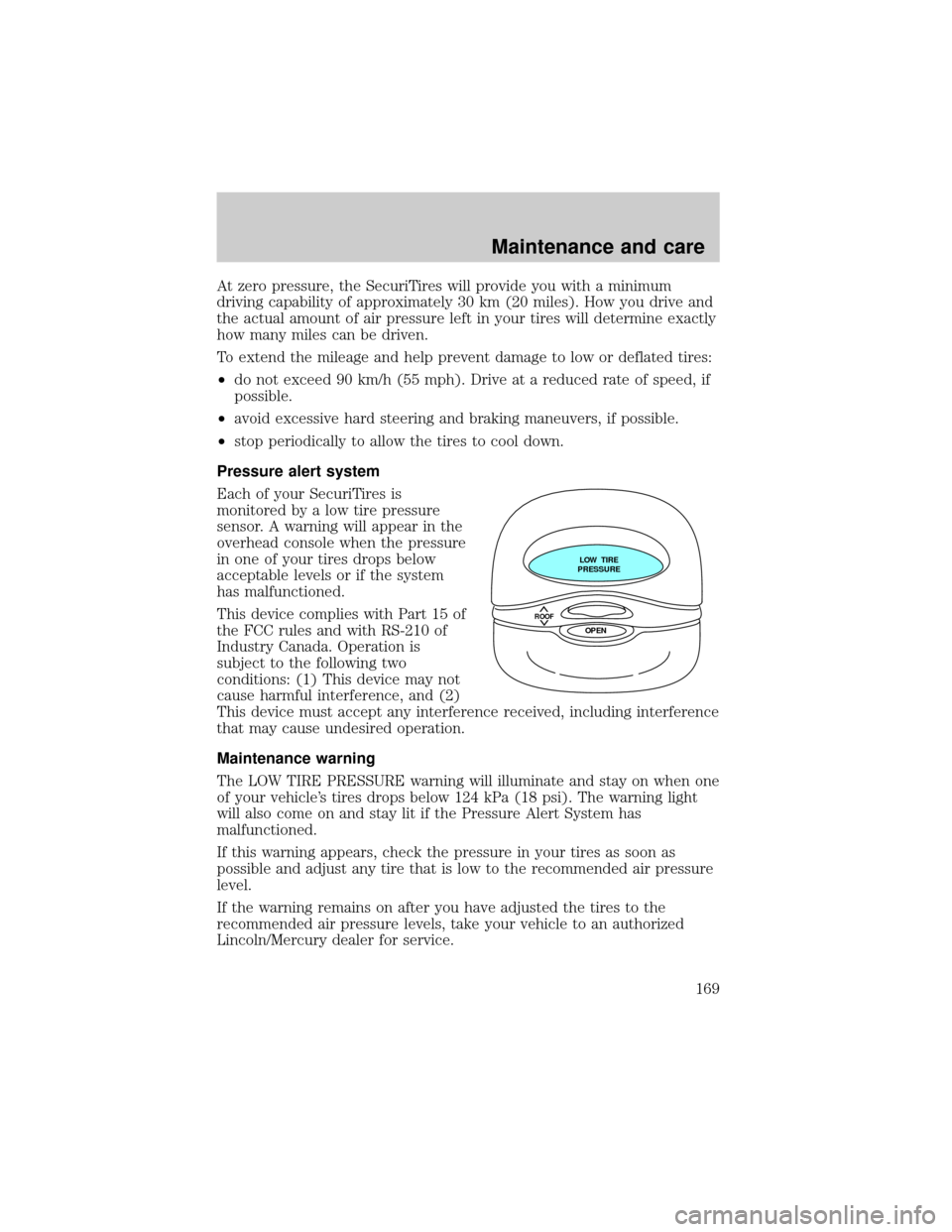
Each of your SecuriTires is
monitored by a low tire pressure
sensor. A warning will appear in the
overhead console when the pressure
in one of your tires drops below
acceptable levels or if the system
has malfunctioned.
This device complies with Part 15 of
the FCC rules and with RS-210 of
Industry Canada. Operation is
subject to the following two
conditions: (1) This device may not
cause harmful interference, and (2)
This device must accept any interference received, including interference
that may cause undesired operation.
Maintenance warning
The LOW TIRE PRESSURE warning will illuminate and stay on when one
of your vehicle's tires drops below 124 kPa (18 psi). The warning light
will also come on and stay lit if the Pressure Alert System has
malfunctioned.
If this warning appears, check the pressure in your tires as soon as
possible and adjust any tire that is low to the recommended air pressure
level.
If the warning remains on after you have adjusted the tires to the
recommended air pressure levels, take your vehicle to an authorized
Lincoln/Mercury dealer for service.
ROOF
LOW TIRE
PRESSURE
OPEN
Maintenance and care
169
Page 170 of 208
Flat tire warning
If the sensors detect a tire pressure lower than 68 kPa (10 psi), the LOW
TIRE PRESSURE warning will appear in the overhead console and the
message WARNING LOW TIRE PRESSURE will be displayed in the
message center, indicating an impending flat tire. If this condition occurs,
your SecuriTire requires service as soon as possible. Refer toServicing
your SecuriTires.
The Pressure Alert System will activate only when the vehicle is moving
faster than 15 km/h (10 mph).
Servicing your SecuriTires
If you cannot service your SecuriTire immediately, replace it with your
temporary spare as soon as safely possible.
Your temporary spare tire can be used until your SecuriTire has been
repaired.
It is recommended that you always have your SecuriTires serviced by an
authorized Michelin tire dealer.Each SecuriTire is equipped with a
pressure sensor around the wheel rim. This sensor could be
damaged when removing and installing the tire.Servicing a
SecuriTire at locations other than your Michelin tire dealer may
adversely affect your warranty.
If you have questions concerning your SecuriTires or servicing, please
call the Michelin Tire Information Line at 1-800-847-3435 or contact your
local Michelin tire dealer.
INFORMATION ABOUT TIRE QUALITY GRADES
New vehicles are fitted with tires
that have their Tire Quality Grade
(described below) molded into the
tire's sidewall. These Tire Quality
Grades are determined by standards
that the United States Department
of Transportation has set.
Maintenance and care
170
Page 182 of 208

EMISSION CONTROL SYSTEM
Your vehicle is equipped with various emission control components and a
catalytic converter which will enable your vehicle to comply with
applicable exhaust emission standards. To make sure that the catalytic
converter and other emission control components continue to work
properly:
²Use only unleaded fuel.
²Avoid running out of fuel.
²Do not turn off the ignition while your vehicle is moving, especially at
high speeds.
²Have the items listed in your Scheduled Maintenance Guide performed
according to the specified schedule.
The scheduled maintenance items listed in the Scheduled Maintenance
Guide are essential to the life and performance of your vehicle and to its
emissions system.
If other than Ford, Motorcraft or Ford-authorized parts are used for
maintenance replacements or for service of components affecting
emission control, such non-Ford parts should be equivalent to genuine
Ford Motor Company parts in performance and durability.
Do not park, idle, or drive your vehicle in dry grass or other dry
ground cover. The emission system heats up the engine
compartment and exhaust system, which can start a fire.
Illumination of the charging system warning light, ªService Engine Soonº
light or the temperature warning light, fluid leaks, strange odors, smoke
or loss of oil pressure, could indicate that the emission control system is
not working properly.
Exhaust leaks may result in entry of harmful and potentially
lethal fumes into the passenger compartment.
Maintenance and care
182
Page 183 of 208

Do not make any unauthorized changes to your vehicle or engine. By
law, vehicle owners and anyone who manufactures, repairs, items, sells,
leases, trades vehicles, or supervises a fleet of vehicles are not permitted
to intentionally remove an emission control device or prevent it from
working. Information about your vehicle's emission system is on the
Vehicle Emission Control Information Decal located on or near the
engine. This decal identifies engine displacement and gives some tune up
specifications.
Please consult your ªWarranty Guideº for complete emission warranty
information.
Readiness for inspection/maintenance (I/M) testing
In some localities, it may be a legal requirement to pass an I/M test of
the on-board diagnostic (OBD-II) system. If your ªCheck Engine/Service
Engine Soonº light is on, refer to the description in theWarning Lights
and Chimessection of theInstrumentationchapter. Your vehicle may
not pass the I/M test with the ªCheck Engine/Service Engine Soonº light
on.
If the vehicle's powertrain system or its battery has just been serviced,
the OBD-II system is reset to a ªnot ready for I/M testº condition. To
ready the OBD-II system for I/M testing, a minimum of 30 minutes of city
and highway driving is necessary as described below:
²First, at least 10 minutes of driving on an expressway or highway.
²Next, at least 20 minutes driving in stop-and-go, city-type traffic with
at least four idle periods.
Allow the vehicle to sit for at least eight hours without starting the
engine. Then, start the engine and complete the above driving cycle. The
engine must warm up to its normal operating temperature. Once started,
do not turn off the engine until the above driving cycle is complete.
REPLACING EXTERIOR BULBS
Check the operation of the following lamps frequently:
²Headlamps
²Tail lamps
²Brakelamps
²High-mount brakelamp
²Turn signals
Maintenance and care
183
Page 202 of 208

Accessory delay ..........................75
Air bag supplemental restraint
system ........................................101
and child safety seats ............102
description .......................101,105
disposal ....................................107
indicator light ..................105,107
passenger air bag ............103,106
Air conditioning
automatic temperature
control system ...........26,27,28,30
Air filter, cabin ..........................166
Air suspension
warning light ...........................124
Anti-theft system .................79,122
arming the system ....................79
disarming a triggered system ..80
Automatic transaxle .................125
driving with ...............127,128,129
Automatic transmission
fluid, refill capacities ................12
Brakes ........................................120
anti-lock ............................120,121
anti-lock brake system (ABS)
warning light ...........................121
fluid, checking and adding ....157
shift interlock ..........................125
Break-in period .............................3
CD player .....................44,45,46,47
Child safety seats
attaching with tether straps ..114
in rear seat ..............................111
tether anchorage hardware ...114
Cleaning your vehicle ...............190
engine compartment ..............191
exterior .............................191,193
exterior lamps .........................192
plastic parts ............................192
washing ....................................190
waxing .....................................191
wheels ......................................191
windows ..................................194wiper blades ............................192
woodtone trim ........................194
Clock ............................................32
Compass, electronic ....................71
calibration .................................72
set zone adjustment .................71
Console ...................................78,79
overhead ....................................55
Controls
power seat ............................92,94
Coolant ...............................160,161
checking and adding ..............159
refill capacities ........................161
Defrost
rear window ..............................31
Emission control system ..........182
Engine
coolant .....................................158
idle speed control ...................164
service points ..........................153
starting after a collision .........135
Engine block heater .................118
Engine oil
checking and adding ..............155
dipstick ....................................154
specifications ...................154,156
Exhaust fumes ..........................118
Floor mats ...................................79
Fuel
choosing the right fuel ...........176
comparisons with EPA fuel
economy estimates .................181
detergent in fuel .....................178
filling your vehicle
with fuel ...........................174,176
fuel filler door override ............78
fuel filler door release lever ....78
gauge .........................................10
quality ......................................177
running out of fuel .................178
safety information relating to
automotive fuels .....................174
Index
202
Page 203 of 208

Fuses ...................................136,137
Gas mileage (see Fuel
economy) ..............178,179,180,181
Gauges .........................................10
engine coolant temperature
gauge .........................................11
Hazard flashers .........................135
Head restraints ...........................92
Headlamps
aiming ...............................188,189
bulb specifications ..................187
high beam ..............................8,24
turning on and off ......................8
warning chime ..........................10
Heating ........................................26
Hood ..........................................153
Ignition .......................................197
Inspection/maintenance (I/M)
testing ........................................183
Instrument panel
cleaning ...................................193
Keyless entry system
autolock .....................................88
keypad .......................................85
programming entry code ...86,87,
88
Keys
key in ignition chime .................9
positions of the ignition ...........47
Lamps
autolamp system .......................25
daytime running light ...............24
headlamps .................................24
headlamps, flash to pass ..........25
instrument panel, dimming .....25
interior lamps ....................54,187
replacing bulbs ..183,184,186,187
Lane change indicator
(see Turn signal) ........................48
Lights, warning and indicator
air bag ..........................................7
anti-lock brakes (ABS) ..............8brake ............................................7
charging system ..........................9
oil pressure .................................9
safety belt ...................................7
service engine soon ....................6
traction control off .....................9
turn signal indicator ...................8
Locks
childproof ..................................77
Lumbar support, seats ...............94
Message center
date/economy button ..........15,16
menu button .............................17
reset button ..............................16
system check button ................13
warning messages .....................14
Mirrors .........................................67
automatic dimming rearview
mirror ........................................73
cleaning ...................................194
heated ........................................76
programmable memory ............84
side view mirrors (power) .......76
Moon roof ....................................66
Motorcraft parts ........................178
Octane rating ............................177
Odometer .....................................11
Overdrive ...................................126
Panic alarm feature, remote
entry system ................................82
Parking brake ............................121
Power distribution box
(see Fuses) ...............................140
Power door locks ........................74
Power steering ...................123,124
fluid, checking and adding ....161
Radio .............32,33,34,35,36,37,38,
39,40,41,42,43
Relays .................................136,142
Remote entry system .......81,88,90
illuminated entry ......................84
locking/unlocking doors ...........81
Index
203