Page 69 of 432
GAUGES, METERS AND SERVICE REMINDER INDICATORS
51
The gauge indicates the engine coolant temperature when
the ignition switch is on. The engine operating
temperature
will vary with changes in weather and engine
load.
If the needle points to the red zone or higher, stop your vehicle
and allow the engine to cool.
Your vehicle may overheat during severe operating
conditions, such as:
� Driving up a long hill on a hot day.
� Reducing speed or stopping after high speed driving.
� Idling for a long period with the air conditioning on in
stop±and±go traffic.
� Towing a trailer.
NOTICE
�Do not remove the thermostat in the engine cooling
system as this may cause the engine to overheat. The
thermostat is designed to control the flow of coolant to
keep the temperature of the engine within the specified
operating range.
� Do not continue driving with an overheated engine.
See ºIf your vehicle overheatsº on page 280.
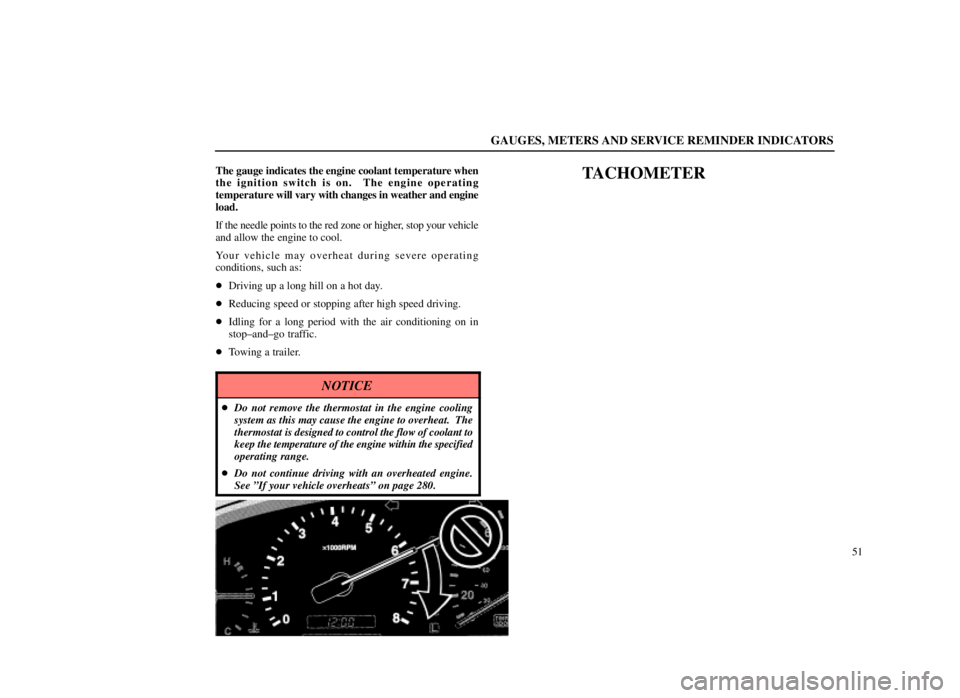
TACHOMETER
Page 98 of 432
INTERIOR EQUIPMENT
80
LUGGAGE STOWAGEPRECAUTIONS
When stowing luggage or cargo in the vehicle, observe the
following:
� Put luggage or cargo in the trunk when at all possible. Be
sure all items are secured in place.
� Be careful to keep the vehicle level. Placing the weight as
far forward as possible helps maintain vehicle balance.
� For better fuel economy, do not carry unnecessary weight.
CAUTION
�Do not place anything on the filler panel behind the rear
seatback. Such items may be thrown about and possibly
injure people in the vehicle during sudden braking or an
accident.
� Do not drive with objects left on top of the instrument
panel. They may interfere with the driver's field of view.
Or they may move during sharp vehicle acceleration or
turning, and impair the driver's control of the vehicle. In
an accident they may injure the vehicle occupants.
NOTICE
Do not load the vehicle beyond the vehicle capacity
weight specified on the tire pressure label.
Page 112 of 432
COMFORT ADJUSTMENT
94
FRONT SEATS
Seat adjustment precautions
Adjust the driver's seat so that the foot pedals, steering wheel
and instrument panel controls are within easy reach of the
driver.
CAUTION
�Do not adjust the seat while the vehicle is moving as the seat
may unexpectedly move and cause the driver to lose control
of the vehicle.
� Be careful not to hit the seat against a passenger, luggage or
the rear seat.
NOTICE
Do not operate the control switch in more than one
dimension at a time. It may cause electrical overload.
Adjusting front seats
Page 217 of 432

AIR CONDITIONING AND AUDIO
199
4. Insert the magazine into the player as indicated by the
arrow head on the magazine and close the cover.
When the magazine is set completely, the system will be in a
ºLoadº cycle for approximately 20 seconds while the system
searches for discs in the magazine. Upon completion of this
cycle, the CD unit will be ready to play. If the ºCDº button
is pushed during the ºLoadº cycle, ºLOADº appears on the
display until the system has completed the load cycle, after
which the system will begin normal play.
(b) Playing a compact disc
1. Push the
(CD) button after setting the magazine in
the player. ºCDº then appears on the display.
The discs set in the magazine are played continuously,
starting with the disc on top. The disc number of the disc
currently being played, the track number and the time from
the beginning of the program will appear on the display.
When play of one disc ends, the first program of the following
disc starts. When play of the final disc ends, play of the first
disc starts again.
The compact disc player can also be turned on by pushing the
ºPWR.VOLº knob if the compact disc player was being
played when the system was turned off.
If the radio or cassette tape player is on when you push the
(CD) button, the radio or cassette tape player will
automatically turn off.
2. Turn the ºPWR. VOLº knob to adjust the volume.
3. Select your program. (See º(c) Selecting a compact discº
and º(d) Selecting a programº.)
4. Adjust the tone and balance on the radio. (See º(d)
Adjusting the toneº and º(e) Adjusting the sound balanceº of
radio operation.)
5. Push the ºPWR. VOLº knob to turn the compact disc
player off.
Page 228 of 432

STARTING AND DRIVING
210
CAUTION
�Keep people and combustible materials away from the
exhaust pipe while the engine is running. The exhaust gas
is very hot.
� Do not drive, idle or park your vehicle over anything that
might burn easily such as grass, leaves, paper or rags.
NOTICE
A large amount of unburned gases flowing into the
three±way catalytic converter may cause it to overheat
and create a fire hazard. To prevent this and other
damage, observe the following precautions:
�Use only unleaded gasoline.
� Do not drive with an extremely low fuel level; running
out of fuel could cause the engine to misfire, creating
an excessive load on the three±way catalytic converter.
� Do not allow the engine to run at idle speed for more
than 20 minutes.
� Avoid racing the engine.
� Do not push±start or pull±start your vehicle.
�Do not turn off the ignition while the vehicle is moving.
� Keep your engine in good running order.
Malfunctions in the engine electrical system,
electronic ignition system or fuel system could cause
an extremely high three±way catalytic converter
temperature.
� If the engine becomes difficult to start or stalls
frequently, take your vehicle in for a check±up as soon
as possible. Remember, your Lexus dealer knows your
vehicle and its three±way catalytic converter system
best.
� To ensure that the three±way catalytic converter and
the entire emission control system operate properly,
your vehicle must receive the periodic inspections
required by the Lexus Maintenance Schedule. For
scheduled maintenance information, refer to the
separate ºOwner's Manual Supplement/
Maintenance Scheduleº.
Page 279 of 432

DRIVING TIPS
261
your Lexus dealer ± they will be pleased to help.
Check
the electronic ignition system for loose connections
or obvious damage.
Keep the door locks from freezing.
Squirt lock de±icer or glycerine into the locks to keep them
from freezing.
Use a washer fluid containing an antifreeze solution.
This product is available at your Lexus dealer and most auto
parts stores. Follow the manufacturer's directions for how
much to mix with water.
NOTICE
Do not use engine antifreeze or any other substitute
because it may damage your vehicle's paint.
Do not use your parking brake when there is a possibility
it could freeze.
When parking, put the transmission into ºPº and block the
front wheels. Do not use the parking brake, or snow or water
accumulated in and around the parking brake mechanism
may freeze the parking brake, making it hard to release.
Keep ice and snow from accumulating under the fenders.
Ice and snow built up under your fenders can make steering
difficult. During bad winter driving, stop and check under the
fenders occasionally. Depending on where you are driving, we recommend you
carry some emergency equipment.
Some of the things you might put in the vehicle are tire chains,
window scraper, bag of sand or salt, flares, small shovel,
jumper cables, etc.
TRAILER TOWING
Your vehicle is designed primarily as a passenger±carrying
vehicle. Towing a trailer will have an adverse effect on
handling, performance, braking, durability and driving
economy (fuel consumption, etc.). Your safety and
satisfaction depend on the proper use of correct equipment
and cautious driving habits. For your safety and the safety of
others, you must not overload your vehicle or trailer. Lexus
warranties do not apply to damage or malfunction caused by
towing a trailer for commercial purposes. Ask your local
Lexus dealer for further details before towing.
Page 280 of 432
DRIVING TIPS
262
Weight limits
Before towing, make sure the total trailer weight, gross
vehicle weight, gross axle weight and trailer tongue load
are all within the limits.
The total trailer weight and tongue load can be measured with
platform scales found at a highway weighing station, building
supply company, trucking company, junk yard, etc.
CAUTION
Page 281 of 432

DRIVING TIPS
263
�The total trailer weight (trailer weight plus its cargo load)
must not exceed 726 kg (1600 lb.). Exceeding this weight is
dangerous.
� Trailer hitch assemblies have different weight capacities
established by the hitch manufacturer. Even though the
vehicle may be physically capable of towing a higher
weight, the operator must determine the maximum weight
rating of the particular hitch assembly and never exceed
the maximum weight rating specified for the trailer hitch.
Exceeding the maximum weight rating set by the trailer
hitch manufacturer can cause an accident resulting in
serious personal injuries.
�The gross vehicle weight must not exceed the Gross V ehicle
Weight Rating (GVWR) indicated on the Certification
Label. The gross vehicle weight is the sum weight of the
unloaded vehicle, driver, passengers, luggage, hitch and
trailer tongue load. It also includes the weight of any
special equipment installed on your vehicle.
� The load on either the front or rear axle resulting from
distribution of the gross vehicle weight on both axles must
not exceed the Gross Axle Weight Rating (GAWR) listed on
the Certification Label.