Page 161 of 432
COMFORT ADJUSTMENT
143
In the following cases, contact your Lexus dealer as soon as
possible:
�
The SRS airbags have been inflated.
� The front part of the vehicle (shaded in the illustration) was
involved in an accident that did not cause the SRS airbags
to inflate.
� The pad section of the steering wheel or front passenger
airbag cover (shaded in the illustration) is scratched,
cracked, or otherwise damaged.
NOTICE
Do not disconnect the battery cables before contacting
your Lexus dealer.
CHILD RESTRAINT
Child restraint precautions
Lexus strongly urges the use of child restraint systems for
children small enough to use them.
The laws of all fifty states in the U.S.A. now require the use
of a child restraint system.
Your vehicle conforms to SAE J1819.
If a child is too large for a child restraint system, the child
should sit in the rear seat and must be restrained using the
vehicle's seat belt. See ºSeat beltsº on page 115 for details.
Page 189 of 432
COMFORT ADJUSTMENT
171
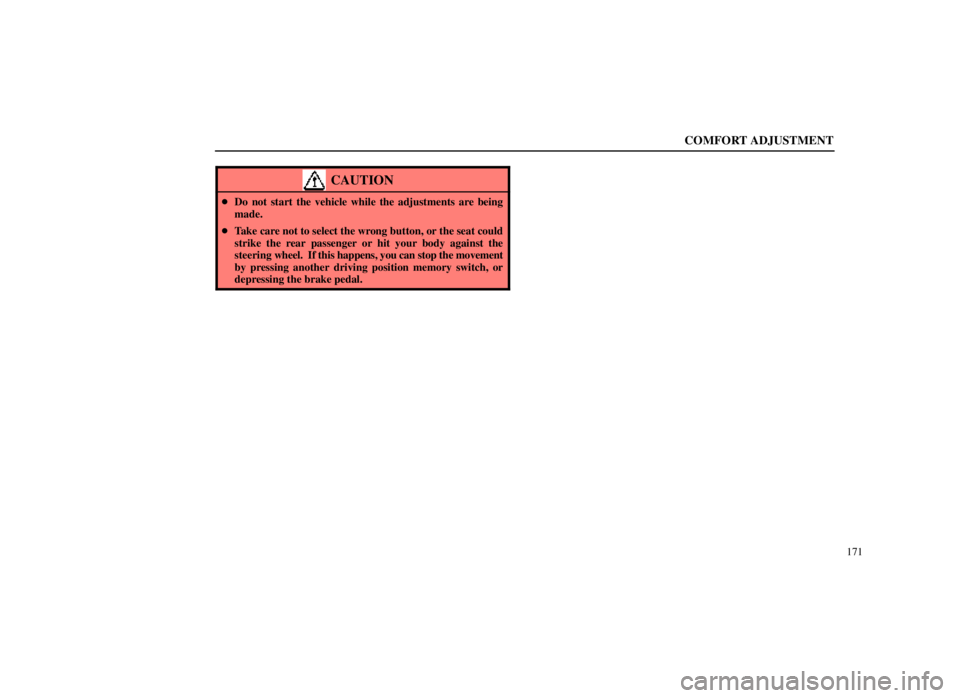
CAUTION
�Do not start the vehicle while the adjustments are being
made.
� Take care not to select the wrong button, or the seat could
strike the rear passenger or hit your body against the
steering wheel. If this happens, you can stop the movement
by pressing another driving position memory switch, or
depressing the brake pedal.
Page 230 of 432
STARTING AND DRIVING
212
�To allow proper operation of your vehicle's
ventilation system, keep the inlet grilles in front of
the windshield clear of snow, leaves, or other
obstructions.
� If you smell exhaust fumes in the vehicle, drive with
the windows open and the trunk lid closed. Have the
cause immediately located and corrected.
BEFORE STARTING THE
ENGINE
1. Check the area around the vehicle before entering it.
2. Adjust seat position, seatback angle, head restraint height
and steering wheel angle.
3. Adjust inside and outside rear view mirrors.
4. Lock all doors.
5. Fasten seat belts.
Remember to check that the service reminder indicators
function when turning the key to ºONº, and check the fuel
gauge to see that you have sufficient fuel.
IGNITION SWITCH WITH
STEERING LOCK
Page 232 of 432
STARTING AND DRIVING
214
ºLOCKº ± Engine is off and the steering wheel is locked.
The ignition key can be removed only at this position.
To turn the key from ºACCº to the ºLOCKº position, you
must put the transmission selector lever in the ºPº position.
Once you remove the key, the engine immobiliser system is
automatically set. See ºEngine immobiliser systemº on page
16.
When starting the engine, the key may seem stuck at the
ºLOCKº position. To free it, first be sure the key is pushed
all the way in, and then rock the steering wheel slightly while
turning the key gently.If, in an emergency, you must turn the engine off while the
vehicle is moving, turn the key only to ºACCº.
Page 268 of 432

STARTING AND DRIVING
250
Anti±lock brake system
The anti±lock brake system is designed to automatically
help prevent lock±up of the wheels during a sudden brake
or braking on slippery road surfaces. This assists in
providing directional stability and steering performance
of the vehicle under these circumstances.
The anti±lock brake system becomes operative after the
vehicle has accelerated to a speed in excess of approximately
10 km/h (6 mph). It stops operating when the vehicle
decelerates to a speed below approximately 5 km/h (3 mph).
You may hear a sound in the engine compartment for a few
seconds when the engine is started or just after the vehicle is
started. This means that the anti±lock brake system is in the
self±check mode, and does not indicate a malfunction.
Effective way to press the ABS brake pedal: When the anti±
lock brake system function is in action, you may feel the brake
pedal pulsating and hear a noise. In this situation, to let the anti±
lock brake system work for you, just hold the brake pedal down
more firmly. Do not pump the brake in a panic stop. Pumping the
brake pedal makes the stopping distance longer.
Page 279 of 432

DRIVING TIPS
261
your Lexus dealer ± they will be pleased to help.
Check
the electronic ignition system for loose connections
or obvious damage.
Keep the door locks from freezing.
Squirt lock de±icer or glycerine into the locks to keep them
from freezing.
Use a washer fluid containing an antifreeze solution.
This product is available at your Lexus dealer and most auto
parts stores. Follow the manufacturer's directions for how
much to mix with water.
NOTICE
Do not use engine antifreeze or any other substitute
because it may damage your vehicle's paint.
Do not use your parking brake when there is a possibility
it could freeze.
When parking, put the transmission into ºPº and block the
front wheels. Do not use the parking brake, or snow or water
accumulated in and around the parking brake mechanism
may freeze the parking brake, making it hard to release.
Keep ice and snow from accumulating under the fenders.
Ice and snow built up under your fenders can make steering
difficult. During bad winter driving, stop and check under the
fenders occasionally. Depending on where you are driving, we recommend you
carry some emergency equipment.
Some of the things you might put in the vehicle are tire chains,
window scraper, bag of sand or salt, flares, small shovel,
jumper cables, etc.
TRAILER TOWING
Your vehicle is designed primarily as a passenger±carrying
vehicle. Towing a trailer will have an adverse effect on
handling, performance, braking, durability and driving
economy (fuel consumption, etc.). Your safety and
satisfaction depend on the proper use of correct equipment
and cautious driving habits. For your safety and the safety of
others, you must not overload your vehicle or trailer. Lexus
warranties do not apply to damage or malfunction caused by
towing a trailer for commercial purposes. Ask your local
Lexus dealer for further details before towing.
Page 285 of 432

DRIVING TIPS
267
Trailer towing tips
When towing a trailer, your vehicle will handle differ ently
than when not towing. The three main causes of
vehicle±trailer accidents are driver error, excessive speed
and improper trailer loading. Keep these in mind when
towing:
� Before starting out, check the operation of the lights and
all vehicle±trailer connections. After driving a short
distance, stop and recheck the lights and connections.
Practice turning, stopping and backing with a trailer in an
area away from traffic until you learn the feel.
� Backing with a trailer is difficult and requires practice.
Grip the bottom of the steering wheel and move your hand
to the left to move the trailer to the left. Move your hand
to the right to move the trailer to the right. (This procedure
is generally opposite to that when backing without a
trailer.) Also, just turn the steering wheel a little at a time,
avoiding sharp or prolonged turning. Have someone guide
you when backing to reduce the risk of an accident.
� Because stopping distance may be increased,
vehicle±to±vehicle distance should be increased when
towing a trailer. For each 16 km/h (10 mph) of speed,
allow at least one vehicle and trailer length between you
and the vehicle ahead. Avoid sudden braking as you may
skid, resulting in jackknifing and loss of control. This is
especially true on wet or slippery surfaces. �
Avoid jerky starts or sudden acceleration.
� Avoid jerky steering and sharp turns. The trailer could hit
your vehicle in a tight turn. Slow down before making a
turn to avoid the need of sudden braking.
� Remember that when making a turn, the trailer wheels will
be closer than the vehicle wheels to the inside of the turn.
Therefore, compensate for this by making a larger than
normal turning radius with your vehicle.
� Crosswinds and rough roads will adversely aff ect handling
of your vehicle and trailer, causing sway. Pay attention to
the rear from time to time to prepare yourself for being
passed by large trucks or buses, which may cause your
vehicle and trailer to sway. If swaying happens, firmly
grip the steering wheel and reduce speed immediately but
gradually. Never increase speed. If it is necessary to
reduce speed, brake slowly. Steer straight ahead. If you
make no extreme correction with the steering or brakes,
your vehicle and trailer will stabilize.
� Be careful when passing other vehicles. Passing requires
considerable distance. After passing a vehicle, do not
forget the length of your trailer and be sure you have plenty
of room before changing lanes.
� In order to maintain efficient engine braking and electrical
charging performance, do not use overdrive.
Transmission must be in the º4º position (SC400) or in the
º3º position (SC300).
Page 317 of 432
IN CASE OF AN EMERGENCY
299
Place the ignition key in the ºACCº position.
NOTICE
�Do not tow with the key removed or in the ºLOCKº
position, as the steering lock mechanism is not strong
enough to hold the front wheels straight.
� When lifting wheels, take care to ensure adequate
ground clearance for towing at the opposite end of the
raised vehicle. Otherwise, the bumper and/or
underbody of the towed vehicle will be damaged
during towing.
(b) Using a flat bed truck