Page 385 of 432

CHASSIS
367
Uniform tire quality grading
This information has been prepared in accordance with
regulations issued by the National Highway T raffic Safety
Administration of the U.S. Department of
Transportation. It provides the purchasers and/or
prospective purchasers of Lexus vehicles with
information on uniform tire quality grading.
Your Lexus dealer will help answer any questions you may
have as you read this information.
DOT quality grades ± All passenger vehicle tires must
conform to Federal Safety Requirements in addition to
these grades. These quality grades are molded on the
sidewall. Treadwear
± The treadwear grade is a comparative rating
based on the wear rate of the tire when tested under controlled
conditions on a specified government test course. For
example, a tire graded 150 would wear one and a half (1 ± 1/2)
times as well on the government course as a tire graded 100.
The relative performance of tires depends upon the actual
conditions of th eir use, however, and may depart significantly
from the norm due to variations in driving habits, service
practices and differences in road characteristics and climate.
Traction AA, A, B, C ± The traction grades, from highest to
lowest, are AA, A, B and C, and they represent the tire's
ability to stop on wet pavement as measured under controlled
conditions on specified government test surfaces of asphalt
and concrete. A tire marked C may have poor traction
performance.
Warning: The traction grade assigned to this tire is based on
braking (straight ahead) traction tests and does not include
cornering (turning) traction.
Temperature A, B, C ± The temperature grades are A (the
highest), B, and C, representing the tire's resistance to the
generation of heat and its ability to dissipate heat when tested
under controlled conditions on a specified indoor laboratory
test wheel. Sustained high temperature can cause the material
of the tire to degenerate and reduce tire life, and excessive
temperature can lead to sudden tire failure. The grade C
corresponds to a level of performance which all passenger car
tires must meet under the Federal Motor Vehicle Safety
Standard No. 109. Grades B and A represent higher levels of
performance on the laboratory test wheel than the minimum
Page 388 of 432
CHASSIS
370
CAUTION
�Snow tires should be inflated as described below, but never
above the maximum cold tire pressure shown on the tire
sidewall.
225/55R16 ... 220 kPa (2.2 kgf/cm
2 or bar, 32 psi)
� Never drive over 120 km/h (75 mph) with any type of snow
tires.
Tire chain selection
Regulations regarding the use of tire chains vary
according to location or type of road. Always check the
local regulations before installing chains.
Use SAE Class ºSº type radial tire chains, with the exception
of radial cable chains or V±bar type chains.
Chain installation
Install the chains on the rear tires as tightly as possible.
Do not use tire chains on the front tires. Retighten chains
after driving 0.5 ± 1.0 km (1/4 ± 1/2 mile).
When installing chains on your tires, carefully follow the
instructions of the chain manufacturer.
Page 389 of 432
CHASSIS
371
CAUTION
�Do not exceed 50 km/h (30 mph) or the chain
manufacturer's recommended speed limit, whichever is
lower.
� Drive carefully avoiding bumps, holes, and sharp turns,
which may cause the vehicle to bounce.
� Avoid sharp turns or locked±wheel braking, as use of
chains may adversely affect vehicle handling.
Page 397 of 432

ELECTRICAL COMPONENTS
379
No.FUSEAMPERECIRCUIT
19PWR30Preset steering, electronic
moon roof, power windows,
theft deterrent system
20IG SW40Starting system
21DOOR30
Theft deterrent system, seat
control system, fuel opener
control system, power door
lock system
22DOME10
Interior light, personal lights,
door courtesy lights, ignition
switch light, open door
warning light, trunk light,
electronic moon roof system,
preset steering system, seat
belt reminder system, cruise
control system, air
conditioning system, inside
rear view mirror, door lock
and theft deterrent system,
foot light, power rear view
mirror, locking with wireless
remote control system,
passenger 's seat control
system.
23EFI30Multiport fuel injection
system/sequential multiport
fuel injection system
24HAZ±HORN15Emergency flashers, horns
No.FUSEAMPERECIRCUIT
25RADIONO.120Radio, cassette tape player,
compact disc player, power
antenna
26TEL15Telephone
27ALT
SENCING7.5Charging system
28ETCS15Traction control system
29HEAD(RH±LWR)*115Right±hand headlight (low
beam)
30HEAD(LH±LWR)*215Left±hand headlight (low
beam)
30DRL7.5Daytime Running Light
System
29HEAD(RH±LPR)15Right±hand headlight (high
beam)
30HEAD(LH±LPR)15Left±hand headlight (high
beam)
31INJ30SC300
Starting system
*1 SC300: HEAD (RH)
*2 SC300: HEAD (LH)
Page 398 of 432
ELECTRICAL COMPONENTS
380
CHECKING BATTERYCONDITION
Precautions
CAUTION
BATTERY PRECAUTIONS
The battery produces flammable and explosive hydrogen gas.
�Do not cause a spark by contacting the battery terminals
with tools.
� Do not smoke or light a match near the battery.
The electrolyte contains poisonous and corrosive sulfuric acid.
� Avoid contact with eyes, skin or clothes.
� Never inhale or swallow electrolyte.
� Wear protective safety glasses when working near the
battery.
� Keep children away from the battery.
EMERGENCY MEASURES
� If electrolyte gets in your eyes, flush your eyes with clean
water for at least 15 minutes and get immediate medical
attention. If possible, continue to apply water with a sponge
or cloth while traveling to the medical office.
Page 399 of 432
ELECTRICAL COMPONENTS
381
�If electrolyte gets on your skin, thoroughly wash the
contact area. If you feel a pain or burn, get medical
attention immediately.
� If electrolyte gets on your clothes, there is a
possibility of its soaking through to your skin, so
immediately take off the exposed clothing and follow
the procedure above, if necessary.
� If you happen to swallow electrolyte, drink a large
quantity of water or milk. Follow with milk of
magnesia, beaten raw egg or vegetable oil. Then go
immediately for emergency help.Checking battery exterior
Page 402 of 432
ELECTRICAL COMPONENTS
384The fluid (electrolyte) level must be between the upper
and lower lines.
When checking
the fluid level, look at all six cells, not just one
or two.
If the level is lower than the lower line, add distilled water.
(See ºAdding distilled waterº on page 386.) (b) Checking by the hydrometer
Page 405 of 432
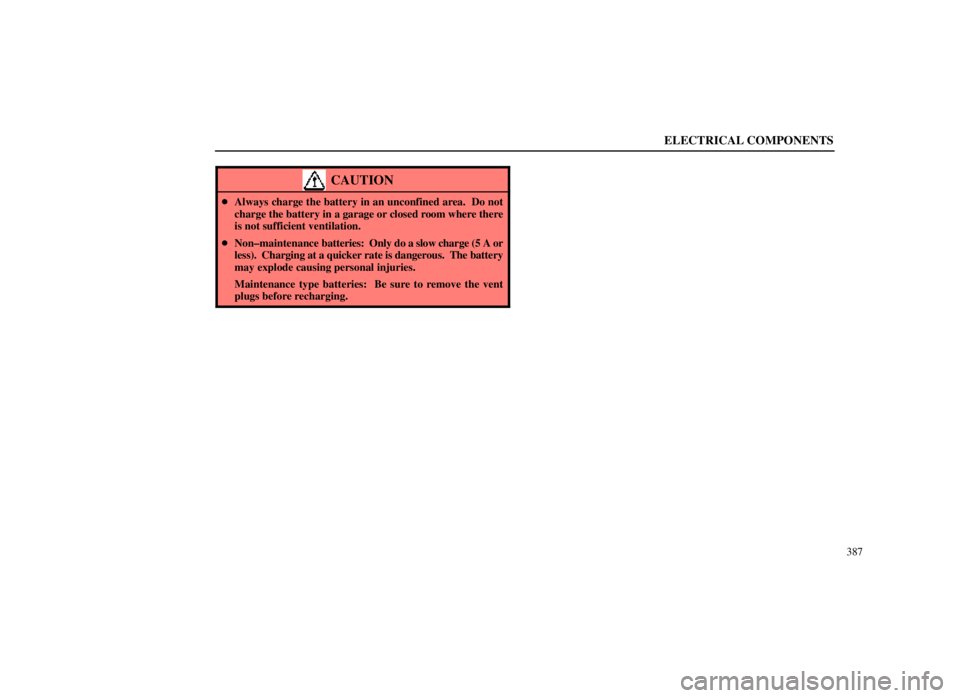
ELECTRICAL COMPONENTS
387
CAUTION
�Always charge the battery in an unconfined area. Do not
charge the battery in a garage or closed room where there
is not sufficient ventilation.
� Non±maintenance batteries: Only do a slow charge (5 A or
less). Charging at a quicker rate is dangerous. The battery
may explode causing personal injuries.
Maintenance type batteries: Be sure to remove the vent
plugs before recharging.