Page 341 of 472

IN CASE OF AN EMERGENCY
321
CAUTION
�When the engine is running, keep hands and clothing
away from the moving fan and engine drive belt.
� Do not attempt to remove the radiator cap when the
engine and radiator are hot. Serious injury could
result from scalding hot fluid and steam blown out
under pressure.
If the cooling fan is not operating or the coolant is not in
the acceptable range, turn off the engine and call your
Lexus dealer.
If both conditions are O.K., after the engine coolant
temperature has cooled to normal, continue driving your
vehicle.
If the engine coolant temperature does not cool down, or
your vehicle overheats again, have it checked as soon
as possible by your Lexus dealer.IF YOU HAVE A FLAT TIRE
1. Reduce your speed gradually, keeping a straight line.
Move cautiously off the road to a safe place ± well away
from the traffic. Avoid stopping on the center divider of
a highway. Park on a level spot with firm ground.
2. Stop the engine and turn on your emergency flashers.
3. Firmly set the p arking brake and put the transmission
in ºPº.
4. Have everyone get out of the vehicle on the side away
from traffic.
5. Read the following instructions thoroughly.
Page 345 of 472
IN CASE OF AN EMERGENCY
325
40E003±5
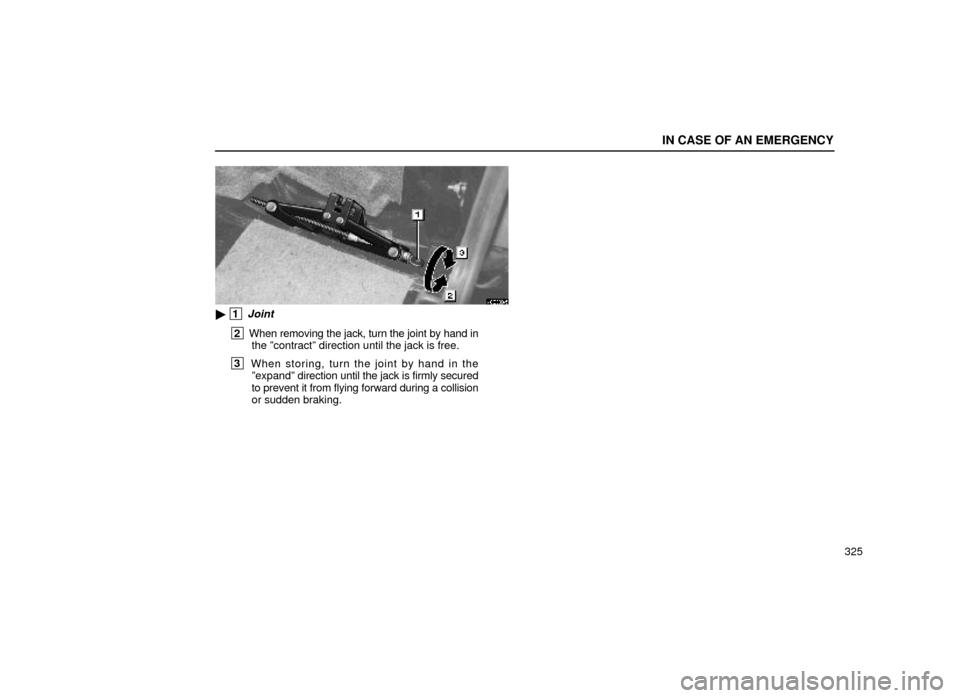
� 1 Joint
2 When removing the jack, turn the joint by hand in
the ºcontractº direction until the jack is free.
3 When storing, turn the joint by hand in the
ºexpandº direction until the jack is firmly secured
to prevent it from flying forward during a collision
or sudden braking.
Page 348 of 472
IN CASE OF AN EMERGENCY
328
40E006
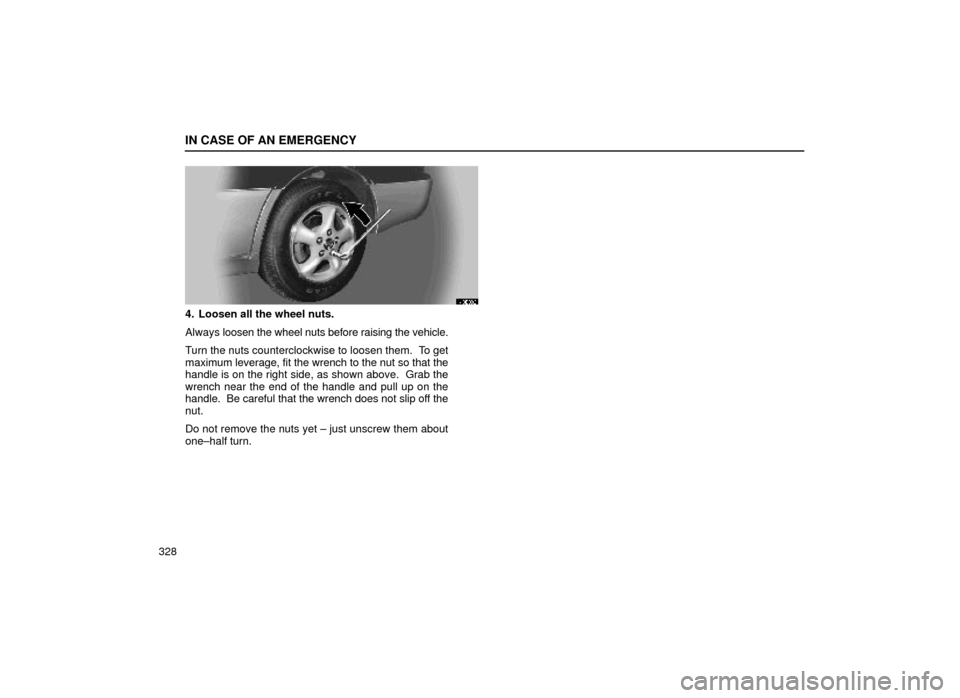
4. Loosen all the wheel nuts.
Always loosen the wheel nuts before raising the vehicle.
Turn the nuts counterclockwise to loosen them. To get
maximum leverage, fit the wrench to the nut so that the
handle is on the right side, as shown above. Grab the
wrench near the end of the handle and pull up on the
handle. Be careful that the wrench does not slip off the
nut.
Do not remove the nuts yet ± just unscrew them about
one±half turn.
Page 350 of 472
IN CASE OF AN EMERGENCY
330
40E008±2
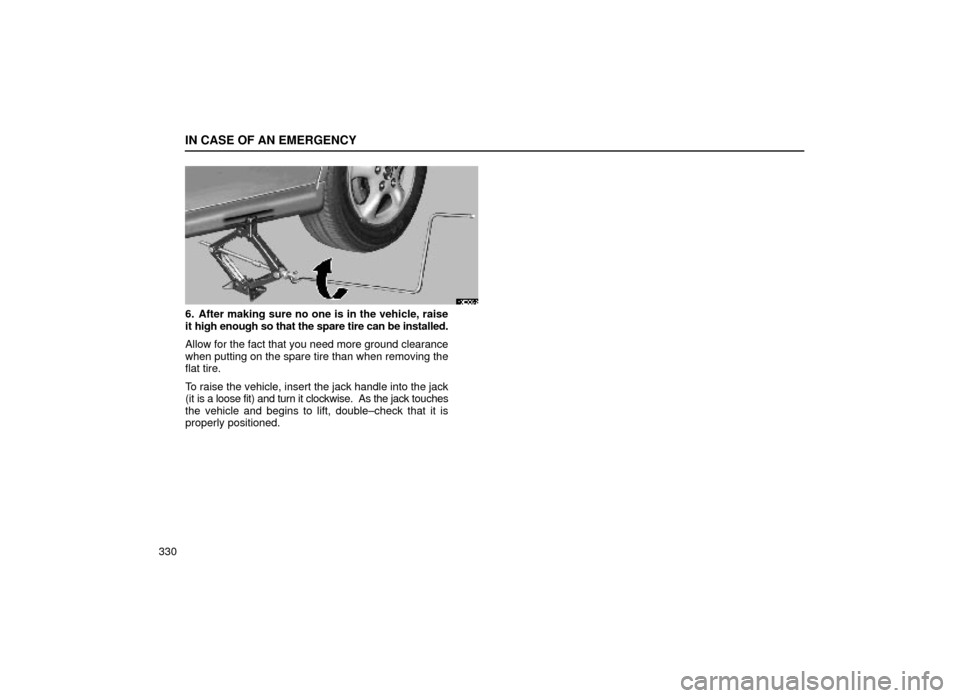
6. After making sure no one is in the vehicle, raise
it high enough so that the spare tire can be installed.
Allow for the fact that you need more ground clearance
when putting on the spare tire than when removing the
flat tire.
To raise the vehicle, insert the jack handle into the jack
(it is a loose fit) and turn it clockwise. As the jack touches
the vehicle and begins to lift, double±check that it is
properly positioned.
Page 354 of 472
IN CASE OF AN EMERGENCY
334
40E012
9. Lower the vehicle completely and tighten the
wheel nuts.
Turn the jack handle counterclockwise to lower the
vehicle.
Use only the wheel nut wrench to tighten the nuts. Do
not use other tools or any additional leverage other than
your hands, such as a hammer, pipe or your foot. Make
sure the wrench is securely engaged over the nut.
Tighten each nut a little at a time in the order shown.
Repeat the process until all the nuts are tight.
Page 366 of 472
IN CASE OF AN EMERGENCY
346
IF YOU CANNOT SHIFT
AUTOMATIC TRANSMISSION SELECTOR LEVER
40E032
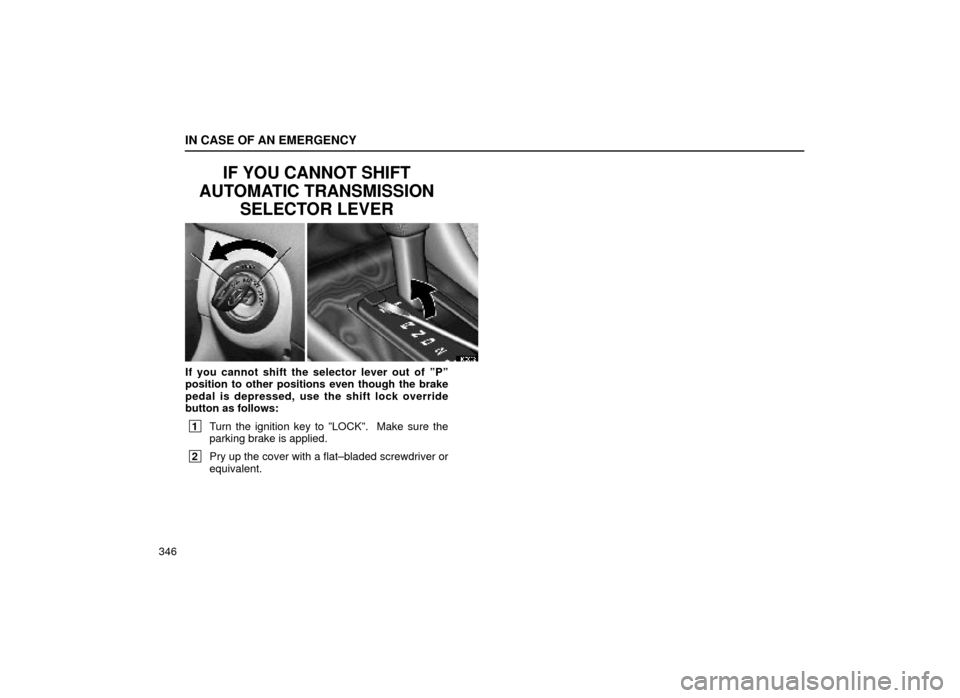
If you cannot shift the selector lever out of ºPº
position to other positions even though the brake
pedal is depressed, use the shift lock override
button as follows:
1Turn the ignition key to ºLOCKº. Make sure the
parking brake is applied.
2Pry up the cover with a flat±bladed screwdriver or
equivalent.
Page 374 of 472

MAINTENANCE
354
Vehicle interior
Items listed below should be checked regularly, e.g.
while performing periodic services, cleaning the
vehicle, etc.
Lights
Make sure the headlight, stop lights, tail lights, turn
signal lights, and other lights are working. Check
headlight aim.
Service reminder indicators and warning buzzers
Check that all service reminder indicators and warning
buzzers function properly.
Steering wheel
Check that it has the specified freeplay. Be alert for
changes in steering condition, such as hard steering,
excessive freeplay or strange noise.
Seats
Check that all front seat controls such as seat adjusters,
seatback recliner, etc. operate smoothly. Check that the
head restraints move up and down smoothly and that the
locks hold securely in any latched position.
Seat belts
Check that the seat belt system such as buckles,
retractors and anchors operate properly and smoothly.
Make sure the belt webbing is not cut, frayed, worn or
damaged. Accelerator pedal
Check
the pedal for smooth operation and uneven pedal
effort or catching.
Brake pedal
Check the pedal for smooth operation and the proper
clearance and freeplay. Check the brake booster
function.
Brakes
At a safe place, check that the brakes do not pull to one
side when applied.
Parking brake
Check that the pedal has the proper travel and that, on
a safe incline, your vehicle is held securely with only the
parking brake applied.
Automatic transmission ºParkº mechanism
Check the lock release button of the selector lever for
proper and smooth operation. On a safe incline, check
that your vehicle is held securely with the selector lever
in ºPº position and all brakes released.
Page 375 of 472

MAINTENANCE
355
Engine compartment
Items listed below should be checked from time to
time, e.g. each time when refueling.
Washer fluid
Make sure there is sufficient fluid in the tank. See page
432 for additional information.
Engine coolant level
Make sure the coolant level is between the ºFULLº and
ºLOWº lines on the see±through reservoir when the
engine is cold. See page 383 for additional information.
Battery
Your Lexus has a maintenance free battery. You do not
have to add distilled water. For longer life of the battery,
however, see page 415 for additional information.
Brake fluid level
Make sure the brake fluid level is correct. See page 391
for additional information.
Engine oil level
Check the level on the dipstick with the engine turned off
and the vehicle parked on a level spot. See page 378 for
additional information.
Power steering fluid level
Check the level through the reservoir. The level should
be in the ºHOTº or ºCOLDº range depending on the fluid temperature. See page 393 for additional information.
Exhaust system
Look
for cracks, holes and loose supports. If you notice
any change in the sound of the exhaust or smell exhaust
fumes, have the cause located and corrected
immediately. (See engine exhaust cautions in Section
3±1.)