1999 LAND ROVER DISCOVERY fuel pressure
[x] Cancel search: fuel pressurePage 305 of 1529

ENGINE MANAGEMENT SYSTEM - V8
18-2-6 DESCRIPTION AND OPERATION
Description - engine management
General
The V8 engine is equipped with the Bosch Motronic M5.2.1 engine management system. This system is a sequential
multiport fuel injection system controlled by an Engine Control Module (ECM).
A single ECM is used for the control of the existing 4.0 litre engine and the new 4.6 litre engine introduced with 03
model year vehicles for the NAS market only. The ECM contains the tunes for both engines variants. When the ECM
is replaced, TestBook/T4 must be used to select the correct tune to match the engine fitment.
The ECM has On Board Diagnostic (OBD) strategies as required by various market legislative bodies. To meet these
requirements the system monitors and reports on any faults that cause excessive exhaust emissions.
In markets that mandate OBD, the ECM monitors performance of the engine for misfires, catalyst efficiency, exhaust
leaks and evaporative control loss. If a fault occurs, the ECM stores the relevant fault code and warns the driver of
component failure by illuminating the Malfunction Indicator Light in the instrument pack.
In markets where OBD is not mandatory, the ECM will still monitor performance of the engine and store the fault code,
but will not illuminate the Malfunction Indicator Light.
The ECM uses input and output information from its sensors and actuators to control the following engine conditions:
lFuel quantity.
lClosed loop fuelling.
lOpen loop fuelling.
lIgnition timing.
lKnock control.
lIdle speed control.
lEmission control.
lOn-Board Diagnostic (OBD) where applicable.
lVehicle immobilisation.
lMisfire detection (where applicable).
lVehicle speed signal.
lRough road signal (where applicable).
lLow fuel level signal (where applicable).
lCoolant temperature gauge signal.
The ECM processes sensor information from the following input sources:
lIgnition switch (position II).
lCrankshaft speed and position sensor.
lCamshaft position sensor.
lEngine coolant temperature sensor.
lMass air flow sensor.
lIntake air temperature sensor.
lKnock sensor.
lThrottle position sensor.
lHeated oxygen sensors.
lHigh/ Low ratio switch.
lFuel tank pressure sensor (where fitted)
lThermostat monitoring sensor (where fitted)
Page 308 of 1529

ENGINE MANAGEMENT SYSTEM - V8
DESCRIPTION AND OPERATION 18-2-9
Pin out details connector C0634
Connector 2 (C0635): This connector contains 24 pins and is primarily used for Heated Oxygen Sensors (HO
2S)
control and earth. The HO
2S sensors require a heater circuit to assist in heating the tip of the sensors to enable closed
loop fuelling to be implemented quickly after cold starting.
Pin out details connector C0635
Pin No. Function Signal type Reading
1 Ignition position II Input 12 V
2 Not used - -
3 Not used - -
4 Chassis earth Earth 0V
5 Fuel injectors earth Earth 0V
6 Power stage earth Earth 0V
7 Permanent battery supply Input battery supply 12V
8 Switched relay positive Input switched 0-12V
9 Not used - -
Pin No. Function Signal type Reading
1HO
2S heater RH bank - downstream Output PWM 12-0V
2 Not used - -
3 Not used - -
4 Not used - -
5 Thermostat monitoring sensor Earth 0V
6 Not used - -
7HO
2S heater LH bank - downstream Output PWM 12-0V
8HO
2S sensor RH bank - downstream Earth/ Signal 0V
9HO
2S sensor LH bank - upstream Earth/ Signal 0V
10 HO
2S sensor RH bank - upstream Earth/ Signal 0V
11 HO
2S sensor LH bank - downstream Earth/ Signal 0V
12 Not used - -
13 HO
2S heater RH bank - upstream Output PWM 12-0V
14 HO
2S sensor RH bank - downstream Input/ Signal Analogue 0-5V
15 HO
2S sensor LH bank - upstream Input/ Signal Analogue 0-5V
16 HO
2S sensor RH bank - upstream Input/ Signal Analogue 0-5V
17 HO
2S sensor LH bank - downstream Input/ Signal Analogue 0-5V
18 Fuel pump relay Output Switch to earth
19 HO
2S heater LH bank - upstream Output PWM 12-0V
20 Not used - -
21 Thermostat monitoring sensor Signal Analogue 0-5V
22 Not used - -
23 Main relay Output Switch to earth
24 EVAP system leak detection pump motor (NAS
vehicles with positive pressure type, EVAP system
leak detection capability only)Output Switch to earth
Page 309 of 1529

ENGINE MANAGEMENT SYSTEM - V8
18-2-10 DESCRIPTION AND OPERATION
Connector 3 (C0636): This connector contains 52 pins and is used for most sensor and actuator inputs and outputs.
Sensor and actuator control is vital to ensure that the ECM maintains adaptive strategy
Pin out details connector C0636
Pin No. Function Signal type Reading
1 Injector cylinder number 2 Output Switch to earth
2 Injector cylinder number 5 Output Switch to earth
3 Purge valve Output, signal PWM 12-0V
4 SAI vacuum solenoid valve (NAS vehicles from 2000MY
only)Output Switch to earth
5 Not used - -
6 Fuel tank pressure sensor (NAS vehicles with vacuum type,
EVAP system leak detection only)Earth 0V
7 MAF sensor 5V supply Output, reference 5V
8 Not used - -
9 MAF sensor earth Earth 0V
10 TP sensor 5V supply Output, reference 5V
11 Not used - -
12 Not used - -
13 Not used - -
14 Injector cylinder number 7 Output Switch to earth
15 Injector cylinder number 6 Output Switch to earth
16 SAI pump relay (NAS vehicles from 2000MY only) Output Switch to earth
17 CMP sensor Earth 0V
18 Low range switch (manual transmission only) Input, signal Active low
19 Not used - -
20 CMP signal Input, signal Digital switch 0-12V
21 ECT sensor Earth 0V
22 Coolant temperature signal Input, signal Analogue 0-5V
23 MAF sensor signal Input, signal Analogue 0-5V
24 TP sensor signal Input, signal Analogue 0-5V
25 TP sensor earth Earth 0V
26 Not used - -
27 Injector cylinder number 3 Output Switch to earth
28 Injector cylinder number 8 Output Switch to earth
29 Hill decent control output Output, signal PWM 0-12V
30 EVAP canister vent solenoid (CVS) valve (NAS vehicles with
vacuum type, EVAP system leak detection only)Output Switch to earth
30 Leak detection pump solenoid (NAS vehicles with positive
pressure type, EVAP system leak detection only)Output Switch to earth
31 A/C condenser fan Output Switch to earth
32 CKP sensor signal Input, signal Analogue, 0-300V peak
33 Not used - -
34 IAT sensor signal Input, signal Analogue 0-5V
35 KS, RH bank earth Earth 0V
36 KS, RH bank signal Input, signal Analogue
37 Not used - -
38 Not used - -
39 Not used - -
40 Injector cylinder number 4 Output Switch to earth
41 Injector cylinder number 1 Output Switch to earth
42 Idle air control valve open Output, signal PWM 12-0V
43 Idle air control valve close Output, signal PWM 12-0V
44 ECT sensor signal Output, signal PWM 0-12V
Page 311 of 1529

ENGINE MANAGEMENT SYSTEM - V8
18-2-12 DESCRIPTION AND OPERATION
Connector 4 (C0637): This connector contains 40 pins and facilitates use of TestBook via the Diagnostic connector.
Also contained in this connector is the Malfunction Indicator Lamp (MIL), this instrument panel lamp informs the driver
of concerns within the engine management system.
Pin out details connector C0637
Pin No. Function Signal type Reading
1 Not used - -
2 Not used - -
3 Not used - -
4 Not used - -
5 Not used - -
6 Not used - -
7 Not used - -
8 Low fuel level Input, signal Active high
9 Fuel tank pressure sensor (NAS vehicles with
vacuum type, EVAP system leak detection
capability only)Output, reference 5V
10 Not used - -
11 Not used - -
12 Analogue fuel level (NAS vehicles with positive
pressure type, EVAP system leak detection only)Input, signal 0-5V
13 Not used - -
14 Fuel tank pressure sensor (NAS vehicles with
vacuum type, EVAP system leak detection
capability only)Input, signal Analogue 0-5V
15 Not used - -
16 ATC compressor request Input, signal Active low
17 Engine speed output Output, signal PWM 0-5V
18 Not used - -
19 Not used - -
20 Malfunction indicator lamp 'ON' Output Switched earth
21 Not used - -
22 Vehicle speed signal (VSS) Input, signal PWM 0-12V
23 Not used - -
24 Not used - -
25 Not used - -
26 Not used - -
27 Not used - -
28 Not used - -
29 ATC compressor relay Output Switched earth
30 Not used - -
31 Positive pressure type EVAP system heater (02MY
vehicles only)Output, drive Switched earth
32 Diagnostic connector K-line Bi-directional Serial 0-12V
33 Immobiliser serial W link Input, signal Serial 0-12V
34 Rough road signal Input, signal PWM 0-12V
35 Not used - -
36 CAN data bus 'high line' Bi-directional 5-2.5V
37 CAN data bus 'low line' Bi-directional 0-2.5V
38 ATC stand by Input, signal Active low
39 Not used - -
40 Not used - -
Page 332 of 1529
ENGINE MANAGEMENT SYSTEM - V8
DESCRIPTION AND OPERATION 18-2-33
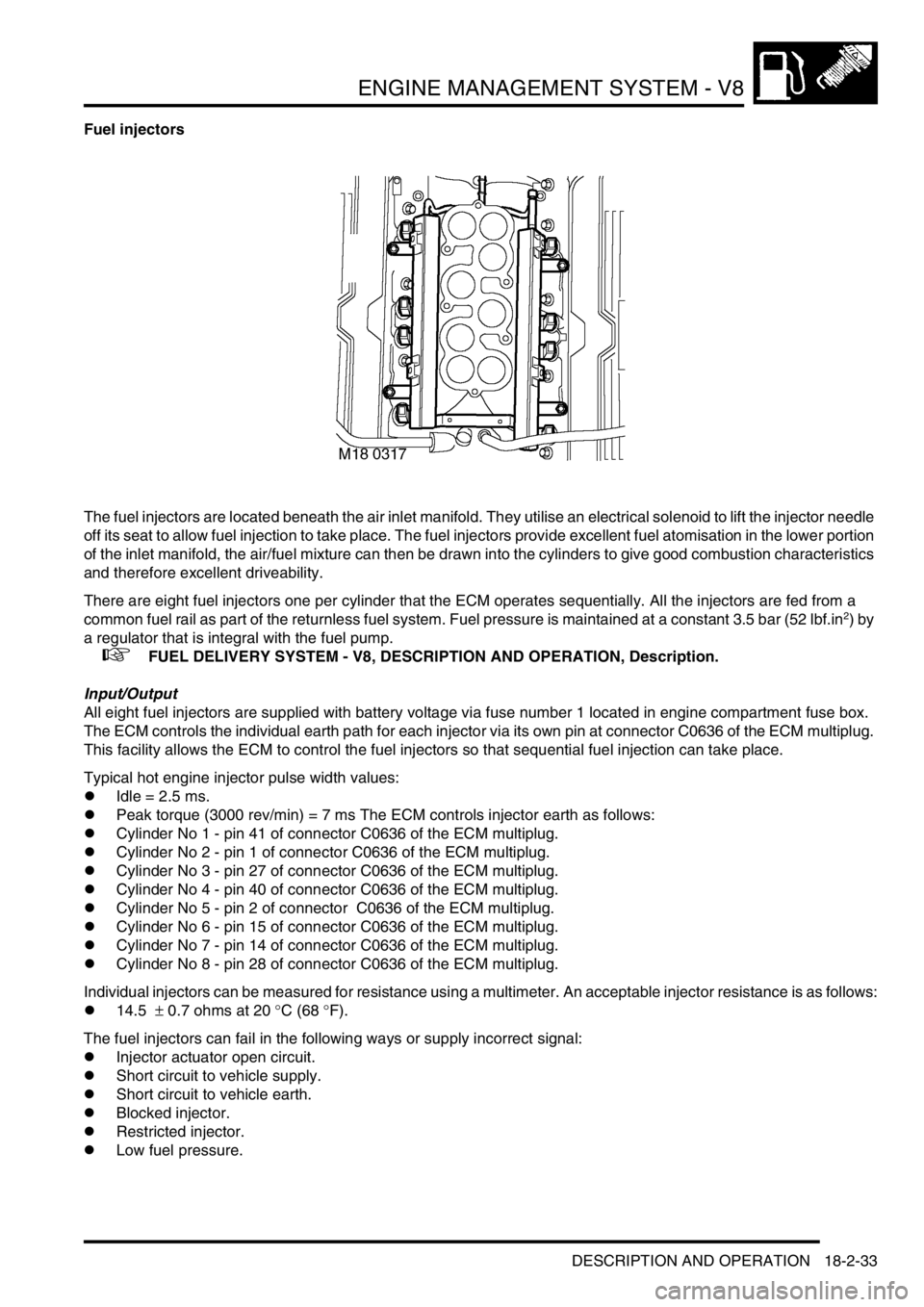
Fuel injectors
The fuel injectors are located beneath the air inlet manifold. They utilise an electrical solenoid to lift the injector needle
off its seat to allow fuel injection to take place. The fuel injectors provide excellent fuel atomisation in the lower portion
of the inlet manifold, the air/fuel mixture can then be drawn into the cylinders to give good combustion characteristics
and therefore excellent driveability.
There are eight fuel injectors one per cylinder that the ECM operates sequentially. All the injectors are fed from a
common fuel rail as part of the returnless fuel system. Fuel pressure is maintained at a constant 3.5 bar (52 lbf.in
2) by
a regulator that is integral with the fuel pump.
+ FUEL DELIVERY SYSTEM - V8, DESCRIPTION AND OPERATION, Description.
Input/Output
All eight fuel injectors are supplied with battery voltage via fuse number 1 located in engine compartment fuse box.
The ECM controls the individual earth path for each injector via its own pin at connector C0636 of the ECM multiplug.
This facility allows the ECM to control the fuel injectors so that sequential fuel injection can take place.
Typical hot engine injector pulse width values:
lIdle = 2.5 ms.
lPeak torque (3000 rev/min) = 7 ms The ECM controls injector earth as follows:
lCylinder No 1 - pin 41 of connector C0636 of the ECM multiplug.
lCylinder No 2 - pin 1 of connector C0636 of the ECM multiplug.
lCylinder No 3 - pin 27 of connector C0636 of the ECM multiplug.
lCylinder No 4 - pin 40 of connector C0636 of the ECM multiplug.
lCylinder No 5 - pin 2 of connector C0636 of the ECM multiplug.
lCylinder No 6 - pin 15 of connector C0636 of the ECM multiplug.
lCylinder No 7 - pin 14 of connector C0636 of the ECM multiplug.
lCylinder No 8 - pin 28 of connector C0636 of the ECM multiplug.
Individual injectors can be measured for resistance using a multimeter. An acceptable injector resistance is as follows:
l14.5 ± 0.7 ohms at 20 °C (68 °F).
The fuel injectors can fail in the following ways or supply incorrect signal:
lInjector actuator open circuit.
lShort circuit to vehicle supply.
lShort circuit to vehicle earth.
lBlocked injector.
lRestricted injector.
lLow fuel pressure.
Page 337 of 1529

ENGINE MANAGEMENT SYSTEM - V8
18-2-38 DESCRIPTION AND OPERATION
Fuel pump relay
The fuel pump relay is located in the engine compartment fuse box. It is a 4 pin normally open relay. Input from the
ECM allows the fuel pump relay to control the electrical input to the fuel pump, regulating the fuel supply to the fuel
injectors. When the ignition is switched on and the engine is cranked, the fuel pump relay is activated by the ECM,
allowing the fuel system to be pressurised to 3.5 bar (52 lbf.in
2). The ECM then deactivates the relay until the engine
has started.
If the fuel pump runs, but the fuel pressure is out of limits, adaptive fuel faults will be stored.
Input/Output
The input value for the relay windings is battery voltage, the input value for the switching contacts comes from fuse
10 in the engine compartment fuse box. The output control of the switching contacts is direct to the fuel pump motor,
and the relay windings are controlled by pin number 18 of connector C0635 of the ECM.
At ignition 'on' (position II) the fuel pump relay contacts remain open until the ECM supplies an earth path for the relay
windings via pin number 18 of connector C0635 of the ECM. At this point, the relay windings are energised, drawing
the relay contacts closed. This allows voltage from fuse 10 in the passenger compartment fuse box to pass directly
to the fuel pump.
The fuel pump relay can fail the following ways or supply incorrect signal:
lRelay drive open circuit.
lShort circuit to vehicle earth.
lShort circuit to vehicle supply.
lComponent failure.
In the event of a fuel pump relay failure any of the following symptoms may be observed:
lEngine stalls or will not start.
lNo fuel pressure at the fuel injectors.
The ECM performs three types of diagnostic test to confirm the fuel pump relay integrity:
lOutput short circuit to earth
lOutput short circuit to battery voltage
lOutput open circuit
Page 338 of 1529

ENGINE MANAGEMENT SYSTEM - V8
DESCRIPTION AND OPERATION 18-2-39
Should a malfunction of the component occur the following fault codes may be evident and can be retrieved by
TestBook.
Evaporative emissions
Refer to Emissions section for description of the evaporative emissions system components.
+ EMISSION CONTROL - V8, DESCRIPTION AND OPERATION, Evaporative Emission Control System.
Secondary air injection (NAS only)
Refer to Emissions section for description of the secondary air injection system components.
+ EMISSION CONTROL - V8, DESCRIPTION AND OPERATION, Secondary Air Injection System.
Fuel tank pressure sensor (NAS only)
Refer to Fuel Delivery section for description of the fuel system components.
+ FUEL DELIVERY SYSTEM - V8, DESCRIPTION AND OPERATION, Description.
Refer to Emissions section for description of the fuel tank pressure sensor.
+ EMISSION CONTROL - V8, DESCRIPTION AND OPERATION, Evaporative Emission Control System.
P Code J2012 Description Land Rover Description
P1230 Fuel pump relay malfunction Fuel pump relay open circuit - not the fuel pump
P1231 Fuel pump relay circuit low Fuel pump relay short circuit to battery supply - not the
fuel pump
P1232 Fuel pump relay circuit high Fuel pump relay short circuit to earth - not the fuel pump
Page 351 of 1529

ENGINE MANAGEMENT SYSTEM - V8
18-2-52 DESCRIPTION AND OPERATION
Evaporative emission control
Due to increasing legislation, all new vehicles must be able to limit evaporative emissions (fuel vapour) from the fuel
tank.
The ECM controls the emission control system using the following components:
lEVAP canister.
lPurge valve.
lCanister vent solenoid (CVS) valve – (NAS vehicles with vacuum type EVAP system leak detection capability
only)
lFuel tank pressure sensor – (NAS vehicles with vacuum type EVAP system leak detection capability only)
lFuel leak detection pump – (NAS vehicles with positive pressure type EVAP system leak detection capability
only)
lInterconnecting pipe work.
Refer to Emissions section for operating conditions of evaporative emission systems.
+ EMISSION CONTROL - V8, DESCRIPTION AND OPERATION, Evaporative Emission Control
Operation.
On-Board Diagnostics (OBD) - North American Specification vehicles only
The ECM monitors performance of the engine for misfires, catalyst efficiency, exhaust leaks and evaporative control
loss. If a fault occurs, the ECM stores the relevant fault code and warns the driver of component failure by illuminating
the Malfunction Indicator Light in the instrument pack.
On vehicles fitted with automatic gearbox, the ECM combines with the Electronic Automatic Transmission (EAT) ECU
to provide the OBD strategy.
Conditions
If the OBD function of the ECM flags a fault during its operation, it falls into one of the following categories:
lmin = minimum value of the signal exceeded.
lmax = maximum value of the signal exceeded.
lsignal = signal not present.
lplaus = an implausible condition has been diagnosed.
Function
All of the ECM's internal diagnostic fault paths are monitored by the OBD system. Specific faults have their own
numeric code relating to certain sensors or actuators etc. These specific faults fall into two types, error codes (E xxx)
or cycle codes (Z xxx). E codes represent instantaneous faults and Z codes relate to codes generated after completion
of a drive cycle.
If an emission relevant fault occurs on a drive cycle, the ECM stores a temporary fault code, if the fault does not occur
on subsequent drive cycles the fault code stays as a temporary fault code. If the fault recurs on subsequent drive
cycles the ECM stores the fault code as a permanent code, and depending on which component has failed the ECM
will illuminate the MIL.
Immobilisation system
The ECM and the body control unit (BCU) security system comprise the immobilisation system.
The ECM and the BCU combine to prevent the engine from running unless the appropriate security criteria are met.
The ECM and the BCU are a matched pair, if either one is replaced for any reason, the system will not operate unless
the replaced unit is correctly matched to its original specification. TestBook must be used to reconfigure the
immobilisation system.
Conditions
The ECM operates immobilisation in three states:
l'New'.
l'Secure'.
l'No Code'.