1999 LAND ROVER DISCOVERY Gear ratio
[x] Cancel search: Gear ratioPage 1489 of 1529

INSTRUMENTS
88-6 DESCRIPTION AND OPERATION
The third warning lamp pack is located in the top right-hand side of the instrument pack and contains the following
warning lamps:
lSRS warning lamp.
lSLS off road mode warning lamp.
lTrailer warning lamp.
lGlow plug warning lamp.
lWater in fuel filter warning lamp.
lSeat belt warning lamp.
lTransmission high temperature warning lamp.
The fourth warning lamp pack is located underneath the tachometer of the instrument pack contains the following
warning lamps:
lOil pressure warning lamp.
lAlternator charge warning lamp.
lHDC fault warning lamp.
lSelf Levelling Suspension (SLS) warning lamp.
lActive Cornering Enhancement (ACE) warning lamp.
lGearbox manual/sport mode warning lamps.
The serial communication link is used to allow information to travel to and from the instrument pack, and it provides
the ability to configure the instrument pack to a specific market. It also allows the instrument pack to be controlled by
TestBook for diagnostics.
There are five market specific variants of the instrument pack:
lUnited Kingdom (UK).
lNorth American Specification (NAS).
lCanada.
lAustralia.
lRest Of the World (ROW), Gulf and Japan.
The main difference between the five markets is that the speedometer will indicate road speed in mph as major figures
and km/h as minor figures, km/h as major figures and mph as minor figures or km/h only.
When TestBook is used to diagnose the instrument pack it demands each of the dials and warning lamps to operate
in-turn so a visual check of their operation can be made.
CAUTION: The instrument pack must not be stored on its face side at any time. This is because the dials have
damping fluid within them to ensure smooth operation of the dials' indicator needles. This fluid will leak out.
Speedometer
The speedometer informs the driver of the current vehicle road speed. It has a Liquid Crystal Display (LCD) to show
odometer, trip meter and, on automatic gearbox models, the selected gear. The speedometer will not show speeds
of less than 1.5 mph (2.5 km/h).
There are three different market configurations:
lNAS and UK = mph as major figures km/h as minor figures.
lCanada = km/h as major figures mph as minor figures.
lROW and Australia = km/h only.
The Self Levelling and Anti-Lock Brake System (SLABS) ECU provides the signal input for the road speed. The signal
is at 8000 pulses per mile (1.6 kilometres).
Page 1490 of 1529
INSTRUMENTS
DESCRIPTION AND OPERATION 88-7
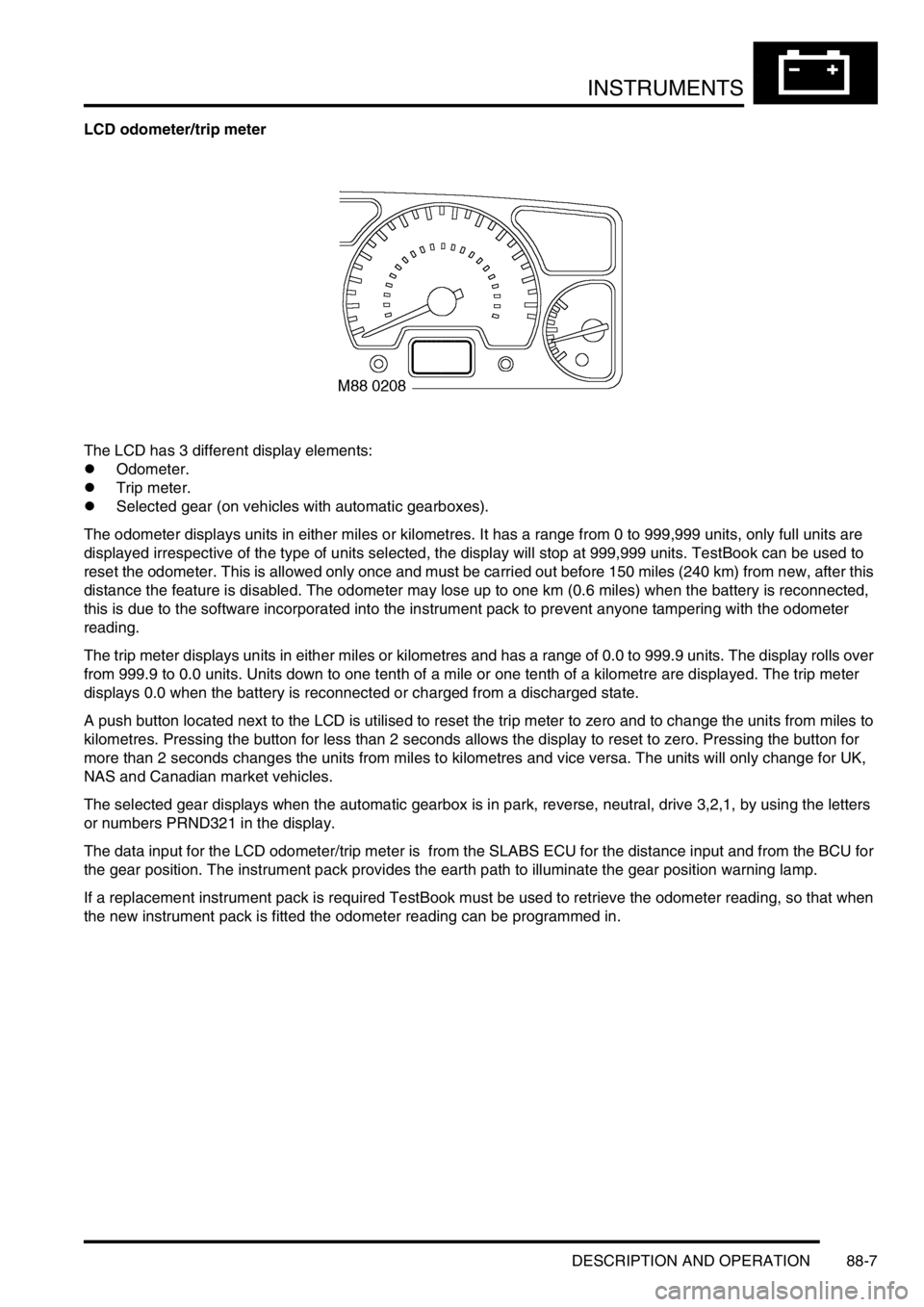
LCD odometer/trip meter
The LCD has 3 different display elements:
lOdometer.
lTrip meter.
lSelected gear (on vehicles with automatic gearboxes).
The odometer displays units in either miles or kilometres. It has a range from 0 to 999,999 units, only full units are
displayed irrespective of the type of units selected, the display will stop at 999,999 units. TestBook can be used to
reset the odometer. This is allowed only once and must be carried out before 150 miles (240 km) from new, after this
distance the feature is disabled. The odometer may lose up to one km (0.6 miles) when the battery is reconnected,
this is due to the software incorporated into the instrument pack to prevent anyone tampering with the odometer
reading.
The trip meter displays units in either miles or kilometres and has a range of 0.0 to 999.9 units. The display rolls over
from 999.9 to 0.0 units. Units down to one tenth of a mile or one tenth of a kilometre are displayed. The trip meter
displays 0.0 when the battery is reconnected or charged from a discharged state.
A push button located next to the LCD is utilised to reset the trip meter to zero and to change the units from miles to
kilometres. Pressing the button for less than 2 seconds allows the display to reset to zero. Pressing the button for
more than 2 seconds changes the units from miles to kilometres and vice versa. The units will only change for UK,
NAS and Canadian market vehicles.
The selected gear displays when the automatic gearbox is in park, reverse, neutral, drive 3,2,1, by using the letters
or numbers PRND321 in the display.
The data input for the LCD odometer/trip meter is from the SLABS ECU for the distance input and from the BCU for
the gear position. The instrument pack provides the earth path to illuminate the gear position warning lamp.
If a replacement instrument pack is required TestBook must be used to retrieve the odometer reading, so that when
the new instrument pack is fitted the odometer reading can be programmed in.
Page 1495 of 1529
INSTRUMENTS
88-12 DESCRIPTION AND OPERATION
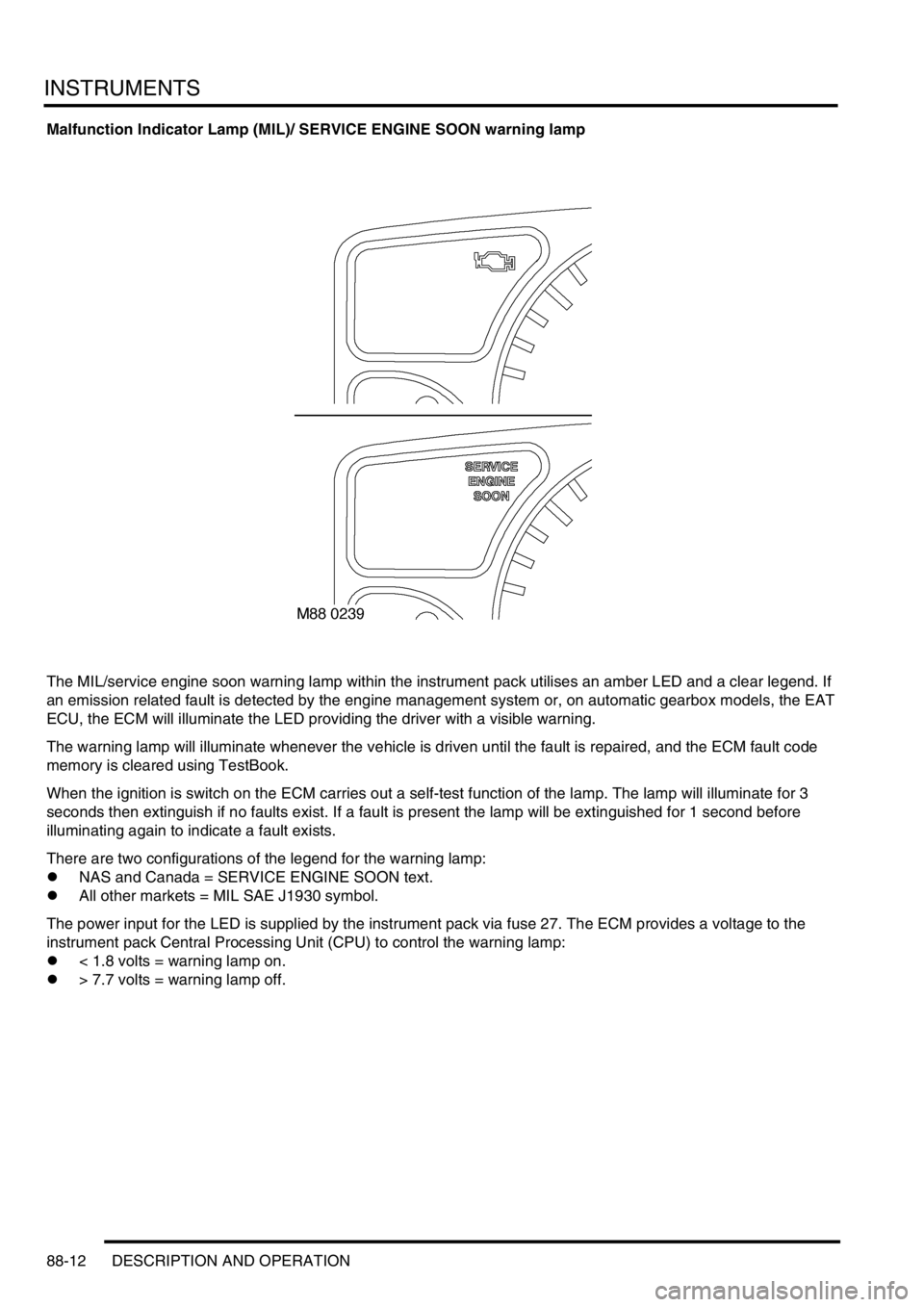
Malfunction Indicator Lamp (MIL)/ SERVICE ENGINE SOON warning lamp
The MIL/service engine soon warning lamp within the instrument pack utilises an amber LED and a clear legend. If
an emission related fault is detected by the engine management system or, on automatic gearbox models, the EAT
ECU, the ECM will illuminate the LED providing the driver with a visible warning.
The warning lamp will illuminate whenever the vehicle is driven until the fault is repaired, and the ECM fault code
memory is cleared using TestBook.
When the ignition is switch on the ECM carries out a self-test function of the lamp. The lamp will illuminate for 3
seconds then extinguish if no faults exist. If a fault is present the lamp will be extinguished for 1 second before
illuminating again to indicate a fault exists.
There are two configurations of the legend for the warning lamp:
lNAS and Canada = SERVICE ENGINE SOON text.
lAll other markets = MIL SAE J1930 symbol.
The power input for the LED is supplied by the instrument pack via fuse 27. The ECM provides a voltage to the
instrument pack Central Processing Unit (CPU) to control the warning lamp:
l< 1.8 volts = warning lamp on.
l> 7.7 volts = warning lamp off.
Page 1515 of 1529
INSTRUMENTS
88-32 DESCRIPTION AND OPERATION
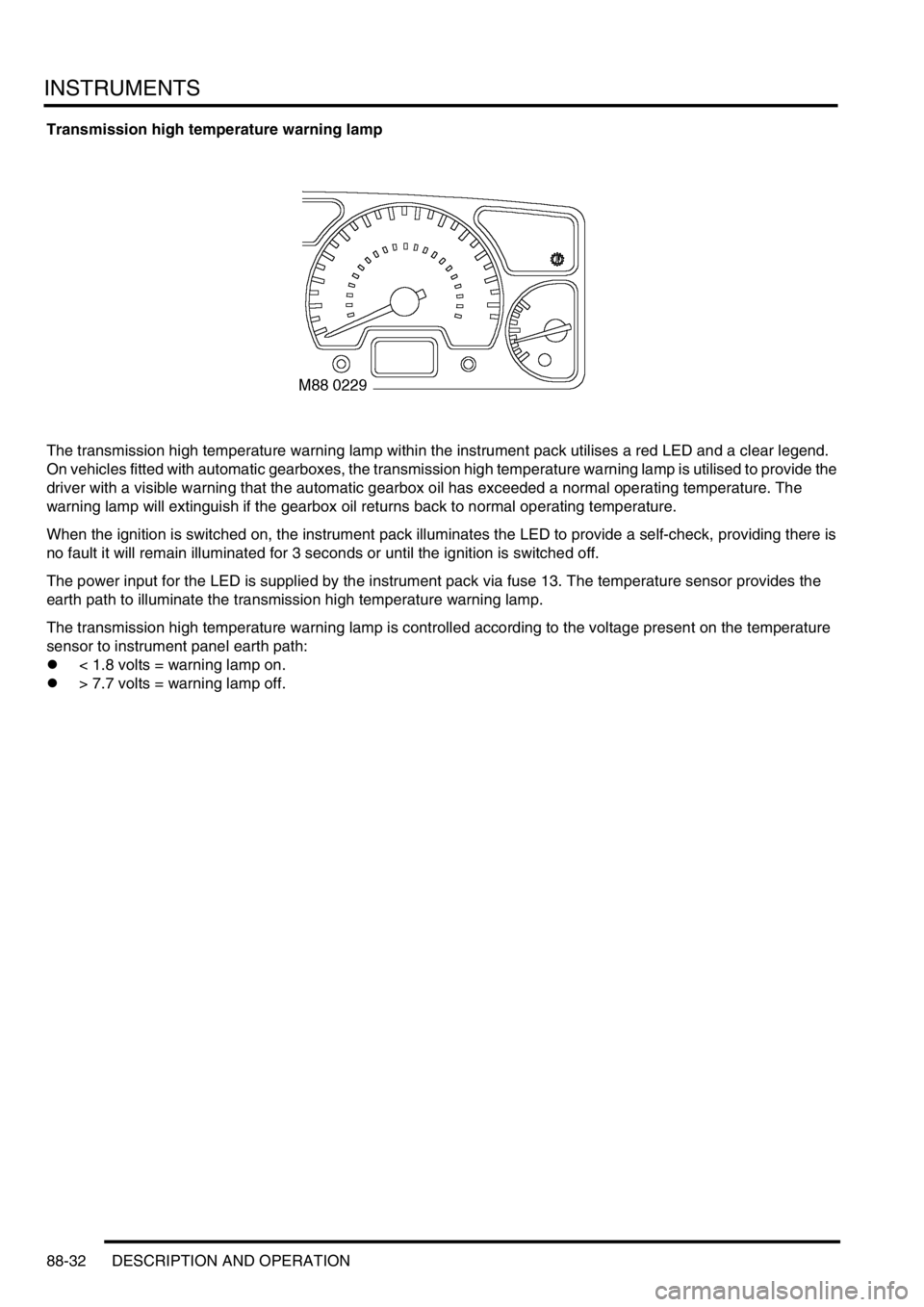
Transmission high temperature warning lamp
The transmission high temperature warning lamp within the instrument pack utilises a red LED and a clear legend.
On vehicles fitted with automatic gearboxes, the transmission high temperature warning lamp is utilised to provide the
driver with a visible warning that the automatic gearbox oil has exceeded a normal operating temperature. The
warning lamp will extinguish if the gearbox oil returns back to normal operating temperature.
When the ignition is switched on, the instrument pack illuminates the LED to provide a self-check, providing there is
no fault it will remain illuminated for 3 seconds or until the ignition is switched off.
The power input for the LED is supplied by the instrument pack via fuse 13. The temperature sensor provides the
earth path to illuminate the transmission high temperature warning lamp.
The transmission high temperature warning lamp is controlled according to the voltage present on the temperature
sensor to instrument panel earth path:
l< 1.8 volts = warning lamp on.
l> 7.7 volts = warning lamp off.
Page 1521 of 1529
INSTRUMENTS
88-38 DESCRIPTION AND OPERATION
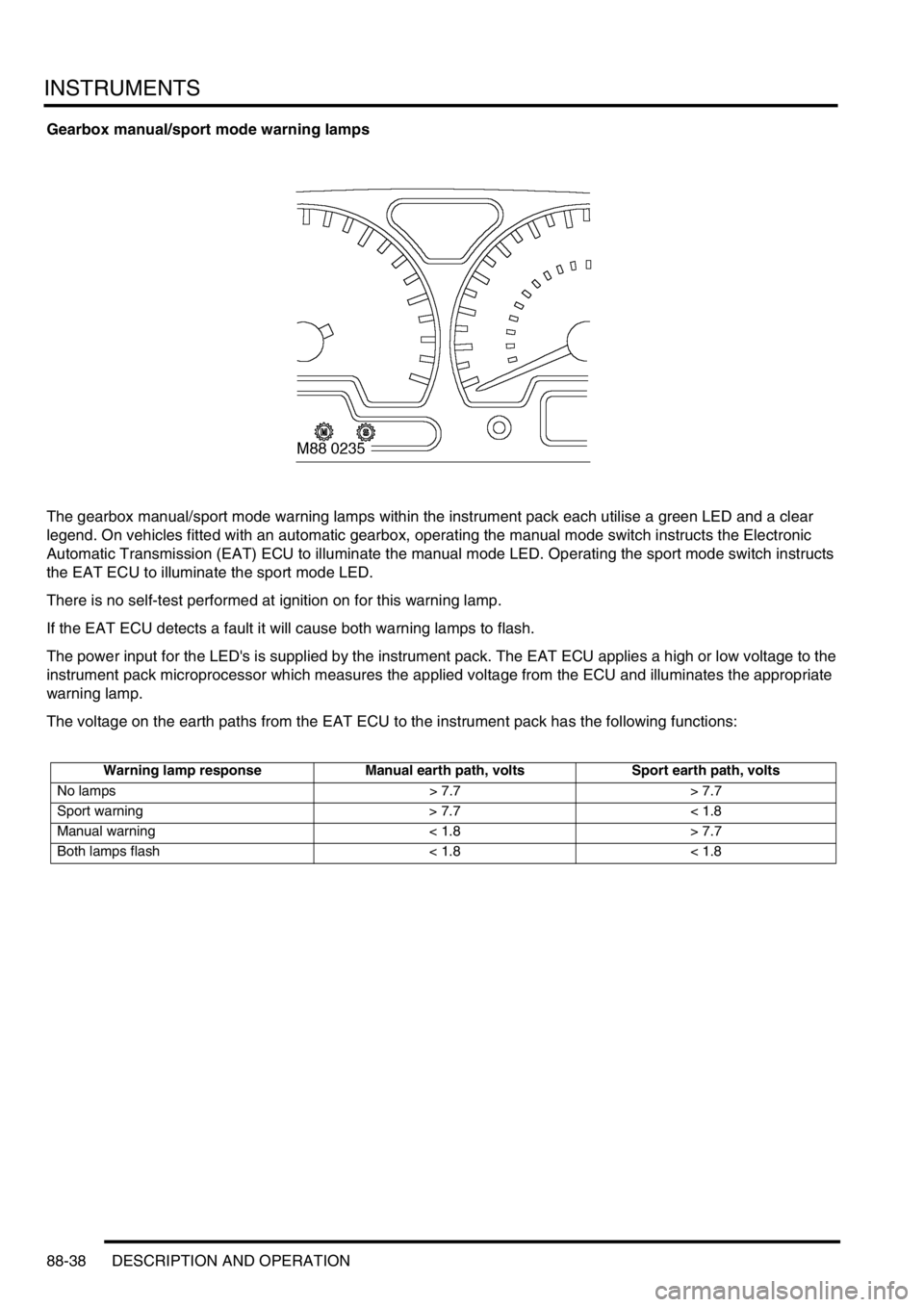
Gearbox manual/sport mode warning lamps
The gearbox manual/sport mode warning lamps within the instrument pack each utilise a green LED and a clear
legend. On vehicles fitted with an automatic gearbox, operating the manual mode switch instructs the Electronic
Automatic Transmission (EAT) ECU to illuminate the manual mode LED. Operating the sport mode switch instructs
the EAT ECU to illuminate the sport mode LED.
There is no self-test performed at ignition on for this warning lamp.
If the EAT ECU detects a fault it will cause both warning lamps to flash.
The power input for the LED's is supplied by the instrument pack. The EAT ECU applies a high or low voltage to the
instrument pack microprocessor which measures the applied voltage from the ECU and illuminates the appropriate
warning lamp.
The voltage on the earth paths from the EAT ECU to the instrument pack has the following functions:
Warning lamp response Manual earth path, volts Sport earth path, volts
No lamps > 7.7 > 7.7
Sport warning > 7.7 < 1.8
Manual warning < 1.8 > 7.7
Both lamps flash < 1.8 < 1.8
Page 1524 of 1529
INSTRUMENTS
DESCRIPTION AND OPERATION 88-41
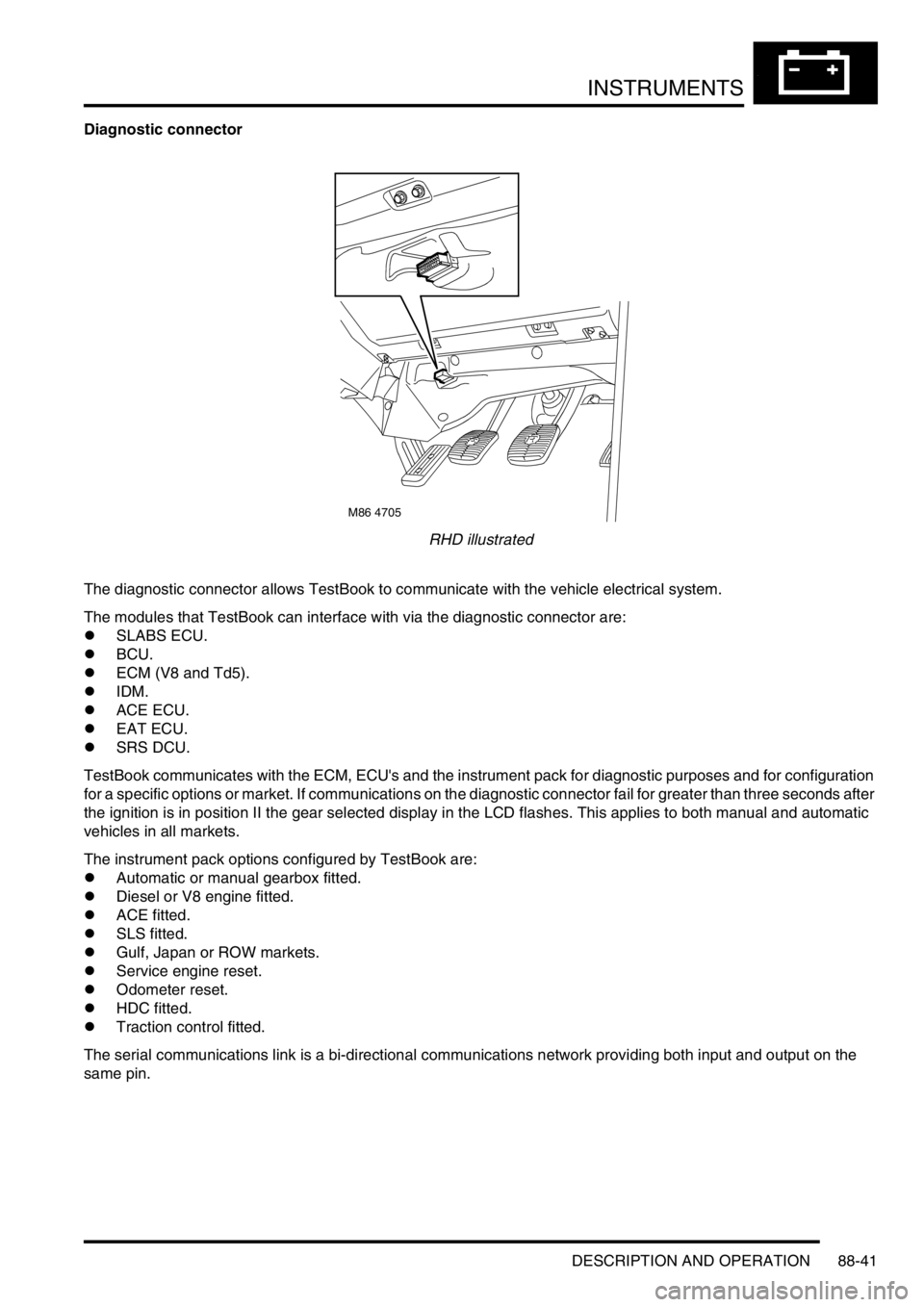
Diagnostic connector
RHD illustrated
The diagnostic connector allows TestBook to communicate with the vehicle electrical system.
The modules that TestBook can interface with via the diagnostic connector are:
lSLABS ECU.
lBCU.
lECM (V8 and Td5).
lIDM.
lACE ECU.
lEAT ECU.
lSRS DCU.
TestBook communicates with the ECM, ECU's and the instrument pack for diagnostic purposes and for configuration
for a specific options or market. If communications on the diagnostic connector fail for greater than three seconds after
the ignition is in position II the gear selected display in the LCD flashes. This applies to both manual and automatic
vehicles in all markets.
The instrument pack options configured by TestBook are:
lAutomatic or manual gearbox fitted.
lDiesel or V8 engine fitted.
lACE fitted.
lSLS fitted.
lGulf, Japan or ROW markets.
lService engine reset.
lOdometer reset.
lHDC fitted.
lTraction control fitted.
The serial communications link is a bi-directional communications network providing both input and output on the
same pin.
M86 4705
Page 1526 of 1529

INSTRUMENTS
DESCRIPTION AND OPERATION 88-43
Compass
The mirror's compass display is activated when the ignition switch is turned to position 'II'. If the compass has been
previously calibrated, the current direction of the vehicle will be shown in the LED display at the upper RH side of the
mirror's reflective surface. The display is able to indicate one of eight compass points (i.e. N, NE, E, SE, S, SW, W or
NW).
The compass mirror circuit board contains a microchip which is able to determine changes in vehicle direction due to
the changes in the earth's magnetic field. The circuit board is located in the stem of the mirror so that it follows the
changes in the vehicles direction and is not affected by adjustment of the mirror itself.
Because of changes in the lines of magnetic influence, the compass is set for operation in one of fifteen different zones
depending on the current location of the vehicle. If the vehicle is to be driven in a different zone, the compass will have
to be reset for operation in that zone. To determine the correct zone for a particular location on the planet, refer
to the maps provided in the Owner's Handbook. The mirror's default setting is zone 8 which is suitable for central
European countries (Germany, Austria, Italy etc.).
The compass should be set to the correct zone using the following procedure:
1Switch the ignition to position 'II'.
aIf the compass displays one of the eight compass point directions, proceed to step '3'.
bIf the compass displays 'C' then proceed to step '2'.
cIf the display does not show either of the above, then the calibration button on the underside of the mirror
should be pressed and held for approximately 6 seconds, using a small probe (e.g. paper clip or ballpoint
pen). The compass should now enter the set mode and 'C' should be shown in the display.
2To calibrate the compass, the vehicle must be driven slowly (5 mph (8 km/h) or less) in a circle until the display
shows a direction (usually 1 or 2 revolutions). The mirror can calibrate itself during normal driving, but this will
take considerably longer.
3Set the compass to the relevant zone of magnetic influence by pressing the calibration button on the underside
of the mirror for approximately 3 seconds, using a small probe, until a number is shown in the display. If the zone
is being entered for the first time, the default zone setting '8' should be displayed. If the zone is being reset from
a previous entry, the previous zone setting number will be displayed.
The calibration button should now be pressed and released with single presses, using a small probe, until the
desired zone number appears in the display.
After approximately 10 seconds, the compass display should return correctly set to the required zone.
Note the degree of magnetic variation from one zone to another is only very slight. Recalibration of the compass is
not normally necessary unless several zone changes are undertaken.
Automatic dimming
The mirror's automatic dimming function operates when the ignition switch is turned to the 'II' position.
A light sensor is contained at the upper centre of the mirror which detects the intensity of light from the headlights of
following vehicles in dark or low light conditions. When the light intensity is sufficiently high, the mirror automatically
adjusts the brightness of the reflected light by photochromatically changing the mirror's reflective properties and so
preventing glare affecting the driver.
When reverse gear is selected, the power supply for the mirror's photochromatic function is opened so that the mirror
defaults to its normal reflective properties while the reversing operation is in progress.
Another light sensor is located on the rear of the mirror so that the unit can detect the difference between strong
ambient light and that attributable to following vehicle headlights. To check operation of the light dimming function of
the mirror, use the following procedure:
1Turn ignition switch to position 'II', and ensure reverse gear is not selected.
2Cover the sensor on the back of the mirror.
3Shine a bright light on the front (reflective side) of the mirror; the mirror should darken.