1999 LAND ROVER DISCOVERY oil
[x] Cancel search: oilPage 261 of 1529

EMISSION CONTROL - V8
17-2-28 DESCRIPTION AND OPERATION
The air delivery pipe is a flexible plastic type, and is connected to the air pump outlet via a plastic quick-fit connector.
The other end of the flexible plastic pipe connects to the fixed metal pipework via a short rubber hose. The part of the
flexible plastic pipe which is most vulnerable to engine generated heat is protected by heat reflective sleeving. The
metal delivery pipe has a fabricated T-piece included where the pressurised air is split for delivery to each exhaust
manifold via the SAI control valves.
The pipes from the T-piece to each of the SAI control valves are approximately the same length, so that the pressure
and mass of the air delivered to each bank will be equal. The ends of the pipes are connected to the inlet port of each
SAI control valve through short rubber hose connections.
The T-piece is mounted at the rear of the engine (by the ignition coils) and features a welded mounting bracket which
is fixed to the engine by two studs and nuts.
The foam filter in the air intake of the SAI pump provides noise reduction and protects the pump from damage due to
particulate contamination. In addition, the pump is fitted on rubber mountings to help prevent noise which is generated
by pump operation from being transmitted through the vehicle body into the passenger compartment.
If the secondary air injection (SAI) pump is found to be malfunctioning, the following fault codes may be stored in the
ECM diagnostic memory, which can be retrieved using Testbook/T4:
NOTE: Refer to 'SAI System Fault Finding' and 'Checking Malfunctions on SAI System' at the end of this section to
determine root cause of fault codes.
NOTE: The electrical test of the SAI pump powerstage only indicates that there is a problem with the relay or the
power supply to the relay. It does not indicate the state of the SAI pump itself (i.e. broken or not connected).
As a result of a SAI pump powerstage malfunction, other fault codes may also become stored in the ECM memory.
These may include the following P codes.
NOTE: A malfunction of the SAI pump powerstage is logically expected to result in both engine banks reporting the
same fault.
NOTE: Refer to 'SAI System Fault Finding' and 'Checking Malfunctions on SAI System' at the end of this section to
determine root cause of fault codes.
Secondary Air Injection (SAI) Pump Relay
The secondary air injection pump relay is located in the engine compartment fusebox. The engine control module
(ECM) is used to control the operation of the SAI pump via the SAI pump relay. Power to the coil of the relay is supplied
from the vehicle battery via the main relay and the ground connection to the coil is via the ECM.
Power to the SAI pump relay contacts is via fusible link FL2 which is located in the engine compartment fusebox.
P-code Description
P0418Secondary Air Injection System – Relay 'A' circuit malfunction (SAI pump
powerstage fault, e.g. - SAI pump relay fault or relay not connected / open circuit /
harness damage).
P-code Description
P1412Secondary Air Injection System – Malfunction Bank 1 LH (Insufficient SAI flow
during passive test)
P1414Secondary Air Injection System – Low air flow Bank 1 LH (Insufficient SAI flow
during active test)
P1415Secondary Air Injection System – Malfunction Bank 2 RH (Insufficient SAI flow
during passive test)
P1417Secondary Air Injection System – Low air flow Bank 2 RH (Insufficient SAI flow
during active test)
Page 267 of 1529

EMISSION CONTROL - V8
17-2-34 DESCRIPTION AND OPERATION
Crankcase Emission Control Operation
Oil laden noxious gas in the engine crankcase is drawn through a spiral oil separator located in the stub pipe to the
ventilation hose on the right hand cylinder head rocker cover, where oil is separated and returned to the cylinder head.
The rubber ventilation hose from the right hand rocker cover is routed to a port on the right hand side of the inlet
manifold plenum chamber, where the returned gases mix with the fresh inlet air passing through the throttle butterfly
valve. The stub pipe on the left hand rocker cover does not contain an oil separator, and the ventilation hose is routed
to the throttle body housing at the air inlet side of the butterfly valve. The mass of fresh air which is drawn in from the
atmospheric side of the throttle butterfly to mix with the returned crankcase gas depends on the throttle position and
the engine speed.
1Hose – RH rocker cover to inlet manifold
2Inlet manifold
3Throttle body
4Air intake
5Hose – LH rocker cover to inlet manifold
6LH rocker cover breather tube
(without oil separator)7LH rocker cover baffle
8RH rocker cover baffle
9RH rocker cover breather tube
10Oil separator (integral with breather tube)
When the engine is running in cruise conditions or at idle, manifold pressure is low and the majority of gases are drawn
into the inlet manifold through the oil / vapour separator in the RH rocker cover stub pipe. At the same time, filtered
air is drawn from the throttle body into the engine via the LH rocker cover.
During periods of driving at Wide Open Throttle (WOT), pressure at either side of the throttle disc equalizes (manifold
depression collapses). The larger ventilation opening at the throttle housing positioned in the fast moving stream of
intake air, now offers more 'pull' than the small opening in the RH rocker cover and the flow of ventilation reverses,
drawing gases from the LH rocker cover into the throttle body for subsequent burning in the combustion chambers.
Page 276 of 1529

EMISSION CONTROL - V8
DESCRIPTION AND OPERATION 17-2-43
Secondary Air Injection System
Operation
When the engine is started, the engine control module checks the engine coolant temperature and if it is below 55°
C, the ECM grounds the electrical connection to the coil of the secondary air injection (SAI) pump relay.
A 12V battery supply is fed to the inertia switch via fuse 13 in the engine compartment fusebox. When the inertia
switch contacts are closed, the feed passes through the switch and is connected to the coil of the Main relay. An earth
connection from the Main relay coil is connected to the ECM. When the ECM completes the earth path, the coil
energises and closes the contacts of the Main relay.
The Main and Secondary Air Injection (SAI) pump relays are located in the engine compartment fusebox. When the
contacts of the Main relay are closed, a 12V battery supply is fed to the coil of the SAI pump relay. An earth connection
from the coil of the SAI pump relay is connected to the ECM. When the ECM completes the earth path, the coil
energises and closes the contacts of the SAI pump relay to supply 12V to the SAI pump via fusible link 2 in the engine
compartment fusebox. The SAI pump starts to operate, and will continue to do so until the ECM switches off the earth
connection to the coil of the SAI pump relay.
The SAI pump remains operational for a period determined by the ECM and depends on the starting temperature of
the engine, or for a maximum operation period determined by the ECM if the target engine coolant temperature has
not been reached in the usual time.
When the contacts of the main relay are closed, a 12V battery supply is fed to the SAI solenoid valve via Fuse 2 in
the engine compartment fusebox.
The ECM grounds the electrical connection to the SAI vacuum solenoid valve at the same time as it switches on the
SAI pump motor. When the SAI vacuum solenoid valve is energised, a vacuum is provided to the operation control
ports on both of the vacuum operated SAI control valves at the exhaust manifolds. The control vacuum is sourced
from the intake manifold depression and routed to the SAI control valves via a vacuum reservoir and the SAI vacuum
solenoid valve.
The vacuum reservoir is included in the vacuum supply circuit to prevent vacuum fluctuations caused by changes in
the intake manifold depression affecting the operation of the SAI control valves.
When a vacuum is applied to the control ports of the SAI control valves, the valves open to allow pressurised air from
the SAI pump to pass through to the exhaust ports in the cylinder heads for combustion.
When the ECM has determined that the SAI pump has operated for the desired duration, it switches off the earth paths
to the SAI pump relay and the SAI vacuum solenoid valve. With the SAI vacuum solenoid valve de-energised, the
valve closes, cutting off the vacuum supply to the SAI control valves. The SAI control valves close immediately and
completely to prevent any further pressurised air from the SAI pump entering the exhaust manifolds.
The engine coolant temperature sensor incurs a time lag in respect of detecting a change in temperature and the SAI
pump automatically enters a 'soak period' between operations to prevent the SAI pump overheating. The ECM also
compares the switch off and start up temperatures, to determine whether it is necessary to operate the SAI pump.
This prevents the pump running repeatedly and overheating on repeat starts.
Other factors which may prevent or stop SAI pump operation include the prevailing engine speed / load conditions.
Page 293 of 1529

EMISSION CONTROL - V8
17-2-60 REPAIRS
Air Manifold - LH - Secondary Air
Injection (SAI)
$% 17.25.17
Remove
1.Remove SAI control valve.
+ EMISSION CONTROL - V8,
REPAIRS, Control Valve - Secondary Air
Injection (SAI).
2.Disconnect 2 air manifold unions from adapters
in cylinder head.
CAUTION: Take care that air manifold pipes
are not damaged during removal of union
nuts.
3.Remove 2 nuts securing air manifold bracket to
inlet manifold.
4.Remove air manifold.Refit
1.Clean air manifold and cylinder head adapters.
2.Apply a small amount of engine oil to top of air
manifold union nuts and around air manifold
pipes.
3.Position air manifold and finger tighten both
union nuts.
CAUTION: Finger tighten union nuts as far
as possible, damage to air manifold pipes or
adapters may result if this is not done.
4.Tighten air manifold unions to 25 Nm (18 lbf.ft).
CAUTION: Ensure that air manifold pipes
are not distorted during tightening
operation.
5.Fit nuts securing air manifold to inlet manifold
and tighten to 25 Nm (18 lbf.ft).
6.Fit SAI control valve.
+ EMISSION CONTROL - V8,
REPAIRS, Control Valve - Secondary Air
Injection (SAI).
M17 0234
4
3
2
2
Page 294 of 1529
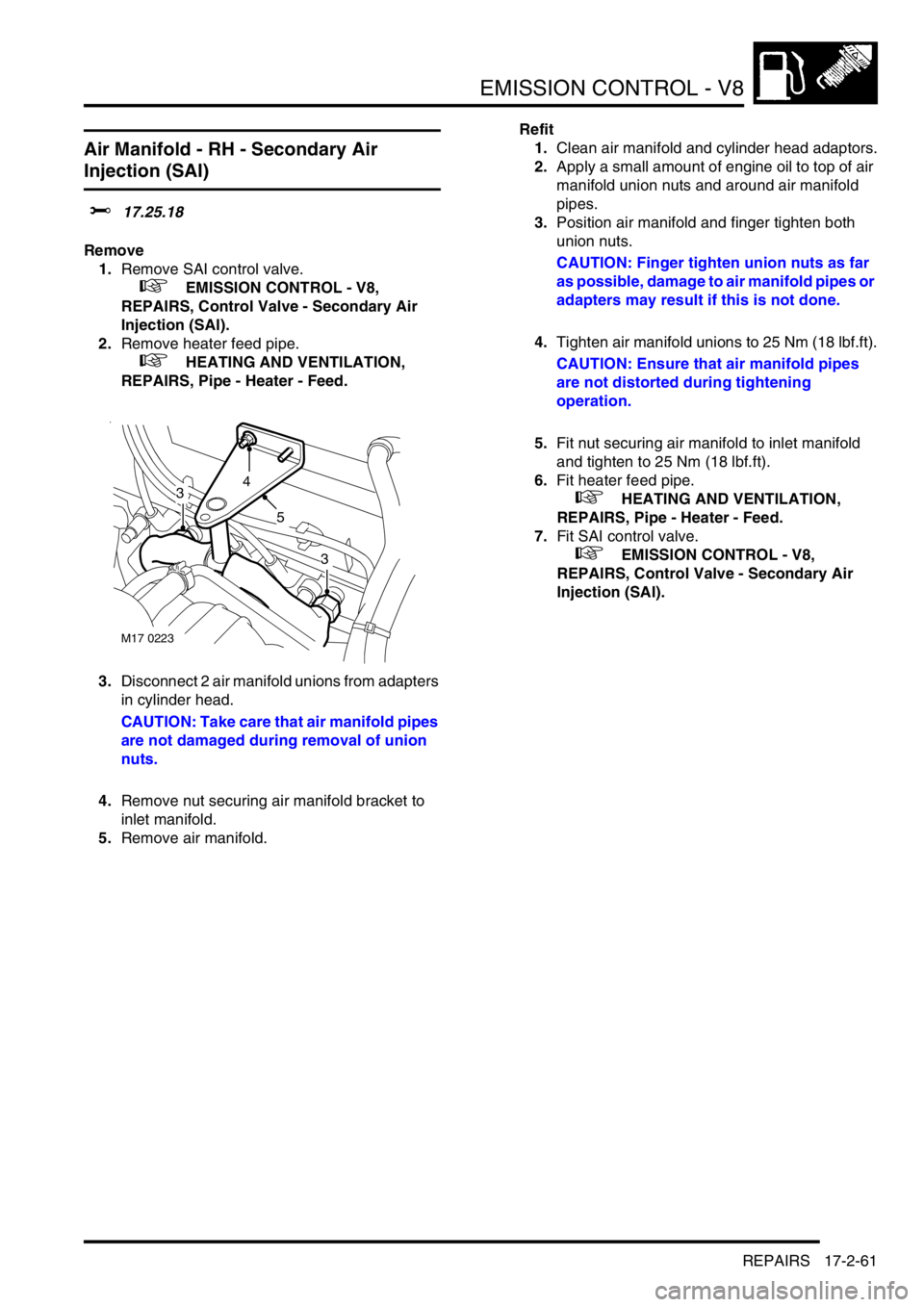
EMISSION CONTROL - V8
REPAIRS 17-2-61
Air Manifold - RH - Secondary Air
Injection (SAI)
$% 17.25.18
Remove
1.Remove SAI control valve.
+ EMISSION CONTROL - V8,
REPAIRS, Control Valve - Secondary Air
Injection (SAI).
2.Remove heater feed pipe.
+ HEATING AND VENTILATION,
REPAIRS, Pipe - Heater - Feed.
3.Disconnect 2 air manifold unions from adapters
in cylinder head.
CAUTION: Take care that air manifold pipes
are not damaged during removal of union
nuts.
4.Remove nut securing air manifold bracket to
inlet manifold.
5.Remove air manifold.Refit
1.Clean air manifold and cylinder head adaptors.
2.Apply a small amount of engine oil to top of air
manifold union nuts and around air manifold
pipes.
3.Position air manifold and finger tighten both
union nuts.
CAUTION: Finger tighten union nuts as far
as possible, damage to air manifold pipes or
adapters may result if this is not done.
4.Tighten air manifold unions to 25 Nm (18 lbf.ft).
CAUTION: Ensure that air manifold pipes
are not distorted during tightening
operation.
5.Fit nut securing air manifold to inlet manifold
and tighten to 25 Nm (18 lbf.ft).
6.Fit heater feed pipe.
+ HEATING AND VENTILATION,
REPAIRS, Pipe - Heater - Feed.
7.Fit SAI control valve.
+ EMISSION CONTROL - V8,
REPAIRS, Control Valve - Secondary Air
Injection (SAI).
M17 0223
43
3
5
Page 302 of 1529

ENGINE MANAGEMENT SYSTEM - V8
DESCRIPTION AND OPERATION 18-2-3
1Mass air flow/ inlet air temperature sensor
2Fuel injectors
3High tension leads/spark plugs
4Fuel pump relay
5ATC compressor clutch relay/ cooling fan relay
6Throttle position sensor
7Heated oxygen sensor
8Idle air control valve
9Ignition coils
10Engine coolant temperature sensor
11Crankshaft speed and position sensor
12Knock sensor
13Camshaft position sensor
Page 304 of 1529

ENGINE MANAGEMENT SYSTEM - V8
DESCRIPTION AND OPERATION 18-2-5
1Engine control module
2Crankshaft speed and position sensor
3Camshaft position sensor
4Engine coolant temperature sensor
5Mass air flow/ inlet air temperature sensor
6Throttle position sensor
7Heated oxygen sensors
8Fuel injectors
9Idle air control valve
10Fuel pump relay
11EVAP canister
12EVAP canister vent valve
13EVAP canister purge valve
14Fuel tank pressure sensor15Ignition coils
16Knock sensor
17Spark plugs
18High/ Low ratio switch
19Malfunction indication lamp
20Diagnostic connector
21Air temperature control clutch relay
22Air temperature control cooling fan relay
23ATC ECU
24CAN link to EAT
25SLABS ECU
26BCU
27Instrument cluster
28Thermostat monitoring sensor (where fitted)
Page 306 of 1529

ENGINE MANAGEMENT SYSTEM - V8
DESCRIPTION AND OPERATION 18-2-7
The ECM controls the following outputs:
lFuel injectors (1 per cylinder).
lIgnition coils/ high tension leads/ spark plugs.
lFuel pump relay.
lIdle air control valve.
lHeated oxygen sensors.
lEVAP canister purge valve.
lEVAP canister vent solenoid (CVS) valve (where fitted).
lMalfunction Indicator Lamp (MIL)/ service engine soon lamp (where fitted).
lHill descent control (via SLABS interface).
lEVAP system fuel leak detection pump (where fitted)
lSecondary air injection pump (where fitted)
The ECM also interfaces with the following:
lDiagnostics via diagnostic connector with TestBook.
lController Area Network (CAN) link to EAT ECU.
lAir conditioning system.
lSelf Levelling & Anti-lock Braking System (SLABS) ECU.
lImmobilisation system via the body control unit (BCU).
lInstrument cluster.
lCruise control ECU
lActive Cornering Enhancement (ACE) ECU