1999 JAGUAR S TYPE fuel
[x] Cancel search: fuelPage 41 of 75

V6 Engine AJ-V6/AJ28
36
Fail Safe Cooling System
A unique feature of the V6 engine is the use of a fail safe cooling strategy, controlled by the EMS, in the
event of coolant loss leading to rising engine temperatures. The principle of the strategy involves
switching off one or more fuel injectors to inhibit combustion and reduce heat, thus allowing the flow of
ambient intake air to further cool the selected cylinders. By cycling the selected cylinders, ie switching
different injectors off for a period and in a sequence determined by EMS parameters, overall engine
temperature can be controlled sufficiently to allow the vehicle to be driven, at reduced power, for a
short distance. Throughout the malfunction period, instrument panel messages and warnings advise the
driver of the current status of the cooling system as described below.
Driver Indication and EMS Action
The fail safe strategy moves though different stages depending on engine temperature:
¥ Temperatures below 122û C (250û F) are within the normal range. At high temperatures below this
level the temperature gauge pointer enters the red zone.
¥ If the temperature rises to between 122û C - 127û C (250û F to 260û F) no action is taken by the EMS
which affects engine running but the following indications appear:
Temperature gauge pointer in red zone
Message Centre HIGH ENGINE TEMPERATURE
Warning light TEMP
Priority light red
Audible indicator single chime sounded
¥ If the temperature rises to 127û C (260û F) or above, the fail safe strategy operates. At 127û C (260û F),
the EMS will cut out one cylinder (the selected cylinder is varied) and as the temperature continues
to rise, this will increase to a maximum of three cylinders cut (with cylinder cycling). The following
indications are given:
Temperature gauge pointer in red zone
Message Centre ENGINE POWER REDUCED
Warning light TEMP
Priority light red
Audible indicator three chimes sounded
¥ At 166û C (300û F) or above, the fail safe strategy continues as described but the following
indications are given:
Temperature gauge pointer in red zone
Message Centre PULL OFF ROAD SAFELY alternates with TURN OFF IGNITION
Warning light TEMP flashes
Priority light red
Audible indicator five chimes sounded
¥ EMS shuts the engine down.
Page 45 of 75

V6 Engine AJ-V6/AJ28
40
Engine Management Sensors
Key to illustration on page 41:
1. Throttle motor
2. TP sensor
3. IAT sensor
4. MAF sensor
5. Top IMT valve
6. Bottom IMT valve
7. EFT sensor
8. IP sensor
9. Fuel injectors
10. Coil-on-plug units
11. VVT shuttle valve
12. CMP sensor
13. CHT sensor
14. KS sensors
15. EOT sensor
16. CKP sensor
17. HO2 sensors
18. HO2 sensors (catalyst monitors)
Cylinder Head Temperature (CHT) Sensor
The single CHT sensor is located between the two
rear coil-on-plug units in the bank 2 cylinder
head. The sensor directly monitors the metal
temperature of the cylinder head. This method of
engine heat sensing is used in place of a
conventional coolant temperature sensor to
enable the fail safe cooling strategy to operate.
The use of a metal temperature sensor allows
cylinder head temperature to be measured even if
coolant has been lost unlike an ECT sensor which
would produce inaccurate temperature
indications, eg measuring steam temperature.
Crankshaft Position (CKP) Sensor
Crankshaft position and rotational speed are
sensed from a steel timing ring keyed to the front
end of the crankshaft immediately behind the
front cover. The timing ring has 36-1 teeth, ie one
missing tooth, which are angled slightly forward
and bent at rightangles to provide a sensing area
for the inductive sensor. The sensor is positioned
in the front cover, to the side of the crankshaft
damper, at approximately 20û to the plane of the
timing ring.
D.303.1342
J.303.1343
CHT SENSOR
CKP SENSOR
D.303-1342
J.303-1343
Engine management sensors and actuators (but
not off engine sensors) are summarised in the
illustration on page 41 and are also described
below or in the relevant section (VVT, fuel system,
throttle, tuned manifold).
The engine management system is described in a
separate section.
Page 48 of 75

V6 EngineAJ-V6/AJ28
43 Intake Air Temperature (IAT) Sensor
The IAT sensor is a conventional thermistor type
device which is a push fit in the intake resonator
duct.
Mass Air Flow (MAF) Sensor
The MAF sensor is an integral assembly consisting
of a hot wire sensor unit and air duct and is non-
serviceable. The assembly is fitted between the air
cleaner and intake resonator tube.
D.303.1381
MAF AND IAT SENSORS
D.303-1381
J.303.1386
HO2 SENSORS
J.303-1386
Heated Oxygen (HO2) Sensors
HO2 sensors are fitted in both the upstream and
downstream positions on the catalytic converters.
Both sensors are standard types with a step
response at the stoichiometric (lambda) air/fuel
value. The upstream sensors provide the feedback
for stoichiometric fuelling control and the
downstream sensors monitor catalyst efficiency
and also provide long term fuelling adaptation
trim.
MAF SensorIAT Sensor
Page 50 of 75

V8 EngineAJ-V6/AJ28
45
Introduction
The AJ28 engine is a variant of the 4.0L 90û V8 units fitted to the XJ and XK range of vehicles. The AJ28
shares some of the changes incorporated in the current AJ27 engine: both engines are derived from the
original AJ26 unit. A number of features are unique to the AJ28 or are shared with the AJ-V6 engine also
described in this publication.
Features of the AJ28 engine are:
¥ Continuously variable inlet valve timing over a 48û
+
-2û crank angle: as fitted to the AJ27 engine
¥ Full authority cable-less electronic throttle control: as fitted to the AJ-V6 engine
¥ Air assisted fuel injection: similar to system used on the AJ27 engine
¥ Unique induction manifold with centrally mounted throttle body
¥ Returnless fuel system: similar to AJ-V6 engine
¥ Twin wall exhaust manifold
¥ Engine management system as used on the AJ-V6
¥ New sensors
¥ Modified sump and oil cooler
¥ Modified front end ancillary drive and components
Engine Specification
Maximum power DIN - 209 kW (281 BHP) at 6100 RPM
EEC - 203 kW (276 PS) at 6100 RPM
Maximum torque DIN - 390 Nm (287 lbft) at 4300 RPM
EEC - 278 Nm (279 lbft) at 4300 RPM
Oil Specification
All markets except the USA and Canada
Engine oil for all markets except the USA and
Canada must be to API specification SJ/ACEA A1
or A3.
The recommended SAE viscosity for different
ranges of ambient temperature are shown in
table 1.
USA/Canada
Engine oil for USA and Canada must be to API
specification SJ/ILSAC GF-2.
The recommended SAE viscosity for different
ranges of ambient temperature are shown in
table 2. For maximum economy and in most
climate conditions, SAE 5W/30 is to be preferred
but SAE 10W/30 or 15W/40 are acceptable in
moderate to hot climates.
JOL.29550
50JOL.296
SAE/TEMPERATURE TABLE 2
SAE/TEMPERATURE TABLE 1
Page 56 of 75
V8 EngineAJ-V6/AJ28
51
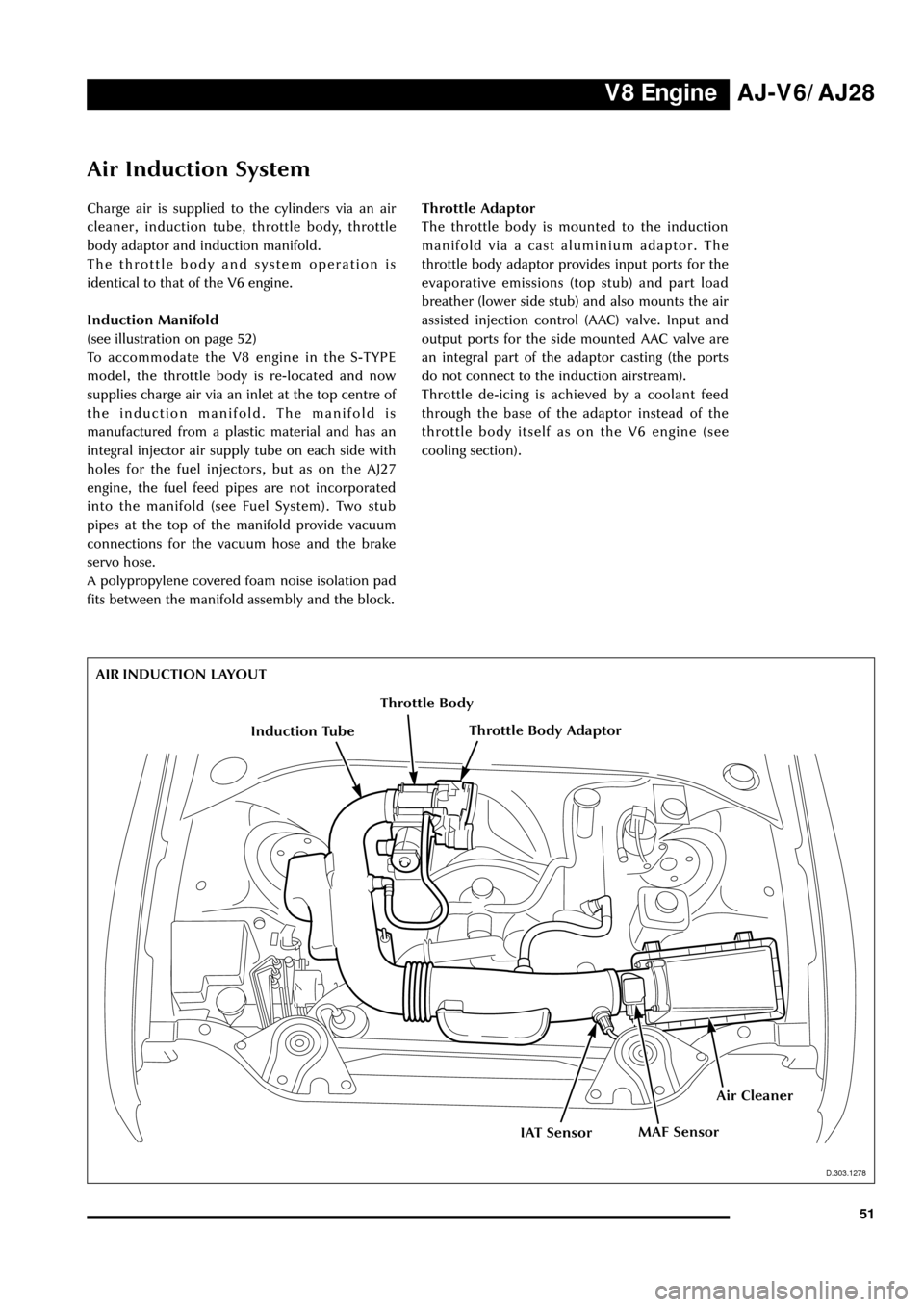
Air Induction System
Charge air is supplied to the cylinders via an air
cleaner, induction tube, throttle body, throttle
body adaptor and induction manifold.
The throttle body and system operation is
identical to that of the V6 engine.
Induction Manifold
(see illustration on page 52)
To accommodate the V8 engine in the S-TYPE
model, the throttle body is re-located and now
supplies charge air via an inlet at the top centre of
the induction manifold. The manifold is
manufactured from a plastic material and has an
integral injector air supply tube on each side with
holes for the fuel injectors, but as on the AJ27
engine, the fuel feed pipes are not incorporated
into the manifold (see Fuel System). Two stub
pipes at the top of the manifold provide vacuum
connections for the vacuum hose and the brake
servo hose.
A polypropylene covered foam noise isolation pad
fits between the manifold assembly and the block.Throttle Adaptor
The throttle body is mounted to the induction
manifold via a cast aluminium adaptor. The
throttle body adaptor provides input ports for the
evaporative emissions (top stub) and part load
breather (lower side stub) and also mounts the air
assisted injection control (AAC) valve. Input and
output ports for the side mounted AAC valve are
an integral part of the adaptor casting (the ports
do not connect to the induction airstream).
Throttle de-icing is achieved by a coolant feed
through the base of the adaptor instead of the
throttle body itself as on the V6 engine (see
cooling section).
D.303.1278
AIR INDUCTION LAYOUT
D.303.1278
Air Cleaner
Induction Tube
MAF SensorIAT Sensor
Throttle Body
Throttle Body Adaptor
Page 59 of 75

V8 Engine AJ-V6/AJ28
54
Engine Management Sensors
The configuration of the AJ28 engine management sensors is changed from the previous V8 variants:
¥ New components unique to AJ28 engine are the MAF sensor and engine fuel temperature (EFT)
sensor.
¥ Components in common with the V6 engine are the IAT sensor, KS sensors, injector pressure (IP)
sensor, engine oil temperature (EOT) sensor and HO2 sensors.
¥ The crankshaft (CKP) and camshaft (CMP) sensors are the same as those fitted to the AJ27 engine.
Heated Oxygen (HO2) Sensors
Upstream and dowmstream HO2 sensors are
fitted and are of the type used on the V6 engine
(the linear type sensor is not used).
J.303.1387
HO2 SENSORS
J.303.1387
J.303.1281
COIL ON PLUG UNIT
J.303.1281
Ignition System
The coil-on-plug ignition modules are specific to
the AJ28 engine and are triggered directly from
the PCM. Double electrode platinum plugs are
fitted.
Page 60 of 75

V8 EngineAJ-V6/AJ28
55
J.303.1389
ENGINE MANAGEMENT SCHEMATIC
13
2
45
6
8
157
9
1110
13
16
J.303-1287
9
10
12
14
Key :
1. MAF sensor
2. IAT sensor
3. TP sensor
4. Throttle motor
5. AAC valve
6. IP sensor8
11
16
1616
7. EFT sensor
8. Fuel injectors
9. CMP sensor
10. Coil-on-plug units
11. VVT shuttle valve
12. ECT sensor13. KS sensors
14. CKP sensor
15. EOT sensor
16. HO2 sensors
Page 61 of 75

V8 Engine AJ-V6/AJ28
56
Fuel Injection
Returnless Fuel System
The function and operation of the returnless fuel
system is the same as that fitted to the V6 engine
but with different fuel pipework to suit the V8
layout. The air assisted, top fed, fuel injectors are
supplied from two separate rails joined by an
interconnecting cross-over pipe (similar to AJ27)
with a single common feed from the fuel tank.
The fuel rail assembly is removeable. An engine
fuel temperature (EFT) sensor and injector
pressure (IP) sensor provide feedback to the PCM
to control the fuel pump flow rate (see ÔS-TYPE
IntroductionÕ Technical Guide). Note that the EFT
sensor is not in direct contact with the fuel (ÔdryÕ
type sonser).
J.303.1390
FUEL RAIL ASSEMBLY
IP Sensor
EFT Sensor
J.303.1390