1999 HONDA ODYSSEY weight
[x] Cancel search: weightPage 217 of 343
Towing a Trailer
Spare Vehicle Tire
When towing a trailer, you should carry a full-size wheel and tire as aspare in case you have a flat. If you
use the compact spare tire that came
with the vehicle, it may adversely affect vehicle handling. See page 317 for information on proper tire
size, and page 293 for information on
how to store a full-size tire. When storing a full-size spare tire in the
trailer, follow the trailer maker's
instructions.
Additional Trailer equipment
Many states and provinces require
special outside mirrors when towing
a trailer. Even if they don't, you should install special mirrors if you
cannot clearly see behind you, or if
the trailer creates a blind spot.
Ask your trailer sales or rental agency if any other items are
recommended or required for your
towing situation. Pre-Tow Checklist
When preparing to tow, and before driving away, be sure to check the
following:
The vehicle has been properlyserviced, and the tires, brakes,
suspension, and cooling system
are in good operating condition.
All weights and loads are within limits (see pages 212 and 213).
The hitch, safety chain, and any other attachments are secure.
All items on and in the trailer are properly secured and cannot shift
while you drive.
The lights and brakes on your vehicle and the trailer are workingproperly. Your vehicle tires and spare are
properly inflated (see page 317),and the trailer tires and spare are
inflated as recommended by the
trailer maker.
You may want to fill the fuel tank with premium fuel. Premium fuelprovides improved performance.
DrivingProCarManuals.comMain Menu Table of Contents s t
Page 218 of 343

Towing a Trailer
Driving Safely With a Trailer
The added weight, length, and height of a trailer will affect your
vehicle's handling and performance, so driving with a trailer requires
some special driving skills and
techniques.
For your safety and the safety of
others, take time to practice driving
maneuvers before heading for the
open road, and follow the guidelines
discussed below.
Towing Speeds and Gears
Driving slower than normal in all driving situations, and obey posted
speed limits for vehicles with trailers.
Use the D 4
position when towing
a trailer on level roads. D 3
is the
proper shift lever position to use when towing a trailer in hilly terrain.
(See "Driving on Hills" in the next
column for additional gear
information.)
Making Turns and Braking
Make turns more slowly and wider
than normal. The trailer tracks a smaller arc than your vehicle, and it
can hit or run over something the
vehicle misses. Allow more time and distance for braking. Do not brake or
turn suddenly as this could cause the
trailer to jackknife or turn over.
Driving on Hills
When climbing hills, closely watch your temperature gauge. If it nearsthe red mark, turn the air
conditioning off, reduce speed and, if
necessary, pull to the side of the
road to let the engine cool. Do notdrive over 45 mph (72 km/h) on a
long uphill stretch.
If the transmission shifts frequently
between 3rd and 4th gears while
going up a hill, shift to D 3
. If you must stop when facing uphill,
use the foot brake or parking brake.
Do not try to hold the vehicle in
place by pressing on the accelerator,
as this can cause the transmission to
overheat.
When driving down hills, reduce your speed and shift down to 2ndgear. Do not "ride" the brakes, and
remember it will take longer to slowdown and stop when towing a trailer.
CONTINUED
DrivingProCarManuals.comMain Menu Table of Contents s t
Page 235 of 343
Engine Oil
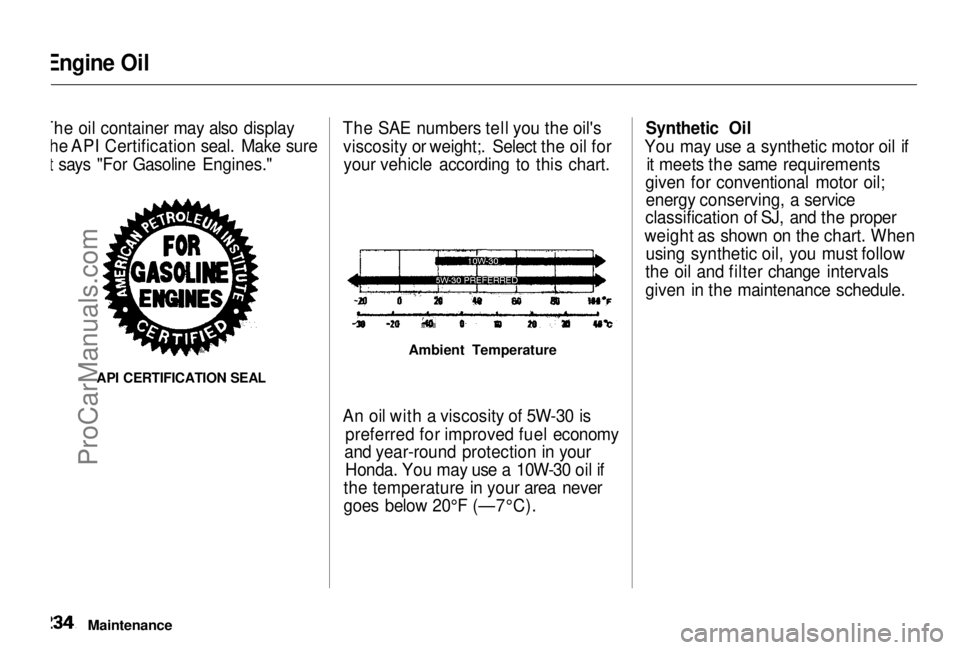
The oil container may also display the API Certification seal. Make sure
it says "For Gasoline Engines."
API CERTIFICATION SEAL
The SAE numbers tell you the oil's
viscosity or weight;. Select the oil foryour vehicle according to this chart.
Ambient Temperature
An oil with a viscosity of 5W-30 is preferred for improved fuel economy
and year-round protection in your
Honda. You may use a 10W-30 oil if
the temperature in your area never
goes below 20°F (—7°C). Synthetic Oil
You may use a synthetic motor oil if it meets the same requirements
given for conventional motor oil; energy conserving, a service
classification of SJ, and the proper
weight as shown on the chart. When using synthetic oil, you must follow
the oil and filter change intervals
given in the maintenance schedule.
MaintenanceProCarManuals.comMain Menu Table of Contents s t
Page 261 of 343
Tires
Maintenance
In addition to proper inflation,correct wheel alignment helps to
decrease tire wear. If you find a tire
is worn unevenly, have your dealer
check the wheel alignment.
The tires were properly balanced by the factory. They may need to berebalanced at some time before they
are worn out. Have your dealer
check the tires if you feel a consis-
tent vibration while driving. A tire should always be rebalanced if it is
removed from the wheel for repair. Make sure the installer balances the
wheels when you have new tires installed. This increases riding
comfort and tire life. Your vehicle's
original tires were dynamic or "spin"
balanced at the factory. For best results, have the installer perform adynamic balance.
On some models
Improper wheel weights can damage
your vehicle 'x aluminum wheels. Use only Genuine Honda wheel weights for
balancing.
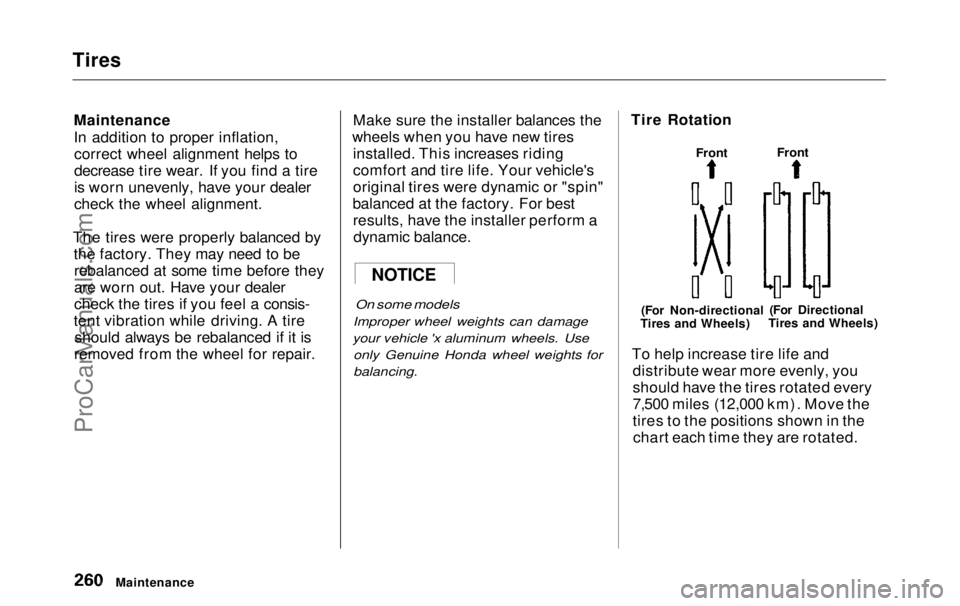
Tire Rotation
To help increase tire life anddistribute wear more evenly, you
should have the tires rotated every
7,500 miles (12,000 km). Move the
tires to the positions shown in thechart each time they are rotated.
Maintenance
NOTICE
(For Non-directional
Tires and Wheels) (For Directional
Tires and Wheels)
Front
FrontProCarManuals.comMain Menu Table of Contents s t
Page 311 of 343
Emergency Towing
If you decide to tow your vehicle
with all four wheels on the groud, make sure you use a properly-designed and attached tow bar.
Prepare the vehicle for towing as
described above, and leave the
ignition switch in Accessory (I) so
the steering wheel does not lock. Make sure the radio and any items
plugged into the accessory powersocket are turned off so they do not
run down the battery.
The steering system can be damaged if
the steering wheel is locked. Leave the
ignition switch in Accessory (I), and
make sure the steering wheel turns
freely before you begin towing.
Trying to lift or tow your vehicle by the
bumpers will cause serious damage.
The bumpers are not designed to
support the vehicle's weight.
Taking Care of the Unexpected
NOTICE
NOTICEProCarManuals.comMain Menu Table of Contents s t
Page 337 of 343

Index
GAWR (Gross Axle Weight
Rating)........................................ 213
GCWR (Gross Combined Weight
Rating)........................................ 213
Gearshift Lever Positions............. 199
Glass Cleaning............................... 281
Glove Box......................................... 87
GVWR (Gross Vehicle Weight
Rating) ........................................ 213
Halogen Headlight Bulbs.............. 266
Hazard Warning Flashers............... 70
Headlights......................................... 66 Aiming......................................... 266
Automatic Lighting Off............... 67
Daytime Running Lights............. 67
High Beam Indicator................... 61
High Beams, Turning on............ 66
Low Beams, Turning on............. 66
Reminder Chime.......................... 66
Replacing Halogen Bulbs ......... 266
Turning on.................................... 66
Head Restraints............................. 104
Heated Mirror................................ 116 Heating and Cooling...................... 130
High Altitude, Starting at.............. 197
High-Low Beam Switch .................. 66
HomeLink Universal
Transmitter.................................. 95
Hood Latch..................................... 248
Hood, Opening the ........................ 184
Horn................................................... 65
Hot Coolant, Warning about........ 237
Hydroplaning.................................. 211
Identification Number, Vehicle.... 314
If Your Vehicle Has to be
Towed......................................... 311
Ignition
Keys...............................................76
Switch............................................78
Timing Control System............. 324
Immobilizer System......................... 77
Important Safety Precautions .......... 6
Indicator Lights, Instrument
Panel.............................................. 57
Individual Map Lights................... 127
Infant Restraint................................ 30
Inflation, Proper Tire .................... 257
Inside Mirror.................................. 115
Inspection,Tire.............................. 259
Instrument Panel........................ 2, 56
Instrument Panel Brightness......... 67
Interior Cleaning............................ 280
Interior Lights................................ 125
Introduction......................................... i
Jacking up the Vehicle.................. 290
Jack, Tire........................................ 288
Jump Starting................................. 297
Keys...................................................76
Label, Certification........................ 314
Lane Change, Signaling.................. 68
Lap/Shoulder Belts.................. 15, 45
CONTINUEDProCarManuals.comMain Menu s t