Page 185 of 440

yellowblue
4-3
Drunken Driving
Death and injury associated with drinking and driving is
a national tragedy. It's the number one contributor to
the highway death toll, claiming thousands of victims
every year.
Alcohol affects four things that anyone needs to
drive a vehicle:
�Judgment
�Muscular Coordination
�Vision
�Attentiveness.
Police records show that almost half of all motor
vehicle
-related deaths involve alcohol. In most cases,
these deaths are the result of someone who was drinking
and driving. In recent years, over 17,000 annual motor
vehicle
-related deaths have been associated with the use
of alcohol, with more than 300,000 people injured.
Many adults
-- by some estimates, nearly half the adult
population
-- choose never to drink alcohol, so they
never drive after drinking. For persons under 21, it's
against the law in every U.S. state to drink alcohol.
There are good medical, psychological and
developmental reasons for these laws.The obvious way to solve the leading highway safety
problem is for people never to drink alcohol and then
drive. But what if people do? How much is ªtoo muchº
if the driver plans to drive? It's a lot less than many
might think. Although it depends on each person
and situation, here is some general information on
the problem.
The Blood Alcohol Concentration (BAC) of someone
who is drinking depends upon four things:
�The amount of alcohol consumed
�The drinker's body weight
�The amount of food that is consumed before and
during drinking
�The length of time it has taken the drinker to
consume the alcohol.
According to the American Medical Association, a
180
-lb. (82 kg) person who drinks three 12-ounce
(355 ml) bottles of beer in an hour will end up with a
BAC of about 0.06 percent. The person would reach the
same BAC by drinking three 4
-ounce (120 ml) glasses
of wine or three mixed drinks if each had 1
-1/2 ounces
(45 ml) of a liquor like whiskey, gin or vodka.
Page 205 of 440

yellowblue
4-23
Q:Am I likely to stall when going downhill?
A:It's much more likely to happen going uphill. But if
it happens going downhill, here's what to do.
�Stop your vehicle by applying the regular brakes.
Apply the parking brake.
�Shift to PARK (P) (or to NEUTRAL (N) with the
manual transmission) and, while still braking, restart
the engine.
�Shift back to a low gear, release the parking brake,
and drive straight down.
�If the engine won't start, get out and get help.
Driving Across an Incline
Sooner or later, an off-road trail will probably go across
the incline of a hill. If this happens, you have to decide
whether to try to drive across the incline. Here are some
things to consider:
�A hill that can be driven straight up or down may be
too steep to drive across. When you go straight up or
down a hill, the length of the wheel base (the
distance from the front wheels to the rear wheels)reduces the likelihood the vehicle will tumble end
over end. But when you drive across an incline, the
much more narrow track width (the distance between
the left and right wheels) may not prevent the vehicle
from tilting and rolling over. Also, driving across an
incline puts more weight on the downhill wheels.
This could cause a downhill slide or a rollover.
�Surface conditions can be a problem when you drive
across a hill. Loose gravel, muddy spots, or even wet
grass can cause your tires to slip sideways, downhill.
If the vehicle slips sideways, it can hit something
that will trip it (a rock, a rut, etc.) and roll over.
�Hidden obstacles can make the steepness of the
incline even worse. If you drive across a rock with
the uphill wheels, or if the downhill wheels drop into
a rut or depression, your vehicle can tilt even more.
For reasons like these, you need to decide carefully
whether to try to drive across an incline. Just because
the trail goes across the incline doesn't mean you
have to drive it. The last vehicle to try it might have
rolled over.
Page 331 of 440
yellowblue
6-49
Windshield Wiper
Blade Replacement
Windshield wiper blades should be inspected at least
twice a year for wear and cracking. See ªWiper Blade
Checkº in Section 7 of this manual under Part B ªOwner
Checks and Servicesº for more information.
Replacement blades come in different types and are
removed in different ways. For proper type and length,
see ªNormal Maintenance Replacement Partsº in the
Index. Here's how to remove the Shephard's Hook type.
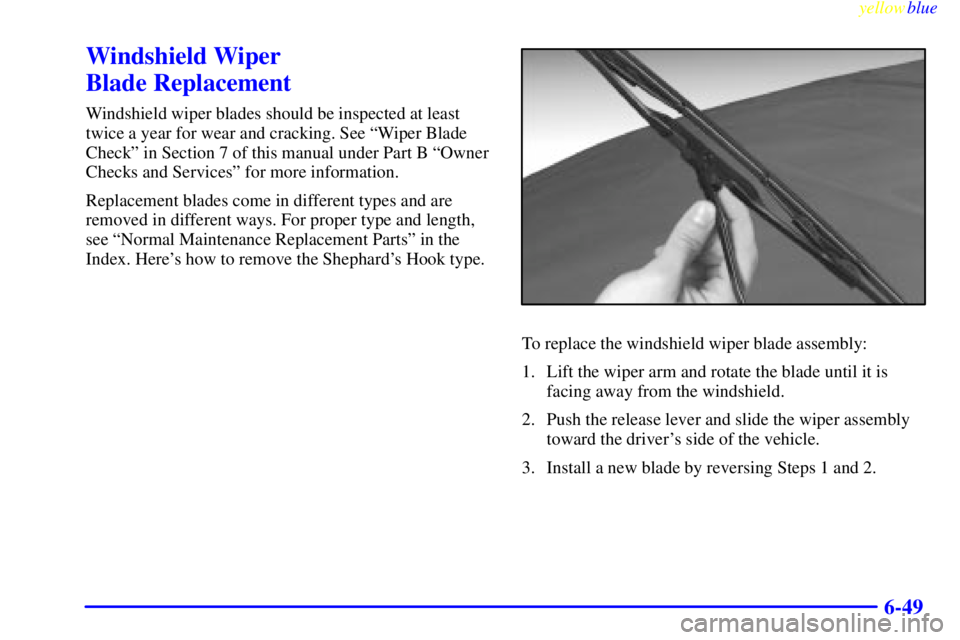
To replace the windshield wiper blade assembly:
1. Lift the wiper arm and rotate the blade until it is
facing away from the windshield.
2. Push the release lever and slide the wiper assembly
toward the driver's side of the vehicle.
3. Install a new blade by reversing Steps 1 and 2.
Page 360 of 440

yellowblue
6-78
Air Conditioning Refrigerants
Not all air conditioning refrigerants are the same. If the air conditioning system in your vehicle needs refrigerant, be
sure the proper refrigerant is used. If you're not sure, ask your dealer.
See the refrigerant charge label under the hood for information regarding refrigerant capacity.
Normal Maintenance Replacement Parts
Replacement part numbers listed in this section are based on the latest information available at the time of printing,
and are subject to change. If a part listed in this manual is not the same as the part used in your vehicle when it was
built, or if you have any questions, please contact your GM truck dealer.
These specifications are for information only. If you have any questions, see the service manual for the chassis or
refer to the body manufacturer's publications.
VIN Code M R J
Oil Filter* PF1218�PF1218�PF1218
Air Cleaner Filter* A1300C��A1300C��A1300C��
PCV Valve* CV769C CV769C CV774C
Spark Plugs* 41
-932 41-932 41-932
Fuel Filter* GF626 GF626 GF626
Wiper Blades** 22154886 22154886 22154886
Wiper Blade Type Trico Trico Trico
Wiper Blade Length 18 inches (45.0 cm) 18 inches (45.0 cm) 18 inches (45.0 cm)
*AC part number
**GM part number�Use a PF52 oil filter if your vehicle has
four
-wheel drive.
��A1301C high
-capacity air cleaner filter.