1999 FORD WINDSTAR light
[x] Cancel search: lightPage 222 of 248

EMISSION CONTROL SYSTEM
Your vehicle is equipped with various emission control components and a
catalytic converter which will enable your vehicle to comply with
applicable exhaust emission standards. To make sure that the catalytic
converter and other emission control components continue to work
properly:
²Use only unleaded fuel.
²Avoid running out of fuel.
²Do not turn off the ignition while your vehicle is moving, especially at
high speeds.
²Have the items listed in your Scheduled Maintenance Guide performed
according to the specified schedule.
The scheduled maintenance items listed in the Scheduled Maintenance
Guide are essential to the life and performance of your vehicle and to its
emissions system.
If other than Ford, Motorcraft or Ford-authorized parts are used for
maintenance replacements or for service of components affecting
emission control, such non-Ford parts should be equivalent to genuine
Ford Motor Company parts in performance and durability.
Do not park, idle, or drive your vehicle in dry grass or other dry
ground cover. The emission system heats up the engine
compartment and exhaust system, which can start a fire.
Illumination of the charging system warning light,Check Engine
indicator light or the temperature warning light, fluid leaks, strange
odors, smoke or loss of oil pressure, could indicate that the emission
control system is not working properly.
Exhaust leaks may result in entry of harmful and potentially
lethal fumes into the passenger compartment.
Maintenance and care
222
Page 223 of 248

Do not make any unauthorized changes to your vehicle or engine. By
law, vehicle owners and anyone who manufactures, repairs, items, sells,
leases, trades vehicles, or supervises a fleet of vehicles are not permitted
to intentionally remove an emission control device or prevent it from
working. Information about your vehicle's emission system is on the
Vehicle Emission Control Information Decal located on or near the
engine. This decal identifies engine displacement and gives some tune up
specifications.
Please consult your ªWarranty Guideº for complete emission warranty
information.
Readiness for inspection/maintenance (I/M) testing
In some localities, it may be a legal requirement to pass an I/M test of
the on-board diagnostic (OBD-II) system. If your ªCheck Engine/Service
Engine Soonº light is on, refer to the description in theWarning Lights
and Chimessection of theInstrumentationchapter. Your vehicle may
not pass the I/M test with the ªCheck Engine/Service Engine Soonº light
on.
If the vehicle's powertrain system or its battery has just been serviced,
the OBD-II system is reset to a ªnot ready for I/M testº condition. To
ready the OBD-II system for I/M testing, a minimum of 30 minutes of city
and highway driving is necessary as described below:
²First, at least 10 minutes of driving on an expressway or highway.
²Next, at least 20 minutes driving in stop-and-go, city-type traffic with
at least four idle periods.
Allow the vehicle to sit for at least eight hours without starting the
engine. Then, start the engine and complete the above driving cycle. The
engine must warm up to its normal operating temperature. Once started,
do not turn off the engine until the above driving cycle is complete.
Maintenance and care
223
Page 224 of 248

EXTERIOR BULBS
Replacing exterior bulbs
It is a good idea to check the operation of the following lights frequently:
²Headlamps
²Turn signals
²Cornering lamps
²High-mount brakelamp
²Tail lamps
²Brakelamps
²Backup lamps
²License plate lamps
Do not remove lamp bulbs unless they will be replaced immediately. If a
bulb is removed for an extended period of time, contaminants may enter
the lamp housings and affect performance.
Handle a halogen bulb carefully and keep out of children's reach.
Grasp the bulb only by its plastic base and do not touch the
glass; the oil from your hand could cause the bulb to break the next
time that the headlamps are operated.
Replacing headlamp bulbs
Handle a halogen headlamp bulb carefully and keep out of
children's reach. Grasp the bulb only by its plastic base and do
not touch the glass. The oil from your hand could cause the bulb to
break the next time the headlamps are operated.
To remove the headlamp bulb:
1. Make sure headlamp switch is in OFF position, then open the hood.
Maintenance and care
224
Page 228 of 248

Using the right bulbs
Function Trade Number
Front park/turn lamps 3157 NAK
Cornering lamps 3156K
Headlamps 9007
Rear license plate lamps 168
High-mount brake lamp 921
Rear turn lamps 3156K
Backup lamps 3156K
Brake/tail lamps 3157K
Dome lamp 921
Cargo liftgate lamp T-562
Map lamps/dome 578 (opt)
Stepwell lamp T-562
Front seat footwell 194
Front door mounted courtesy lamp 168
Second row reading lamp 578
To replace all instrument panel lights - see your dealer.
AIMING THE HEADLAMPS
Your vehicle is equipped with a Vehicle Headlamp Aim Device (VHAD)
on each headlamp body. Each headlamp may be properly aimed in the
horizontal direction (left/right) and the vertical position (up/down).
A non-zero bubble reading does not necessarily indicate out-of-aim
headlamps. If your vehicle is not positioned on a level surface, the slope
will be included in the level indicator. Therefore, vertical headlamp
adjustment should be performed only when beam direction appears to be
incorrect.
You will need one E8 Torx socket to make the adjustments.
If the vehicle has been in an accident, the vehicle's front structure
should be properly aligned before aiming the headlamps.
Maintenance and care
228
Page 231 of 248
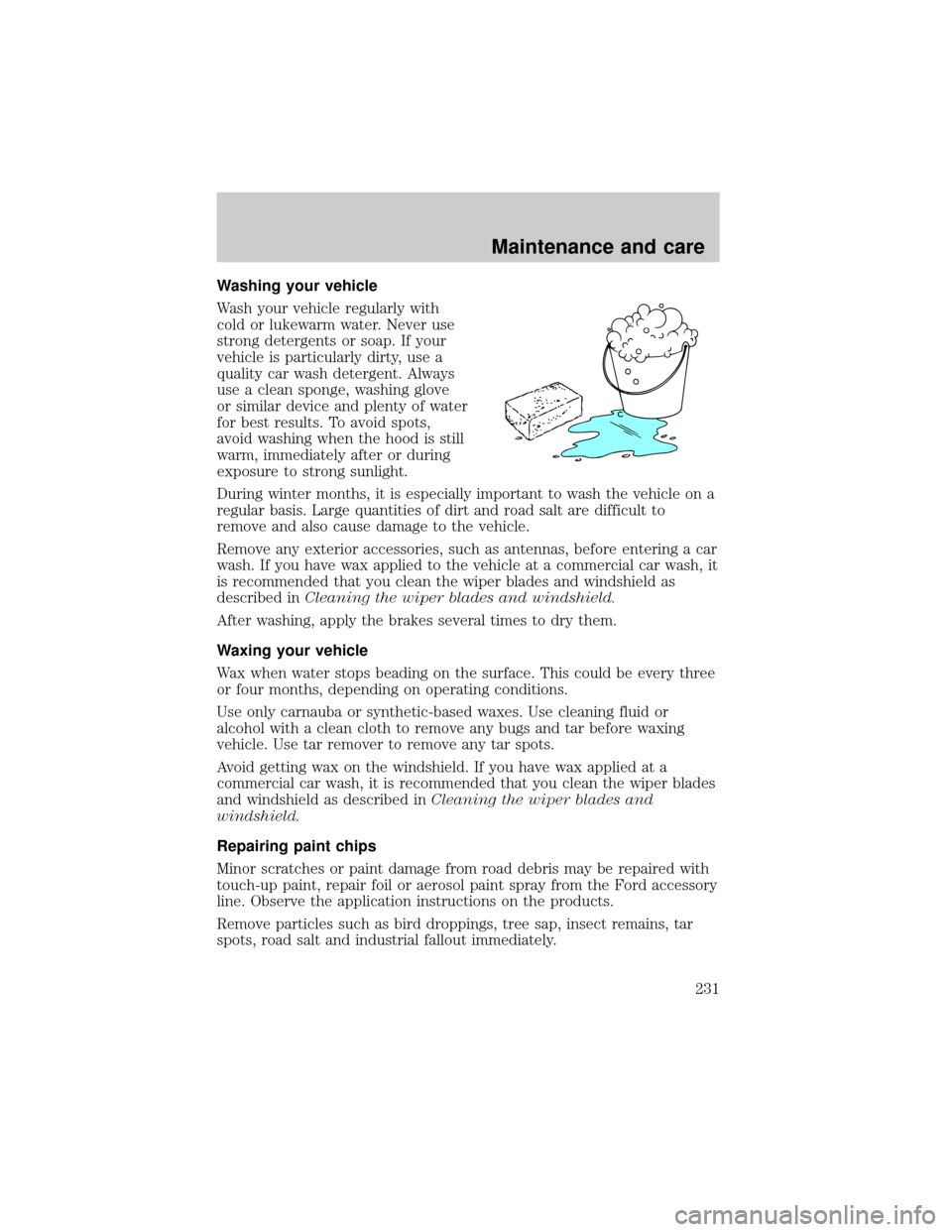
Washing your vehicle
Wash your vehicle regularly with
cold or lukewarm water. Never use
strong detergents or soap. If your
vehicle is particularly dirty, use a
quality car wash detergent. Always
use a clean sponge, washing glove
or similar device and plenty of water
for best results. To avoid spots,
avoid washing when the hood is still
warm, immediately after or during
exposure to strong sunlight.
During winter months, it is especially important to wash the vehicle on a
regular basis. Large quantities of dirt and road salt are difficult to
remove and also cause damage to the vehicle.
Remove any exterior accessories, such as antennas, before entering a car
wash. If you have wax applied to the vehicle at a commercial car wash, it
is recommended that you clean the wiper blades and windshield as
described inCleaning the wiper blades and windshield.
After washing, apply the brakes several times to dry them.
Waxing your vehicle
Wax when water stops beading on the surface. This could be every three
or four months, depending on operating conditions.
Use only carnauba or synthetic-based waxes. Use cleaning fluid or
alcohol with a clean cloth to remove any bugs and tar before waxing
vehicle. Use tar remover to remove any tar spots.
Avoid getting wax on the windshield. If you have wax applied at a
commercial car wash, it is recommended that you clean the wiper blades
and windshield as described inCleaning the wiper blades and
windshield.
Repairing paint chips
Minor scratches or paint damage from road debris may be repaired with
touch-up paint, repair foil or aerosol paint spray from the Ford accessory
line. Observe the application instructions on the products.
Remove particles such as bird droppings, tree sap, insect remains, tar
spots, road salt and industrial fallout immediately.
Maintenance and care
231
Page 232 of 248
Cleaning the wheels
Wash with the same detergent as the body of your vehicle. Do not use
acid-based or alcohol-based wheel cleaners, steel wool, fuel or strong
detergents. Never use abrasives that will damage the finish of special
wheel surfaces. Use a tar remover to remove grease and tar.
Cleaning the engine
Engines are more efficient when they are clean because grease and dirt
buildup keep the engine warmer than normal. When washing:
²Take care when using a power washer to clean the engine. The high
pressure fluid could penetrate the sealed parts and cause damage.
²Do not spray with cold water to avoid cracking the engine block or
other engine components.
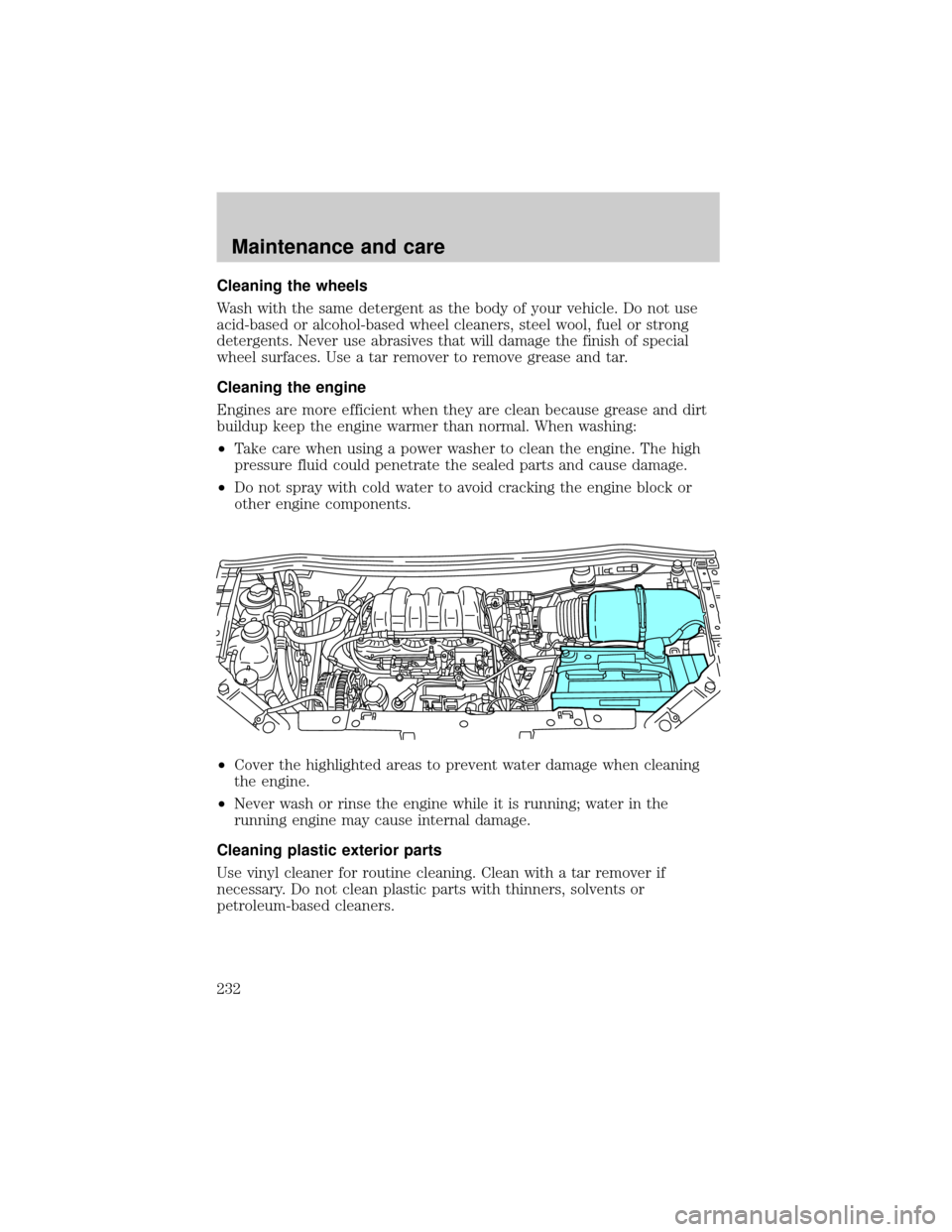
²Cover the highlighted areas to prevent water damage when cleaning
the engine.
²Never wash or rinse the engine while it is running; water in the
running engine may cause internal damage.
Cleaning plastic exterior parts
Use vinyl cleaner for routine cleaning. Clean with a tar remover if
necessary. Do not clean plastic parts with thinners, solvents or
petroleum-based cleaners.
Maintenance and care
232
Page 243 of 248

Accessory delay ..........................78
Air bag supplemental restraint
system ........................................124
and child safety seats ............126
description .......................125,128
disposal ....................................131
indicator light ..................128,130
passenger air bag ............126,129
Air filter, cabin ..........................203
Anti-theft system ...99,100,101,102
,103
arming the system ..................100
disarming a triggered system 100
Automatic transaxle .................155
driving with ...............156,157,158
Brakes ........................................151
anti-lock ............................151,152
anti-lock brake system (ABS)
warning light ...........................152
fluid, checking and adding ....195
shift interlock ..........................155
Break-in period .............................3
Cargo net ...................................104
CD player .....................64,65,66,67
Child safety seats
attaching with tether straps ..136
in rear seat .......................133,136
tether anchorage
hardware ...................137,138,140
Cleaning your vehicle ...............230
built-in child seat ...........141,142,
145,146
engine compartment ..............232
exterior .............................231,234
exterior lamps .........................233
interior .....................................234
plastic parts ............................232
washing ....................................231
waxing .....................................231
wheels ......................................232
windows ..................................235
wiper blades ............................233Compass, electronic
set zone adjustment .......22,23,24
Console ........................................90
overhead ....................................86
Controls
power seat ...............................108
Coolant ......................................199
checking and adding ..............197
refill capacities ........................199
Cupholder(s) .110,112,113,115,117
Defrost
rear window ..............................37
Doors
power sliding .............87,88,89,90
Emission control system ..........222
Engine
check engine/service engine
soon light ...............................9,10
coolant .....................................197
idle speed control ...................206
service points ...................190,191
starting after a collision .........167
Engine block heater .................149
Engine oil
checking and adding ..............193
dipstick ....................................192
specifications ...................192,194
Exhaust fumes ..........................150
Floor mats ...................................91
Fuel
choosing the right fuel ...........216
comparisons with EPA fuel
economy estimates .................221
detergent in fuel .....................217
filling your vehicle
with fuel ...........................214,215
gauge .........................................12
quality ......................................217
running out of fuel .................218
safety information relating to
automotive fuels .....................214
Fuses ...................................168,169
Index
243
Page 244 of 248

Gas mileage (see Fuel
economy) ..............218,219,220,221
Gauges .........................................12
engine coolant temperature
gauge .........................................13
GVWR
(Gross Vehicle Weight Rating)
calculating ...............................161
Hazard flashers .........................167
Head restraints ...........105,109,110
Headlamps
aiming ........................228,229,230
bulb specifications ..................228
high beam ..............................8,26
warning chime ..........................11
Heating ........................................27
heater only system ...27,28,29,30,
31,32,33,34
rear seat controls .....................35
Hood ..........................................189
Ignition .......................................239
Inspection/maintenance (I/M)
testing ........................................223
Instrument panel
cleaning ...................................233
Keyless entry system
autolock .....................................99
Keys
key in ignition chime ...............11
positions of the ignition ...........70
Lamps
autolamp system .......................27
daytime running light ...............26
headlamps .................................25
headlamps, flash to pass ..........26
instrument panel, dimming .....25
interior lamps ......................85,87
replacing bulbs .........224,226,227
Lane change indicator
(see Turn signal) ........................74
Liftgate ......................................103Lights, warning and indicator
air bag ..........................................8
anti-lock brakes (ABS) ..............8
anti-theft .....................................7
brake ............................................9
charging system ..........................6
door ajar ....................................10
high beam .................................11
low fuel ........................................6
low washer fluid .......................11
oil pressure .................................8
overdrive off ................................9
safety belt ...................................7
traction control off .....................7
turn signal indicator ...................7
Locks
childproof ..................................80
Lumbar support, seats ......108,109
Message center ......................14,15
system check button ...........15,16
warning messages ................16,21
Mirrors .........................................81
automatic dimming rearview
mirror ........................................80
cleaning ...................................235
fold away ...................................79
heated ........................................79
side view mirrors (power) .......78
Motorcraft parts ........................218
Octane rating ............................217
Odometer .....................................13
Overdrive ..............................75,156
Panic alarm feature, remote
entry system ................................95
Parking brake ............................152
Power distribution box
(see Fuses) ...............................173
Power door locks ...................79,80
Power steering ..........................154
fluid, checking and
adding ...............................200,201
Index
244