1999 FORD TAURUS wiper blades
[x] Cancel search: wiper bladesPage 159 of 224

2. Put the gearshift in P (Park), turn off all
accessories and start the engine.
3. Let the engine idle for at least one minute.
4. The relearning process will automatically
complete as you drive the vehicle.
²The vehicle may need to be driven 16 km (10
miles) or more to relearn the idle and fuel trim
strategy.
²If you do not allow the engine to relearn its idle
trim, the idle quality of your vehicle may be
adversely affected until the idle trim is eventually
relearned.
If the battery has been disconnected or a new
battery has been installed, the clock and the preset
radio stations must be reset once the battery is
reconnected.
²Always dispose of
automotive batteries
in a responsible
manner. Follow your
local authorized
standards for
disposal. Call your
local authorized
recycling center to find out more about recycling
automotive batteries.
WINDSHIELD WIPER BLADES
Check the wiper blades at least twice a year or when
they seem less effective. Substances such as tree sap
and some hot wax treatments used by commercial
car washes reduce the effectiveness of wiper blades.
Checking the wiper blades
If the wiper blades do not wipe properly, clean both
the windshield and wiper blades using undiluted
windshield wiper solution or a mild detergent. Rinse
thoroughly with clean water. To avoid damaging the
LEAD
RETURN
RECYCLE
Maintenance and care
159
Page 160 of 224

blades, do not use fuel, kerosene, paint thinner or
other solvents.
Changing the wiper blades
To replace the wiper blades:
1. Pull the wiper arm
away from the
windshield and lock
into the service
position.
2. Turn the blade at an
angle from the wiper
arm. Push the lock pin
manually to release the
blade and pull the
wiper blade down
toward the windshield
to remove it from the arm.
3. Attach the new wiper to the wiper arm and press
it into place until a click is heard.
INFORMATION ABOUT TIRE QUALITY GRADES
New vehicles are fitted
with tires that have
their Tire Quality
Grade (described
below) molded into the
tire's sidewall. These
Tire Quality Grades are
determined by
standards that the
United States Department of Transportation has set.
Tire Quality Grades apply to new pneumatic tires for
use on passenger cars. They do not apply to deep
tread, winter-type snow tires, space-saver or
temporary use spare tires, tires with nominal rim
diameters of 10 to 12 inches or limited production
tires as defined in Title 49 Code of Federal
Regulations Part 575.104(c)(2).
Maintenance and care
160
Page 184 of 224

Washing your vehicle
Wash your vehicle
regularly with cold or
lukewarm water. Never
use strong detergents or
soap. If your vehicle is
particularly dirty, use a
quality car wash
detergent. Always use a
clean sponge, washing glove or similar device and
plenty of water for best results. To avoid spots, avoid
washing when the hood is still warm, immediately
after or during exposure to strong sunlight.
During winter months, it is especially important to
wash the vehicle on a regular basis. Large quantities
of dirt and road salt are difficult to remove and also
cause damage to the vehicle.
Remove any exterior accessories, such as antennas,
before entering a car wash. If you have wax applied
to the vehicle at a commercial car wash, it is
recommended that you clean the wiper blades and
windshield as described inCleaning the wiper
blades and windshield.
After washing, apply the brakes several times to dry
them.
Waxing your vehicle
Wax when water stops beading on the surface. This
could be every three or four months, depending on
operating conditions.
Use only carnauba or synthetic-based waxes. Use
cleaning fluid or alcohol with a clean cloth to remove
any bugs before waxing vehicle. Use tar remover to
remove any tar spots.
Avoid getting wax on the windshield. If you have
wax applied at a commercial car wash, it is
recommended that you clean the wiper blades and
windshield as described inCleaning the wiper
blades and windshield.
Maintenance and care
184
Page 187 of 224
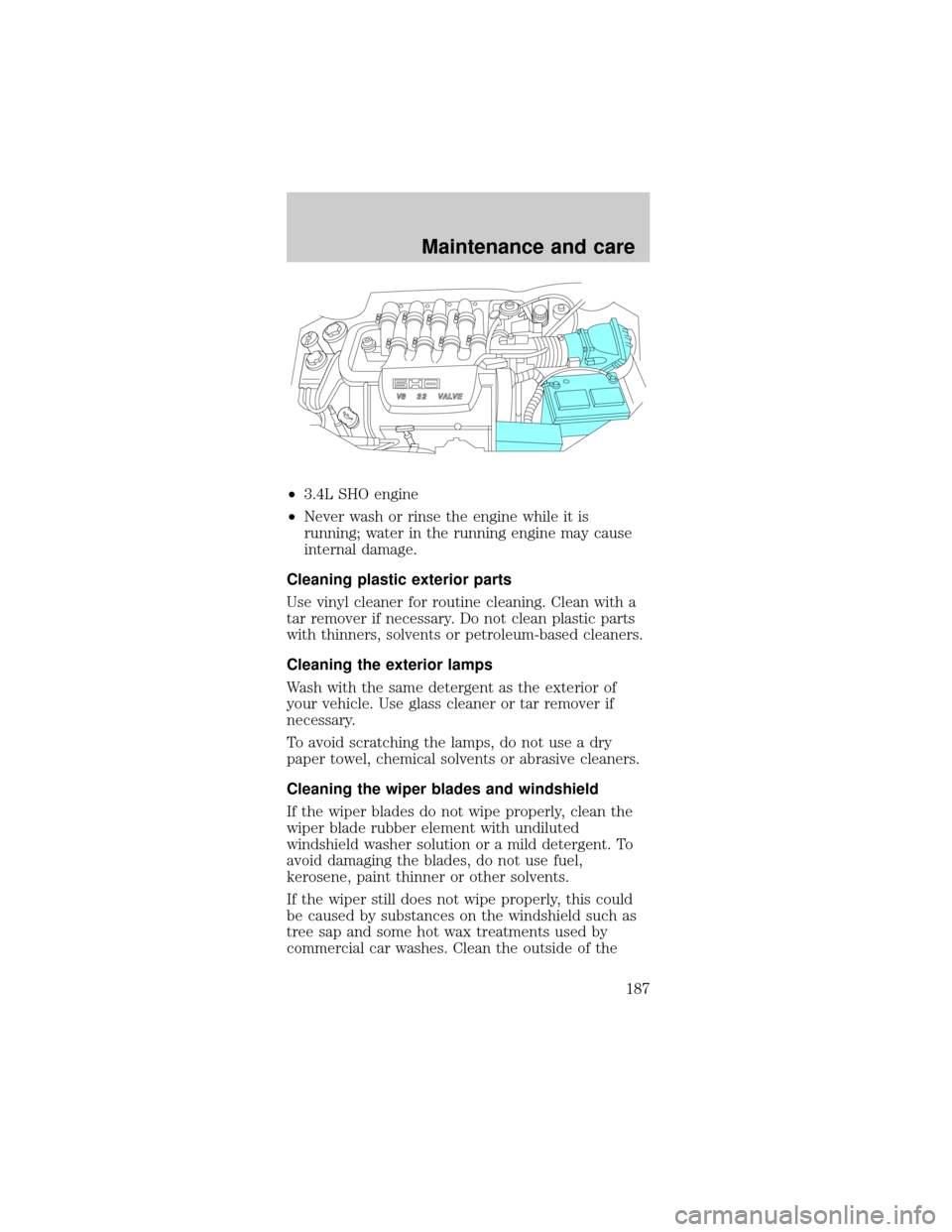
²3.4L SHO engine
²Never wash or rinse the engine while it is
running; water in the running engine may cause
internal damage.
Cleaning plastic exterior parts
Use vinyl cleaner for routine cleaning. Clean with a
tar remover if necessary. Do not clean plastic parts
with thinners, solvents or petroleum-based cleaners.
Cleaning the exterior lamps
Wash with the same detergent as the exterior of
your vehicle. Use glass cleaner or tar remover if
necessary.
To avoid scratching the lamps, do not use a dry
paper towel, chemical solvents or abrasive cleaners.
Cleaning the wiper blades and windshield
If the wiper blades do not wipe properly, clean the
wiper blade rubber element with undiluted
windshield washer solution or a mild detergent. To
avoid damaging the blades, do not use fuel,
kerosene, paint thinner or other solvents.
If the wiper still does not wipe properly, this could
be caused by substances on the windshield such as
tree sap and some hot wax treatments used by
commercial car washes. Clean the outside of the
V8 32 VALVE
Maintenance and care
187
Page 188 of 224

windshield with a non-abrasive cleanser such as the
non-abrasive Bon-Amitpowder. Rinse thoroughly
with clean water.Do notuse abrasive cleansers on
glass as they may cause scratches. The windshield is
clean if beads do not form when you rinse it with
water. The windshield and wiper blades should be
cleaned on a regular basis, and blades or rubber
elements replaced when worn.
Cleaning the instrument panel
Clean with a damp cloth, then dry with a dry cloth.
Avoid cleaner or polish that increases the gloss of
the upper portion of the instrument panel. The dull
finish in this area helps protect the driver from
undesirable windshield reflection.
Cleaning the interior fabric
Remove dust and loose dirt with a whisk broom or a
vacuum cleaner. Remove fresh spots immediately. Do
not use household or glass cleaners. These agents
can stain and discolor the fabric. Use a mild soap
and water solution if necessary.
Cleaning leather seats (if equipped)
To clean, simply use a soft cloth dampened with
water and a mild soap. Wipe the leather again with a
damp cloth to remove soap residue. Dry with a soft
cloth. For tougher soiling concerns, Ford
recommends using the Deluxe Leather Care Kit
F8AZ-19G253±AA, which is available from your Ford
Dealer. This mild cleaner and special pad, cleans the
leather and maintains its natural beauty. Follow the
instructions on the cleaner label. Regular cleaning of
your leather upholstery helps maintain its resiliency
and color.
Do not use household cleaning products,
alcohol solutions, solvents or cleaners intended
for rubber, vinyl or plastics.
Maintenance and care
188
Page 217 of 224

exterior .................. 185
exterior lamps ....... 187
instrument panel .. 188
interior ................... 188
plastic parts .......... 187
safety belts ............ 189
washing .................. 184
waxing ................... 184
wheels .................... 185
wiper blades .......... 187
Clock ..................... 33,41
Console ...................... 56
Controls
power seat ............... 75
Coolant ...... 150,152,153
checking
and adding ............ 151
refill
capacities ........ 153,191
specifications.. 193,194
Customer
Assistance ................ 200
Ford accessories for
your vehicle .......... 209
Ford Extended
Service Plan .......... 201
Getting assistance
outside the U.S.
and Canada ........... 208
Getting roadside
assistance .............. 200
Getting the service
you need ............... 202
Ordering additional
owner's literature... 214
The Dispute
Settlement Board... 204
Defrost
rear window ............ 18
Dipstick
engine oil ............... 145Doors
central unlocking .... 54
door ajar warning ..... 7
Driving under special
conditions
through water ....... 118
Emergencies, roadside
jump-starting ........ 135
Emission
control system ......... 175
Engine ............... 194,195
check engine/service
engine soon light ...... 7
coolant ................... 150
idle speed control.. 157
lubrication
specifications.. 193,194
refill capacities ...... 191
service
points ....... 143,144,145
starting after a
collision ................. 124
Engine
block heater ............ 105
Engine oil ................ 145
checking and
adding ............. 145,147
dipstick .................. 145
filter,
specifications.. 147,190
recommendations... 147
refill
capacities ........ 145,191
specifications ........ 145
147,193,194
Exhaust fumes ........ 105
Floor mats ................. 56
Fluid capacities ....... 191
Fuel .......................... 165
calculating fuel
economy ................ 171
cap ......................... 167
Index
217
Page 221 of 224

lubricant
specifications ........ 194
Transmission
fluid, checking
and adding
(automatic) ........... 155
Trip odometer ........... 14
Trunk ......................... 61
remote release ........ 57
Turn signal ............. 6,49
Vehicle dimensions . 195
Vehicle Identification
Number (VIN) ......... 199
Vehicle loading ........ 116
Ventilating
your vehicle ............. 106
Warning chimes ......... 11Warning lights
(see Lights) ................. 6
Washer fluid ............ 149
Water,
Driving through ....... 118
Windows
power ....................... 53
rear wiper/washer ... 50
Windshield washer
fluid and wipers
checking
and cleaning .......... 159
operation ................. 49
replacing
wiper blades .......... 160
Wrecker towing ....... 140
Index
221