Page 111 of 216

N (Neutral)
With the gearshift in N (Neutral),
the vehicle can be started and is
free to roll. Hold the brake pedal
down while in this gear.
(Overdrive)
The normal driving position for the
best fuel economy. Transmission
operates in gears one through five.
(Overdrive) can be deactivated
by pressing the transmission control
switch on the end of the gearshift
lever.
The transmission control indicator
light (TCIL) will illuminate on the
instrument cluster.
Drive± Not shown on the display. Activate by pressing the transmission
control switch on the end of the gearshift lever with the gearshift in the
position. The TCIL will illuminate on the instrument cluster.
Transmission operates in gears one through four.
(Drive) provides
more engine braking than
(Overdrive) and is useful whenever driving
conditions (i.e., city traffic, hilly terrain, etc.) cause the transmission to
excessively shift between
(Overdrive) and(Drive). Also deactivate
(Overdrive) when:
²driving with a heavy load
²towing a trailer up or down steep hills
²additional engine braking is desired. If towing a trailer, refer to
Driving while you towin theTrailer Towingchapter.
To return to
(Overdrive) mode, press the transmission control switch.
The TCIL will no longer be illuminated.
Each time the vehicle is started, the transmission will automatically
return to normal overdrive mode.
O/D
ON/OFF
O/ D
OFF
Driving
111
Page 116 of 216

Using the electronic shift 4WD system (if equipped)
Positions of the electronic shift system
2WD (2WD High)± Power to rear axle only.
4X4 HIGH (4WD High)± Power delivered to front and rear axles for
increased traction.
4X4 LOW (4WD Low)± Power to front and rear axles at low speeds.
Shifting from 2WD (2WD high) to 4X4 HIGH (4WD high)
Move the 4WD control to the 4X4
HIGH position.
At temperatures below 0ÉC (32ÉF),
shifts from 2WD to 4X4 HIGH
should not be performed above 72
km/h (45 mph).
²Do not shift into 4X4 HIGH with
the rear wheels slipping.
Shifting from 4X4 HIGH (4WD high) to 2WD (2WD high)
Move the 4WD control to 2WD
position at any forward speed. You
do notneed to put the gearshift in
R (Reverse) to disengage your front
hubs.
Shifting from 2WD (2WD high) to 4X4 LOW (4WD low)
1. Bring the vehicle to a stop.
2. Depress the brake.
3. Place the gearshift in N (Neutral) (automatic transmission) or depress
the clutch (manual transmission).
4X4
HIGH
2WD4X4
LOW
4X4
HIGH
2WD4X4
LOW
Driving
116
Page 117 of 216
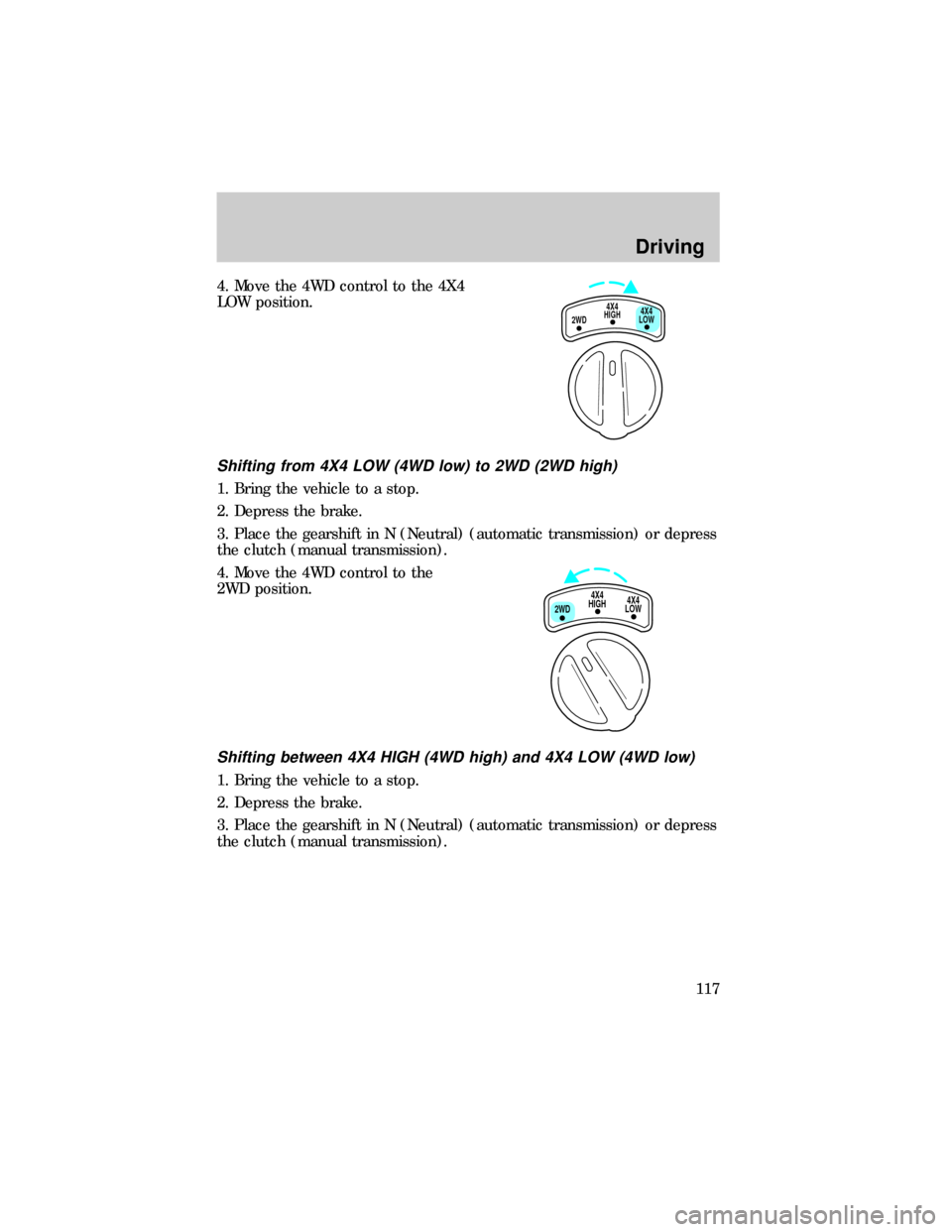
4. Move the 4WD control to the 4X4
LOW position.
Shifting from 4X4 LOW (4WD low) to 2WD (2WD high)
1. Bring the vehicle to a stop.
2. Depress the brake.
3. Place the gearshift in N (Neutral) (automatic transmission) or depress
the clutch (manual transmission).
4. Move the 4WD control to the
2WD position.
Shifting between 4X4 HIGH (4WD high) and 4X4 LOW (4WD low)
1. Bring the vehicle to a stop.
2. Depress the brake.
3. Place the gearshift in N (Neutral) (automatic transmission) or depress
the clutch (manual transmission).
4X4
HIGH
2WD4X4
LOW
4X4
HIGH
2WD4X4
LOW
Driving
117
Page 120 of 216

When speed control is on and you are driving uphill, your vehicle speed
may drop considerably, especially if you are carrying a heavy load.
If vehicle speed drops more than 16 km/h (10 mph), the speed control
will cancel automatically. Resume speed with accelerator pedal.
If speed control cancels after climbing the hill, reset speed by pressing
and holding the SET ACCEL button to resume speeds over 50 km/h (30
mph).
Automatic transmissions may shift frequently while driving up steep
grades. Eliminate frequent shifting by shifting out of
(Overdrive) into
D (Drive).
Driving on snow and ice
A 4WD vehicle has advantages over 2WD vehicles in snow and ice but
can skid like any other vehicle.
Avoid sudden applications of power and quick changes of direction on
snow and ice. Apply the accelerator slowly and steadily when starting
from a full stop.
When braking, apply the brakes as you normally would. In order to allow
the anti-lock brake system (ABS) to operate properly, keep steady
pressure on the brake pedal.
Allow more stopping distance and drive slower than usual. Consider
using one of the lower gears.
TRACTION-LOK AXLE (IF EQUIPPED)
This axle provides added traction on slippery surfaces, particularly when
one wheel is on a poor traction surface. Under normal conditions, the
Traction-Lok axle functions like a standard rear axle.
Extended use of other than the manufacturer's specified size tires on a
Traction-Lok rear axle could result in a permanent reduction in
effectiveness. This loss of effectiveness does not affect normal driving
and should not be noticeable to the driver.
To avoid injury, never run the engine with one wheel off the
ground, such as when changing a tire.
Driving
120
Page 126 of 216
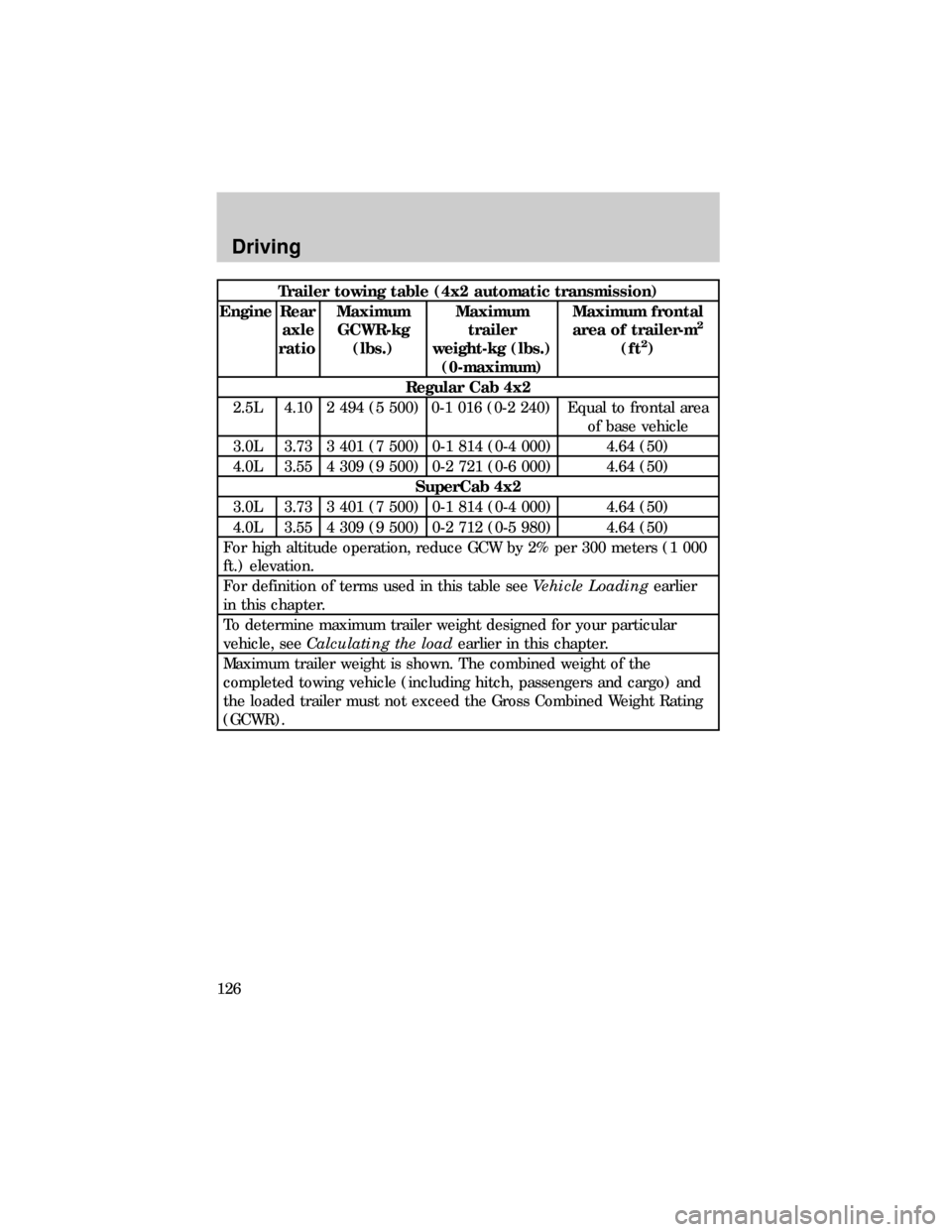
Trailer towing table (4x2 automatic transmission)
Engine Rear
axle
ratioMaximum
GCWR-kg
(lbs.)Maximum
trailer
weight-kg (lbs.)
(0-maximum)Maximum frontal
area of trailer-m
2
(ft2)
Regular Cab 4x2
2.5L 4.10 2 494 (5 500) 0-1 016 (0-2 240) Equal to frontal area
of base vehicle
3.0L 3.73 3 401 (7 500) 0-1 814 (0-4 000) 4.64 (50)
4.0L 3.55 4 309 (9 500) 0-2 721 (0-6 000) 4.64 (50)
SuperCab 4x2
3.0L 3.73 3 401 (7 500) 0-1 814 (0-4 000) 4.64 (50)
4.0L 3.55 4 309 (9 500) 0-2 712 (0-5 980) 4.64 (50)
For high altitude operation, reduce GCW by 2% per 300 meters (1 000
ft.) elevation.
For definition of terms used in this table seeVehicle Loadingearlier
in this chapter.
To determine maximum trailer weight designed for your particular
vehicle, seeCalculating the loadearlier in this chapter.
Maximum trailer weight is shown. The combined weight of the
completed towing vehicle (including hitch, passengers and cargo) and
the loaded trailer must not exceed the Gross Combined Weight Rating
(GCWR).
Driving
126
Page 127 of 216

Trailer tow table (4x4 automatic transmission)
Engine Rear
axle
ratioMaximum
GCWR-kg
(lbs.)Maximum
trailer
weight-kg (lbs.)Maximum frontal
area of trailer-m
2
(ft2)
Regular Cab
3.0L 3.73 3 401 (7 500) 0-1 751 (0-3 860) 4.64 (50)
3.0L 4.10 3 628 (8 000) 0-1 978 (0-4 360) 4.64 (50)
4.0L 3.73 4 309 (9 500) 0-2 640 (0-5 820) 4.64 (50)
4.0L 4.10 4 309 (9 500) 0-2 640 (0-5 820) 4.64 (50)
SuperCab
3.0L 3.73 3 401 (7 500) 0-1 678 (0-3 700) 4.64 (50)
3.0L 4.10 3 628 (8 000) 0-1 905 (0-4 200) 4.64 (50)
4.0L 3.73 4 309 (9 500) 0-2 567 (5 660) 4.64 (50)
4.0L 4.10 4 309 (9 500) 0-2 567 (0-5 660) 4.64 (50)
For high altitude operation, reduce GCW by 2% per 300 meters
(1 000 ft.) of elevation.
For definition of terms used in this table, seeVehicle loadingearlier
in this chapter.
To determine maximum trailer weight designed for your vehicle, see
Calculating the loadearlier in this chapter.
Maximum trailer weight is shown. The combined weight of the
completed towing vehicle (including hitch, passengers and cargo) and
the loaded trailer must not exceed the Gross Combined Weight Rating
(GCWR).
Do not exceed the GVWR or the GAWR specified on the Safety
Compliance Certification Label.
Towing trailers beyond the maximum recommended gross trailer
weight could result in engine damage, transmission/axle damage,
structural damage, loss of control, and personal injury.
Driving
127
Page 130 of 216

Trailer towing tips
²Practice turning, stopping and backing up in an area before starting on
a trip to get the feel of the vehicle trailer combination. When turning,
make wider turns so the trailer wheels will clear curbs and other
obstacles.
²Allow more distance for stopping with a trailer attached.
²The trailer tongue weight should be 10±15% of the loaded trailer
weight.
²After you have traveled 80 km (50 miles), thoroughly check your
hitch, electrical connections and trailer wheel lug nuts.
²When stopped in traffic for long periods of time in hot weather, place
the gearshift in P (Park) (automatic transmissions) or N (Neutral)
(manual transmissions). This aids engine cooling and air conditioner
efficiency.
²Vehicles with trailers should not be parked on a grade. If you must
park on a grade, place wheel chocks under the trailer's wheels.
Launching or retrieving a boat
When backing down a ramp during boat launching or retrieval,
²Do not allow the static water level to rise above the bottom edge of
the rear bumper and
²Do not allow waves to break higher than 15 cm (six inches) above the
bottom edge of the rear bumper.
Exceeding these limits may allow water to enter critical vehicle
components, adversely affecting driveability, emissions, reliability and
causing internal transmission damage.
Replace the rear axle lubricant anytime the axle has been submerged in
water. Rear axle lubricant quantities are not to be checked or changed
unless a leak is suspected or repair required.
Disconnect the wiring to the trailer before backing the trailer into the
water. Reconnect the wiring to the trailer after the trailer is removed
from the water.
Recreational towing (all wheels on the ground)
Follow these guidelines for your specific powertrain combination to tow
your vehicle with all four wheels on the ground (such as behind a
recreational vehicle).
Driving
130
Page 131 of 216
These guidelines are designed to ensure that your transmission is not
damaged due to insufficient lubrication.
2WD (automatic transmissions)
²Release the parking brake and place the transmission in N (Neutral).
²Maximum speed is 56 km/h (35 mph).
²Maximum distance is 80 km (50 miles).
If a distance of 80 km (50 miles) or a speed of 56 km/h (35 mph) must
be exceeded, you must disconnect the driveshaft. Mark the driveshaft
and axle flanges to ensure proper position when reconnecting the
driveshaft. Refer to the ªWorkshop Manualº for proper fastener torque
specifications.
When disconnecting/installing the driveshaft, the parking brake
must be set and the wheels blocked to ensure the vehicle does
not roll.
With the driveshaft disconnected, the maximum speed is 88 km/h (55
mph) and there are no mileage restrictions.
See your dealer for help with disconnecting the driveshaft.
2WD (manual transmissions)
²Release the parking brake and place the transmission in the neutral
position.
²Maximum speed is 56 km/h (35 mph).
²Maximum distance is limited by towing equipment manufacturer's
recommendation.
4WD ± Electronic shift transfer case
²Release the parking brake and place transmission in the neutral
position.
²Shift the transfer case to 2H (2WD high).
Both the 4WD HIGH and 4WD LOW indicator lights in the instrument
cluster will be off when the 4WD control is in 2WD.
Driving
131