Page 136 of 216
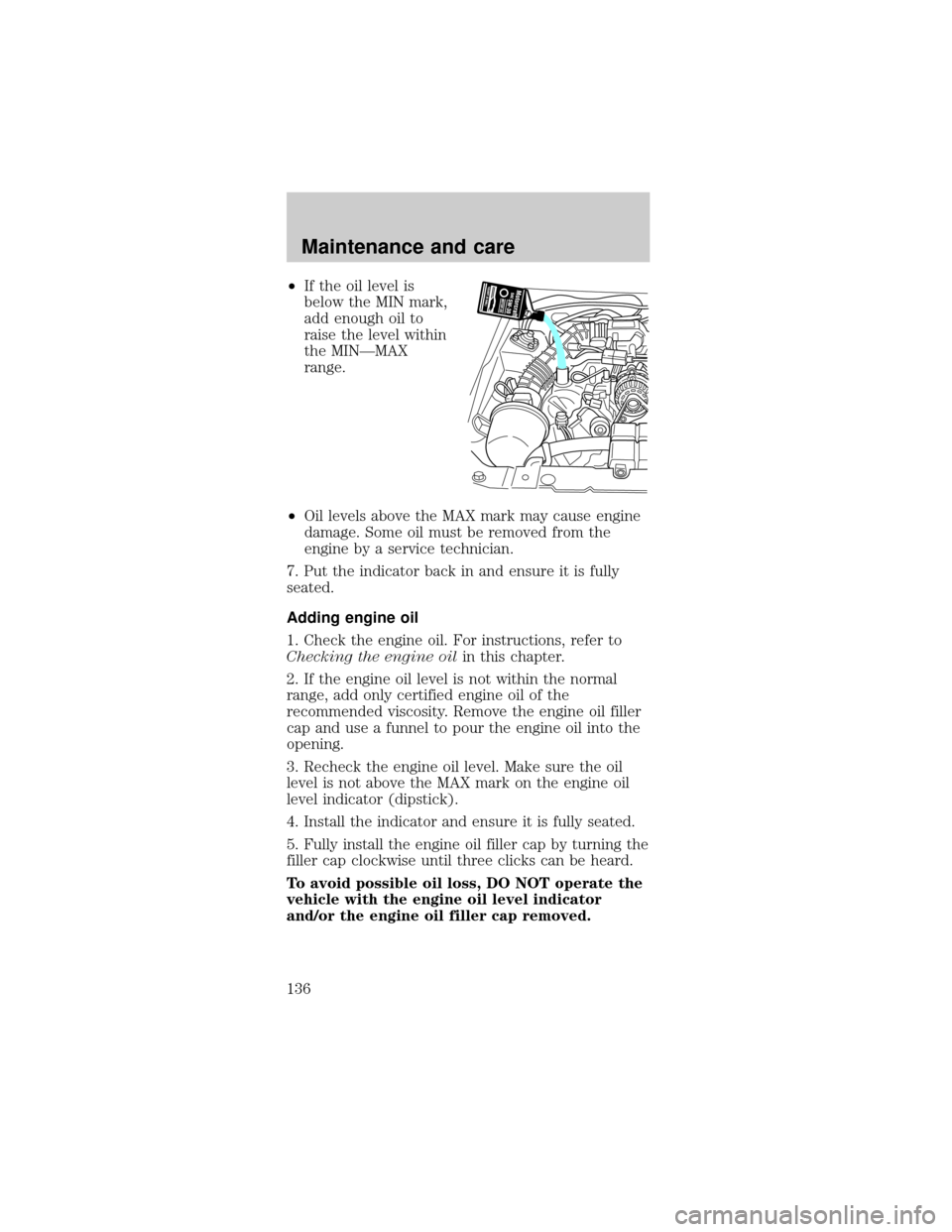
²If the oil level is
below the MIN mark,
add enough oil to
raise the level within
the MINÐMAX
range.
²Oil levels above the MAX mark may cause engine
damage. Some oil must be removed from the
engine by a service technician.
7. Put the indicator back in and ensure it is fully
seated.
Adding engine oil
1. Check the engine oil. For instructions, refer to
Checking the engine oilin this chapter.
2. If the engine oil level is not within the normal
range, add only certified engine oil of the
recommended viscosity. Remove the engine oil filler
cap and use a funnel to pour the engine oil into the
opening.
3. Recheck the engine oil level. Make sure the oil
level is not above the MAX mark on the engine oil
level indicator (dipstick).
4. Install the indicator and ensure it is fully seated.
5. Fully install the engine oil filler cap by turning the
filler cap clockwise until three clicks can be heard.
To avoid possible oil loss, DO NOT operate the
vehicle with the engine oil level indicator
and/or the engine oil filler cap removed.
Maintenance and care
136
Page 137 of 216
Engine oil and filter recommendations
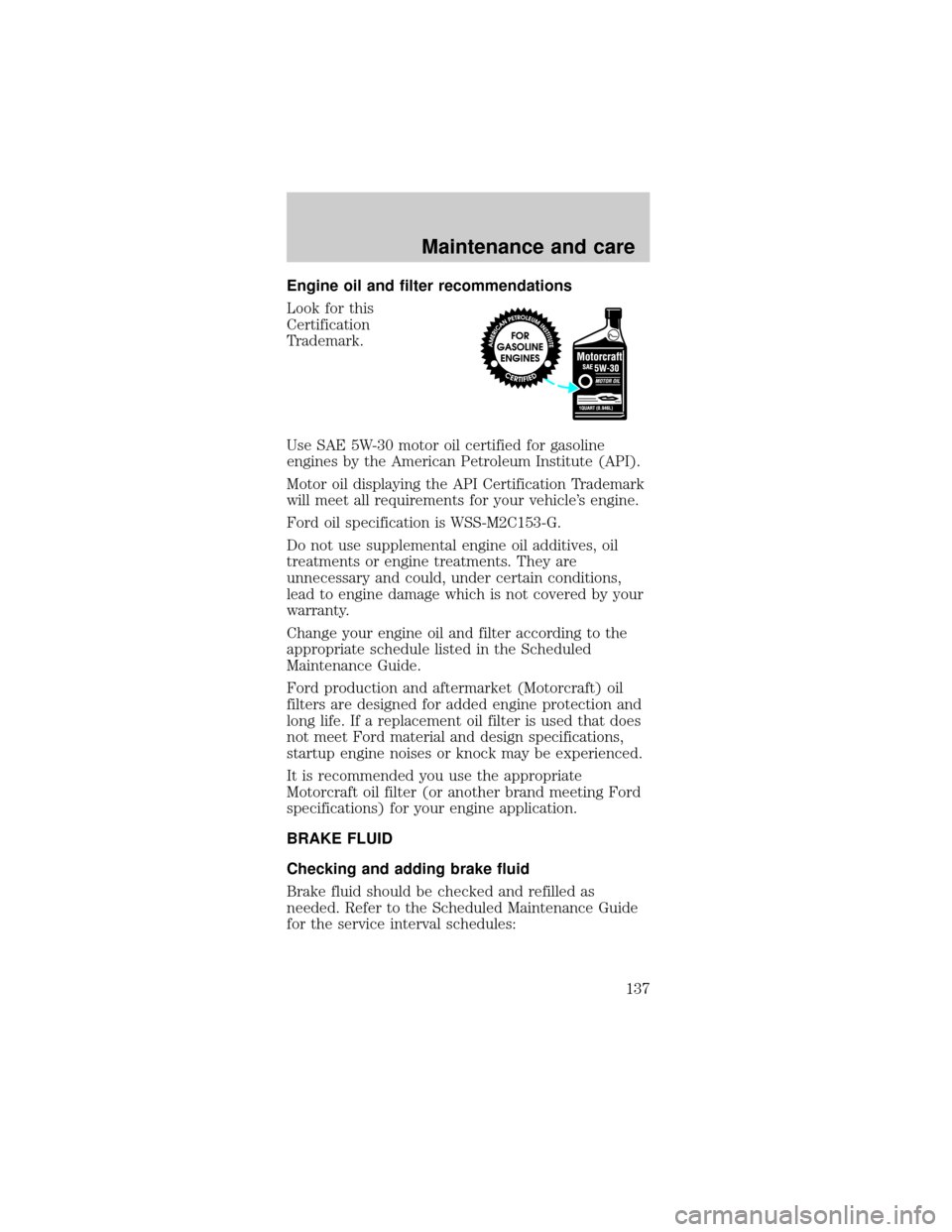
Look for this
Certification
Trademark.
Use SAE 5W-30 motor oil certified for gasoline
engines by the American Petroleum Institute (API).
Motor oil displaying the API Certification Trademark
will meet all requirements for your vehicle's engine.
Ford oil specification is WSS-M2C153-G.
Do not use supplemental engine oil additives, oil
treatments or engine treatments. They are
unnecessary and could, under certain conditions,
lead to engine damage which is not covered by your
warranty.
Change your engine oil and filter according to the
appropriate schedule listed in the Scheduled
Maintenance Guide.
Ford production and aftermarket (Motorcraft) oil
filters are designed for added engine protection and
long life. If a replacement oil filter is used that does
not meet Ford material and design specifications,
startup engine noises or knock may be experienced.
It is recommended you use the appropriate
Motorcraft oil filter (or another brand meeting Ford
specifications) for your engine application.
BRAKE FLUID
Checking and adding brake fluid
Brake fluid should be checked and refilled as
needed. Refer to the Scheduled Maintenance Guide
for the service interval schedules:
Maintenance and care
137
Page 138 of 216
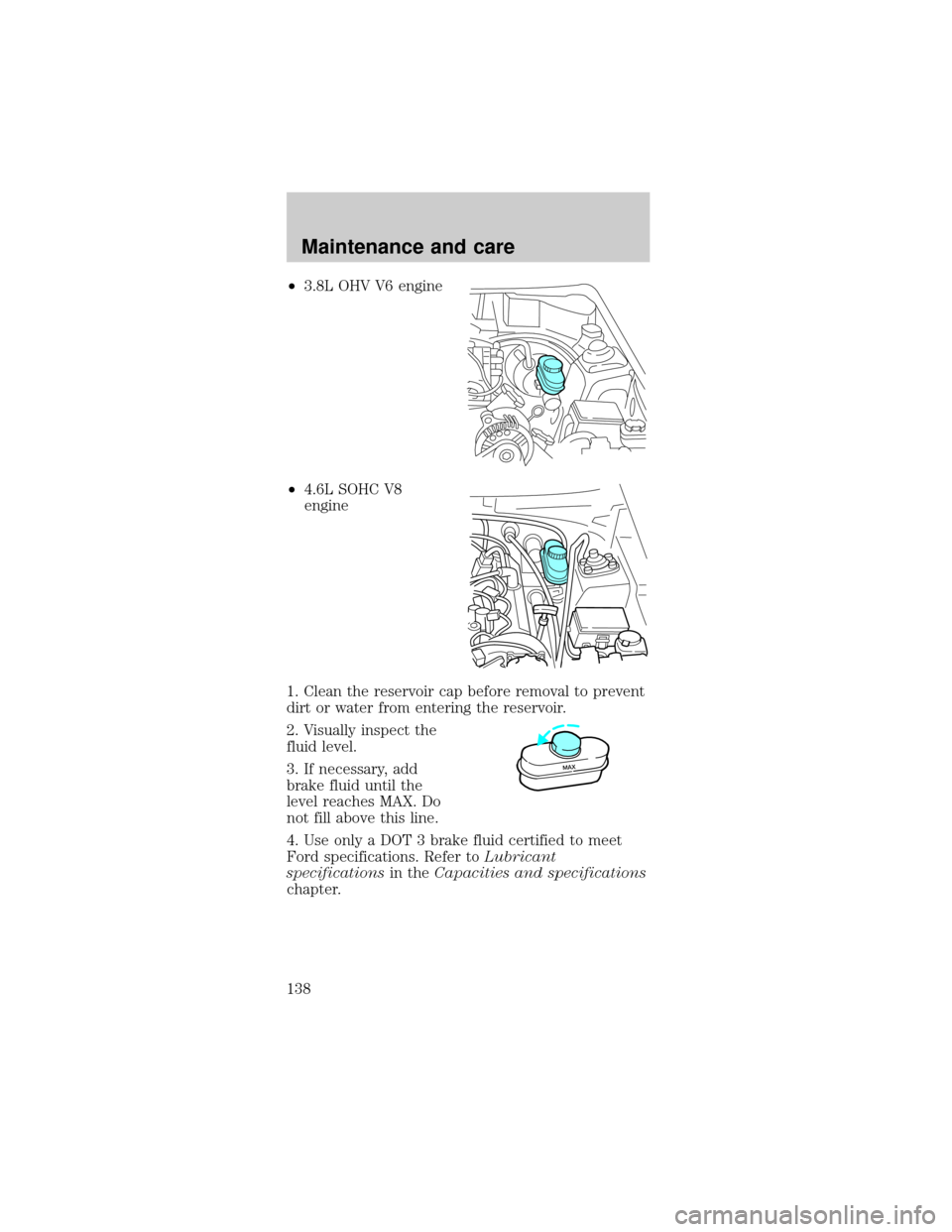
²3.8L OHV V6 engine
²4.6L SOHC V8
engine
1. Clean the reservoir cap before removal to prevent
dirt or water from entering the reservoir.
2. Visually inspect the
fluid level.
3. If necessary, add
brake fluid until the
level reaches MAX. Do
not fill above this line.
4. Use only a DOT 3 brake fluid certified to meet
Ford specifications. Refer toLubricant
specificationsin theCapacities and specifications
chapter.
MAX
Maintenance and care
138
Page 139 of 216
Brake fluid is toxic.
If you use a brake fluid that is not DOT 3,
you will cause permanent damage to your
brakes.
Do not let the reservoir for the master
cylinder run dry. This may cause the brakes
to fail.
CLUTCH ADJUSTMENT (IF EQUIPPED)
Check the clutch
adjustment. Refer to
the Scheduled
Maintenance Guide for
the service interval
schedules.
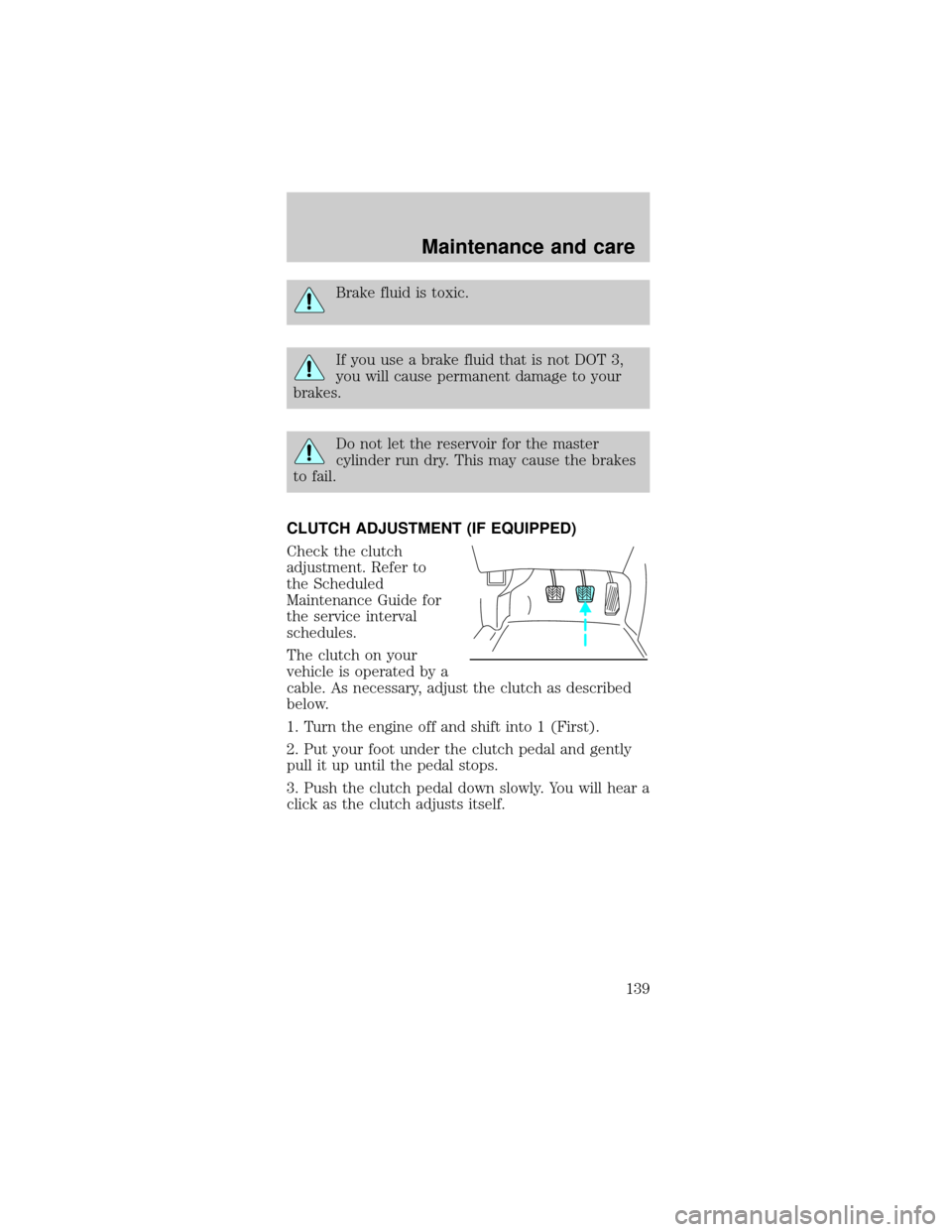
The clutch on your
vehicle is operated by a
cable. As necessary, adjust the clutch as described
below.
1. Turn the engine off and shift into 1 (First).
2. Put your foot under the clutch pedal and gently
pull it up until the pedal stops.
3. Push the clutch pedal down slowly. You will hear a
click as the clutch adjusts itself.
Maintenance and care
139
Page 140 of 216
WINDSHIELD WASHER FLUID
Checking and adding washer fluid
Check the washer fluid
whenever you stop for
fuel. The reservoir is
highlighted with a
symbol.
If the level is low, add
enough fluid to fill the
reservoir. In very cold
weather, do not fill the
reservoir all the way.
Do not put engine coolant in the container
for the windshield washer fluid.
Maintenance and care
140
Page 141 of 216
ENGINE COOLANT
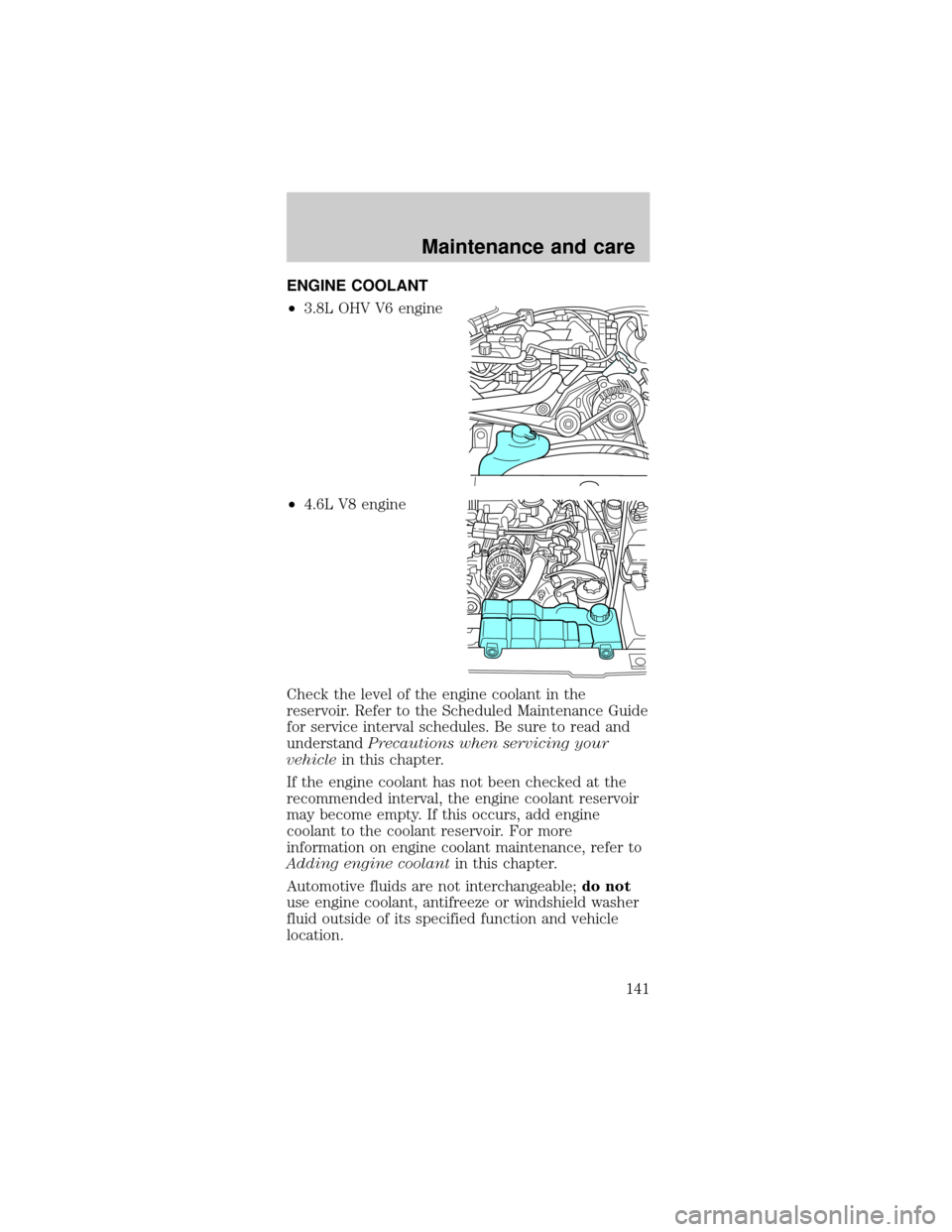
²3.8L OHV V6 engine
²4.6L V8 engine
Check the level of the engine coolant in the
reservoir. Refer to the Scheduled Maintenance Guide
for service interval schedules. Be sure to read and
understandPrecautions when servicing your
vehiclein this chapter.
If the engine coolant has not been checked at the
recommended interval, the engine coolant reservoir
may become empty. If this occurs, add engine
coolant to the coolant reservoir. For more
information on engine coolant maintenance, refer to
Adding engine coolantin this chapter.
Automotive fluids are not interchangeable;do not
use engine coolant, antifreeze or windshield washer
fluid outside of its specified function and vehicle
location.
Maintenance and care
141
Page 142 of 216
Adding engine coolant
Use only Ford Premium Engine Coolant
E2FZ-19549±AA (in Oregon, F5FZ-19549±CC, in
Canada, Motorcraft CXC-10) or a premium
engine coolant that meets Ford specification
ESE-M97B44±A.
²DO NOT USE Ford Extended Life Engine
Coolant F6AZ-19544±AA (orange in color).
²DO NOT USE a DEX-COOLtengine coolant
or an equivalent engine coolant that meets
Ford specification WSS-M97B44±D.
²DO NOT USE alcohol or methanol antifreeze
or any engine coolants mixed with alcohol or
methanol antifreeze.
²DO NOT USE supplemental coolant additives
in your vehicle. These additives may harm
your engine's cooling system.
²DO NOT MIX recycled coolant and
conventional coolant together in your
vehicle. Mixing of engine coolants may harm
your engine's cooling system.
²The use of an improper coolant may harm
engine and cooling system components and
may void the warranty of your vehicle's
engine cooling system.
²Use only the type of coolant with which your
vehicle was originally equipped. If you are
unsure which type of coolant your vehicle
requires, contact your local dealer.
Do not put engine coolant in the container
for the windshield washer fluid.
If sprayed on the windshield, engine coolant could
make it difficult to see through the windshield.
When the engine is cool, add a 50/50 mixture of
engine coolant and distilled water to the engine
coolant reservoir.
Maintenance and care
142
Page 143 of 216
Plain water may be added in an emergency, but you
mustreplace it with a 50/50 mixture of coolant and
distilled water as soon as possible.
Check the coolant level in the coolant reservoir the
next few times you drive the vehicle. If necessary,
add enough of a 50/50 mixture of coolant and
distilled water to bring the liquid level to the fill line
on the reservoir.
Never remove the coolant reservoir cap
while the engine is running or hot.
If you must remove the coolant reservoir cap, follow
these steps to avoid personal injury:
1. Before you remove the cap, turn the engine off
and let it cool.
2. When the engine is cool, wrap a thick cloth
around the cap. Slowly turn cap counterclockwise
until pressure begins to release.
3. Step back while the pressure releases.
4. When you are sure that all the pressure has been
released, use the cloth to turn it counterclockwise
and remove the cap.
Change your engine coolant according to the
appropriate schedule listed in the Scheduled
Maintenance Guide.
Recycled engine coolant
Ford Motor Company recommends that Ford and
Lincoln-Mercury dealers use recycled engine coolant
produced by Ford-approved processes.
Not all coolant recycling processes produce coolant
which meets Ford specification ESE-M97B44±A, and
use of such coolant may harm engine and cooling
system components.
Maintenance and care
143