Page 56 of 216

Raising the convertible top
The convertible top will not operate unless the
parking brake is engaged. Do not raise the top while
the vehicle is moving because the top may be
severely damaged.
To raise the convertible top:
1. Bring the vehicle to a complete stop. Engage the
parking brake. Key must be in the ON position.
2. Remove the boot cover and store it in the luggage
compartment.
3. Lower the front and rear side windows.
4. Push the convertible top button, holding it until
the top unfolds and moves forward toward the
windshield header.
5. Open both top clamps before the top meets the
windshield header
6. Continue to use the top motor to raise the top
until it has reached the fully closed position flush to
the header.
7. The two pins under the forward edge of the top
should seat themselves in the matching holes in the
header.
8. To fasten both clamps securely, push the clamp
handles into the header on the top until they are
flush with the header. Pulling down on the header at
the center grip while closing the latches may assist
in fastening the clamps.
9. Raise the front and rear side windows.
10. Disengage the parking brake.
REMOTE ENTRY SYSTEM
The remote entry system allows you to:
²lock or unlock all vehicle doors without a key.
²open the trunk.
²activate the panic alarm.
Controls and features
56
Page 60 of 216
²weather conditions
²nearby radio towers
²structures around the vehicle
²other vehicles parked next to the vehicle
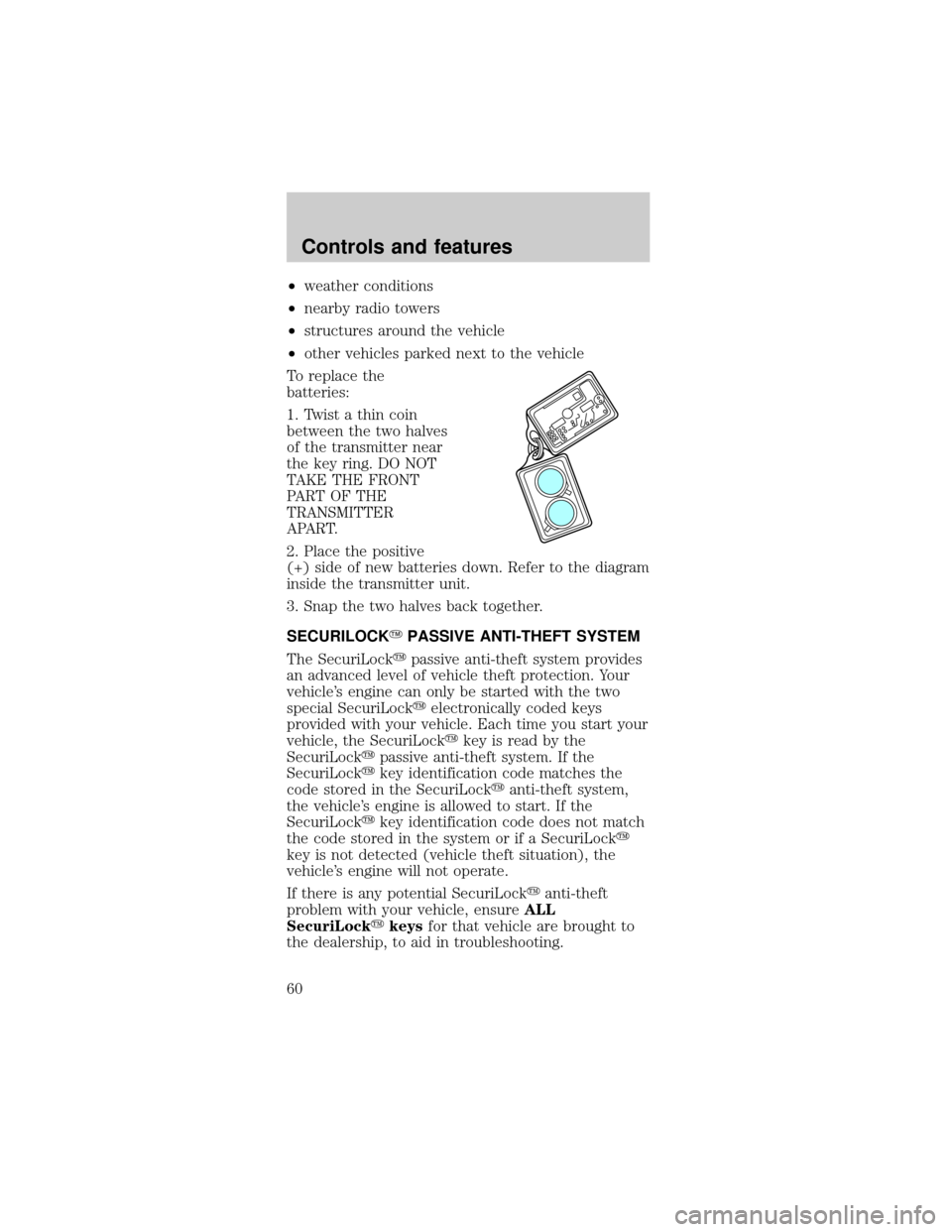
To replace the
batteries:
1. Twist a thin coin
between the two halves
of the transmitter near
the key ring. DO NOT
TAKE THE FRONT
PART OF THE
TRANSMITTER
APART.
2. Place the positive
(+) side of new batteries down. Refer to the diagram
inside the transmitter unit.
3. Snap the two halves back together.
SECURILOCKYPASSIVE ANTI-THEFT SYSTEM
The SecuriLockypassive anti-theft system provides
an advanced level of vehicle theft protection. Your
vehicle's engine can only be started with the two
special SecuriLockyelectronically coded keys
provided with your vehicle. Each time you start your
vehicle, the SecuriLockykey is read by the
SecuriLockypassive anti-theft system. If the
SecuriLockykey identification code matches the
code stored in the SecuriLockyanti-theft system,
the vehicle's engine is allowed to start. If the
SecuriLockykey identification code does not match
the code stored in the system or if a SecuriLocky
key is not detected (vehicle theft situation), the
vehicle's engine will not operate.
If there is any potential SecuriLockyanti-theft
problem with your vehicle, ensureALL
SecuriLockykeysfor that vehicle are brought to
the dealership, to aid in troubleshooting.
Controls and features
60
Page 85 of 216
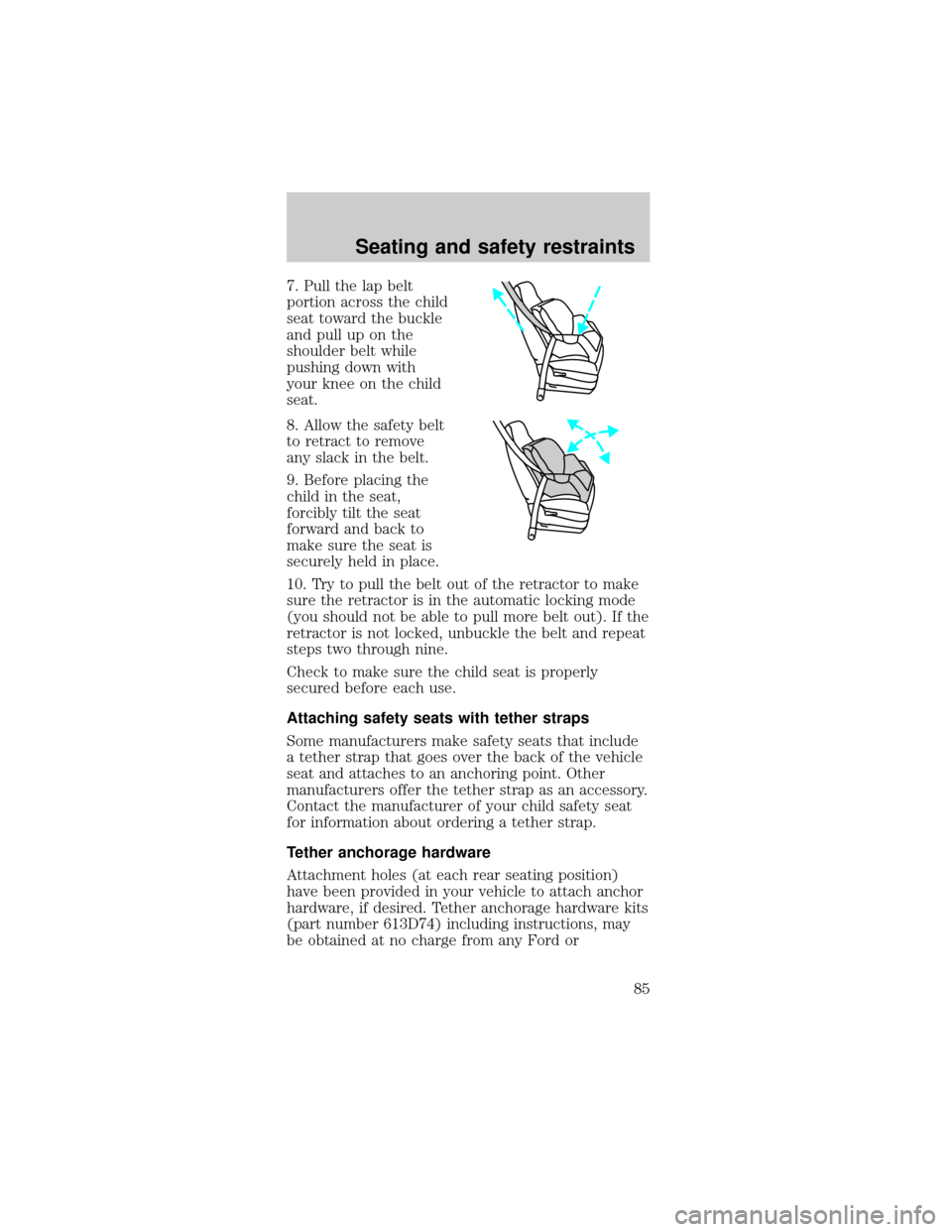
7. Pull the lap belt
portion across the child
seat toward the buckle
and pull up on the
shoulder belt while
pushing down with
your knee on the child
seat.
8. Allow the safety belt
to retract to remove
any slack in the belt.
9. Before placing the
child in the seat,
forcibly tilt the seat
forward and back to
make sure the seat is
securely held in place.
10. Try to pull the belt out of the retractor to make
sure the retractor is in the automatic locking mode
(you should not be able to pull more belt out). If the
retractor is not locked, unbuckle the belt and repeat
steps two through nine.
Check to make sure the child seat is properly
secured before each use.
Attaching safety seats with tether straps
Some manufacturers make safety seats that include
a tether strap that goes over the back of the vehicle
seat and attaches to an anchoring point. Other
manufacturers offer the tether strap as an accessory.
Contact the manufacturer of your child safety seat
for information about ordering a tether strap.
Tether anchorage hardware
Attachment holes (at each rear seating position)
have been provided in your vehicle to attach anchor
hardware, if desired. Tether anchorage hardware kits
(part number 613D74) including instructions, may
be obtained at no charge from any Ford or
Seating and safety restraints
85
Page 98 of 216

Do not drive your vehicle until you verify
that the brakelamps are working.
If your vehicle gets stuck in mud or snow it may be
rocked out by shifting from forward and reverse
gears, stopping between shifts, in a steady pattern.
Press lightly on the accelerator in each gear.
Do not rock the vehicle for more than a few
minutes. The transmission and tires may be
damaged or the engine may overheat.
Always set the parking brake fully and make
sure the gearshift is latched in P (Park).
Turn off the ignition whenever you leave your
vehicle.
If the parking brake is fully released, but the
brake warning lamp remains illuminated, the
brakes may not be working properly. See your
dealer or a qualified service technician.
Driving with a 4±speed automatic transmission
(if equipped)
Understanding gearshift positions
Pull the gearshift lever towards you and downward
to move the automatic gearshift.
Hold the brake pedal down while you move
the gearshift lever from P (Park) to another
position. If you do not hold the brake pedal down,
your vehicle may move unexpectedly and injure
someone.
Driving
98
Page 101 of 216

instrument cluster. Transmission operates in gears one
through three.
(Drive) provides more engine
braking than
(Overdrive) and is useful when:
²driving with a heavy load
²towing a trailer up or down steep hills
²additional engine braking is desired. If towing a
trailer, refer toDriving while you towin the
Trailer Towingchapter.
To return to
(Overdrive) mode, press the
transmission control switch. The O/D OFF indicator
will no longer be illuminated.
Each time the vehicle is started, the transmission
will automatically return to normal overdrive mode.
Every time the vehicle is shut off and restarted, you
must press the transmission control switch to cancel
overdrive operation if driving in overdrive is not
desired.
2 (Second)
Use 2 (Second) to
start-up on slippery
roads or to provide
additional engine
braking on downgrades.
1 (First)
Use 1 (Low) to provide
maximum engine
braking on steep
downgrades. Upshifts
can be made by
shifting to 2 (Second)
or to
(Overdrive).
Selecting 1 (Low) at
higher speeds causes the transmission to shift to a
lower gear, and will shift to 1 (Low) after vehicle
decelerates to the proper speed.
Driving
101
Page 105 of 216
gearshift back into Neutral. Then, release the
clutch pedal for a moment and repeat steps 2
through 4.
Removing key from ignition
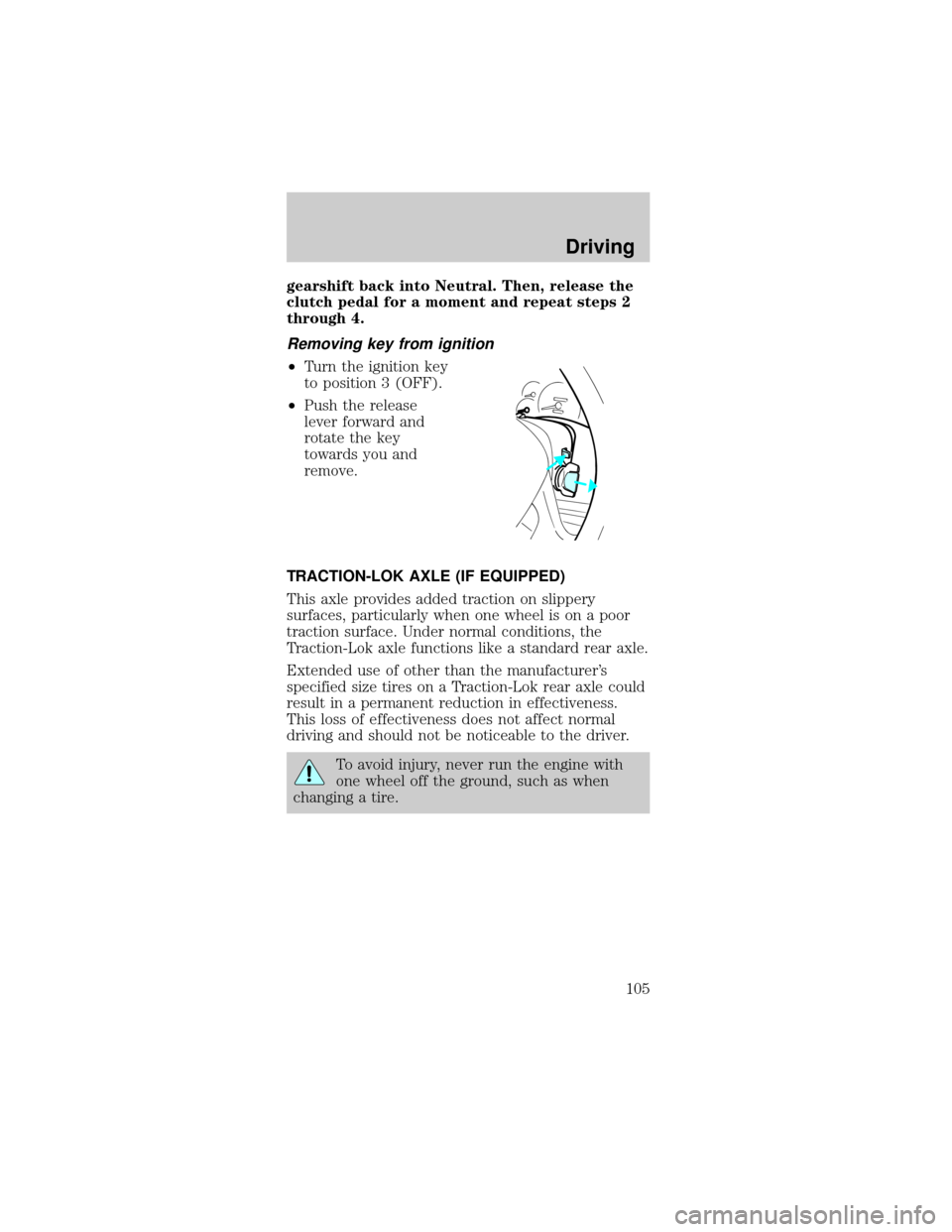
²Turn the ignition key
to position 3 (OFF).
²Push the release
lever forward and
rotate the key
towards you and
remove.
TRACTION-LOK AXLE (IF EQUIPPED)
This axle provides added traction on slippery
surfaces, particularly when one wheel is on a poor
traction surface. Under normal conditions, the
Traction-Lok axle functions like a standard rear axle.
Extended use of other than the manufacturer's
specified size tires on a Traction-Lok rear axle could
result in a permanent reduction in effectiveness.
This loss of effectiveness does not affect normal
driving and should not be noticeable to the driver.
To avoid injury, never run the engine with
one wheel off the ground, such as when
changing a tire.
Driving
105
Page 106 of 216

VEHICLE LOADING
Before loading a vehicle, familiarize yourself with the
following terms:
²Base Curb Weight: Weight of the vehicle
including any standard equipment, fluids,
lubricants, etc. It does not include passengers or
aftermarket equipment.
²Payload: Combined maximum allowable weight
of cargo, passengers and optional equipment. The
payload equals the gross vehicle weight rating
minus base curb weight.
²GVW (Gross Vehicle Weight): Base curb
weight plus payload weight. The GVW is not a
limit or a specification.
²GVWR (Gross Vehicle Weight Rating):
Maximum total weight of the base vehicle,
passengers, optional equipment and cargo. The
GVWR is specific to each vehicle and is listed on the
Safety Compliance Label on the driver's door pillar.
²GAWR (Gross Axle Weight Rating): Carrying
capacity for each axle system. The GAWR is
specific to each vehicle and is listed on the Safety
Compliance Label on the driver's door pillar.
²GCW (Gross Combined Weight): The
combined weight of the towing vehicle (including
passengers and cargo) and the trailer.
²GCWR (Gross Combined Weight Rating):
Maximum combined weight of towing vehicle
(including passengers and cargo) and the trailer.
The GCWR indicates the maximum loaded weight
that the vehicle is designed to tow.
²Maximum Trailer Weight Rating: Maximum
weight of a trailer the vehicle is permitted to tow.
The maximum trailer weight rating is determined
by subtracting the vehicle curb weight for each
engine/transmission combination, any required
option weight for trailer towing and the weight of
the driver from the GCWR for the towing vehicle.
Driving
106
Page 107 of 216
²Maximum Trailer Weight: maximum weight of
a trailer the loaded vehicle (including passengers
and cargo) is permitted to tow. It is determined
by subtracting the weight of the loaded trailer
towing vehicle from the GCWR for the towing
vehicle.
²Trailer Weight Range: Specified weight range
that the trailer must fall within that ranges from
zero to the maximum trailer weight rating.
Remember to figure in the tongue load of your
loaded trailer when figuring the total weight.
Do not exceed the GVWR or the GAWR
specified on the certification label.
Do not use replacement tires with lower load
carrying capacities than the originals because they
may lower the vehicle's GVWR and GAWR
limitations. Replacement tires with a higher limit
than the originals do not increase the GVWR and
GAWR limitations.
The Certification Label, found on the inside pillar of
the driver's door, lists several important vehicle
weight rating limitations. Before adding any
additional equipment, refer to these limitations. If
you are adding weight to the front of your vehicle,
(potentially including weight added to the cab), the
weight added should not exceed the Front Axle
Reserve Capacity (FARC). Additional frontal weight
may be added to the front axle reserve capacity
provided you limit your payload in other ways (i.e.
restrict the number of passengers or amount of
cargo carried).
You may add equipment throughout your vehicle if
the total weight added is equal to or less than the
Total Axle Reserve Capacity (TARC) weight. You
should NEVER exceed the Total Axle Reserve
Capacity.
Driving
107