Page 144 of 216
Always dispose of used automotive fluids in a
responsible manner. Follow your community's
regulations and standards for recycling and disposing
of automotive fluids.
Coolant refill capacity
To find out how much fluid your vehicle's cooling
system can hold, refer toRefill capacitiesin the
Capacities and specificationschapter.
Have your dealer check the engine cooling system
for leaks if you have to add more than 1.0 liter (1.0
quart) of engine coolant per month.
Severe winter climate
If you drive in extremely cold climates (less than
±36ÉC [±34ÉF]), it may be necessary to increase the
coolant concentration above 50%. Refer to the chart
on the coolant container to ensure the coolant
concentration in your vehicle is such that the
coolant will not freeze at the temperature level in
which you drive during winter months. Never
increase the coolant concentration above 60%.
Increased engine coolant concentrations above 60%
will decrease the freeze protection characteristics of
the engine coolant. Vehicles driven year-round in
non-extreme climates should use a 50/50 mixture of
engine coolant and distilled water for optimum
freeze protection.
CHECKING AND ADDING POWER STEERING
FLUID
Check the power steering fluid. Refer to the
Scheduled Maintenance Guide for the service
interval schedules. If adding fluid is necessary, use
only MERCONtAT F.
Maintenance and care
144
Page 146 of 216

If your vehicle is
equipped with a 4.6L
V8 engine,check the
power steering fluid
level with the engine at
ambient temperature.
Allow at least one-half
hour after driving for
the power steering
fluid to cool.
1. Start the engine and
allow the engine to
idle.
2. Turn the steering
wheel left and right
several times.
3. Turn the engine off.
4. Check the fluid level in the reservoir. It should be
between the MIN and MAX lines. Do not add fluid if
the level is within this range.
5. If the fluid is low, add fluid in small amounts,
continuously checking the level until it reaches the
correct operating range. Be sure to put the cap back
on the reservoir.
TRANSMISSION FLUID
Checking automatic transmission fluid
Refer to your Scheduled Maintenance Guide for
scheduled intervals for fluid checks and changes.
Your transmission does not consume fluid. However,
the fluid level should be checked if the transmission
is not working properly, i.e., if the transmission slips
or shifts slowly or if you notice some sign of fluid
leakage.
Automatic transmission fluid expands when warmed.
To obtain an accurate fluid check, drive the vehicle
until it is at normal operating temperature
(approximately 30 km [20 miles]). If your vehicle has
MAXMIN
Maintenance and care
146
Page 150 of 216
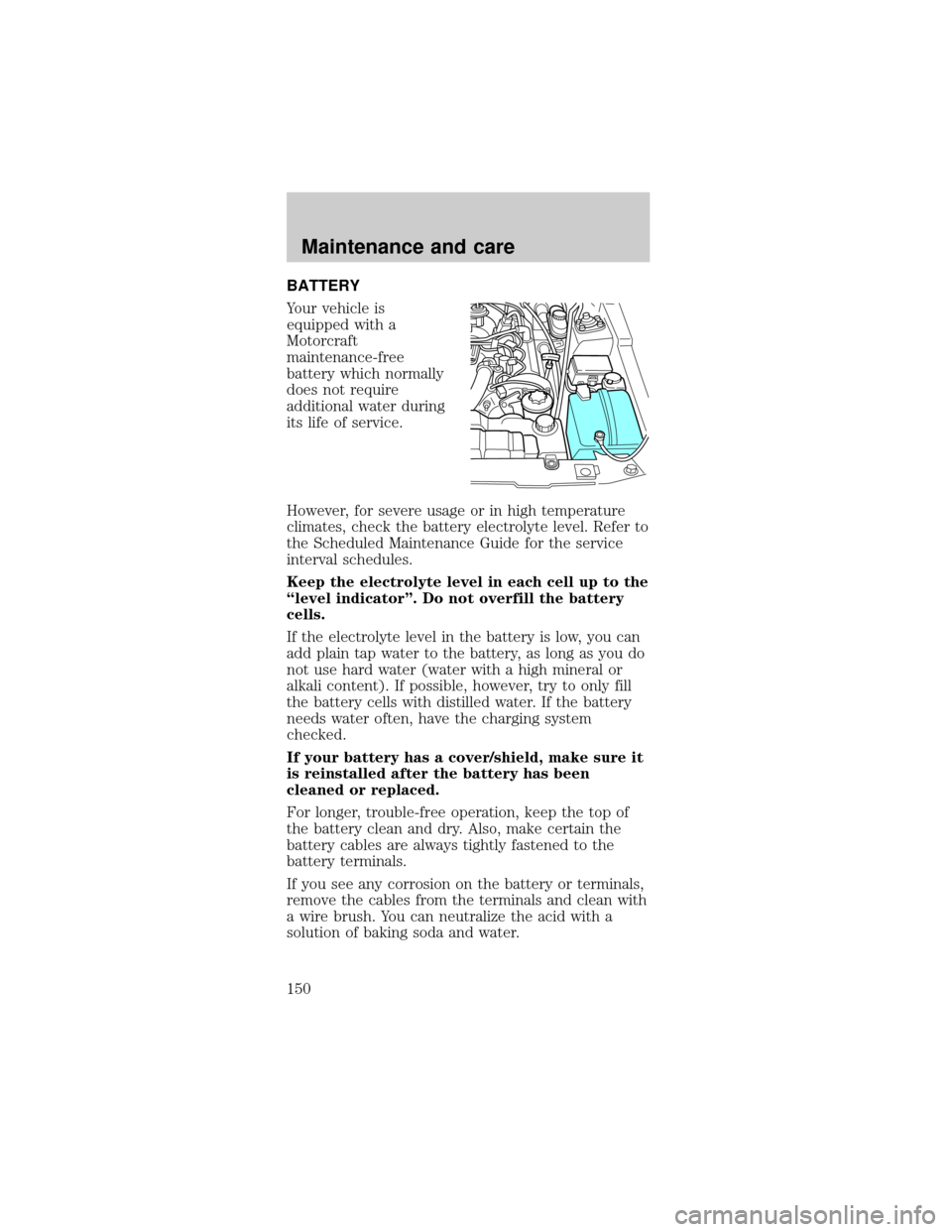
BATTERY
Your vehicle is
equipped with a
Motorcraft
maintenance-free
battery which normally
does not require
additional water during
its life of service.
However, for severe usage or in high temperature
climates, check the battery electrolyte level. Refer to
the Scheduled Maintenance Guide for the service
interval schedules.
Keep the electrolyte level in each cell up to the
ªlevel indicatorº. Do not overfill the battery
cells.
If the electrolyte level in the battery is low, you can
add plain tap water to the battery, as long as you do
not use hard water (water with a high mineral or
alkali content). If possible, however, try to only fill
the battery cells with distilled water. If the battery
needs water often, have the charging system
checked.
If your battery has a cover/shield, make sure it
is reinstalled after the battery has been
cleaned or replaced.
For longer, trouble-free operation, keep the top of
the battery clean and dry. Also, make certain the
battery cables are always tightly fastened to the
battery terminals.
If you see any corrosion on the battery or terminals,
remove the cables from the terminals and clean with
a wire brush. You can neutralize the acid with a
solution of baking soda and water.
Maintenance and care
150
Page 155 of 216
Motor Vehicle Safety Standard No. 109. Grades B
and A represent higher levels of performance on the
laboratory test wheel than the minimum required by
law.
The temperature grade for this tire is
established for a tire that is properly inflated
and not overloaded. Excessive speed,
underinflation, or excessive loading, either
separately or in combination, can cause heat
buildup and possible tire failure.
SERVICING YOUR TIRES
Checking the tire pressure
²Use an accurate tire pressure gauge.
²Check the tire pressure when tires are cold, after
the vehicle has been parked for at least one hour
or has been driven less than 5 km (3 miles).
²Adjust tire pressure to recommended
specifications found on the Certification Label.
Improperly inflated tires can affect vehicle
handling and can fail suddenly, possibly
resulting in loss of vehicle control.
Tire rotation
Because your vehicle's tires perform different jobs,
they often wear differently. To make sure your tires
wear evenly and last longer, rotate them as indicated
in the Scheduled Maintenance Guide. If you notice
that the tires wear unevenly, have them checked.
Maintenance and care
155
Page 163 of 216
ªPremiumº unleaded gasoline is not recommended
(particularly in the United States) because it may
cause these problems to become more pronounced.
If the problems persist, see your dealer or a qualified
service technician.
It should not be necessary to add any aftermarket
products to your fuel tank if you continue to use a
high quality fuel.
Cleaner air
Ford approves the use of gasolines to improve air
quality, including reformulated gasolines that contain
oxygenates up to 10% ethanol or 15% MTBE.
Running out of fuel
Avoid running out fuel because this situation may
have an adverse affect on powertrain components.
If you have run out of fuel:
²You may need to crank the engine several times
after refueling before the system starts to pump
the fuel from the tank to the engine.
²Your ªService Engine Soonº indicator may come
on. For more information on the ªService Engine
Soonº indicator, refer to theInstrumentation
chapter.
Fuel Filter
For fuel filter replacement, see your dealer or a
qualified service technician. Refer to the Scheduled
Maintenance Guide for the appropriate intervals for
changing the fuel filter.
Replace the fuel filter with an authorized
Motorcraft part. The customer warranty may
be void for any damage to the fuel system if an
authorized Motorcraft fuel filter is not used.
Maintenance and care
163
Page 167 of 216
²Combine errands and minimize stop-and-go
driving.
Maintenance
²Keep tires properly inflated and use only
recommended size.
²Operating a vehicle with the wheels out of
alignment will reduce fuel economy.
²Use recommended engine oil. Refer toLubricant
Specifications.
²Perform all regularly scheduled maintenance
items. Follow the recommended maintenance
schedule and owner maintenance checks found in
your vehicle Scheduled Maintenance Guide.
Conditions
²Heavily loading a vehicle or towing a trailer may
reduce fuel economy at any speed.
²Carrying unnecessary weight may reduce fuel
economy (approximately 2 km/h [1 mpg] is lost
for every 180 kg [400 lb] of weight carried).
²Adding certain accessories to your vehicle (for
example bug deflectors, rollover/light bars,
running boards, ski/luggage racks) may reduce
fuel economy.
²Using fuel blended with alcohol may lower fuel
economy.
²Fuel economy may decrease with lower
temperatures during the first 12±16 km (8±10
miles) of driving.
²Driving on flat terrain offers improved fuel
economy as compared to driving on hilly terrain.
²Transmissions give their best fuel economy when
operated in the top cruise gear and with steady
pressure on the gas pedal.
²Close windows for high speed driving.
Maintenance and care
167
Page 168 of 216
EPA window sticker
Every new vehicle should have the EPA window
sticker. Contact your dealer if the window sticker is
not supplied with your vehicle. The EPA window
sticker should be your guide for the fuel economy
comparisons with other vehicles.
It is important to note the box in the lower left
corner of the window sticker. These numbers
represent the Range of Km/L (MPG) expected on
the vehicle under optimum conditions. Your fuel
economy may vary depending upon the method of
operation and conditions.
EMISSION CONTROL SYSTEM
Your vehicle is equipped with various emission
control components and a catalytic converter which
will enable your vehicle to comply with applicable
exhaust emission standards. To make sure that the
catalytic converter and other emission control
components continue to work properly:
²Use only unleaded fuel.
²Avoid running out of fuel.
²Do not turn off the ignition while your vehicle is
moving, especially at high speeds.
²Have the items listed in your Scheduled
Maintenance Guide performed according to the
specified schedule.
The scheduled maintenance items listed in the
Scheduled Maintenance Guide are essential to the
life and performance of your vehicle and to its
emissions system.
If other than Ford, Motorcraft or Ford-authorized
parts are used for maintenance replacements or for
service of components affecting emission control,
such non-Ford parts should be equivalent to genuine
Ford Motor Company parts in performance and
durability.
Maintenance and care
168
Page 185 of 216
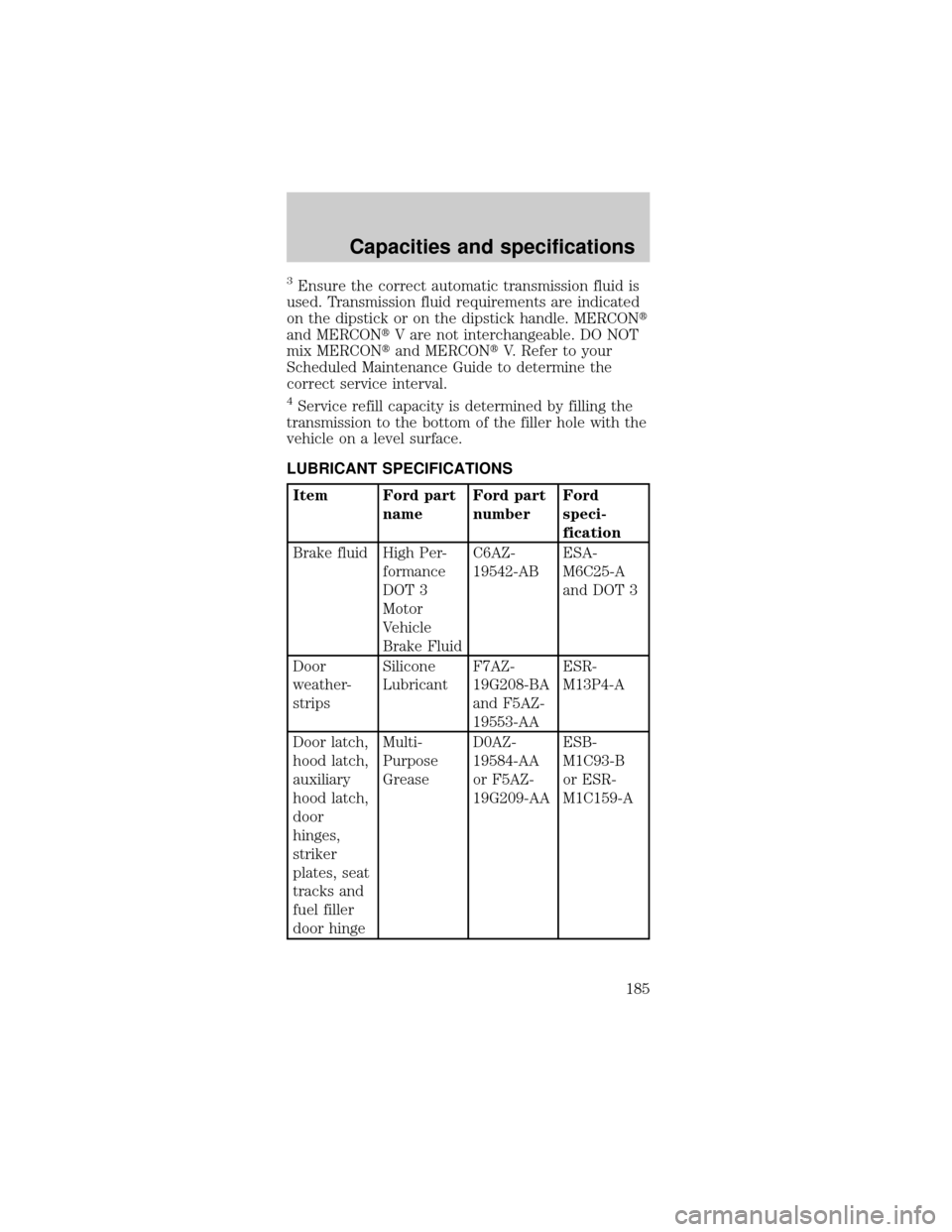
3Ensure the correct automatic transmission fluid is
used. Transmission fluid requirements are indicated
on the dipstick or on the dipstick handle. MERCONt
and MERCONtV are not interchangeable. DO NOT
mix MERCONtand MERCONtV. Refer to your
Scheduled Maintenance Guide to determine the
correct service interval.
4Service refill capacity is determined by filling the
transmission to the bottom of the filler hole with the
vehicle on a level surface.
LUBRICANT SPECIFICATIONS
Item Ford part
nameFord part
numberFord
speci-
fication
Brake fluid High Per-
formance
DOT 3
Motor
Vehicle
Brake FluidC6AZ-
19542-ABESA-
M6C25-A
and DOT 3
Door
weather-
stripsSilicone
LubricantF7AZ-
19G208-BA
and F5AZ-
19553-AAESR-
M13P4-A
Door latch,
hood latch,
auxiliary
hood latch,
door
hinges,
striker
plates, seat
tracks and
fuel filler
door hingeMulti-
Purpose
GreaseD0AZ-
19584-AA
or F5AZ-
19G209-AAESB-
M1C93-B
or ESR-
M1C159-A
Capacities and specifications
185