Page 80 of 216

Never let a passenger hold a child on his or
her lap while the vehicle is moving. The
passenger cannot protect the child from injury in a
collision.
Always follow the instructions and warnings that
come with any infant or child restraint you might
use.
When possible, always place children under age 12
in the rear seat of your vehicle. Accident statistics
suggest that children are safer when properly
restrained in the rear seating positions than in the
front seating position.
Children and safety belts
If the child is the proper size, restrain the child in a
safety seat.
Children who are too large for child safety seats (as
specified by your child safety seat manufacturer)
should always wear safety belts.
Follow all the important safety restraint and air bag
precautions that apply to adult passengers in your
vehicle.
If the shoulder belt portion of a combination lap and
shoulder belt can be positioned so it does not cross
or rest in front of the child's face or neck, the child
should wear the lap and shoulder belt. Moving the
child closer to the center of the vehicle may help
provide a good shoulder belt fit.
Do not leave children, unreliable adults, or
pets unattended in your vehicle.
To improve the fit of lap and shoulder belts on
children who have outgrown child safety seats, Ford
recommends use of a belt-positioning booster seat
that is labelled as conforming to all Federal motor
vehicle safety standards. Belt-positioning booster
Seating and safety restraints
80
Page 81 of 216
seats raise the child and provide a shorter, firmer
seating cushion that encourages safer seating
posture and better fit of lap and shoulder belts on
the child.
A belt-positioning booster should be used if the
shoulder belt rests in front of the child's face or
neck, or if the lap belt does not fit snugly on both
thighs, or if the thighs are too short to let the child
sit all the way back on the seat cushion when the
lower legs hang over the edge of the seat cushion.
You may wish to discuss the special needs of your
child with your pediatrician.
SAFETY SEATS FOR CHILDREN
Child and infant or child safety seats
Use a safety seat that is recommended for the size
and weight of the child. Carefully follow all of the
manufacturer's instructions with the safety seat you
put in your vehicle. If you do not install and use the
safety seat properly, the child may be injured in a
sudden stop or collision.
Seating and safety restraints
81
Page 82 of 216
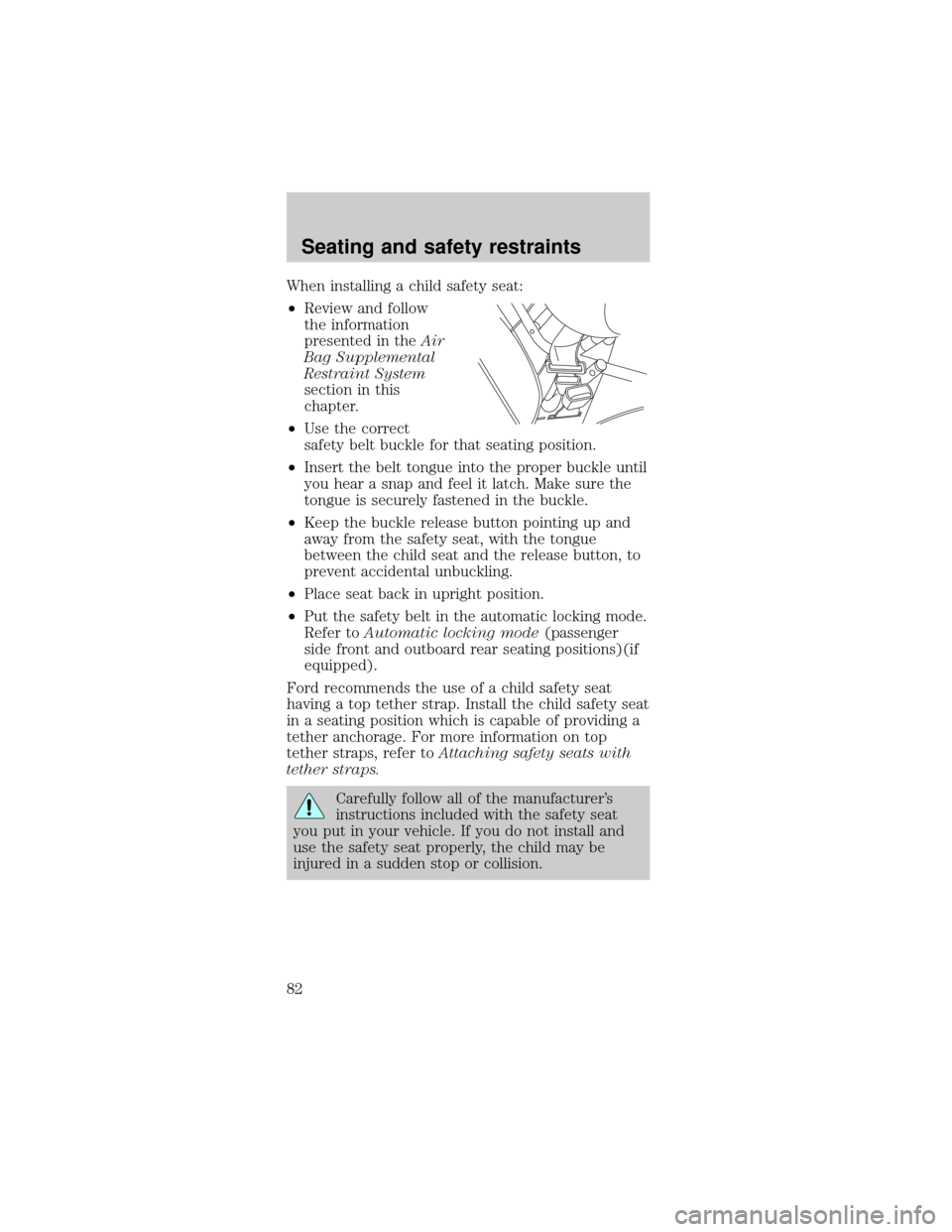
When installing a child safety seat:
²Review and follow
the information
presented in theAir
Bag Supplemental
Restraint System
section in this
chapter.
²Use the correct
safety belt buckle for that seating position.
²Insert the belt tongue into the proper buckle until
you hear a snap and feel it latch. Make sure the
tongue is securely fastened in the buckle.
²Keep the buckle release button pointing up and
away from the safety seat, with the tongue
between the child seat and the release button, to
prevent accidental unbuckling.
²Place seat back in upright position.
²Put the safety belt in the automatic locking mode.
Refer toAutomatic locking mode(passenger
side front and outboard rear seating positions)(if
equipped).
Ford recommends the use of a child safety seat
having a top tether strap. Install the child safety seat
in a seating position which is capable of providing a
tether anchorage. For more information on top
tether straps, refer toAttaching safety seats with
tether straps.
Carefully follow all of the manufacturer's
instructions included with the safety seat
you put in your vehicle. If you do not install and
use the safety seat properly, the child may be
injured in a sudden stop or collision.
Seating and safety restraints
82
Page 83 of 216
Installing child safety seats in combination lap
and shoulder belt seating positions
If you must use a forward facing child seat in the
front seat (reminder children 12 years old and
unders should always be properly restrained in the
rear seat). The shoulder belt must be routed
through the belt holder at the top of the seatback,
refer toSafety Restraintsearlier in this chapter for
routing through the belt holder.
1. Position the child
safety seat in a seat
with a combination lap
and shoulder belt.
An air bag can kill or injure a child in a child
seat. If you must use a forward-facing child
seat in the front seat, move seat all the way back.
Children 12 and under should be properly
restrained in the rear seat whenever
possible.
2. Pull down on the
shoulder belt and then
grasp the shoulder belt
and lap belt together.
Seating and safety restraints
83
Page 84 of 216
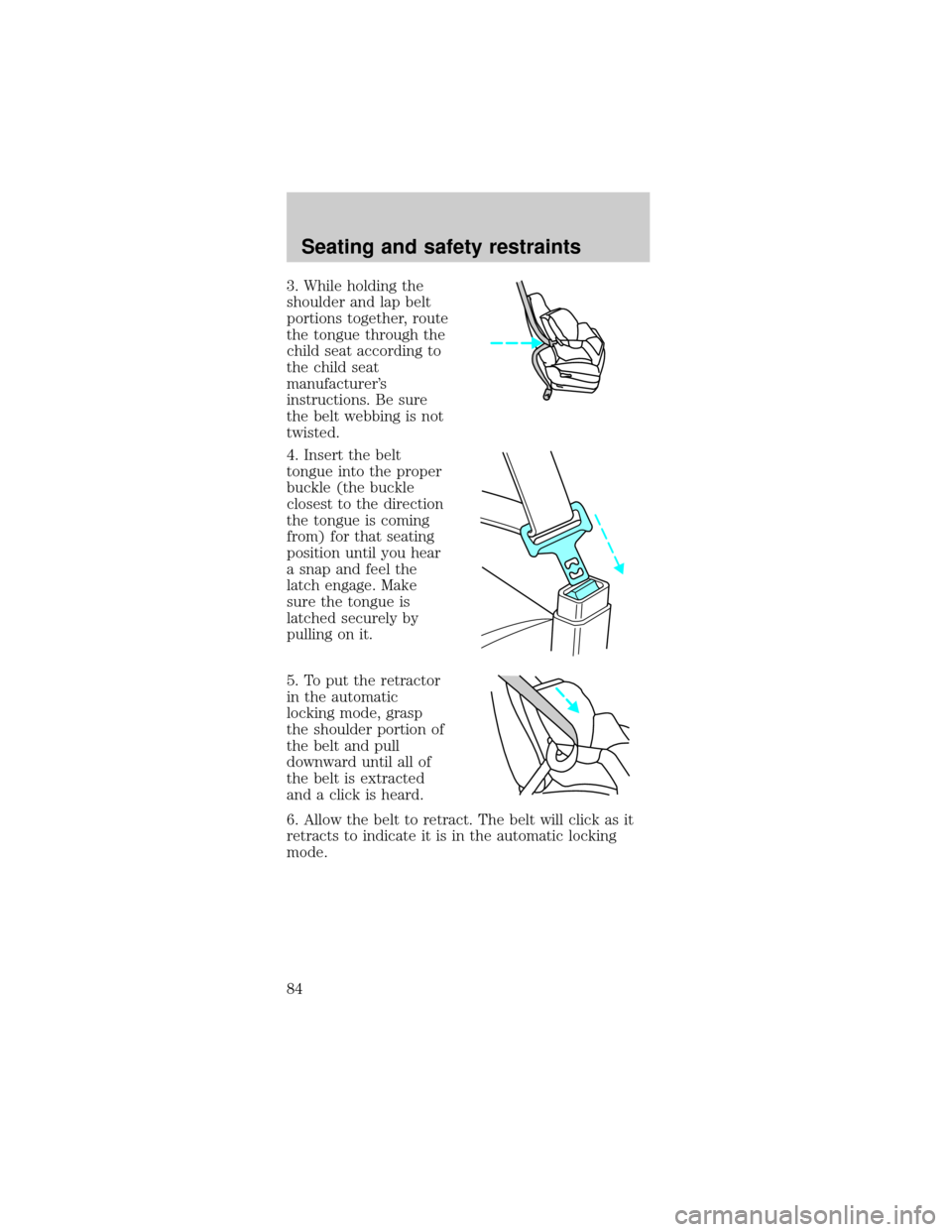
3. While holding the
shoulder and lap belt
portions together, route
the tongue through the
child seat according to
the child seat
manufacturer's
instructions. Be sure
the belt webbing is not
twisted.
4. Insert the belt
tongue into the proper
buckle (the buckle
closest to the direction
the tongue is coming
from) for that seating
position until you hear
a snap and feel the
latch engage. Make
sure the tongue is
latched securely by
pulling on it.
5. To put the retractor
in the automatic
locking mode, grasp
the shoulder portion of
the belt and pull
downward until all of
the belt is extracted
and a click is heard.
6. Allow the belt to retract. The belt will click as it
retracts to indicate it is in the automatic locking
mode.
Seating and safety restraints
84
Page 85 of 216
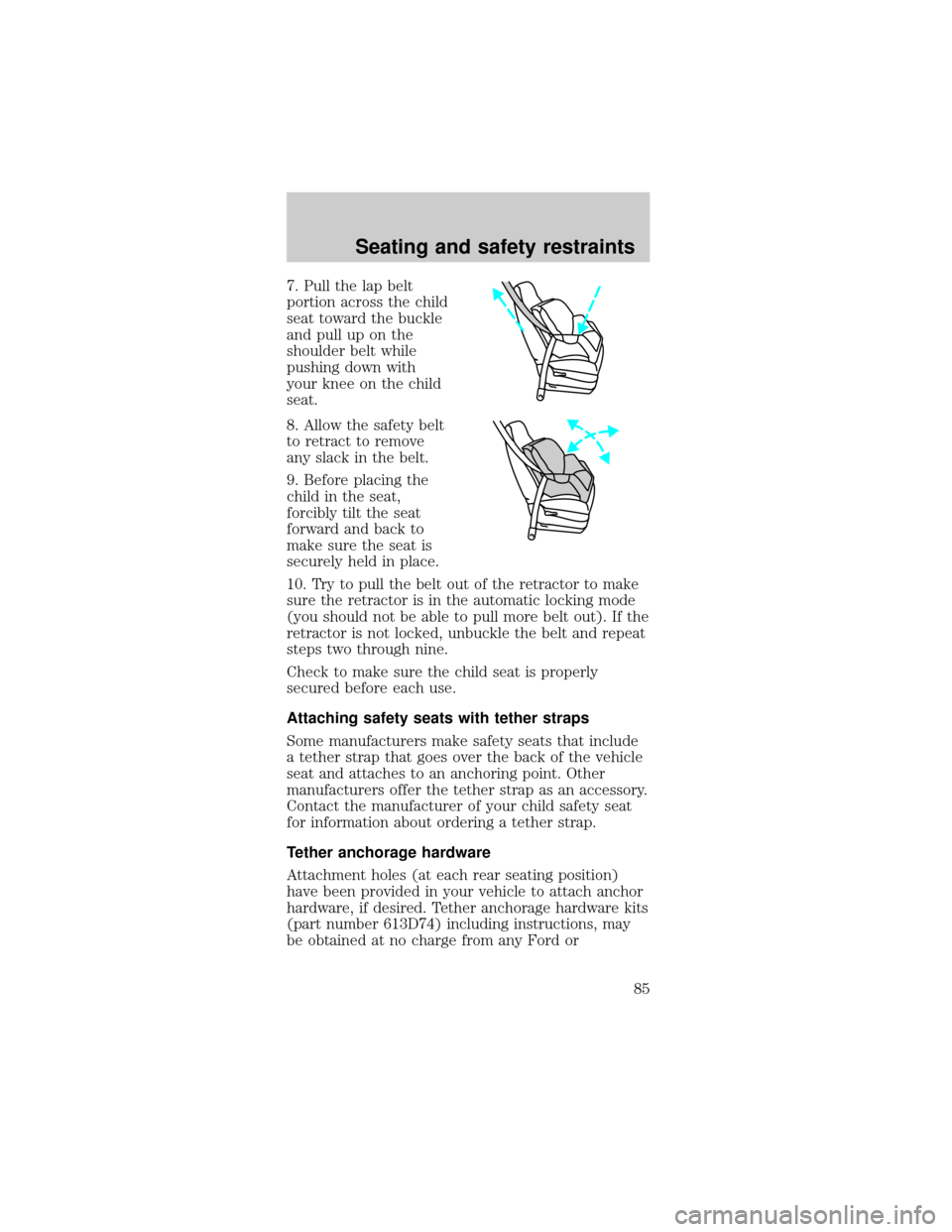
7. Pull the lap belt
portion across the child
seat toward the buckle
and pull up on the
shoulder belt while
pushing down with
your knee on the child
seat.
8. Allow the safety belt
to retract to remove
any slack in the belt.
9. Before placing the
child in the seat,
forcibly tilt the seat
forward and back to
make sure the seat is
securely held in place.
10. Try to pull the belt out of the retractor to make
sure the retractor is in the automatic locking mode
(you should not be able to pull more belt out). If the
retractor is not locked, unbuckle the belt and repeat
steps two through nine.
Check to make sure the child seat is properly
secured before each use.
Attaching safety seats with tether straps
Some manufacturers make safety seats that include
a tether strap that goes over the back of the vehicle
seat and attaches to an anchoring point. Other
manufacturers offer the tether strap as an accessory.
Contact the manufacturer of your child safety seat
for information about ordering a tether strap.
Tether anchorage hardware
Attachment holes (at each rear seating position)
have been provided in your vehicle to attach anchor
hardware, if desired. Tether anchorage hardware kits
(part number 613D74) including instructions, may
be obtained at no charge from any Ford or
Seating and safety restraints
85
Page 86 of 216
Lincoln-Mercury dealer. All vehicles built for sale in
Canada include a tether anchor hardware kit.
Be sure to follow the child safety seat
manufacturer's instructions.
Tighten the anchor according to
specifications. Otherwise, the safety seat
may not be properly secured and the child may be
injured in a sudden stop or collision.
Seating and safety restraints
86
Page 207 of 216

Air bag supplemental
restraint system ........ 74
and child
safety seats ............. 76
description .............. 74
disposal .................... 79
driver air bag .......... 77
indicator light ...... 7,78
operation ................. 77
passenger air bag ... 77
Air cleaner filter ..... 182
Air conditioning ........ 18
manual heating
and air conditioning
system ..................... 18
Anti-theft
system .............. 60,61,62
warning light ............. 7
Automatic
transmission .............. 97
driving an automatic
overdrive ................. 98
fluid,
refill capacities ...... 183
fluid,
specification .......... 188
Axle
lubricant
specifications ........ 188
refill capacities ...... 183
traction lok ............ 105
Battery ..................... 150
acid, treating
emergencies .......... 150
charging system
warning light ............. 7
jumping a disabled
battery ................... 123
maintenance-free .. 150
replacement,
specifications ........ 182
servicing ................ 150voltage gauge .......... 15
Brakes ................... 92,94
anti-lock .............. 92,93
anti-lock brake
system (ABS)
warning light ...... 10,93
brake
warning light ........... 10
fluid, checking
and adding ............ 137
fluid,
refill capacities ...... 183
fluid,
specifications . 185,188
lubricant
specifications . 185,188
parking .................... 94
shift interlock .......... 97
Break-in period ........... 2
Capacities for
refilling fluids .......... 183
Child safety
restraints ................... 80
child safety belts .... 80
child safety seats .... 81
Child safety seats ...... 81
attaching with
tether straps ........... 85
built-in child seat ... 81
in front seat ............ 83
in rear seat .............. 83
tether anchorage
hardware ................. 85
Cleaning
your vehicle ............. 176
engine
compartment ......... 178
exterior ........... 178,181
exterior lamps ....... 179
instrument panel .. 180
interior ................... 180
plastic parts .......... 179
Index
207