Page 129 of 232
N (Neutral)± No power to either axle.
4L (4WD Low)± Power to front and rear axles at reduced speed.
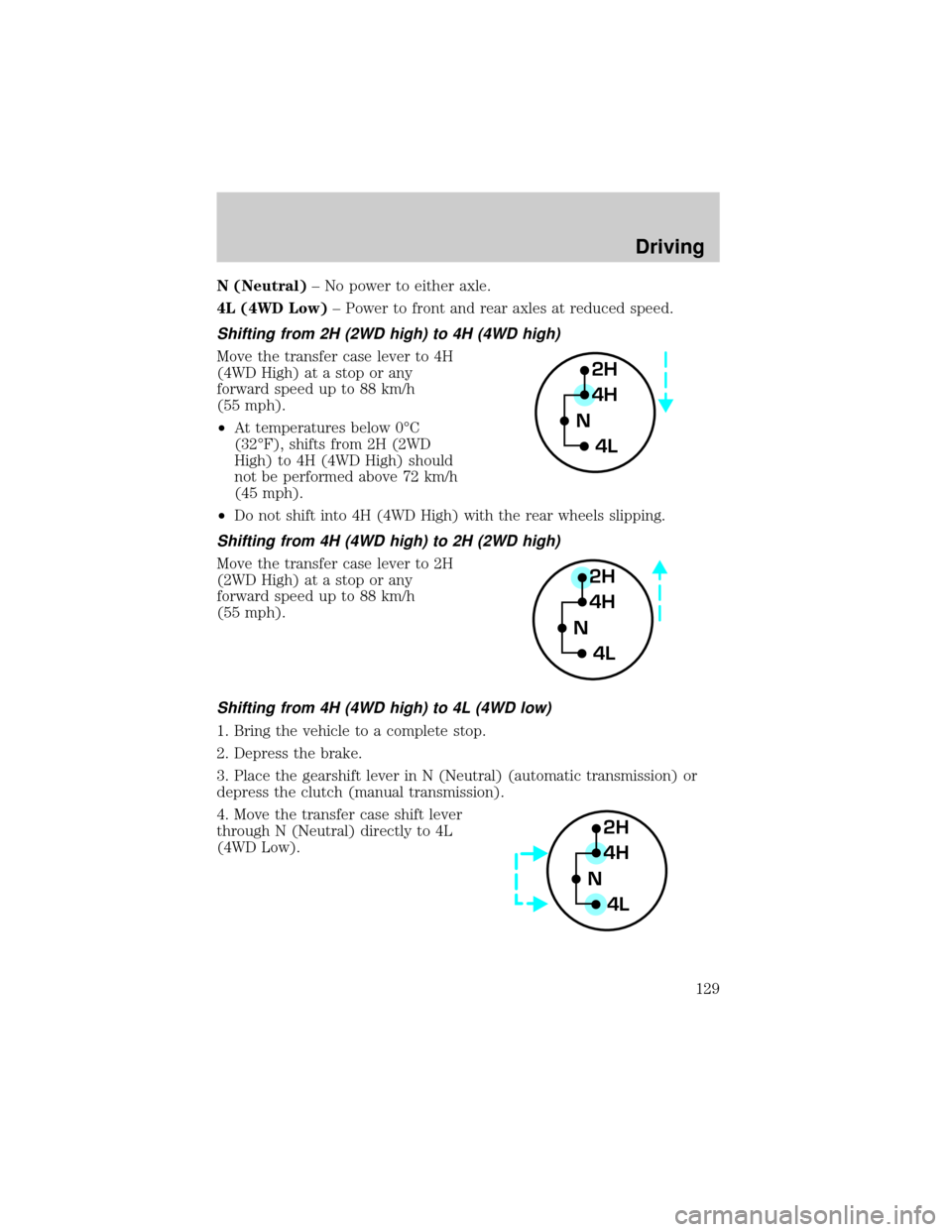
Shifting from 2H (2WD high) to 4H (4WD high)
Move the transfer case lever to 4H
(4WD High) at a stop or any
forward speed up to 88 km/h
(55 mph).
²At temperatures below 0ÉC
(32ÉF), shifts from 2H (2WD
High) to 4H (4WD High) should
not be performed above 72 km/h
(45 mph).
²Do not shift into 4H (4WD High) with the rear wheels slipping.
Shifting from 4H (4WD high) to 2H (2WD high)
Move the transfer case lever to 2H
(2WD High) at a stop or any
forward speed up to 88 km/h
(55 mph).
Shifting from 4H (4WD high) to 4L (4WD low)
1. Bring the vehicle to a complete stop.
2. Depress the brake.
3. Place the gearshift lever in N (Neutral) (automatic transmission) or
depress the clutch (manual transmission).
4. Move the transfer case shift lever
through N (Neutral) directly to 4L
(4WD Low).
2H
4H
4L N
2H
4H
4L N
2H
4H
4L N
Driving
129
Page 131 of 232
Shifting from 4H (4WD high) to 2H (2WD high)
Move the 4WD control to 2H at any
forward speed.
Shifting between 4H (4WD high) and 4L (4WD low)
1. Bring the vehicle to a stop.
2. Depress the brake.
3. Place the gearshift in N (Neutral) (automatic transmission) or depress
the clutch (manual transmission).
4. Move the 4WD control to the 4H
or 4L position.
Driving off-road with 4WD
Your vehicle is specially equipped for driving on sand, snow, mud and
rough terrain and has operating characteristics that are somewhat
different from conventional vehicles, both on and off the road.
Maintain steering wheel control at all times, especially in rough terrain.
Since sudden changes in terrain can result in abrupt steering wheel
motion, make sure you grip the steering wheel from the outside. Do not
grip the spokes.
Drive cautiously to avoid vehicle damage from concealed objects such as
rocks and stumps.
4H
2H
4L
4H
2H
4L
Driving
131
Page 133 of 232

Replace rear axle lubricant any time the axle has been submerged in
water. The rear axle does not normally require a lubricant change for the
life of the vehicle. Rear axle lubricant quantities are not to be checked or
changed unless a leak is suspected or repair is required.
Driving on hilly or sloping terrain
When driving on a hill, avoid driving crosswise or turning on steep
slopes. You could lose traction and slip sideways. Drive straight up,
straight down or avoid the hill completely. Know the conditions on the
other side of a hill before driving over the crest.
When climbing a steep hill, start in a lower gear rather than downshifting
to a lower gear from a higher gear once the ascent has started. This
reduces strain on the engine and the possibility of stalling.
When descending a steep hill, avoid sudden braking. Shift to a lower gear
when added engine braking is desired.
When speed control is on and you are driving uphill, your vehicle speed
may drop considerably, especially if you are carrying a heavy load.
If vehicle speed drops more than 16 km/h (10 mph), the speed control
will cancel automatically. Resume speed with accelerator pedal.
If speed control cancels after climbing the hill, reset speed by pressing
and holding the SET ACCEL button to resume speeds over 50 km/h
(30 mph).
Automatic transmissions may shift frequently while driving up steep
grades. Eliminate frequent shifting by shifting out of
(Overdrive) into
a lower gear.
Driving on snow and ice
A 4WD vehicle has advantages over 2WD vehicles in snow and ice but
can skid like any other vehicle.
Avoid sudden applications of power and quick changes of direction on
snow and ice. Apply the accelerator slowly and steadily when starting
from a full stop.
When braking, apply the brakes as you normally would. In order to allow
the anti-lock brake system (ABS) to operate properly, keep steady
pressure on the brake pedal.
Allow more stopping distance and drive slower than usual. Consider
using one of the lower gears.
Driving
133
Page 137 of 232
Do not exceed the GVWR or the GAWR specified on the Safety
Compliance Certification Label.
Towing trailers beyond the maximum recommended gross trailer
weight could result in engine damage, transmission/axle damage,
structural damage, loss of control, and personal injury.
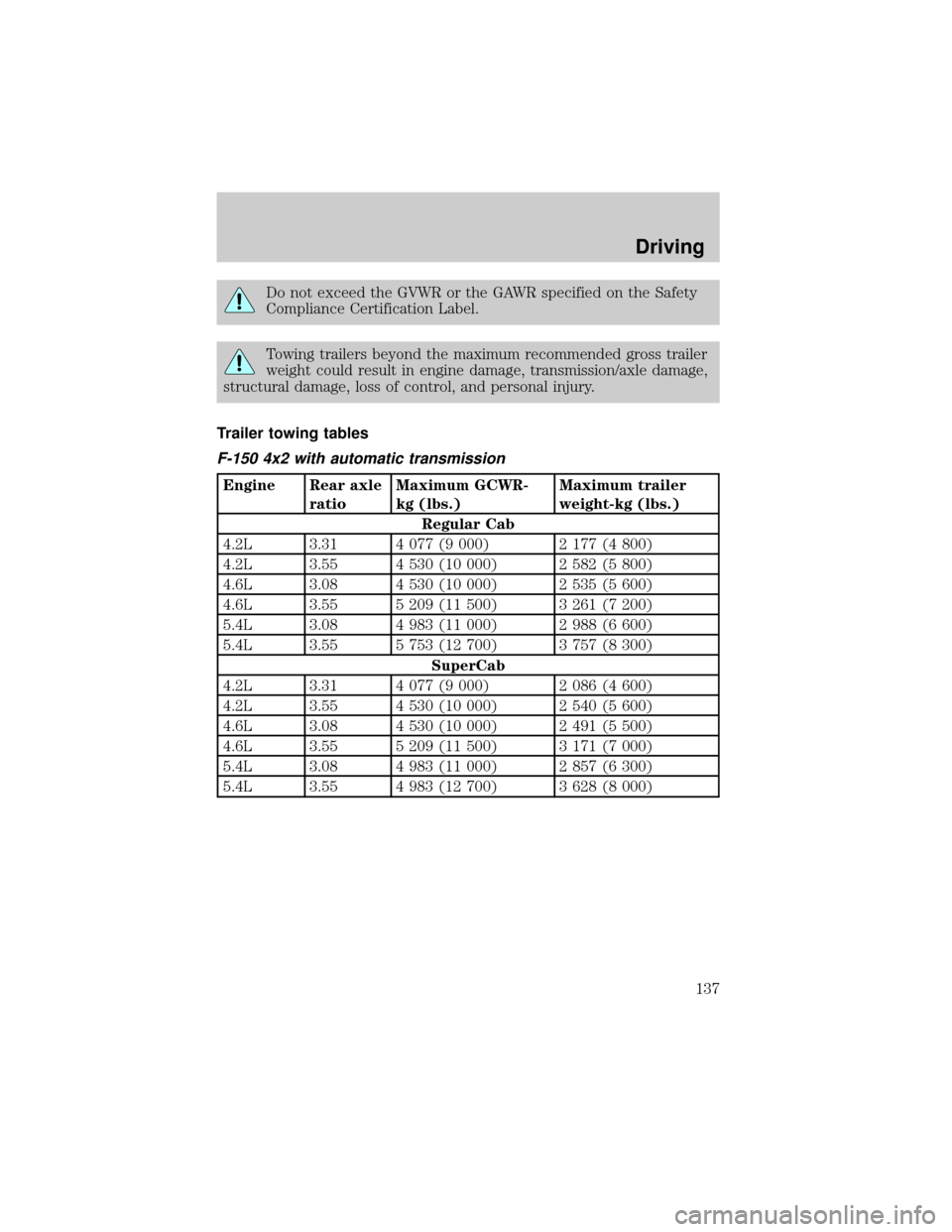
Trailer towing tables
F-150 4x2 with automatic transmission
Engine Rear axle
ratioMaximum GCWR-
kg (lbs.)Maximum trailer
weight-kg (lbs.)
Regular Cab
4.2L 3.31 4 077 (9 000) 2 177 (4 800)
4.2L 3.55 4 530 (10 000) 2 582 (5 800)
4.6L 3.08 4 530 (10 000) 2 535 (5 600)
4.6L 3.55 5 209 (11 500) 3 261 (7 200)
5.4L 3.08 4 983 (11 000) 2 988 (6 600)
5.4L 3.55 5 753 (12 700) 3 757 (8 300)
SuperCab
4.2L 3.31 4 077 (9 000) 2 086 (4 600)
4.2L 3.55 4 530 (10 000) 2 540 (5 600)
4.6L 3.08 4 530 (10 000) 2 491 (5 500)
4.6L 3.55 5 209 (11 500) 3 171 (7 000)
5.4L 3.08 4 983 (11 000) 2 857 (6 300)
5.4L 3.55 4 983 (12 700) 3 628 (8 000)
Driving
137
Page 138 of 232
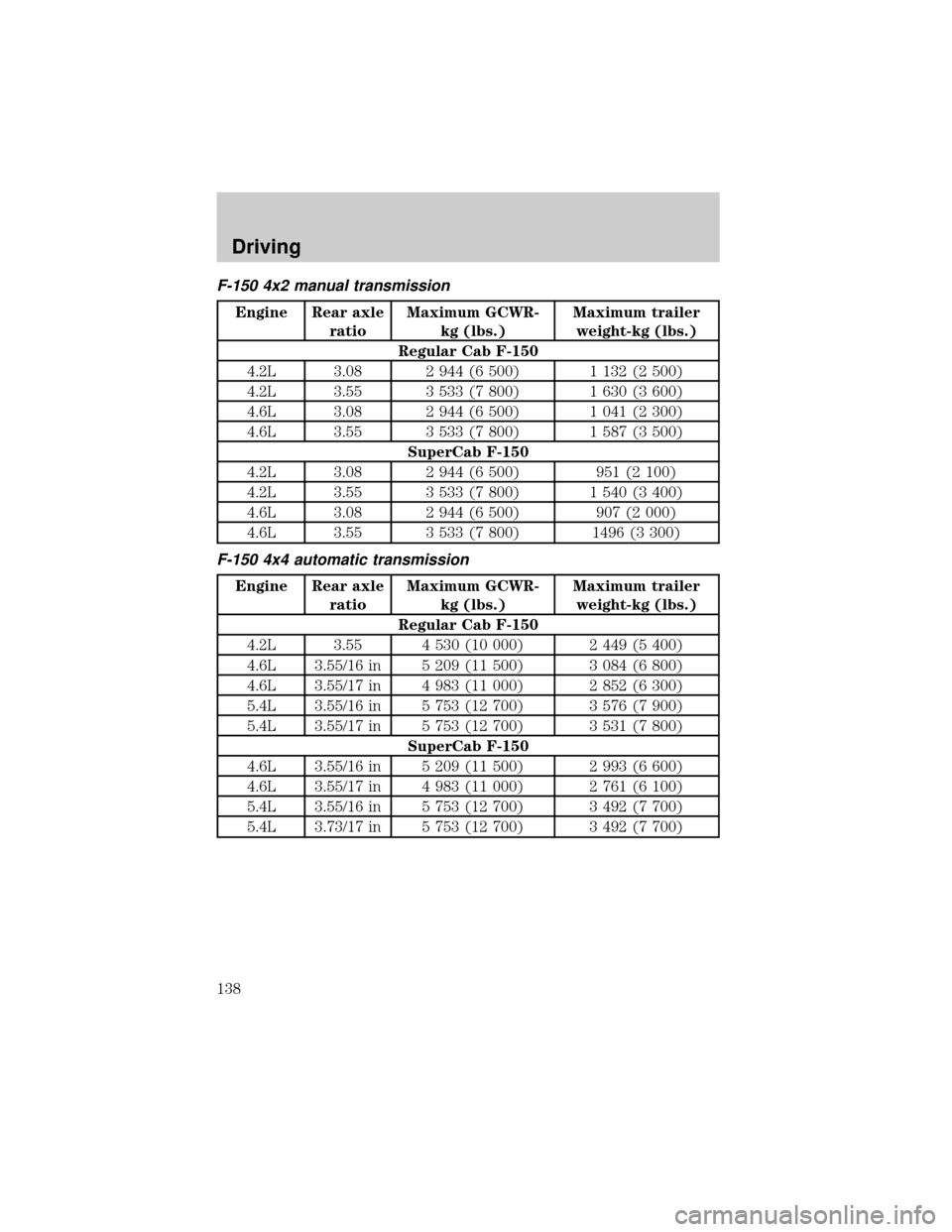
F-150 4x2 manual transmission
Engine Rear axle
ratioMaximum GCWR-
kg (lbs.)Maximum trailer
weight-kg (lbs.)
Regular Cab F-150
4.2L 3.08 2 944 (6 500) 1 132 (2 500)
4.2L 3.55 3 533 (7 800) 1 630 (3 600)
4.6L 3.08 2 944 (6 500) 1 041 (2 300)
4.6L 3.55 3 533 (7 800) 1 587 (3 500)
SuperCab F-150
4.2L 3.08 2 944 (6 500) 951 (2 100)
4.2L 3.55 3 533 (7 800) 1 540 (3 400)
4.6L 3.08 2 944 (6 500) 907 (2 000)
4.6L 3.55 3 533 (7 800) 1496 (3 300)
F-150 4x4 automatic transmission
Engine Rear axle
ratioMaximum GCWR-
kg (lbs.)Maximum trailer
weight-kg (lbs.)
Regular Cab F-150
4.2L 3.55 4 530 (10 000) 2 449 (5 400)
4.6L 3.55/16 in 5 209 (11 500) 3 084 (6 800)
4.6L 3.55/17 in 4 983 (11 000) 2 852 (6 300)
5.4L 3.55/16 in 5 753 (12 700) 3 576 (7 900)
5.4L 3.55/17 in 5 753 (12 700) 3 531 (7 800)
SuperCab F-150
4.6L 3.55/16 in 5 209 (11 500) 2 993 (6 600)
4.6L 3.55/17 in 4 983 (11 000) 2 761 (6 100)
5.4L 3.55/16 in 5 753 (12 700) 3 492 (7 700)
5.4L 3.73/17 in 5 753 (12 700) 3 492 (7 700)
Driving
138
Page 139 of 232
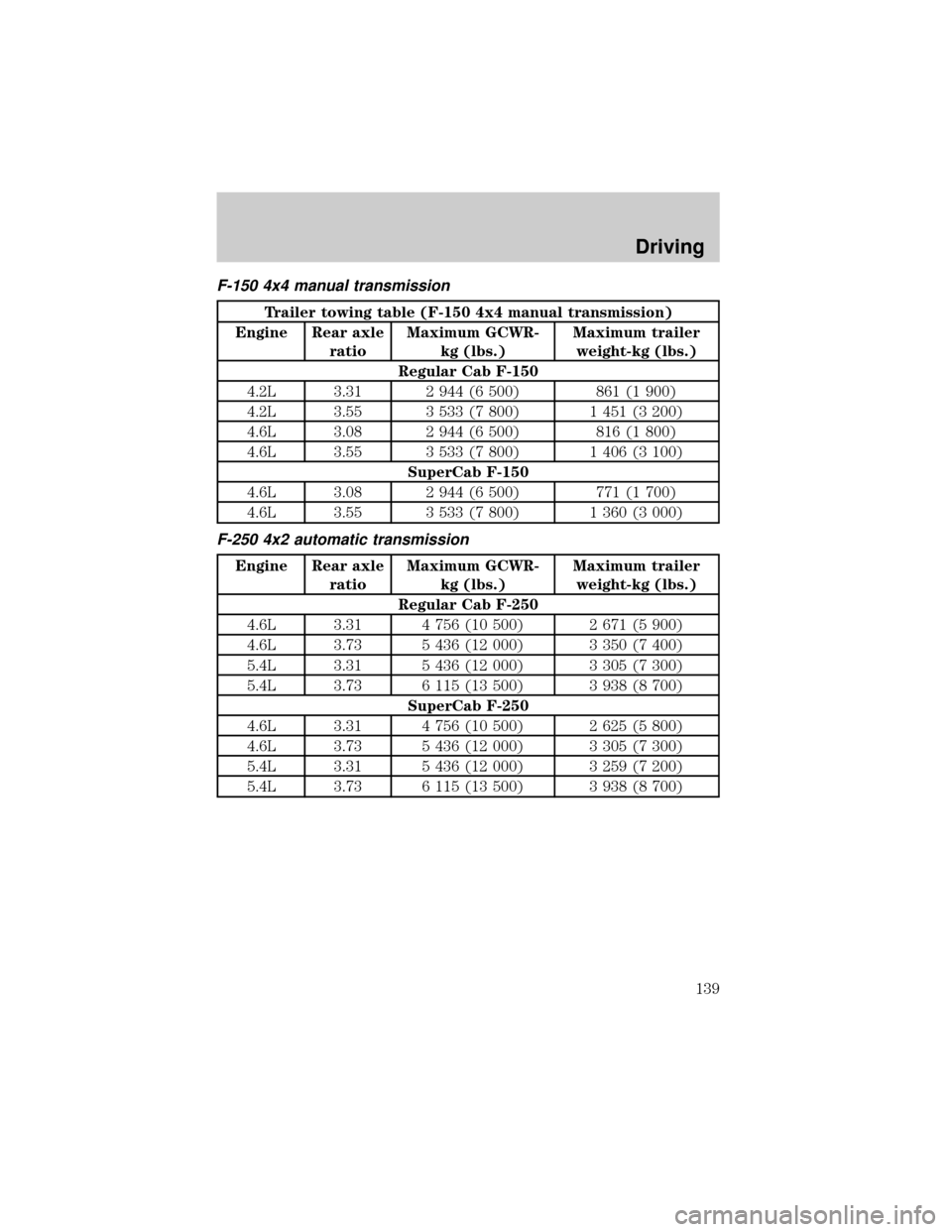
F-150 4x4 manual transmission
Trailer towing table (F-150 4x4 manual transmission)
Engine Rear axle
ratioMaximum GCWR-
kg (lbs.)Maximum trailer
weight-kg (lbs.)
Regular Cab F-150
4.2L 3.31 2 944 (6 500) 861 (1 900)
4.2L 3.55 3 533 (7 800) 1 451 (3 200)
4.6L 3.08 2 944 (6 500) 816 (1 800)
4.6L 3.55 3 533 (7 800) 1 406 (3 100)
SuperCab F-150
4.6L 3.08 2 944 (6 500) 771 (1 700)
4.6L 3.55 3 533 (7 800) 1 360 (3 000)
F-250 4x2 automatic transmission
Engine Rear axle
ratioMaximum GCWR-
kg (lbs.)Maximum trailer
weight-kg (lbs.)
Regular Cab F-250
4.6L 3.31 4 756 (10 500) 2 671 (5 900)
4.6L 3.73 5 436 (12 000) 3 350 (7 400)
5.4L 3.31 5 436 (12 000) 3 305 (7 300)
5.4L 3.73 6 115 (13 500) 3 938 (8 700)
SuperCab F-250
4.6L 3.31 4 756 (10 500) 2 625 (5 800)
4.6L 3.73 5 436 (12 000) 3 305 (7 300)
5.4L 3.31 5 436 (12 000) 3 259 (7 200)
5.4L 3.73 6 115 (13 500) 3 938 (8 700)
Driving
139
Page 140 of 232
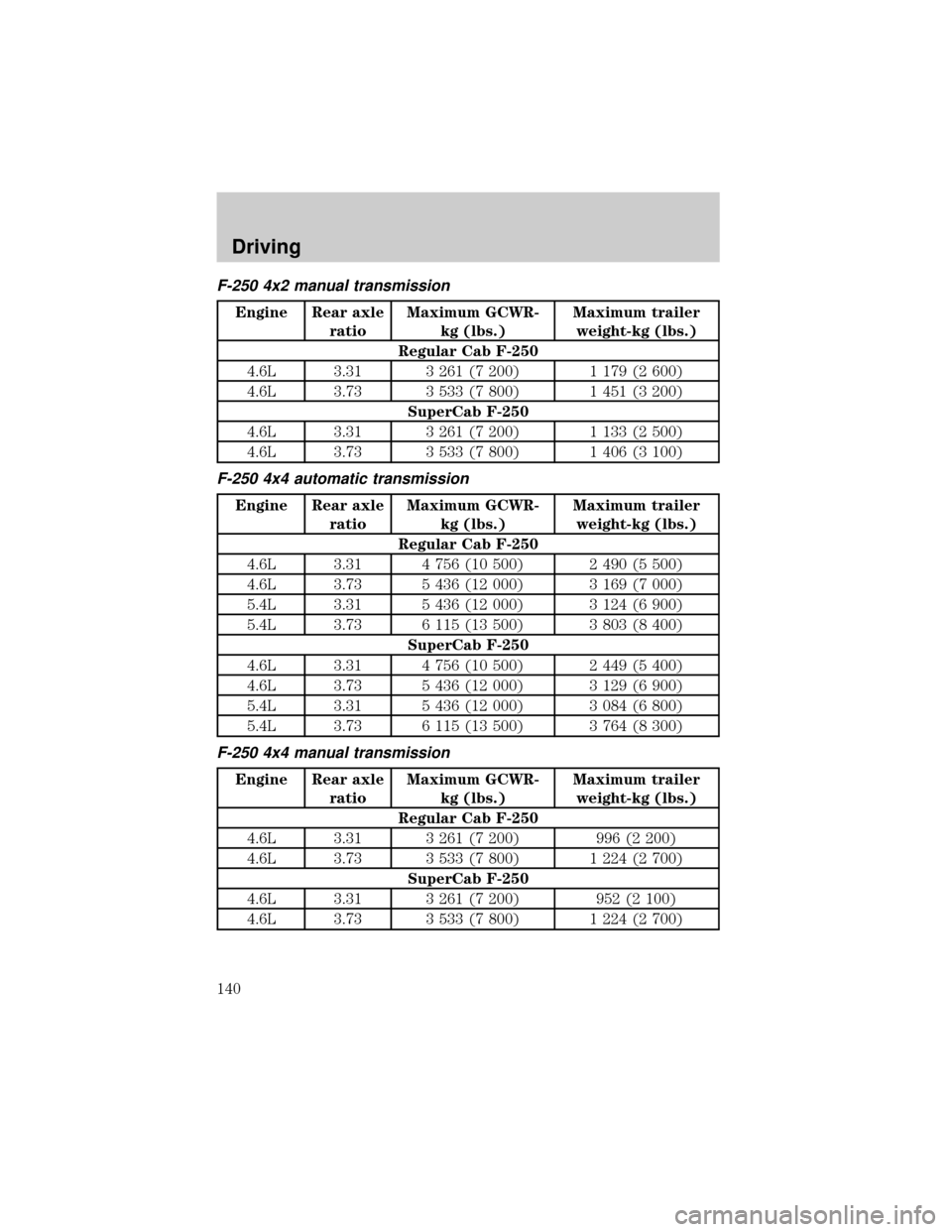
F-250 4x2 manual transmission
Engine Rear axle
ratioMaximum GCWR-
kg (lbs.)Maximum trailer
weight-kg (lbs.)
Regular Cab F-250
4.6L 3.31 3 261 (7 200) 1 179 (2 600)
4.6L 3.73 3 533 (7 800) 1 451 (3 200)
SuperCab F-250
4.6L 3.31 3 261 (7 200) 1 133 (2 500)
4.6L 3.73 3 533 (7 800) 1 406 (3 100)
F-250 4x4 automatic transmission
Engine Rear axle
ratioMaximum GCWR-
kg (lbs.)Maximum trailer
weight-kg (lbs.)
Regular Cab F-250
4.6L 3.31 4 756 (10 500) 2 490 (5 500)
4.6L 3.73 5 436 (12 000) 3 169 (7 000)
5.4L 3.31 5 436 (12 000) 3 124 (6 900)
5.4L 3.73 6 115 (13 500) 3 803 (8 400)
SuperCab F-250
4.6L 3.31 4 756 (10 500) 2 449 (5 400)
4.6L 3.73 5 436 (12 000) 3 129 (6 900)
5.4L 3.31 5 436 (12 000) 3 084 (6 800)
5.4L 3.73 6 115 (13 500) 3 764 (8 300)
F-250 4x4 manual transmission
Engine Rear axle
ratioMaximum GCWR-
kg (lbs.)Maximum trailer
weight-kg (lbs.)
Regular Cab F-250
4.6L 3.31 3 261 (7 200) 996 (2 200)
4.6L 3.73 3 533 (7 800) 1 224 (2 700)
SuperCab F-250
4.6L 3.31 3 261 (7 200) 952 (2 100)
4.6L 3.73 3 533 (7 800) 1 224 (2 700)
Driving
140
Page 143 of 232

When towing a trailer:
²Use a lower gear when towing up or down steep hills. This will
eliminate excessive downshifting and upshifting for optimum fuel
economy and transmission cooling.
²Anticipate stops and brake gradually.
Exceeding the GCWR rating may cause internal transmission
damage and void your warranty coverage.
Servicing after towing
If you tow a trailer for long distances, your vehicle will require more
frequent service intervals. Refer to your Scheduled Maintenance guide
for more information.
Trailer towing tips
²Practice turning, stopping and backing up in an area before starting on
a trip to get the feel of the vehicle trailer combination. When turning,
make wider turns so the trailer wheels will clear curbs and other
obstacles.
²Allow more distance for stopping with a trailer attached.
²The trailer tongue weight should be 10±15% of the loaded trailer
weight.
²After you have traveled 80 km (50 miles), thoroughly check your
hitch, electrical connections and trailer wheel lug nuts.
²When stopped in traffic for long periods of time in hot weather, place
the gearshift in P (Park) (automatic transmissions) or N (Neutral)
(manual transmissions). This aids engine cooling and air conditioner
efficiency.
²Vehicles with trailers should not be parked on a grade. If you must
park on a grade, place wheel chocks under the trailer's wheels.
Launching or retrieving a boat
When backing down a ramp during boat launching or retrieval,
²Do not allow the static water level to rise above the bottom edge of
the rear bumper and
²Do not allow waves to break higher than 15 cm (six inches) above the
bottom edge of the rear bumper.
Driving
143