1999 FORD F SERIES MOTORHOME AND COMMERCIAL CHASSIS brake light
[x] Cancel search: brake lightPage 34 of 96
Once through the water, always try the brakes. Wet brakes do not stop
the vehicle as effectively as dry brakes. Drying can be improved by
moving your vehicle slowly while applying light pressure on the brake
pedal.
Driving through deep water where the transmission is submerged
may allow water into the transmission and cause internal
transmission damage.
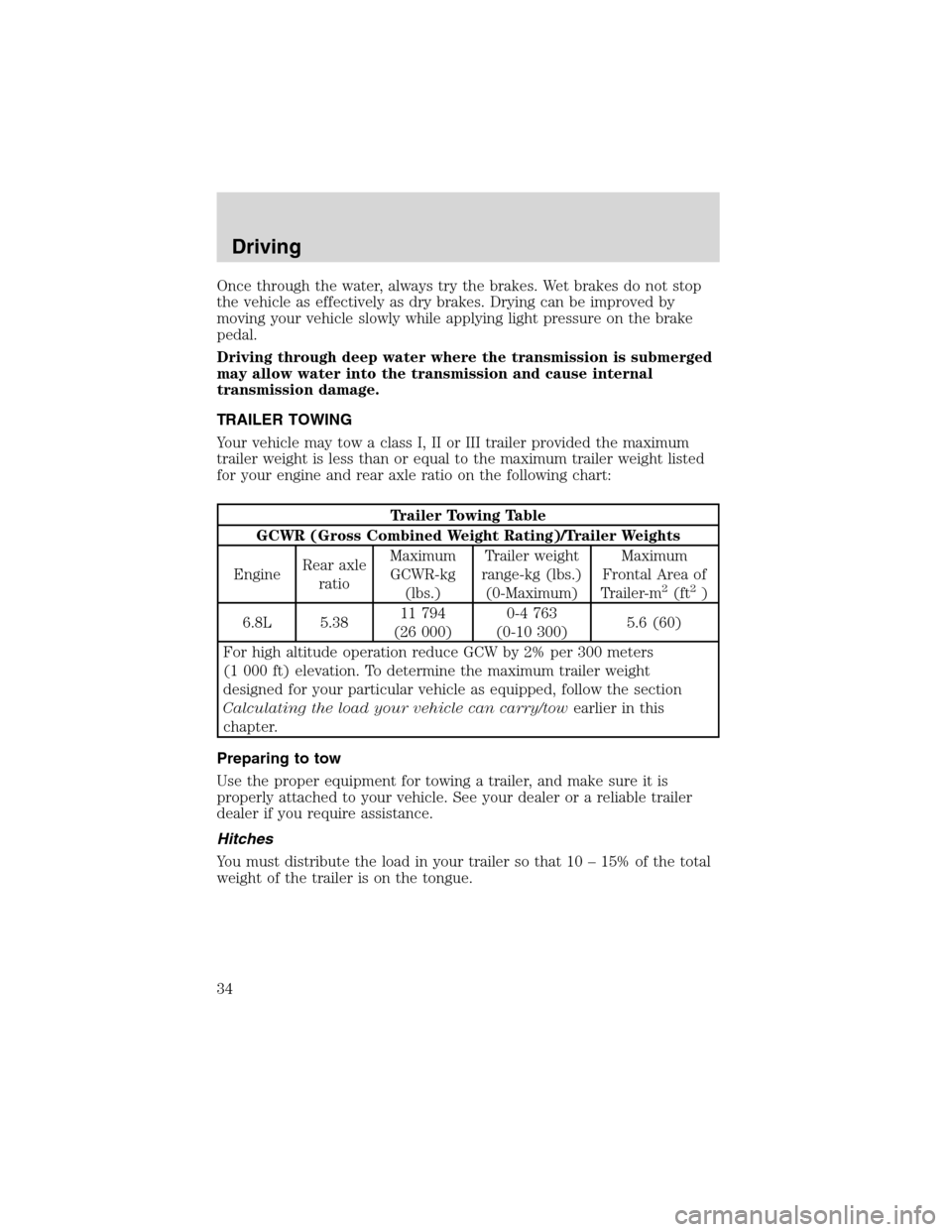
TRAILER TOWING
Your vehicle may tow a class I, II or III trailer provided the maximum
trailer weight is less than or equal to the maximum trailer weight listed
for your engine and rear axle ratio on the following chart:
Trailer Towing Table
GCWR (Gross Combined Weight Rating)/Trailer Weights
EngineRear axle
ratioMaximum
GCWR-kg
(lbs.)Trailer weight
range-kg (lbs.)
(0-Maximum)Maximum
Frontal Area of
Trailer-m
2(ft2)
6.8L 5.3811 794
(26 000)0-4 763
(0-10 300)5.6 (60)
For high altitude operation reduce GCW by 2% per 300 meters
(1 000 ft) elevation. To determine the maximum trailer weight
designed for your particular vehicle as equipped, follow the section
Calculating the load your vehicle can carry/towearlier in this
chapter.
Preparing to tow
Use the proper equipment for towing a trailer, and make sure it is
properly attached to your vehicle. See your dealer or a reliable trailer
dealer if you require assistance.
Hitches
You must distribute the load in your trailer so that 10 – 15% of the total
weight of the trailer is on the tongue.
Driving
34
Page 44 of 96
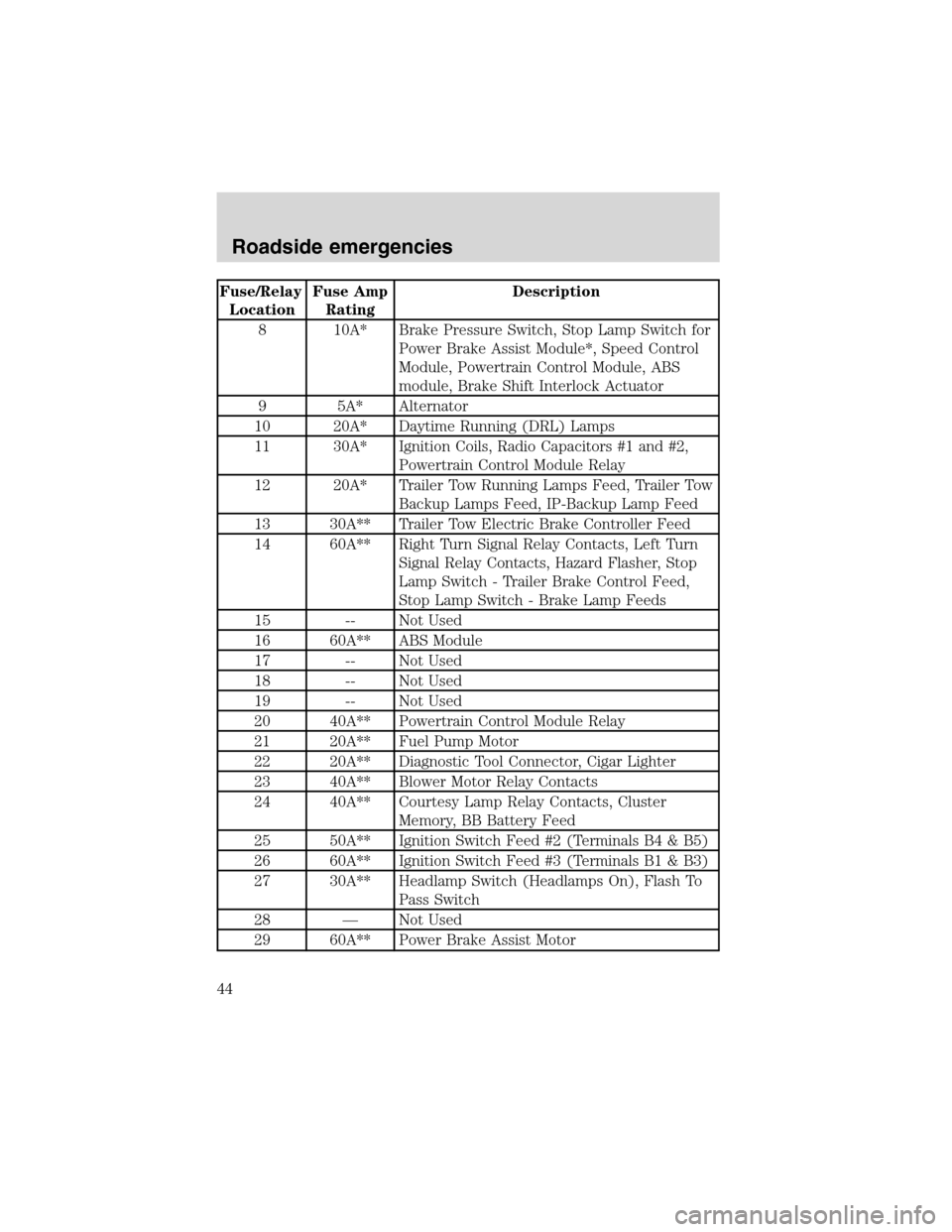
Fuse/Relay
LocationFuse Amp
RatingDescription
8 10A* Brake Pressure Switch, Stop Lamp Switch for
Power Brake Assist Module*, Speed Control
Module, Powertrain Control Module, ABS
module, Brake Shift Interlock Actuator
9 5A* Alternator
10 20A* Daytime Running (DRL) Lamps
11 30A* Ignition Coils, Radio Capacitors #1 and #2,
Powertrain Control Module Relay
12 20A* Trailer Tow Running Lamps Feed, Trailer Tow
Backup Lamps Feed, IP-Backup Lamp Feed
13 30A** Trailer Tow Electric Brake Controller Feed
14 60A** Right Turn Signal Relay Contacts, Left Turn
Signal Relay Contacts, Hazard Flasher, Stop
Lamp Switch - Trailer Brake Control Feed,
Stop Lamp Switch - Brake Lamp Feeds
15 -- Not Used
16 60A** ABS Module
17 -- Not Used
18 -- Not Used
19 -- Not Used
20 40A** Powertrain Control Module Relay
21 20A** Fuel Pump Motor
22 20A** Diagnostic Tool Connector, Cigar Lighter
23 40A** Blower Motor Relay Contacts
24 40A** Courtesy Lamp Relay Contacts, Cluster
Memory, BB Battery Feed
25 50A** Ignition Switch Feed #2 (Terminals B4 & B5)
26 60A** Ignition Switch Feed #3 (Terminals B1 & B3)
27 30A** Headlamp Switch (Headlamps On), Flash To
Pass Switch
28 — Not Used
29 60A** Power Brake Assist Motor
Roadside emergencies
44
Page 49 of 96
Batteries contain sulfuric acid which burns skin, eyes, and
clothing.
Preparing your vehicle
1.Use only a 12–volt supply to start your vehicle.
2. Do not disconnect the battery of the disabled vehicle as this could
damage the vehicle’s electrical system.
3.
Park the booster vehicle close to the hood of the disabled vehicle
making sure the two vehiclesdo nottouch. Set the parking brake on both
vehicles and stay clear of the engine cooling fan and other moving parts.
4. Check all battery terminals and remove any excessive corrosion before
you attach the battery cables. Ensure that vent caps are tight and level.
5. Turn the heater fan on in both vehicles to protect any electrical
surges. Turn all other accessories off.
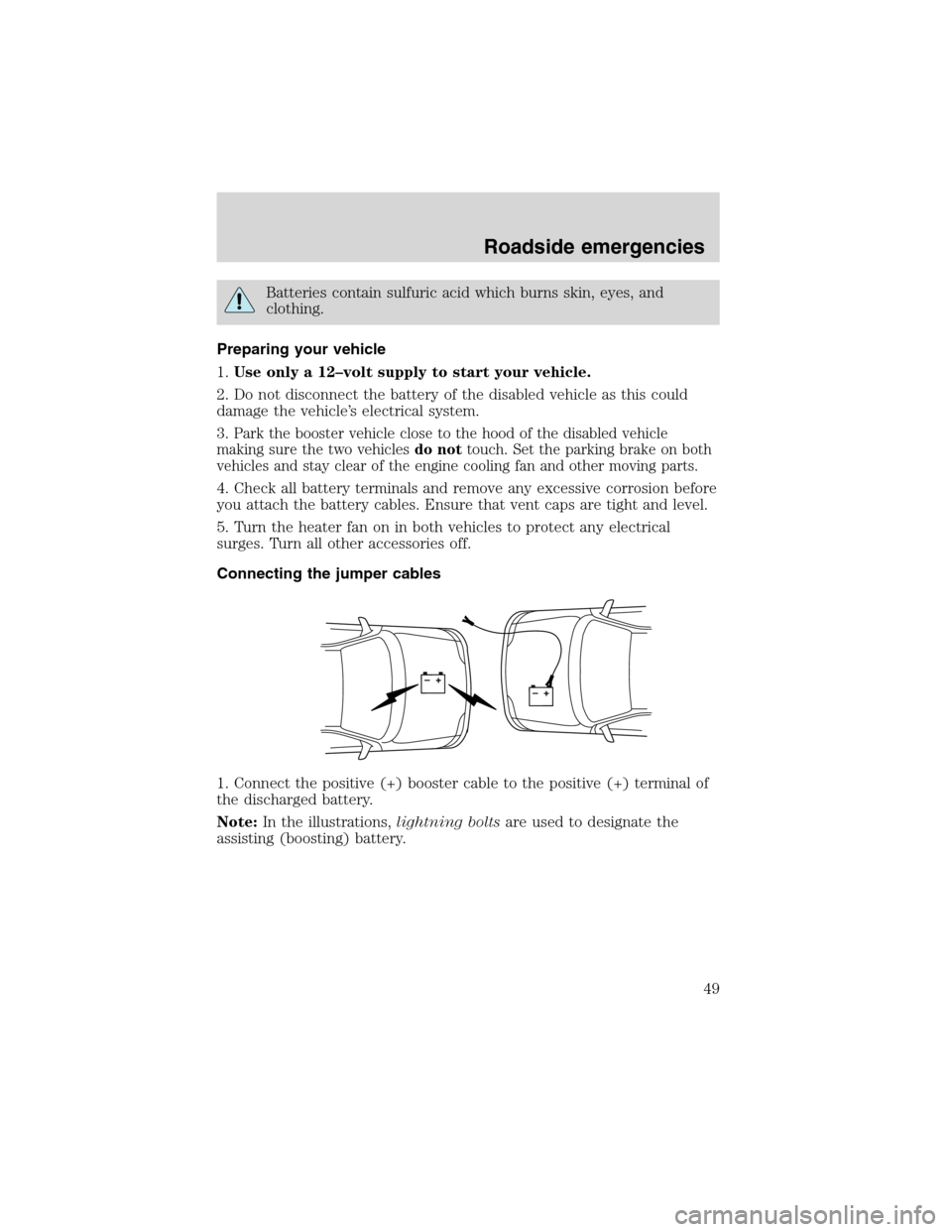
Connecting the jumper cables
1. Connect the positive (+) booster cable to the positive (+) terminal of
the discharged battery.
Note:In the illustrations,lightning boltsare used to designate the
assisting (boosting) battery.
+–+–
Roadside emergencies
49
Page 54 of 96
SERVICE RECOMMENDATIONS
To help you service your vehicle:
•We highlight do-it-yourself items in the engine compartment for easy
location.
•We provide a Scheduled Maintenance Guide which makes tracking
routine service easy.
If your vehicle requires professional service, your dealership can provide
necessary parts and service. Check your “Warranty Guide” to find out
which parts and services are covered.
Use only recommended fuels, lubricants, fluids and service parts
conforming to specifications. Motorcraft parts are designed and built to
provide the best performance in your vehicle.
PRECAUTIONS WHEN SERVICING YOUR VEHICLE
Be especially careful when inspecting or servicing your vehicle.
•Do not work on a hot engine.
•When the engine is running, make sure that loose clothing, jewelry or
long hair does not get caught up in moving parts.
•Do not work on a vehicle with the engine running in an enclosed
space, unless you are sure you have enough ventilation.
•Keep all lit cigarettes, open flames and other lit material away from
the battery and all fuel related parts.
If you disconnect the battery, the engine must “relearn” its idle
conditions before your vehicle will drive properly, as explained inBattery
in this chapter.
Working with the engine off
1. Set the parking brake and ensure the gearshift is securely latched in P
(Park).
2. Turn off the engine and remove the key.
3. Block the wheels to prevent the vehicle from moving unexpectedly.
Working with the engine on
1. Set the parking brake and ensure the gearshift is securely latched in P
(Park).
2. Block the wheels to prevent the vehicle from moving unexpectedly.
Maintenance and care
54
Page 68 of 96
Batteries normally produce explosive gases which can cause
personal injury. Therefore, do not allow flames, sparks or lighted
substances to come near the battery. When working near the battery,
always shield your face and protect your eyes. Always provide proper
ventilation.
When lifting a plastic-cased battery, excessive pressure on the
end walls could cause acid to flow through the vent caps,
resulting in personal injury and/or damage to the vehicle or battery.
Lift the battery with a battery carrier or with your hands on opposite
corners.
Keep batteries out of reach of children. Batteries contain sulfuric
acid. Avoid contact with skin, eyes or clothing. Shield your eyes
when working near the battery to protect against possible splashing of
acid solution. In case of acid contact with skin or eyes, flush
immediately with water for a minimum of 15 minutes and get prompt
medical attention. If acid is swallowed, call a physician immediately.
To account for customer driving habits and conditions, your automatic
transmission electronically controls the shift quality by using an adaptive
learning strategy. The adaptive learning strategy is maintained by power
from the battery. When the battery is disconnected or a new battery is
installed, the transmission must relearn its adaptive strategy. Optimal
shifting will resume within a few hundred kilometers (miles) of
operation.
If the shift quality does not improve within a few hundred
kilometers (miles) of operation, or if the downshifts and other
throttle conditions do not function normally, see your dealer or a
qualified service technician as soon as possible.
Because your vehicle’s engine is also electronically controlled by a
computer, some control conditions are maintained by power from the
battery. When the battery is disconnected or a new battery is installed,
the engine must relearn its idle and fuel trim strategy for optimum
driveability and performance. To begin this process:
1. Set your parking brake.
Maintenance and care
68
Page 82 of 96
•Using the air conditioner or defroster may reduce fuel economy.
•Using speed control (if equipped) may improve fuel economy. Speed
control can help maintain a constant speed and reduce speed changes.
You may want to turn off the speed control in hilly terrain as
unnecessary shifting between third and fourth gears may occur and
could result in reduced fuel economy.
•Warming up a vehicle on cold mornings is not required and may
reduce fuel economy.
•Resting your foot on the brake pedal while driving may reduce fuel
economy.
•Combine errands and minimize stop-and-go driving.
Maintenance
•Keep tires properly inflated and use only recommended size.
•Operating a vehicle with the wheels out of alignment will reduce fuel
economy.
•Use recommended engine oil. Refer toLubricant Specifications.
•Perform all regularly scheduled maintenance items. Follow the
recommended maintenance schedule and owner maintenance checks
found in your vehicle Scheduled Maintenance Guide.
Conditions
•Heavily loading a vehicle or towing a trailer may reduce fuel economy
at any speed.
•Carrying unnecessary weight may reduce fuel economy (approximately
2 km/h [1 mpg] is lost for every 180 kg [400 lb] of weight carried).
•Adding certain accessories to your vehicle (for example bug
deflectors, rollover/light bars, running boards, ski/luggage racks) may
reduce fuel economy.
•Using fuel blended with alcohol may lower fuel economy.
•Fuel economy may decrease with lower temperatures during the first
12–16 km (8–10 miles) of driving.
•Driving on flat terrain offers improved fuel economy as compared to
driving on hilly terrain.
•Transmissions give their best fuel economy when operated in the top
cruise gear and with steady pressure on the gas pedal.
•Close windows for high speed driving.
Maintenance and care
82
Page 90 of 96
Air cleaner filter .........................84
Ambulance packages ....................3
Automatic transmission
driving an automatic
overdrive ...................................29
fluid, refill capacities ................84
fluid, specification ....................87
Axle
lubricant specifications ............87
refill capacities ..........................84
Battery .........................................67
acid, treating emergencies .......67
charging system
warning light ...............................5
jumping a disabled battery ......48
maintenance-free ......................67
replacement, specifications .....84
servicing ....................................67
voltage gauge ............................11
Brakes .....................................25,26
anti-lock ................................25,26
anti-lock brake system
(ABS) warning light ..............8,26
brake warning light ....................5
fluid, checking and adding ......58
fluid, refill capacities ................84
fluid, specifications ..............86,87
lubricant specifications .......86,87
shift interlock ............................28
Break-in period .............................2
Capacities for refilling fluids ......84
Cleaning your vehicle .................76
engine compartment ................77
exterior ......................................77
wheels ........................................76
Coolant ..............................59,61,62
checking and adding ................60
refill capacities .....................61,84
specifications .......................86,87
Dipstick
engine oil ...................................55Doors
door ajar warning .......................9
Driveline universal joint
and slip yoke ...............................67
Driving under special
conditions
through water ...........................33
Emergencies, roadside
jump-starting ............................48
Emission control system ............74
Engine ..........................................87
check engine/
service engine soon light ........6,7
coolant .......................................59
idle speed control .....................67
lubrication specifications ....86,87
refill capacities ..........................84
service points ............................55
Engine block heater ...................23
Engine oil ....................................55
checking and adding ...........55,56
dipstick ......................................55
filter, specifications .............57,84
recommendations .....................57
refill capacities .....................55,84
specifications .............55,57,86,87
Exhaust fumes ............................24
Fail safe cooling ..........................62
Fluid capacities ...........................84
Fuel ..............................................71
calculating fuel economy .........80
capacity .....................................84
choosing the right fuel .............73
comparisons with EPA fuel
economy estimates ...................83
detergent in fuel .......................74
filling your vehicle
with fuel ...............................71,80
filter, specifications .............77,84
gauge .........................................10
improving fuel economy ..........80
low fuel warning light ................4
Index
90
Page 91 of 96
octane rating ........................73,87
quality ........................................74
running out of fuel ...................74
safety information relating
to automotive fuels ..................71
Fuses ............................................39
Gas mileage
(see Fuel economy) ...................80
Gauges .........................................10
battery voltage gauge ...............11
engine coolant
temperature gauge ...................11
engine oil pressure gauge ........10
fuel gauge ..................................10
odometer ...................................12
speedometer .............................12
tachometer ................................13
trip odometer ............................12
GAWR
(Gross Axle Weight Rating) .......32
calculating .................................33
definition ...................................32
driving with a heavy load ........32
location ......................................32
GVWR (Gross
Vehicle Weight Rating) ...............32
calculating ............................32,33
definition ...................................32
driving with a heavy load ........32
location ......................................32
Hazard flashers ...........................37
Headlamps ...................................14
daytime running lights .............14
flash to pass ..............................15
high beam ..............................9,14
turning on and off ....................14
warning chime ............................9
Ignition .........................................87
positions of the ignition ...........15
Inspection/maintenance
(I/M) testing ................................75Instrument panel
lighting up panel
and interior ...............................15
Jump-starting your vehicle ........48
Keys
key in ignition chime .................9
positions of the ignition ...........15
Lamps
cargo lamps ...............................15
daytime running light ...............14
headlamps .................................14
headlamps, flash to pass ..........15
instrument panel, dimming .....15
replacing bulbs .........................76
Lights, warning and indicator ......4
anti-lock brakes (ABS) .........8,26
brake ............................................5
charging system ..........................5
check coolant ..............................4
door ajar ......................................9
engine oil pressure .....................4
fuel reset .....................................9
high beam ...................................9
low fuel ........................................4
safety belt ...................................5
service engine soon .................6,7
turn signal indicator ...................9
Load limits ...................................32
GAWR ........................................32
GVWR ........................................32
trailer towing ............................32
Lubricant specifications ........86,87
Motorcraft parts .....................77,84
Octane rating ..............................73
Odometer .....................................12
Overdrive .....................................20
Parking brake ..............................27
Parts (see Motorcraft parts) ......84
Power distribution box
(see Fuses) .................................42
Power steering
fluid, checking and adding ......64
Index
91