1999 FORD EXPLORER four wheel drive
[x] Cancel search: four wheel drivePage 224 of 264
SERVICING YOUR TIRES
Checking the tire pressure
²Use an accurate tire pressure gauge.
²Check the tire pressure when tires are cold, after the vehicle has been
parked for at least one hour or has been driven less than 5 km (3
miles).
²Adjust tire pressure to recommended specifications found on the
Safety Compliance Certification Label, located on the drivers door
jamb.
Improperly inflated tires can affect vehicle handling and can fail
suddenly, possibly resulting in loss of vehicle control.
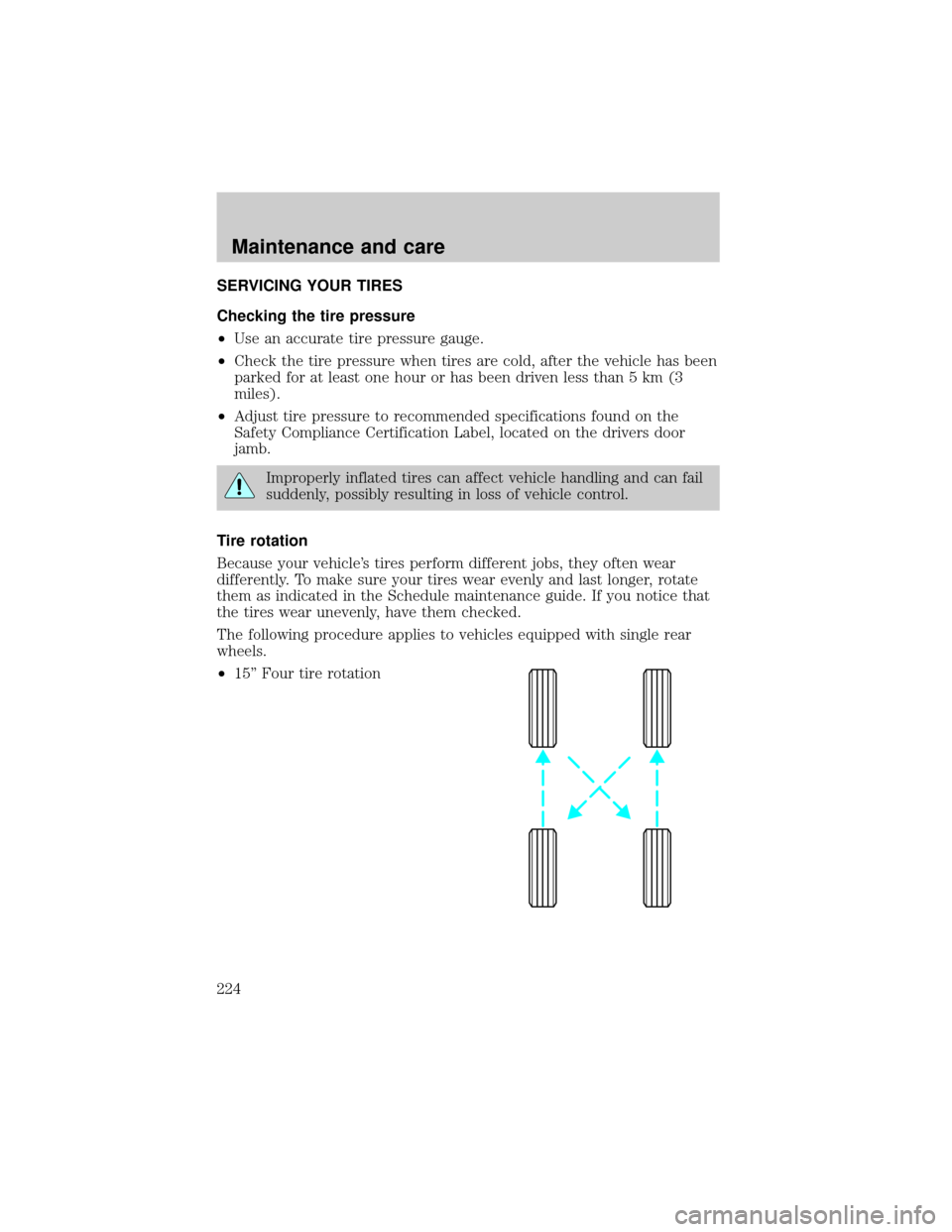
Tire rotation
Because your vehicle's tires perform different jobs, they often wear
differently. To make sure your tires wear evenly and last longer, rotate
them as indicated in the Schedule maintenance guide. If you notice that
the tires wear unevenly, have them checked.
The following procedure applies to vehicles equipped with single rear
wheels.
²15'' Four tire rotation
Maintenance and care
224
Page 233 of 264

Habits
²Smooth, moderate operation can yield up to 10% savings in fuel.
²Steady speeds without stopping will usually give the best fuel
economy.
²Idling for long periods of time (greater than one minute) may waste
fuel.
²Anticipate stopping; slowing down may eliminate the need to stop.
²Sudden or hard accelerations may reduce fuel economy.
²Slow down gradually.
²Drive at reasonable speeds (traveling at 105 km /h [65 mph] uses 15%
more fuel than traveling at 88 km/h [55 mph]).
²Revving the engine before turning it off may reduce fuel economy.
²Use of the air conditioner or defroster may reduce fuel economy.
²Use of speed control (if equipped) may improve fuel economy. Speed
control can help maintain a constant speed and reduce speed changes.
You may want to turn off the speed control in hilly terrain as
unnecessary shifting between third and fourth gears may occur and
could result in reduced fuel economy.
²Warming up a vehicle on cold mornings is not required and may
reduce fuel economy.
²Resting your foot on the brake pedal while driving may reduce fuel
economy.
²Combine errands and minimize stop-and-go driving.
Maintenance
²Keep tires properly inflated and use only recommended size.
²Operating a vehicle with the wheels out of alignment will reduce fuel
economy.
²Use recommended engine oil. Refer toLubricant Specifications.
²Perform all regularly scheduled maintenance items. Follow the
recommended maintenance schedule and owner maintenance checks
found in your vehicle Scheduled Maintenance Guide.
Maintenance and care
233
Page 234 of 264
![FORD EXPLORER 1999 2.G Owners Manual Conditions
²Heavily loading a vehicle or towing a trailer may reduce fuel economy
at any speed.
²Carrying unnecessary weight may reduce fuel economy (approximately
2 km/h [1 mpg] is lost for every 1](/manual-img/11/4957/w960_4957-233.png "FORD EXPLORER 1999 2.G Owners Manual Conditions
²Heavily loading a vehicle or towing a trailer may reduce fuel economy
at any speed.
²Carrying unnecessary weight may reduce fuel economy (approximately
2 km/h [1 mpg] is lost for every 1")
Conditions
²Heavily loading a vehicle or towing a trailer may reduce fuel economy
at any speed.
²Carrying unnecessary weight may reduce fuel economy (approximately
2 km/h [1 mpg] is lost for every 180 kg [400 lb] of weight carried).
²Adding certain accessories to your vehicle (for example bug
deflectors, rollover/light bars, running boards, ski/luggage racks) may
reduce fuel economy.
²Use of fuel blended with alcohol may lower fuel economy.
²Fuel economy may decrease with lower temperatures during the first
12±16 km (8±10 miles) of driving.
²Flat terrain driving improves fuel economy over hilly roads.
²Transmissions give their best fuel economy when operated in the top
cruise gear and with steady pressure on the gas pedal.
²Four-wheel-drive operation (if equipped) is less fuel efficient than
two-wheel-drive operation.
²Close windows for high speed driving.
EPA window sticker
Every new vehicle should have the EPA window sticker. Contact your
dealer if the window sticker is not supplied with your vehicle. The EPA
window sticker should be your guide for the fuel economy comparisons
with other vehicles.
It is important to note the box in the lower left corner of the window
sticker. These numbers represent the Range of Km/L (MPG) expected on
the vehicle, depending upon the driver's method of operation and
conditions.
EMISSION CONTROL SYSTEM
Your vehicle is equipped with various emission control components and a
catalytic converter which will enable your vehicle to comply with
applicable exhaust emission standards. To make sure that the catalytic
converter and other emission control components continue to work
properly:
²Use only unleaded fuel.
²Avoid running out of fuel.
Maintenance and care
234
Page 251 of 264
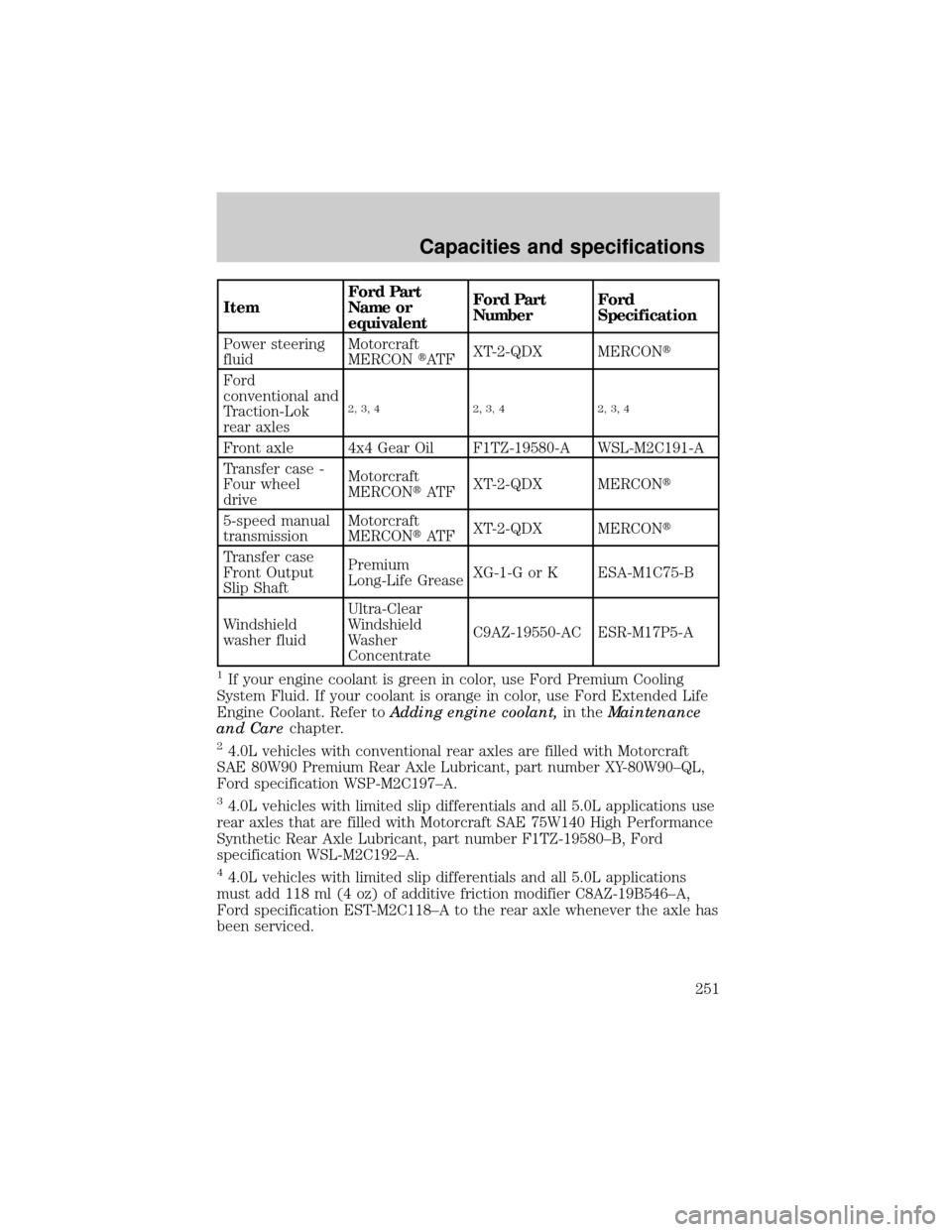
ItemFord Part
Name or
equivalentFord Part
NumberFord
Specification
Power steering
fluidMotorcraft
MERCONtAT FXT-2-QDX MERCONt
Ford
conventional and
Traction-Lok
rear axles
2, 3, 4 2, 3, 4 2, 3, 4
Front axle 4x4 Gear Oil F1TZ-19580-A WSL-M2C191-A
Transfer case -
Four wheel
driveMotorcraft
MERCONtAT FXT-2-QDX MERCONt
5-speed manual
transmissionMotorcraft
MERCONtAT FXT-2-QDX MERCONt
Transfer case
Front Output
Slip ShaftPremium
Long-Life GreaseXG-1-G or K ESA-M1C75-B
Windshield
washer fluidUltra-Clear
Windshield
Washer
ConcentrateC9AZ-19550-AC ESR-M17P5-A
1If your engine coolant is green in color, use Ford Premium Cooling
System Fluid. If your coolant is orange in color, use Ford Extended Life
Engine Coolant. Refer toAdding engine coolant,in theMaintenance
and Carechapter.
24.0L vehicles with conventional rear axles are filled with Motorcraft
SAE 80W90 Premium Rear Axle Lubricant, part number XY-80W90±QL,
Ford specification WSP-M2C197±A.
34.0L vehicles with limited slip differentials and all 5.0L applications use
rear axles that are filled with Motorcraft SAE 75W140 High Performance
Synthetic Rear Axle Lubricant, part number F1TZ-19580±B, Ford
specification WSL-M2C192±A.
44.0L vehicles with limited slip differentials and all 5.0L applications
must add 118 ml (4 oz) of additive friction modifier C8AZ-19B546±A,
Ford specification EST-M2C118±A to the rear axle whenever the axle has
been serviced.
Capacities and specifications
251
Page 258 of 264

Engine oil
checking and adding ..............207
dipstick ....................................205
specifications ...................205,207
Exhaust fumes ..........................143
Floor mats .................................103
Four-Wheel Drive
vehicles ..............................9,10,157
control trac .............................157
description .......................157,159
driving off road ................160,162
electronic shift ..........................31
Fuel
choosing the right fuel ...........228
comparisons with EPA fuel
economy estimates .................234
detergent in fuel .....................229
filling your vehicle
with fuel ...........................227,230
gauge .........................................14
quality ......................................229
running out of fuel .................230
safety information relating to
automotive fuels .....................227
Fuses ............................179,180,181
Gas mileage
(see Fuel economy) .........231,232,
233,234
Gauges .........................................11
engine coolant temperature
gauge .........................................12
engine oil pressure gauge ........14
GVWR
(Gross Vehicle Weight Rating)
calculating ...............................167
Hazard flashers .........................178
Head restraints ...........116,118,119
Headlamps
aiming ......................................241
autolamp system .......................97
bulb specifications ..................240
high beam ..............................9,19warning chime ..........................11
Heating ........................................20
heating and air conditioning
system .............................20,21,22
Hood ..........................................201
Ignition .......................................252
Inspection/maintenance (I/M)
testing ........................................236
Instrument panel
cleaning ...................................245
Keyless entry system
autolock ............................109,110
keypad .....................................111
locking and unlocking doors ..112
programming entry
code ..................................111,112
Keys
key in ignition chime ...............11
positions of the ignition ...........79
Lamps
daytime running light ...............19
fog lamps ...................................19
headlamps .................................19
headlamps, flash to pass ..........20
instrument panel, dimming .....20
replacing bulbs ...............236,237,
238,239,240
Lane change indicator
(see Turn signal) ........................79
Liftgate ......................................103
Lights, warning and indicator
air bag ..........................................7
anti-lock brakes (ABS) ..............8
anti-theft .....................................9
brake ............................................8
charging system ..........................9
check coolant ..............................9
cruise indicator .........................10
door ajar ....................................10
fuel reset .....................................7
overdrive off ..............................10
safety belt ...................................8
Index
258