1999 FORD EXPEDITION change time
[x] Cancel search: change timePage 159 of 216
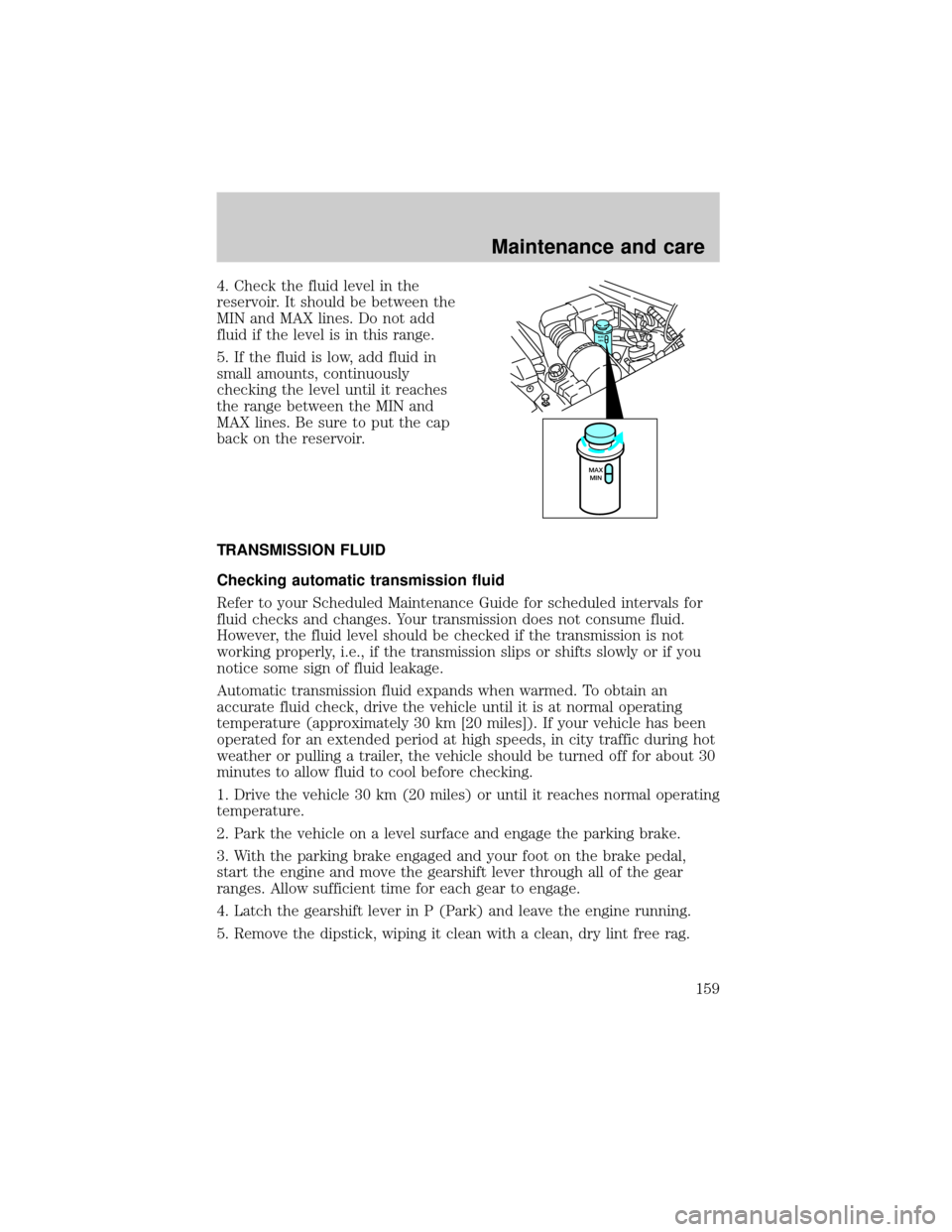
4. Check the fluid level in the
reservoir. It should be between the
MIN and MAX lines. Do not add
fluid if the level is in this range.
5. If the fluid is low, add fluid in
small amounts, continuously
checking the level until it reaches
the range between the MIN and
MAX lines. Be sure to put the cap
back on the reservoir.
TRANSMISSION FLUID
Checking automatic transmission fluid
Refer to your Scheduled Maintenance Guide for scheduled intervals for
fluid checks and changes. Your transmission does not consume fluid.
However, the fluid level should be checked if the transmission is not
working properly, i.e., if the transmission slips or shifts slowly or if you
notice some sign of fluid leakage.
Automatic transmission fluid expands when warmed. To obtain an
accurate fluid check, drive the vehicle until it is at normal operating
temperature (approximately 30 km [20 miles]). If your vehicle has been
operated for an extended period at high speeds, in city traffic during hot
weather or pulling a trailer, the vehicle should be turned off for about 30
minutes to allow fluid to cool before checking.
1. Drive the vehicle 30 km (20 miles) or until it reaches normal operating
temperature.
2. Park the vehicle on a level surface and engage the parking brake.
3. With the parking brake engaged and your foot on the brake pedal,
start the engine and move the gearshift lever through all of the gear
ranges. Allow sufficient time for each gear to engage.
4. Latch the gearshift lever in P (Park) and leave the engine running.
5. Remove the dipstick, wiping it clean with a clean, dry lint free rag.
MAX
MIN
MAX
MIN
Maintenance and care
159
Page 176 of 216
show how temperature impacts fuel economy. In general, lower
temperatures give lower fuel economy.
Driving style Ð good driving and fuel economy habits
Give consideration to the lists that follow and you may be able to change
a number of variables and improve your fuel economy.
Habits
²Smooth, moderate operation can yield up to 10% savings in fuel.
²Steady speeds without stopping will usually give the best fuel
economy.
²Idling for long periods of time (greater than one minute) may waste
fuel.
²Anticipate stopping; slowing down may eliminate the need to stop.
²Sudden or hard accelerations may reduce fuel economy.
²Slow down gradually.
²Drive at reasonable speeds (traveling at 105 km /h [65 mph] uses 15%
more fuel than traveling at 88 km/h [55 mph]).
²Revving the engine before turning it off may reduce fuel economy.
²Use of the air conditioner or defroster may reduce fuel economy.
²Use of speed control (if equipped) may improve fuel economy. Speed
control can help maintain a constant speed and reduce speed changes.
You may want to turn off the speed control in hilly terrain as
unnecessary shifting between third and fourth gears may occur and
could result in reduced fuel economy.
²Warming up a vehicle on cold mornings is not required and may
reduce fuel economy.
²Resting your foot on the brake pedal while driving may reduce fuel
economy.
²Combine errands and minimize stop-and-go driving.
Maintenance
²Keep tires properly inflated and use only recommended size.
²Operating a vehicle with the wheels out of alignment will reduce fuel
economy.
²Use recommended engine oil. Refer toLubricant Specifications.
Maintenance and care
176
Page 193 of 216
FluidFord Part
NameApplication Capacity
Rear axle
lubricant
4Motorcraft SAE
75W140
Synthetic Rear
Axle LubricantAll
2.9-3.1L
(5.5-5.8 pints)
Windshield
washer fluidUltra-Clear
Windshield
Washer
ConcentrateAll
4.1L
(4.5 quarts)
1Ensure the correct automatic transmission fluid is used for a specific
application. Check the container to verify the fluid is MERCONt
approved. Transmission fluid requirements are indicated on the dipstick
handle. Refer to the Scheduled Maintenance Guide.
Do NOT use any non-approved automatic transmission fluid for an
application specifying MERCONt. Use of a non-approved fluid may cause
internal transmission component damage.
2Indicates only approximate dry-fill capacity. Some applications may
vary based on cooler size and if equipped with an in-tank cooler. The
amount of transmission fluid and fluid level should be set by the
indication on the dipstick's normal operating range.
3Use Ford Premium Engine Coolant (green in color). DO NOT USE Ford
Extended Life Engine Coolant (orange in color). Refer toAdding engine
coolant, in the Maintenance and Care chapter.
4Your vehicle's rear axle is filled with a synthetic rear axle lubricant and
is considered lubricated for life.These lubricants are not to be checked or
changed unless a leak is suspected, service is required or the axle has
been submerged in water. The axle lubricant should be changed any time
the axle has been submerged in water. Add 118 ml (4 oz.) of additive
friction modifier C8AZ-19B546±A, Ford specification EST-M2C118±A for
complete refill of Traction-Lok axles.
Service refill capacities are determined by filling the rear axle 6 mm to
14 mm (1/4 inch to 9/16 inch) below the bottom of the filler hole.
Capacities and specifications
193
Page 200 of 216
Ford extended service plan
You can get more protection for your new car or light truck by
purchasing Ford Extended Service Plan (Ford ESP) coverage. Ford ESP
is an optional service contract which is backed by Ford Motor Company
or Ford Motor Service Company (in the U.S.) and Ford of Canada (in
Canada). It provides:
²Protection against repair costs after your New Vehicle Limited
Warranty period expires;
and
²Other benefits during the warranty period (such as reimbursement for
rentals and towing.)
You may purchase Ford ESP from any participating Ford or
Lincoln-Mercury or Ford of Canada dealer. There are several plans
available in various time, distance and deductible combinations which
can be tailored to fit your own driving needs. Ford ESP also offers
reimbursement benefits for towing and rental coverage. (In Hawaii, rules
vary. See your dealer for details.)
When you buy Ford ESP, you receive Peace-of-Mind protection
throughout the United States and Canada, provided by a network of
more than 5,200 participating Ford, Lincoln-Mercury and Ford of Canada
dealers.
If you did not take advantage of the Ford Extended Service Plan at the
time of purchasing your vehicle, you may still be eligible. Please contact
your dealer for further information. Since this information is subject to
change, please ask your dealer for complete details about Ford Extended
Service Plan coverage options.
Also, please be aware that some dealers offer service contracts that are
not backed by Ford Motor Company or Ford of Canada. On the surface,
many independent plans appear to be like Ford's. The problem is that
they can often require the use of non-factory approved parts and have
much more complex and restrictive claims coverage terms than Ford.
At Ford Motor Company and Ford of Canada, we are dedicated to
providing Ford, Lincoln and Mercury vehicle owners with programs that
will enhance your ownership experience and protect you from
unexpected repair bills. Genuine Ford ESP is the only Extended Service
Plan that enables us to provide that service.
Customer assistance
200
Page 213 of 216

Engine oil
checking and adding ..............152
dipstick ....................................150
specifications ...................150,152
Exhaust fumes ..........................103
Fail safe cooling ........................157
Floor mats ...................................64
Four-Wheel Drive vehicles ..10,114
control trac .............................115
description ..............................115
driving off road .......................117
electronic shift ............19,116,117
indicator light ...........................10
Fuel
choosing the right fuel ...........172
comparisons with EPA fuel
economy estimates .................177
detergent in fuel .....................173
filling your vehicle
with fuel ...........................170,173
quality ......................................172
running out of fuel .................173
safety information relating to
automotive fuels .....................170
Fuses ...................................129,130
Garage door opener ....................56
Gas mileage (see Fuel
economy) ..............174,175,176,177
Gauges .........................................11
battery voltage gauge ...............14
engine coolant temperature
gauge .........................................12
engine oil pressure gauge ........14
fuel gauge ..................................12
odometer ...................................13
speedometer .............................12
tachometer ................................13
trip odometer ............................13
GVWR
(Gross Vehicle Weight Rating)
calculating ...............................121
Hazard flashers .........................128Head
restraints .......74,77,78,79,80,81,82
Headlamps
aiming ......................................184
bulb specifications ..................184
high beam ..............................9,54
Heating ........................................38
heating and air
conditioning system ............38,40
Hood ..........................................149
Ignition .......................................196
Inspection/maintenance
(I/M) testing ..............................179
Instrument panel
cleaning ...................................188
Keyless entry system
locking and unlocking doors ....73
programming entry code .........72
Keys
positions of the ignition ...........48
Lamps
autolamp system .......................18
daytime running light ...............17
fog lamps ...................................17
headlamps .................................17
headlamps, flash to pass ..........55
instrument panel, dimming .....18
interior lamps .........................184
replacing
bulbs ............179,180,181,182,183
Lane change indicator
(see Turn signal) ........................48
Liftgate ........................................64
Lights, warning and indicator ......6
air bag ..........................................7
air suspension .........................110
anti-lock brakes (ABS) ..............8
anti-theft .....................................9
brake ............................................8
charging system ..........................9
door ajar ....................................10
engine oil pressure .....................9
Index
213