1999 FORD EXPEDITION brakes
[x] Cancel search: brakesPage 119 of 216

Driving on snow and ice
A 4WD vehicle has advantages over 2WD vehicles in snow and ice but
can skid like any other vehicle.
Avoid sudden applications of power and quick changes of direction on
snow and ice. Apply the accelerator slowly and steadily when starting
from a full stop.
When braking, apply the brakes as you normally would. In order to allow
the anti-lock brake system (ABS) to operate properly, keep steady
pressure on the brake pedal.
Allow more stopping distance and drive slower than usual. Consider
using one of the lower gears.
DRIVING THROUGH WATER
Do not drive quickly through standing water, especially if the depth is
unknown. Traction or brake capability may be limited and if the ignition
system gets wet, your engine may stall. Water may also enter your
engine's air intake and severely damage your engine.
If driving through deep or standing water is unavoidable, proceed very
slowly. Never drive through water that is higher than the bottom of the
hubs.
Once through the water, always try the brakes. Wet brakes do not stop
the vehicle as effectively as dry brakes. Drying can be improved by
moving your vehicle slowly while applying light pressure on the brake
pedal.
Driving through deep water where the transmission is submerged
may allow water into the transmission and cause internal
transmission damage.
VEHICLE LOADING
Before loading a vehicle, familiarize yourself with the following terms:
²Base Curb Weight: Weight of the vehicle including any standard
equipment, fluids, lubricants, etc. It does not include passengers or
aftermarket equipment.
²Payload: Combined maximum allowable weight of cargo, passengers
and optional equipment. The payload equals the gross vehicle weight
rating minus base curb weight.
Driving
119
Page 122 of 216
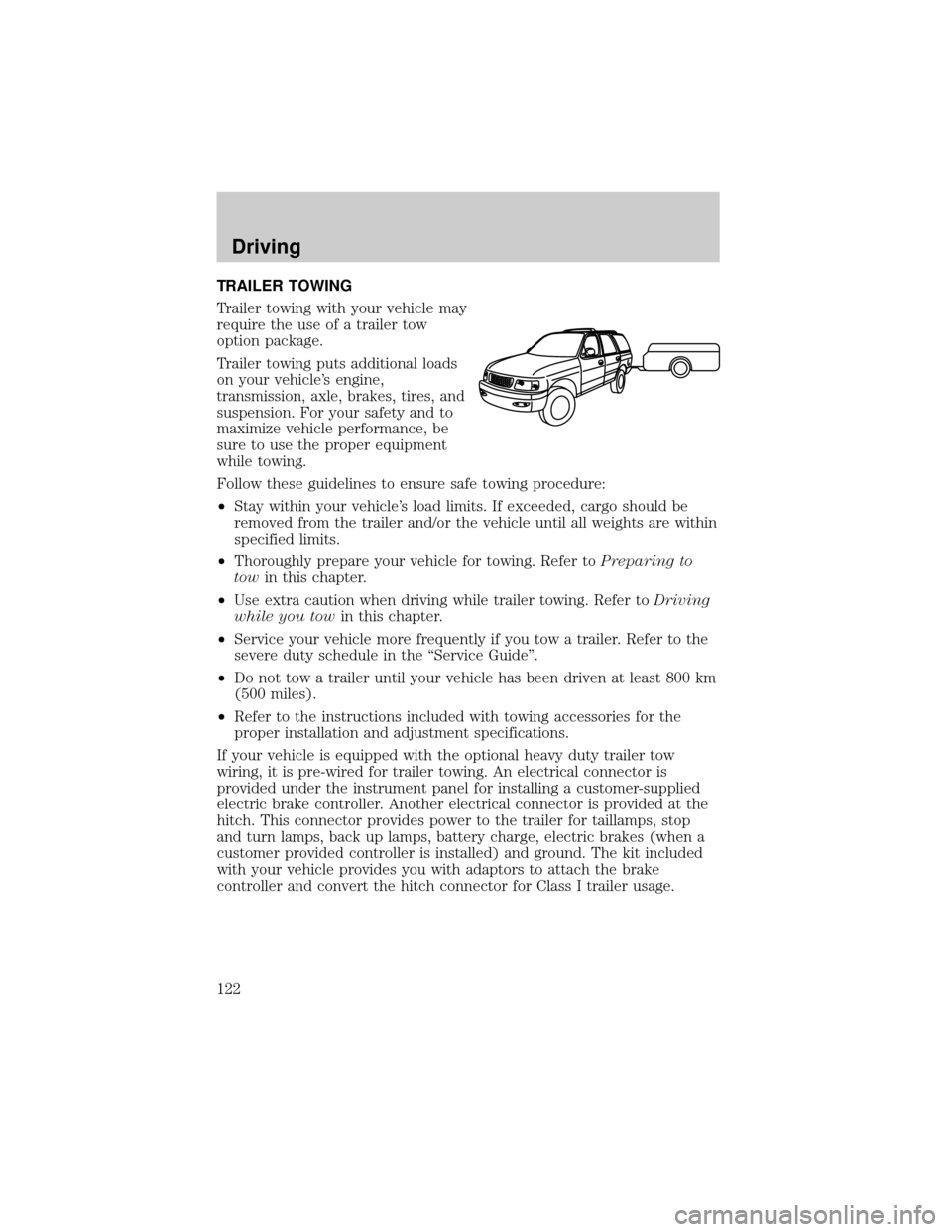
TRAILER TOWING
Trailer towing with your vehicle may
require the use of a trailer tow
option package.
Trailer towing puts additional loads
on your vehicle's engine,
transmission, axle, brakes, tires, and
suspension. For your safety and to
maximize vehicle performance, be
sure to use the proper equipment
while towing.
Follow these guidelines to ensure safe towing procedure:
²Stay within your vehicle's load limits. If exceeded, cargo should be
removed from the trailer and/or the vehicle until all weights are within
specified limits.
²Thoroughly prepare your vehicle for towing. Refer toPreparing to
towin this chapter.
²Use extra caution when driving while trailer towing. Refer toDriving
while you towin this chapter.
²Service your vehicle more frequently if you tow a trailer. Refer to the
severe duty schedule in the ªService Guideº.
²Do not tow a trailer until your vehicle has been driven at least 800 km
(500 miles).
²Refer to the instructions included with towing accessories for the
proper installation and adjustment specifications.
If your vehicle is equipped with the optional heavy duty trailer tow
wiring, it is pre-wired for trailer towing. An electrical connector is
provided under the instrument panel for installing a customer-supplied
electric brake controller. Another electrical connector is provided at the
hitch. This connector provides power to the trailer for taillamps, stop
and turn lamps, back up lamps, battery charge, electric brakes (when a
customer provided controller is installed) and ground. The kit included
with your vehicle provides you with adaptors to attach the brake
controller and convert the hitch connector for Class I trailer usage.
Driving
122
Page 125 of 216
Safety chains
Always connect the trailer's safety chains to the vehicle. To connect the
trailer's safety chains, cross the chains under the trailer tongue and allow
slack for turning corners.
If you use a rental trailer, follow the instructions that the rental agency
gives to you.
Do not attach safety chains to the bumper.
Trailer brakes
Electric brakes and manual, automatic or surge-type brakes are safe if
installed properly and adjusted to the manufacturer's specifications. The
trailer brakes must meet local and Federal regulations.
Do not connect a trailer's hydraulic brake system directly to your
vehicle's brake system. Your vehicle may not have enough
braking power and your chances of having a collision greatly increase.
The braking system of the tow vehicle is rated for operation at the
GVWR not GCWR.
Trailer lamps
Trailer lamps are required on most towed vehicles. Make sure your
trailer lamps conform to local and Federal regulations. See your dealer or
trailer rental agency for proper instructions and equipment for hooking
up trailer lamps.
Using a step bumper
The rear bumper is equipped with an integral hitch and requires only a
ball with a 25.4 mm (one inch) shank diameter. The bumper has a
1 814 kg (4 000 lb.) trailer weight and 181 kg (400 lb.) tongue weight
capability.
Use a frame-mounted weight distributing hitch for trailers over 1814 kg
(4 000 lb).
Driving
125
Page 153 of 216
BRAKE FLUID
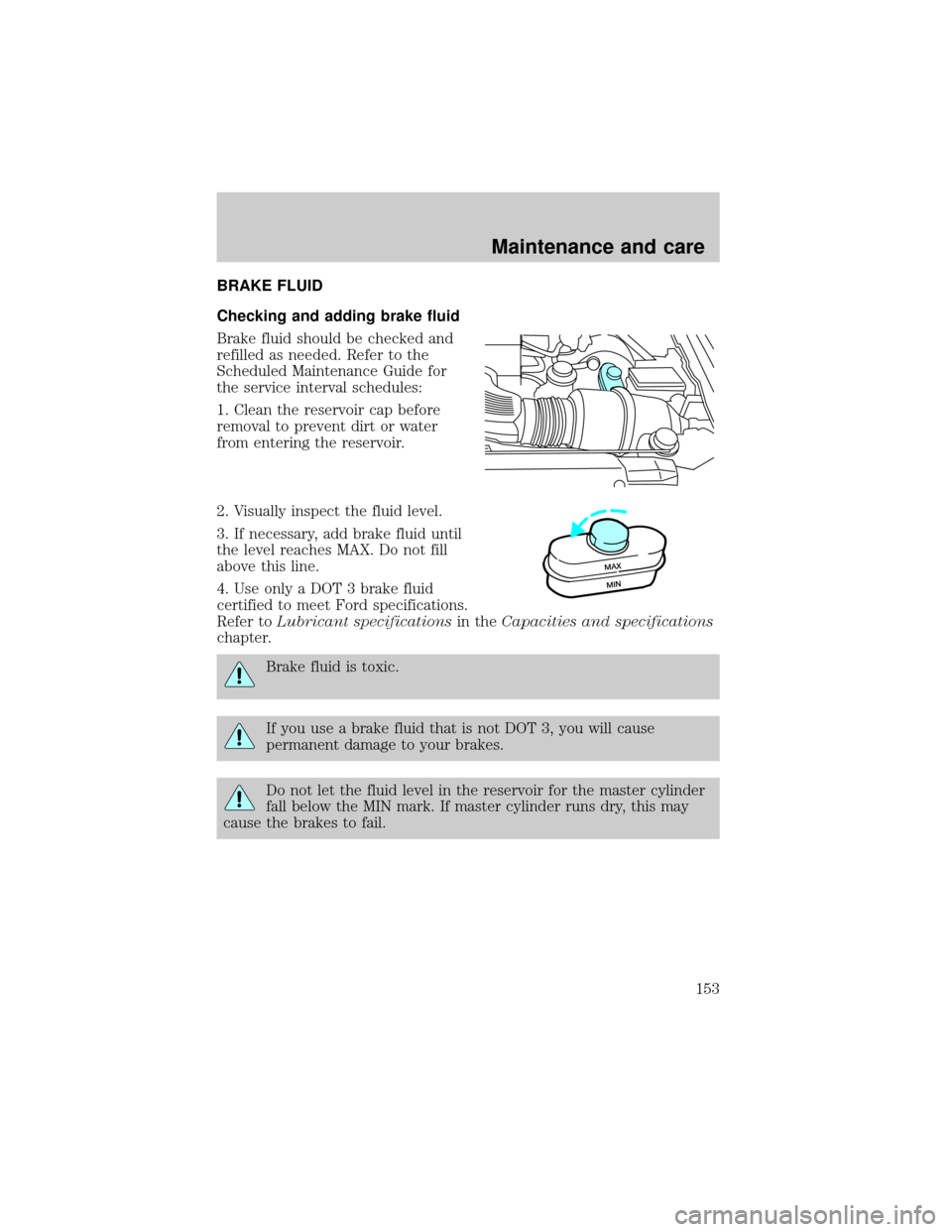
Checking and adding brake fluid
Brake fluid should be checked and
refilled as needed. Refer to the
Scheduled Maintenance Guide for
the service interval schedules:
1. Clean the reservoir cap before
removal to prevent dirt or water
from entering the reservoir.
2. Visually inspect the fluid level.
3. If necessary, add brake fluid until
the level reaches MAX. Do not fill
above this line.
4. Use only a DOT 3 brake fluid
certified to meet Ford specifications.
Refer toLubricant specificationsin theCapacities and specifications
chapter.
Brake fluid is toxic.
If you use a brake fluid that is not DOT 3, you will cause
permanent damage to your brakes.
Do not let the fluid level in the reservoir for the master cylinder
fall below the MIN mark. If master cylinder runs dry, this may
cause the brakes to fail.
MAX
MIN
Maintenance and care
153
Page 185 of 216
²Oncoming motorists frequently signal you to deactivate your high
beams, and your high beams are not activated.
²The headlamps do not seem to provide enough light for clear night
vision.
²The headlamp beams are pointed substantially away from a slightly
down and to the right position.
CLEANING AND CARING FOR YOUR VEHICLE
Refer to the Customer Assistance chapter for a list of Ford-approved
cleaners, polishes and waxes.
Washing your vehicle
Wash your vehicle regularly with
cold or lukewarm water. Never use
strong detergents or soap. If your
vehicle is particularly dirty, use a
quality car wash detergent. Always
use a clean sponge, washing glove
or similar device and plenty of water
for best results. To avoid spots,
avoid washing when the hood is still
warm, immediately after or during
exposure to strong sunlight.
During winter months, it is especially important to wash the vehicle on a
regular basis. Large quantities of dirt and road salt are difficult to
remove and also cause damage to the vehicle.
Remove any exterior accessories, such as antennas, before entering a car
wash. If you have wax applied to the vehicle at a commercial car wash, it
is recommended that you clean the wiper blades and windshield as
described inCleaning the wiper blades and windshield.
After washing, apply the brakes several times to dry them.
Waxing your vehicle
Wax when water stops beading on the surface. This could be every three
or four months, depending on operating conditions.
Use only carnauba or synthetic-based waxes. Use cleaning fluid or
alcohol with a clean cloth to remove any bugs and tar before waxing
vehicle. Use tar remover to remove any tar spots.
Maintenance and care
185
Page 212 of 216

Accessory delay ..........................61
Air bag supplemental restraint
system ..........................................89
and child safety seats ..............90
description ................................89
disposal ......................................93
indicator light ...........................92
passenger air bag .....................91
Air cleaner filter .......................164
Air conditioning
automatic temperature
control system ......40,41,42,43,45
auxiliary heater and air
conditioner ................................46
Air suspension ...........................109
warning light .............................10
Anti-theft system ........................66
Armrests ......................................76
Automatic transmission
driving an automatic
overdrive ...................112,113,114
Axle
refill capacities ........................191
Brakes ........................................105
anti-lock ............................105,106
anti-lock brake system (ABS)
warning light ...........................106
fluid, checking and adding ....153
shift interlock ..........................111
Break-in period .............................2
CD changer ..................33,35,36,37
Child safety seats
attaching with tether straps ....98
in rear seat ................................96
tether anchorage hardware .....99
Cleaning your vehicle ...............185
engine compartment ..............187
exterior ....................................186
exterior lamps .........................187
interior .....................................188
plastic parts ............................187
washing ....................................185waxing .....................................185
wheels ......................................186
wiper blades ............................188
Compass, electronic ....................57
calibration .................................59
set zone adjustment .................58
Console ........................................63
overhead ...............................55,56
rear ............................................64
Controls
power seat ............................76,77
Coolant ......................................156
checking and adding ..............155
refill capacities ........................156
Customer Assistance
Ford accessories for
your vehicle ..............206,207,208
Ford Extended Service Plan .200
Getting assistance outside the
U.S. and Canada .....................205
Getting roadside assistance ...199
Getting the service you need...201
Ordering additional owner's
literature .................................210
The Dispute Settlement
Board ..................202,203,204,205
Defrost
rear window ..............................19
Driveline universal joint and
slip yoke ....................................161
Driving under special
conditions ..................................118
sand .........................................117
snow and ice ...........................119
through water .........................117
Emission control system ..........178
Engine
coolant .....................................154
idle speed control ...................162
service points ..........................150
starting after a collision .........128
Engine block heater .................103
Index
212
Page 213 of 216

Engine oil
checking and adding ..............152
dipstick ....................................150
specifications ...................150,152
Exhaust fumes ..........................103
Fail safe cooling ........................157
Floor mats ...................................64
Four-Wheel Drive vehicles ..10,114
control trac .............................115
description ..............................115
driving off road .......................117
electronic shift ............19,116,117
indicator light ...........................10
Fuel
choosing the right fuel ...........172
comparisons with EPA fuel
economy estimates .................177
detergent in fuel .....................173
filling your vehicle
with fuel ...........................170,173
quality ......................................172
running out of fuel .................173
safety information relating to
automotive fuels .....................170
Fuses ...................................129,130
Garage door opener ....................56
Gas mileage (see Fuel
economy) ..............174,175,176,177
Gauges .........................................11
battery voltage gauge ...............14
engine coolant temperature
gauge .........................................12
engine oil pressure gauge ........14
fuel gauge ..................................12
odometer ...................................13
speedometer .............................12
tachometer ................................13
trip odometer ............................13
GVWR
(Gross Vehicle Weight Rating)
calculating ...............................121
Hazard flashers .........................128Head
restraints .......74,77,78,79,80,81,82
Headlamps
aiming ......................................184
bulb specifications ..................184
high beam ..............................9,54
Heating ........................................38
heating and air
conditioning system ............38,40
Hood ..........................................149
Ignition .......................................196
Inspection/maintenance
(I/M) testing ..............................179
Instrument panel
cleaning ...................................188
Keyless entry system
locking and unlocking doors ....73
programming entry code .........72
Keys
positions of the ignition ...........48
Lamps
autolamp system .......................18
daytime running light ...............17
fog lamps ...................................17
headlamps .................................17
headlamps, flash to pass ..........55
instrument panel, dimming .....18
interior lamps .........................184
replacing
bulbs ............179,180,181,182,183
Lane change indicator
(see Turn signal) ........................48
Liftgate ........................................64
Lights, warning and indicator ......6
air bag ..........................................7
air suspension .........................110
anti-lock brakes (ABS) ..............8
anti-theft .....................................9
brake ............................................8
charging system ..........................9
door ajar ....................................10
engine oil pressure .....................9
Index
213