1999 FORD E SERIES check engine
[x] Cancel search: check enginePage 8 of 39

WAIT TO START
With the key in the ON position, the
WAIT TO START light will illuminate
if glow plug heat is necessary as a
starting aid. Wait until the light goes
off before starting. The light should
always illuminate briefly, when the ignition key is in the ON position. If
the light does not illuminate, there may be a problem. Refer to the
Startingchapter in this guide. After the engine starts, the light should
remain off.
The light should always illuminate at least momentarily when the engine
is cold and the ignition is turned to ON. If it does not illuminate, the
glow plug system should be checked and repaired promptly to avoid
difficulty in cold starting.
WATER IN FUEL
During refueling, it is possible for
water-contaminated diesel fuel to be
pumped into your tank. Your vehicle
fuel system is equipped with a fuel
filter/water separator to remove
water from the fuel. The WATER IN FUEL light will illuminate when the
ignition is turned to START (as part of the light function check) and
when the fuel filter/water separator has a significant quantity of water in
it.
If the light illuminates when the engine is running, stop the vehicle as
soon as safely possible, shut off the engine, then drain the filter bowl.
Refer to theGeneral maintenancechapter for drain procedure.
Allowing water to stay in the system could result in extensive damage to,
or failure of, the fuel injection system.
Do not drain the water separator while the engine is running.
Fuel may ignite if the separator is drained while the engine is
running or the vehicle is moving.
WAIT
TO
START
WATER
IN
FUEL
Warning lights
8
Page 11 of 39

Operation in standing water
Ingestion of water into the diesel engine can result in immediate and
severe damage to the engine. If driving through water, slow down to
avoid splashing water into the intake. If the engine stalls, and ingestion
of water into the engine is suspected, do not try to restart the engine.
Consult your dealer for service immediately. Follow the cylinder
compression test procedure outlined in the Workshop Manual, then
check the engine oil for contamination.
Engine block heater (if equipped)
Refer to theStartingchapter in your Owner Guide.
JUMP STARTING YOUR VEHICLE
The gases around the battery can explode if exposed to flames,
sparks, or lit cigarettes. An explosion could result in injury or
vehicle damage.
Do not push start your vehicle. You could damage the catalytic
converter.
Batteries contain sulfuric acid which burns skin, eyes, and
clothing.
Preparing your vehicle
Also see the label on the battery.
1. Use only a 12±volt supply to start your vehicle. If you connect your
battery to a 24±volt power supply you can damage your starter, ignition
system and other electrical components. Do not attach the jumper cables
to the glow plug relay as this could severely damage the glow plugs,
injector driver module and PCM.
2. Do not disconnect the battery of the disabled vehicle as this could
damage the vehicle's electrical system.
3. Park the booster vehicle close to the hood of the disabled vehicle
making sure theydo nottouch. Set the parking brake on both vehicles
and stay clear of the engine cooling fan and other moving parts.
Starting
11
Page 12 of 39
4. Check all battery terminals and remove any excessive corrosion before
you attach the battery cables.
5. Turn the heater fan on in both vehicles to protect any electrical
surges. Turn all other accessories off.
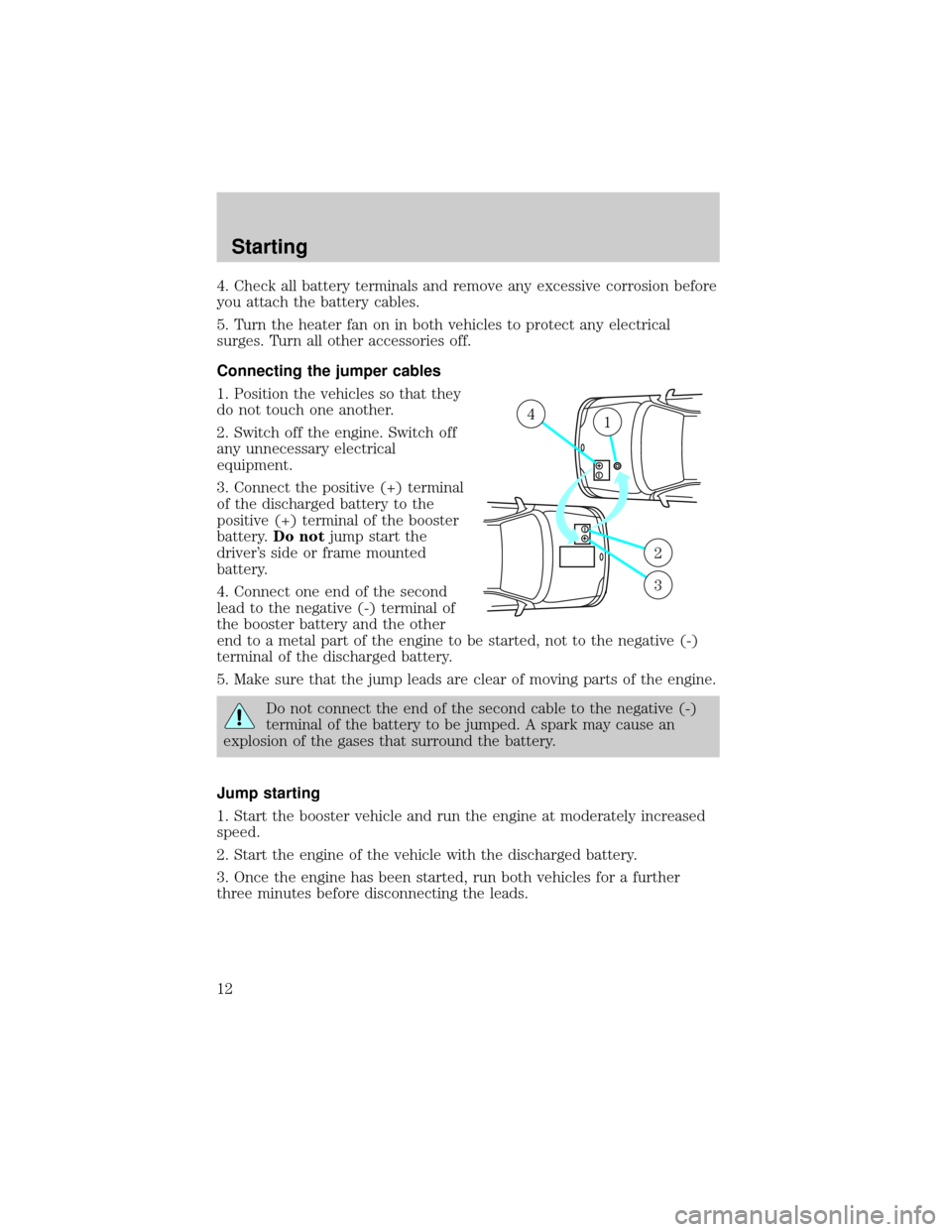
Connecting the jumper cables
1. Position the vehicles so that they
do not touch one another.
2. Switch off the engine. Switch off
any unnecessary electrical
equipment.
3. Connect the positive (+) terminal
of the discharged battery to the
positive (+) terminal of the booster
battery.Do notjump start the
driver's side or frame mounted
battery.
4. Connect one end of the second
lead to the negative (-) terminal of
the booster battery and the other
end to a metal part of the engine to be started, not to the negative (-)
terminal of the discharged battery.
5. Make sure that the jump leads are clear of moving parts of the engine.
Do not connect the end of the second cable to the negative (-)
terminal of the battery to be jumped. A spark may cause an
explosion of the gases that surround the battery.
Jump starting
1. Start the booster vehicle and run the engine at moderately increased
speed.
2. Start the engine of the vehicle with the discharged battery.
3. Once the engine has been started, run both vehicles for a further
three minutes before disconnecting the leads.
+–
+–
41
2
3
Starting
12
Page 22 of 39

After changing the fuel filter, the engine will purge the trapped air as it
runs. Engine may run roughly and smoke until the air is completely
eliminated.
ENGINE OIL
Checking engine oil level
Because it is normal to add some oil between oil changes, check your
engine oil level each time you stop for fuel. To check the engine oil level
consistently and accurately, the following procedure is recommended:
1. Have engine at normal operating temperature (at least into the
NORMAL range on the engine coolant temperature gauge).
2. Park the vehicle on a level surface, then turn off the engine and open
the hood.
4. Allow at least20 minutesafter engine shutdown to assure that the oil
contained in the upper parts of the engine has returned to the oil pan.
5. Protecting yourself from engine
heat, pull out the dipstick, wipe it
clean and reinsert fully.
6. Read oil level on both sides of dipstick and use highest level (reading)
for the actual engine oil level.
7. Maintain the oil level between ADD and OPERATING RANGE on the
dipstick by adding oil as required. The distance from ADD to
OPERATING RANGE on the dipstick represents 1.9L (2 quarts). Do not
overfill. If the oil level exceeds OPERATING RANGE, oil consumption
may result.
General maintenance information
22
Page 24 of 39

A symbol has been developed by the
American Petroleum Institute (API)
to help you select the proper engine
oil. It will be included on the oil
container you purchase. The top
section of the symbol shows the oil
performance by the API designation.
This should match the owner guide recommendation. The center section
will show the SAE viscosity grade. The lower section will state energy
conserving if the oil has proven fuel saving capabilities.
Changing engine oil and filter
Change your oil and filter according to the ªService Guideº. Change more
frequently if your vehicle operation includes extended periods of idling
or low-speed operation, driving for a long time in cold temperatures or
driving short distances. See the following section ªEngine Lubrication for
Severe Service Operationº for all severe duty restrictions.
Use Ford Engine Oil Filter Part No. F4TZ-6731±A (FL±1995) or
equivalent. These filters protect your engine by filtering harmful,
abrasive or sludge particles. The FL±1995 filters particles significantly
smaller than most available ªwill fitº filters.
To replace, use an oil filter wrench to unscrew the filter from the oil
cooler fitting. Turn it horizontally to let excess oil drain off, and remove.
Do not handle a hot oil filter with bare hands.
Clean the filter mounting area on the oil cooler, lightly coat the gasket
surface of the new filter with clean engine oil and hand tighten until the
gasket contacts the base.Then tighten another 1±1/4 to 2 turns.Fill
the crankcase and run the engine to check for leaks.
Continuous contact with USED motor oil has caused cancer in
laboratory mice. Protect your skin by washing with soap and
water.
APISERVICECG-4/SHSAE15W-40
General maintenance information
24
Page 27 of 39

3.On F-Series models,open filter
drain valve by turning clockwise.
Allow to drain for approximately 25
seconds or until clean fuel is
observed. Close drain valve by
turning counterclockwise until firmly
seated.
3.On Econoline models,open filter drain valve release handle. Allow
to drain for approximately 25 seconds or until clean fuel is observed.
Close drain valve by resetting handle to original position.
4.On all models,verify that the fuel drain is closed. Close the hood and
remove the container from under the vehicle.
5. Restart the engine and check WATER IN FUEL indicator light. The
light should not glow. If it continues to glow, have fuel system checked
and repaired.
DRAIN
CLOSE
General maintenance information
27
Page 28 of 39
ENGINE COOLANT
Replacing coolant
A coolant mixture of 50% coolant concentrate and 50% water is
recommended to maintain best overall performance. To avoid damaging
the engine and radiator, the coolant concentrate should not exceed 60%.
When refilling the coolant system either as part of the regular
maintenance (48 months, or 80 000 km [50 000 miles], whichever comes
first and then every 36 months or 48 000 km [30 000 miles], whichever
comes first), or due to service performed, adhere to the following
instructions:
1. Drain and flush the cooling system to remove dirt deposits, oil, rust
particles.
2. Add 1.89L (4 pints) of supplemental coolant additive FW-15, directly
to the cooling system. An additional 237±295 ml (8±10 oz.) of
supplemental coolant additive FW-15 should be added at 24 000 km (15
000 mile) intervals to maintain proper concentration.
3. Fill the coolant reservoir with the specified coolant/water mixture until
the level stabilizes at the top hose fitting. Replace and tighten cap. Fill
the radiator when cold. Level the coolant in the coolant bottle.
4. Reinstall the coolant bottle cap.
5. Start and idle engine until the radiator upper hose is warm
(approximately 10±15 minutes). If the hose does not get warm then
repeat at a higher engine speed.
6. Immediately shut off engine. Cautiously remove coolant bottle cap and
add coolant to Cold Fill mark.
Checking coolant level
Check coolant level in coolant reservoir bottle at least once a month,
only when the engine is cool. Fill to within the ªCold Fill Levelº range
noted on the reservoir as required with a 50/50 mixture of coolant
concentrate and water.
A coolant mixture of 50% coolant concentrate and 50% water is
recommended to maintain best overall performance. A 60/40 antifreeze
to water ratio is acceptable for extremely cold climates, but must be
returned to a 50/50 ratio at the end of the winter season.
Vehicles with diesel engines typically are used to carry heavy loads and
accumulate mileage rapidly. These two factors cause the additives in the
General maintenance information
28
Page 29 of 39
coolant to ªwear outº in a shorter time. Ford recommends an interim
service interval performed at 12 months or 24 000 km (15 000 miles),
whichever occurs first. Add 237±295 ml (8±10 oz.) of supplemental
coolant additive FW-15 to the cooling system. For vehicles with extensive
idling time, add 237±295 ml (8±10 oz.) of coolant additive FW-15 after
every 500 hours of operation.
Operating engine with insufficient coolant and/or coolant additive can
cause severe engine damage.
Failure to follow these instructions could result in serious
personal injury from hot coolant or steam blow out and/or
damage to the cooling system or engine. Never remove the coolant
bottle cap under any circumstances while the engine is operating.
Switch off the engine and wait until it has cooled. Wrap a thick cloth
around the cap and turn it slowly while the pressure is relieved. Step
back while the pressure is released from the cooling system. When you
are sure all the pressure has been released, still with a cloth Ð turn
and remove it. Stand clear of the opening. Hot coolant may splash out.
Whenever coolant level checks are made, check condition of coolant
bottle cap rubber seal. Make sure it is clean and free of any dirt
particles. Rinse off with water, if necessary. When replacing cap on
coolant bottle, also make sure coolant bottle neck seal is clean. Check
that overflow hose is not kinked.
Coolant specification
Use only a permanent-type coolant that meets Ford Specification
ESE-M97B44±A such as Ford Premium Cooling System Fluid
E2FZ-19549±AA. Do not use alcohol or methanol antifreeze or mix them
with the specified coolant.
Use of the wrong coolant may cause radiator and/or engine damage.
Plain water may be used in an emergency, but replace it with the
specified coolant as soon as possible to avoid damage to the system. With
only water in the system, do not let the engine run hot or remain parked
in temperatures below 0ÉC (32ÉF).
Coolant conditioner (liquid)
A supplemental coolant additive FW-15 has been added to the coolant in
this engine.
General maintenance information
29