Page 29 of 39
coolant to ªwear outº in a shorter time. Ford recommends an interim
service interval performed at 12 months or 24 000 km (15 000 miles),
whichever occurs first. Add 237±295 ml (8±10 oz.) of supplemental
coolant additive FW-15 to the cooling system. For vehicles with extensive
idling time, add 237±295 ml (8±10 oz.) of coolant additive FW-15 after
every 500 hours of operation.
Operating engine with insufficient coolant and/or coolant additive can
cause severe engine damage.
Failure to follow these instructions could result in serious
personal injury from hot coolant or steam blow out and/or
damage to the cooling system or engine. Never remove the coolant
bottle cap under any circumstances while the engine is operating.
Switch off the engine and wait until it has cooled. Wrap a thick cloth
around the cap and turn it slowly while the pressure is relieved. Step
back while the pressure is released from the cooling system. When you
are sure all the pressure has been released, still with a cloth Ð turn
and remove it. Stand clear of the opening. Hot coolant may splash out.
Whenever coolant level checks are made, check condition of coolant
bottle cap rubber seal. Make sure it is clean and free of any dirt
particles. Rinse off with water, if necessary. When replacing cap on
coolant bottle, also make sure coolant bottle neck seal is clean. Check
that overflow hose is not kinked.
Coolant specification
Use only a permanent-type coolant that meets Ford Specification
ESE-M97B44±A such as Ford Premium Cooling System Fluid
E2FZ-19549±AA. Do not use alcohol or methanol antifreeze or mix them
with the specified coolant.
Use of the wrong coolant may cause radiator and/or engine damage.
Plain water may be used in an emergency, but replace it with the
specified coolant as soon as possible to avoid damage to the system. With
only water in the system, do not let the engine run hot or remain parked
in temperatures below 0ÉC (32ÉF).
Coolant conditioner (liquid)
A supplemental coolant additive FW-15 has been added to the coolant in
this engine.
General maintenance information
29
Page 30 of 39

This additive aids in the prevention of rust and scale buildup on the
internal parts of the cooling system. Prevention of rust and scale buildup
allows for proper dissipation of heat generated by combustion.
See the ªService Guideº for recommended intervals.
EMISSION CONTROL SYSTEM(S) LAWS
Federal law prohibits vehicle manufacturers, dealers and other persons
engaged in the business of repairing, servicing, selling, leasing or trading
motor vehicles as well as fleet operations from unknowingly removing or
rendering emission control system(s) inoperative. Further, modifications
of the emission control system(s) could create liability on the part of the
individual owners under the laws of some states. In Canada,
modifications of the emission control system(s) could create liability
under applicable Federal or Provincial laws.
Do not remove or alter the original equipment floor covering or
insulation between it and the metal floor of the vehicle. The floor
covering and insulation protect occupants of the vehicle from the engine
and exhaust system heat and noise. On vehicles with no original
equipment floor covering insulation, do not carry passengers in a manner
that permits prolonged skin contact with the metal floor. Provide
adequate insulation.
NOISE EMISSIONS WARRANTY, PROHIBITED TAMPERING ACTS
AND MAINTENANCE
On January 1, 1978, Federal regulation became effective governing the
noise emission on trucks over 4 536 kg (10 000 lbs.) GVWR (Gross
Vehicle Weight Rating). The following statements concerning prohibited
tampering acts and maintenance, and the noise warranty found in the
Warranty Facts Booklet, are applicable to complete chassis cabs over
4 536 (10 000 lbs.) GVWR.
Tampering with noise control system prohibited
Federal law prohibits the following acts or the causing thereof: (1) The
removal or rendering inoperative by any person other than for purposes
of maintenance, repair or replacement of any device or element of design
incorporated into any new vehicle for the purpose of noise control prior
to its sale or delivery to the ultimate purchaser or while it is in use, or
(2) the use of the vehicle after such device or element of design has
been removed or rendered inoperative by any person.
General maintenance information
30
Page 32 of 39

VEHICLE EMISSIONS CONTROL INFORMATION (VECI)
Emissions information appears on
the VECI decal on the engine valve
cover. This decal identifies engine
displacement and provides certain
engine specifications.
SCHEDULED MAINTENANCE SERVICES
Refer to your ªService Guideº for details of maintenance on your vehicle.
If you are using your vehicle in a manner in which it will remain
stationary (door to door service, taxi, etc.), then it is recommended that
you change the engine oil every 200 engine hours as opposed to a
mileage limit. Since most vehicles are not equipped with hourmeters, it
may be necessary for you to approximate your time and plan engine oil
and filter changes accordingly.
Any modification of the emissions control system could create liability
under federal law (U.S.) if made prior to sale and registration, under the
laws of some states if made thereafter. Further, federal law prohibits
vehicle manufacturers, dealers and other persons engaged in the
business of repairing, servicing, selling, leasing or trading motor vehicles
as well as fleet operations from knowingly removing or rendering an
emissions control system inoperative after sale and delivery to an
ultimate purchaser. In Canada, modifications of the emissions control
system could create liability under applicable federal or provincial laws.
Scheduled maintenance
32
Page 33 of 39

The complexity of the diesel engine makes it so the owner is discouraged
from attempting to perform maintenance other than the services
described in this supplement.
If you experience difficult starting, rough idling, excessive exhaust
smoke, a decrease in engine performance or excess fuel consumption,
perform the following checks:
²a plugged air inlet system.
²water in the fuel filter/water separator.
²a clogged fuel filter.
²contaminated fuel.
²air in the fuel system, due to loose connections.
²an open or pinched sensor hose.
²low engine oil level.
If these checks do not help you correct the engine performance problem
you are experiencing, consult an authorized dealer.
FUELING
Do not use starting fluid such as ether or gasoline in the diesel
air intake system. Such fluids can cause immediate explosive
damage to the engine and possible personal injury.
If you fuel your vehicle at a truck stop, you may notice that the fuel
nozzle may shut off every 5±10 seconds. This is due to the flow rates
being designed for larger heavy duty trucks. You may have to fuel at a
slower rate (don't depress the nozzle trigger fully).
Do not run your diesel vehicle out of fuel as this will allow air to enter
the fuel system which will make restarting difficult. Longer engine
cranking time may be required once air is in the fuel system. If air enters
the fuel system (either through running the fuel tank(s) empty or during
a fuel filter change), the engine will self-purge the trapped air once it
starts running. The engine may run roughly and produce white smoke
while air is in the fuel system; this is normal and should stop after a
short time.
Minor troubleshooting guide
33
Page 38 of 39
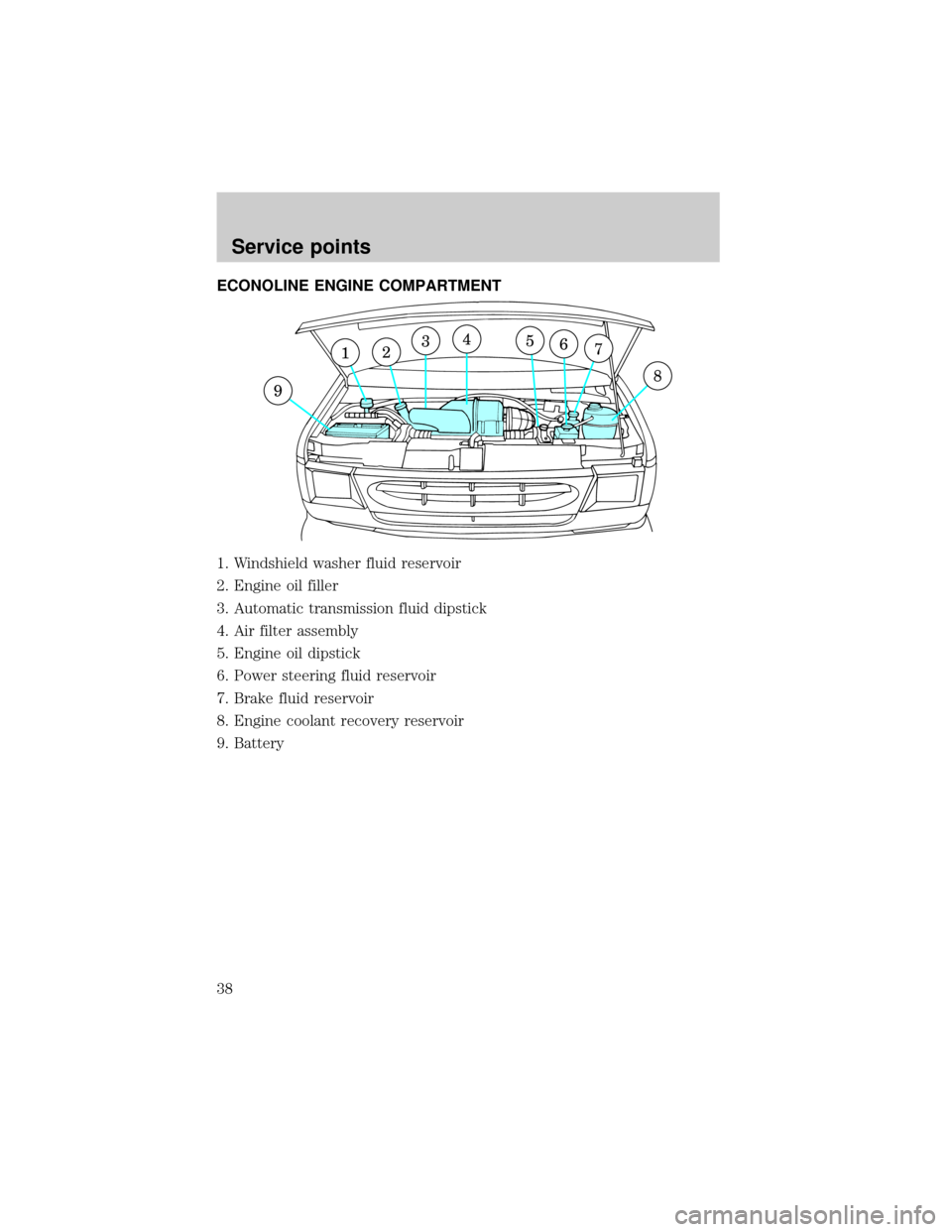
ECONOLINE ENGINE COMPARTMENT
1. Windshield washer fluid reservoir
2. Engine oil filler
3. Automatic transmission fluid dipstick
4. Air filter assembly
5. Engine oil dipstick
6. Power steering fluid reservoir
7. Brake fluid reservoir
8. Engine coolant recovery reservoir
9. Battery
91234
5
6
7
8
Service points
38
Page 39 of 39
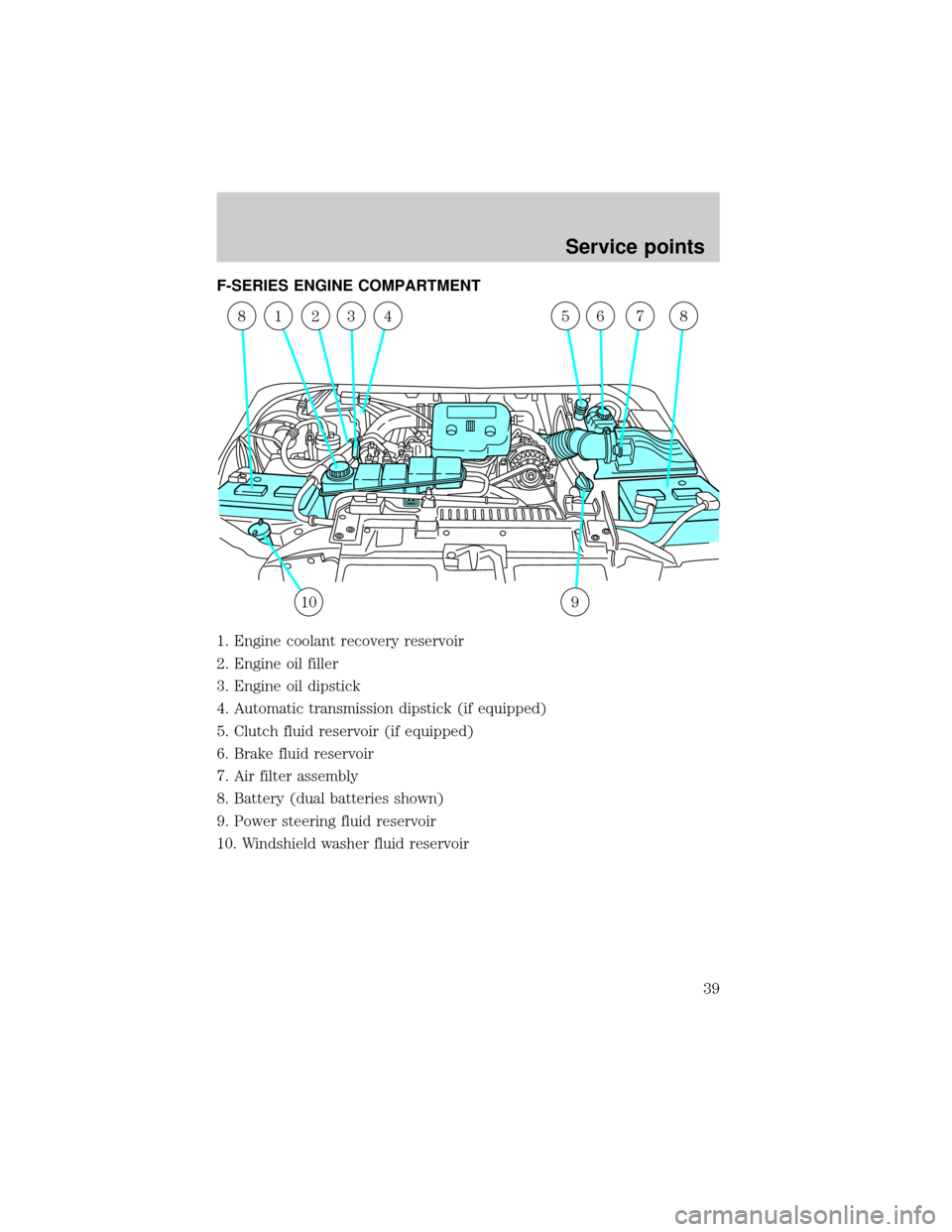
F-SERIES ENGINE COMPARTMENT
1. Engine coolant recovery reservoir
2. Engine oil filler
3. Engine oil dipstick
4. Automatic transmission dipstick (if equipped)
5. Clutch fluid reservoir (if equipped)
6. Brake fluid reservoir
7. Air filter assembly
8. Battery (dual batteries shown)
9. Power steering fluid reservoir
10. Windshield washer fluid reservoir
109
123456788
Service points
39