Page 342 of 440
yellowblue
6-32
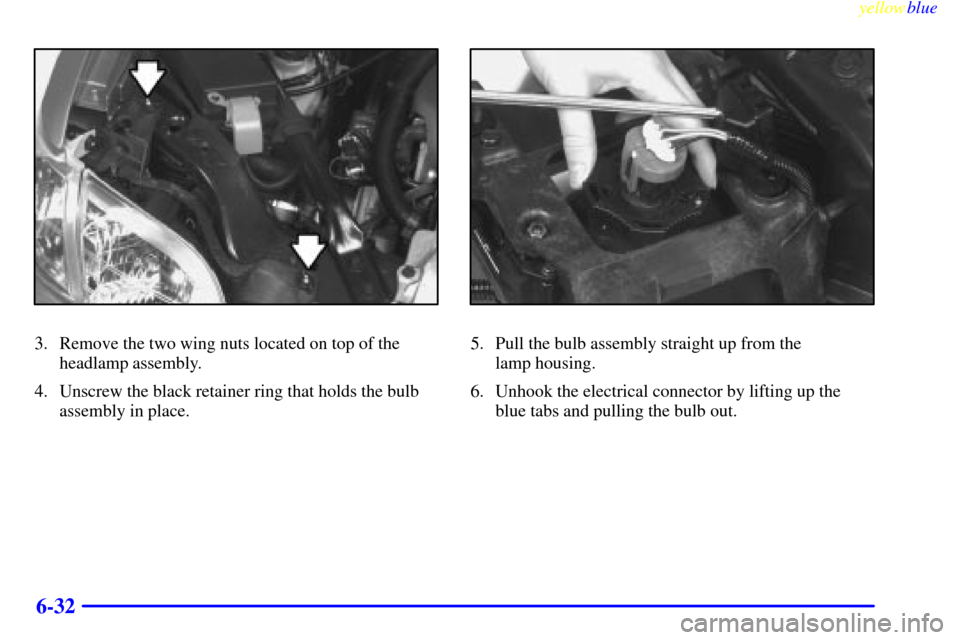
3. Remove the two wing nuts located on top of the
headlamp assembly.
4. Unscrew the black retainer ring that holds the bulb
assembly in place.5. Pull the bulb assembly straight up from the
lamp housing.
6. Unhook the electrical connector by lifting up the
blue tabs and pulling the bulb out.
Page 343 of 440
yellowblue
6-33
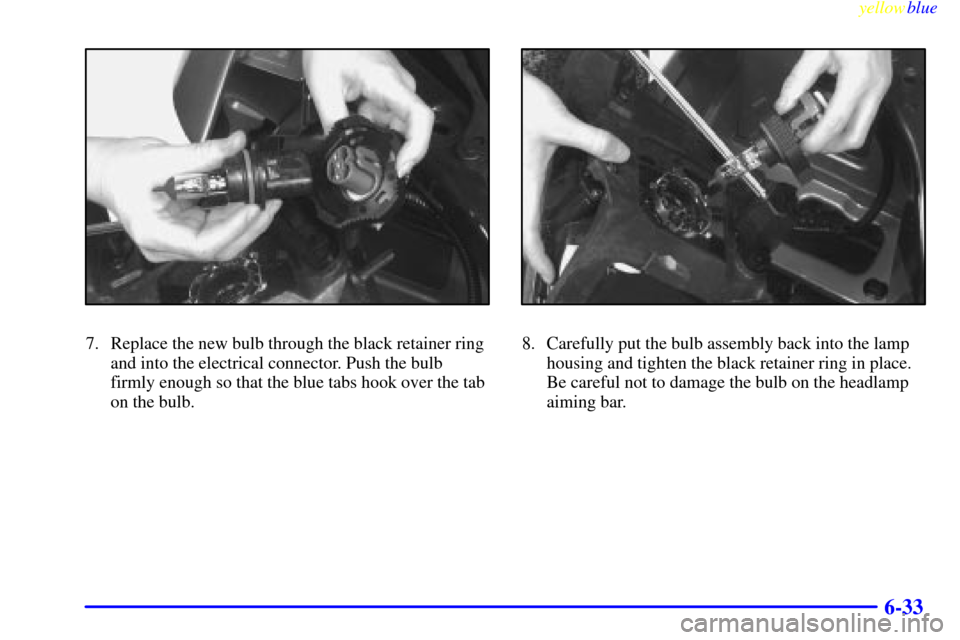
7. Replace the new bulb through the black retainer ring
and into the electrical connector. Push the bulb
firmly enough so that the blue tabs hook over the tab
on the bulb.8. Carefully put the bulb assembly back into the lamp
housing and tighten the black retainer ring in place.
Be careful not to damage the bulb on the headlamp
aiming bar.
Page 344 of 440
yellowblue
6-34
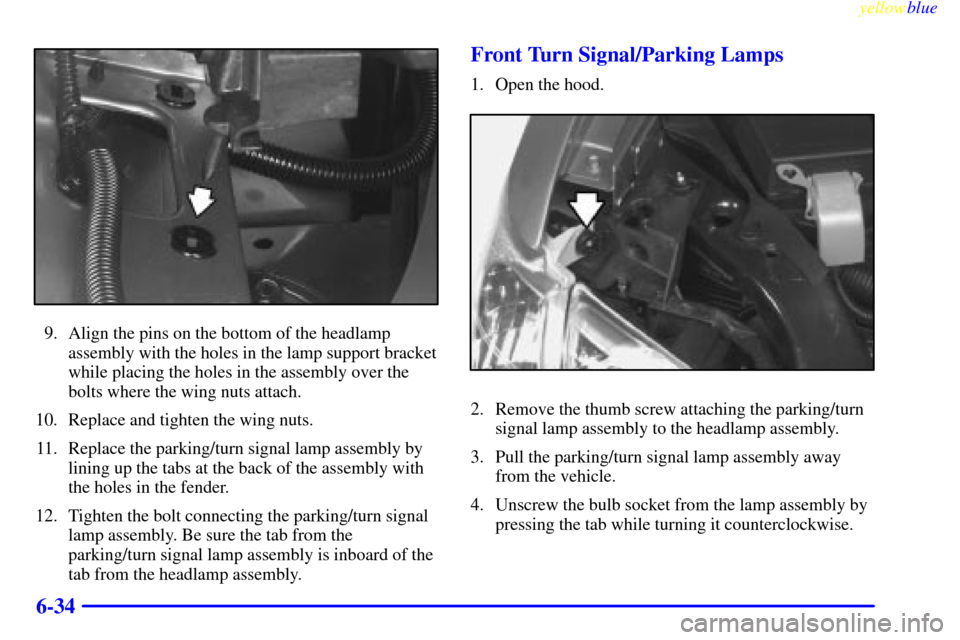
9. Align the pins on the bottom of the headlamp
assembly with the holes in the lamp support bracket
while placing the holes in the assembly over the
bolts where the wing nuts attach.
10. Replace and tighten the wing nuts.
11. Replace the parking/turn signal lamp assembly by
lining up the tabs at the back of the assembly with
the holes in the fender.
12. Tighten the bolt connecting the parking/turn signal
lamp assembly. Be sure the tab from the
parking/turn signal lamp assembly is inboard of the
tab from the headlamp assembly.
Front Turn Signal/Parking Lamps
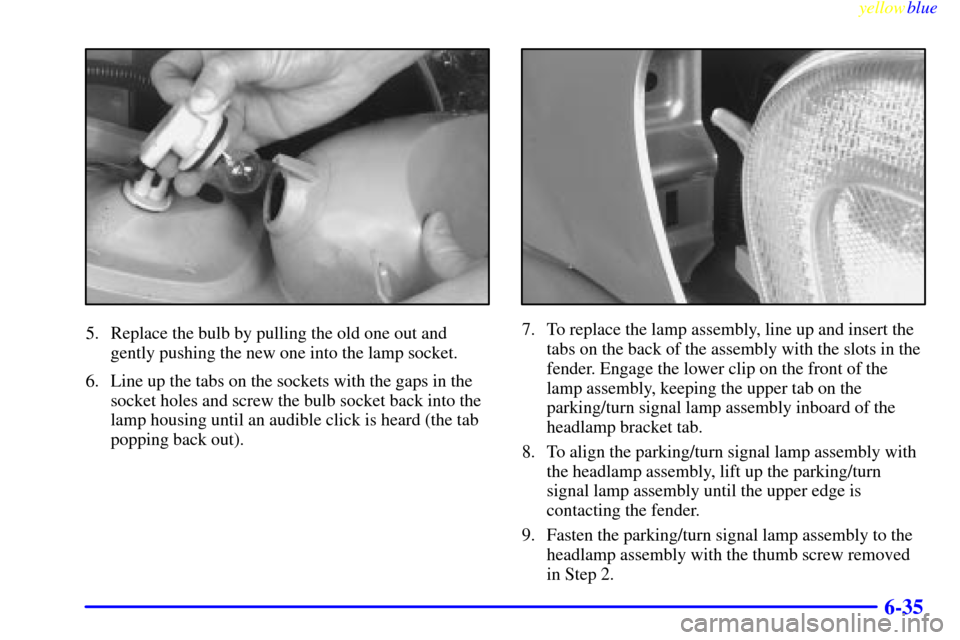
1. Open the hood.
2. Remove the thumb screw attaching the parking/turn
signal lamp assembly to the headlamp assembly.
3. Pull the parking/turn signal lamp assembly away
from the vehicle.
4. Unscrew the bulb socket from the lamp assembly by
pressing the tab while turning it counterclockwise.
Page 345 of 440
yellowblue
6-35
5. Replace the bulb by pulling the old one out and
gently pushing the new one into the lamp socket.
6. Line up the tabs on the sockets with the gaps in the
socket holes and screw the bulb socket back into the
lamp housing until an audible click is heard (the tab
popping back out).7. To replace the lamp assembly, line up and insert the
tabs on the back of the assembly with the slots in the
fender. Engage the lower clip on the front of the
lamp assembly, keeping the upper tab on the
parking/turn signal lamp assembly inboard of the
headlamp bracket tab.
8. To align the parking/turn signal lamp assembly with
the headlamp assembly, lift up the parking/turn
signal lamp assembly until the upper edge is
contacting the fender.
9. Fasten the parking/turn signal lamp assembly to the
headlamp assembly with the thumb screw removed
in Step 2.
Page 346 of 440
yellowblue
6-36 Front Sidemarker
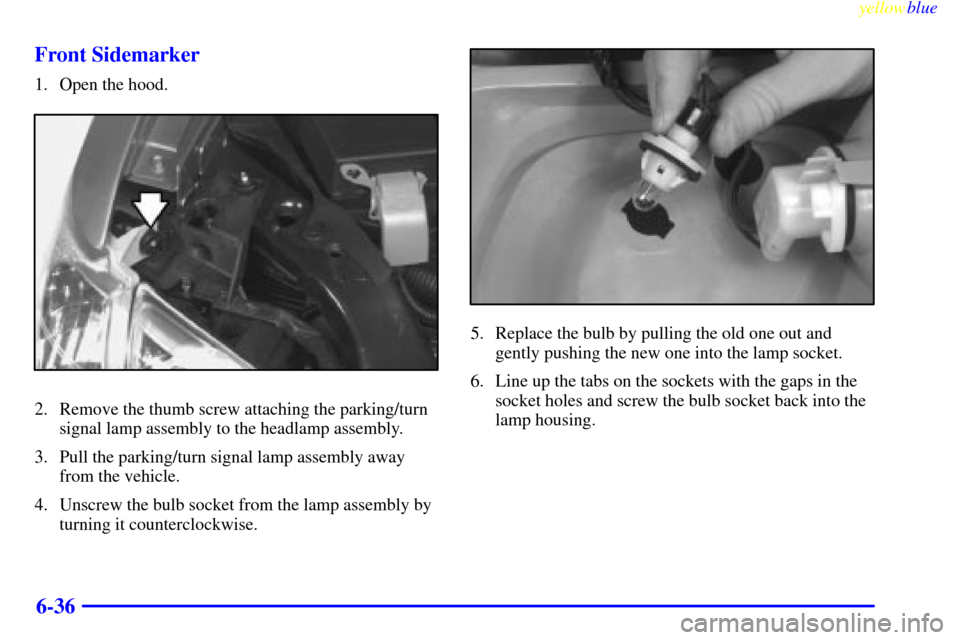
1. Open the hood.
2. Remove the thumb screw attaching the parking/turn
signal lamp assembly to the headlamp assembly.
3. Pull the parking/turn signal lamp assembly away
from the vehicle.
4. Unscrew the bulb socket from the lamp assembly by
turning it counterclockwise.
5. Replace the bulb by pulling the old one out and
gently pushing the new one into the lamp socket.
6. Line up the tabs on the sockets with the gaps in the
socket holes and screw the bulb socket back into the
lamp housing.
Page 347 of 440
yellowblue
6-37
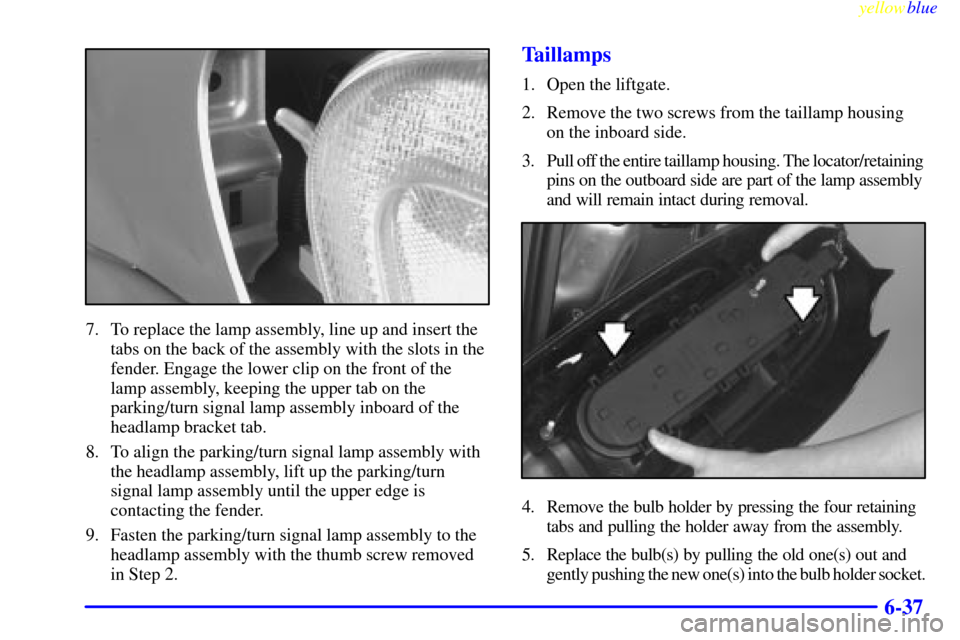
7. To replace the lamp assembly, line up and insert the
tabs on the back of the assembly with the slots in the
fender. Engage the lower clip on the front of the
lamp assembly, keeping the upper tab on the
parking/turn signal lamp assembly inboard of the
headlamp bracket tab.
8. To align the parking/turn signal lamp assembly with
the headlamp assembly, lift up the parking/turn
signal lamp assembly until the upper edge is
contacting the fender.
9. Fasten the parking/turn signal lamp assembly to the
headlamp assembly with the thumb screw removed
in Step 2.
Taillamps
1. Open the liftgate.
2. Remove the two screws from the taillamp housing
on the inboard side.
3. Pull off the entire taillamp housing. The locator/retaining
pins on the outboard side are part of the lamp assembly
and will remain intact during removal.
4. Remove the bulb holder by pressing the four retaining
tabs and pulling the holder away from the assembly.
5. Replace the bulb(s) by pulling the old one(s) out and
gently pushing the new one(s) into the bulb holder socket.
Page 356 of 440
yellowblue
6-46
Each new wheel should have the same load-carrying
capacity, diameter, width, offset and be mounted the
same way as the one it replaces.
If you need to replace any of your wheels, wheel bolts
or wheel nuts, replace them only with new GM original
equipment parts. This way, you will be sure to have the
right wheel, wheel bolts and wheel nuts for your vehicle.
CAUTION:
Using the wrong replacement wheels, wheel bolts
or wheel nuts on your vehicle can be dangerous.
It could affect the braking and handling of your
vehicle, make your tires lose air and make you
lose control. You could have a collision in which
you or others could be injured. Always use the
correct wheel, wheel bolts and wheel nuts
for replacement.
NOTICE:
The wrong wheel can also cause problems with
bearing life, brake cooling, speedometer or
odometer calibration, headlamp aim, bumper
height, vehicle ground clearance and tire or tire
chain clearance to the body and chassis.
See ªChanging a Flat Tireº in the Index for
more information.
Used Replacement Wheels
CAUTION:
Putting a used wheel on your vehicle is
dangerous. You can't know how it's been used or
how far it's been driven. It could fail suddenly
and cause an accident. If you have to replace a
wheel, use a new GM original equipment wheel.
Page 367 of 440
yellowblue
6-57
Electrical System
Add-On Electrical Equipment
NOTICE:
Don't add anything electrical to your vehicle
unless you check with your dealer first. Some
electrical equipment can damage your vehicle
and the damage wouldn't be covered by your
warranty. Some add
-on electrical equipment can
keep other components from working as
they should.
Your vehicle has an air bag system. Before attempting to
add anything electrical to your vehicle, see ªServicing
Your Air Bag
-Equipped Vehicleº in the Index.
Headlamp Wiring
The headlamp wiring is protected by an internal circuit
breaker in the instrument panel fuse panel. An electrical
overload will cause the lamps to go on and off, or in
some cases to remain off. If this happens, have your
headlamp wiring checked right away.
Windshield Wipers
The windshield wiper motor is protected by an internal
circuit breaker and a fuse. If the motor overheats due to
heavy snow, etc., the wiper will stop until the motor
cools. If the overload is caused by some electrical
problem, be sure to get it fixed.
Power Windows and Other Power Options
Circuit breakers in the instrument panel fuse panel
protect the power windows and other power accessories.
When the current load is too heavy, the circuit breaker
opens and closes, protecting the circuit until the problem
is fixed.