Page 272 of 432
yellowblue
5-12
Cooling System (Gasoline Engine)
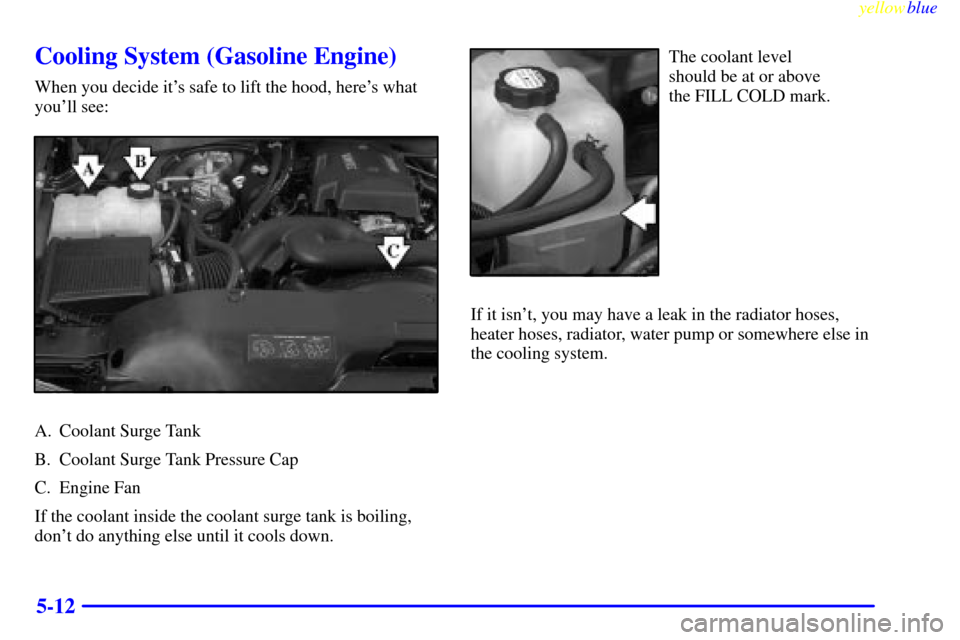
When you decide it's safe to lift the hood, here's what
you'll see:
A. Coolant Surge Tank
B. Coolant Surge Tank Pressure Cap
C. Engine Fan
If the coolant inside the coolant surge tank is boiling,
don't do anything else until it cools down.
The coolant level
should be at or above
the FILL COLD mark.
If it isn't, you may have a leak in the radiator hoses,
heater hoses, radiator, water pump or somewhere else in
the cooling system.
Page 299 of 432
6-
yellowblue
6-1
Section 6 Service and Appearance Care
Here you will find information about the care of your vehicle. This section begins with service and fuel information,
and then it shows how to check important fluid and lubricant levels. There is also technical information about your
vehicle, and a part devoted to its appearance care.
6
-2 Service
6
-3 Fuel (Gasoline Engine)
6
-5 Fuels in Foreign Countries (Gasoline Engines)
6
-6 Filling Your Tank (Gasoline Engine)
6
-8 Checking Things Under the Hood
6
-12 Engine Oil (Gasoline Engine)
6
-16 Engine Air Cleaner/Filter
6
-19 Automatic Transmission Fluid
6
-22 Manual Transmission Fluid
6
-24 Hydraulic Clutch
6
-25 Rear Axle
6
-25 Four-Wheel Drive
6
-28 Coolant Surge Tank Pressure Cap
(Gasoline Engine)
6
-28 Thermostat
6
-29 Engine Coolant
6
-32 Power Steering Fluid6
-33 Windshield Washer Fluid
6
-34 Brakes
6
-37 Battery
6
-38 Bulb Replacement
6
-44 Windshield Wiper Blade Replacement
6
-45 Tires
6
-54 Appearance Care
6
-54 Cleaning the Inside of Your Vehicle
6
-58 Cleaning the Outside of Your Vehicle
6
-62 GM Vehicle Care/Appearance Materials
6
-63 Vehicle Identification Number (VIN)
6
-64 Electrical System
6
-73 Replacement Bulbs
6
-74 Capacities and Specifications
6
-76 Air Conditioning Refrigerants
6
-77 Normal Maintenance Replacement Parts
Page 310 of 432
yellowblue
6-12
Engine Oil (Gasoline Engine)
If your vehicle has a diesel engine, see ªEngine Oil
(Diesel Engine)º in the Diesel Engine Supplement.
If the CHECK ENG OIL
LEVEL light on the
instrument panel comes on,
it means you need to check
your engine oil level
right away.
For more information, see ªCHECK ENG OIL LEVELº
in the Index. You should check your engine oil level
regularly; this is an added reminder.
It's a good idea to check your engine oil every time you
get fuel. In order to get an accurate reading, the oil must
be warm and the vehicle must be on level ground.
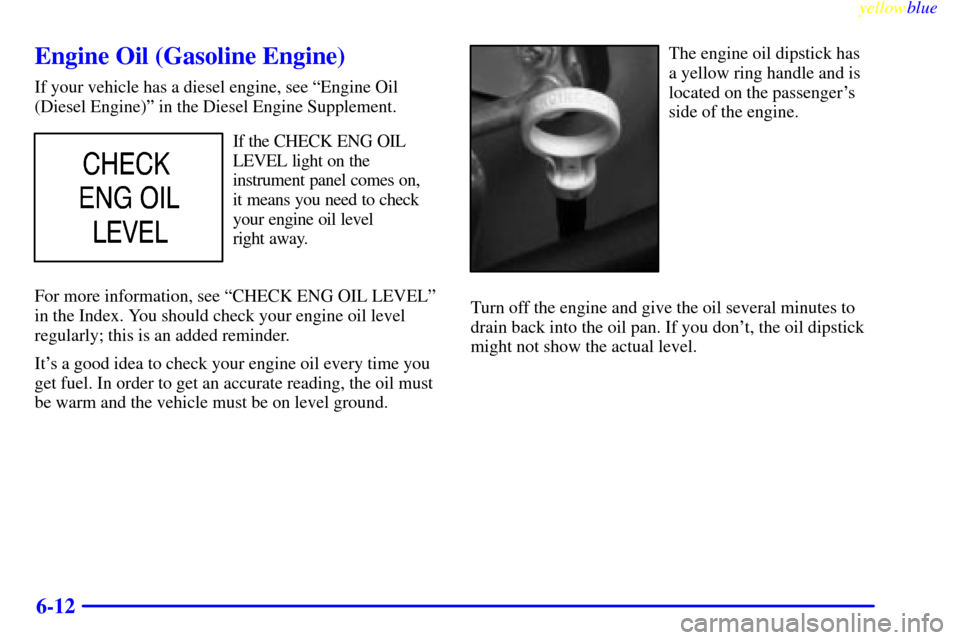
The engine oil dipstick has
a yellow ring handle and is
located on the passenger's
side of the engine.
Turn off the engine and give the oil several minutes to
drain back into the oil pan. If you don't, the oil dipstick
might not show the actual level.
Page 311 of 432
yellowblue
6-13 Checking Engine Oil
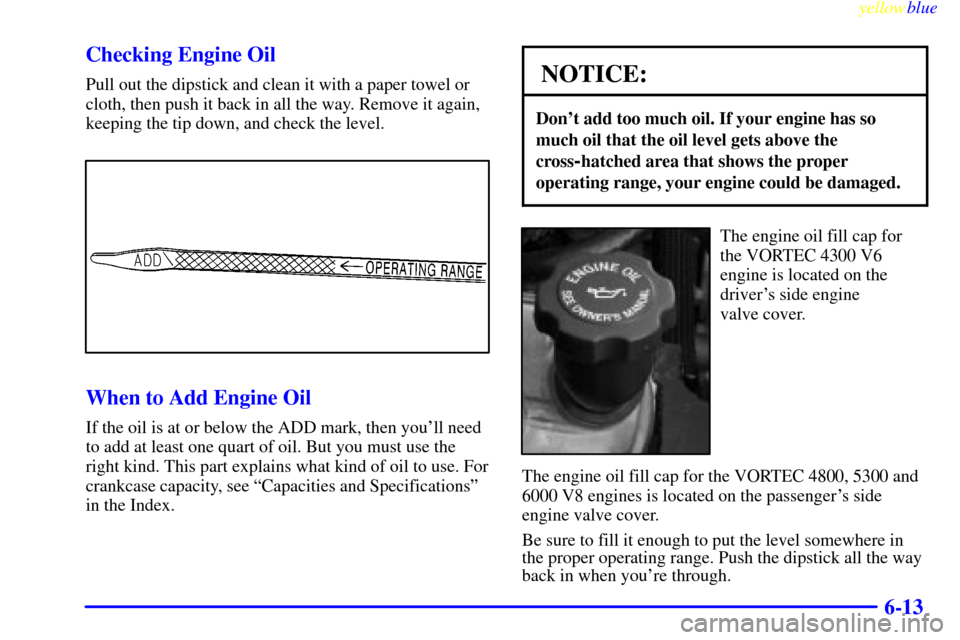
Pull out the dipstick and clean it with a paper towel or
cloth, then push it back in all the way. Remove it again,
keeping the tip down, and check the level.
When to Add Engine Oil
If the oil is at or below the ADD mark, then you'll need
to add at least one quart of oil. But you must use the
right kind. This part explains what kind of oil to use. For
crankcase capacity, see ªCapacities and Specificationsº
in the Index.
NOTICE:
Don't add too much oil. If your engine has so
much oil that the oil level gets above the
cross
-hatched area that shows the proper
operating range, your engine could be damaged.
The engine oil fill cap for
the VORTEC 4300 V6
engine is located on the
driver's side engine
valve cover.
The engine oil fill cap for the VORTEC 4800, 5300 and
6000 V8 engines is located on the passenger's side
engine valve cover.
Be sure to fill it enough to put the level somewhere in
the proper operating range. Push the dipstick all the way
back in when you're through.
Page 317 of 432
yellowblue
6-19
3. Remove the air filter by pulling downward on the
element. Remove the second portion of the air filter
by sliding it towards the rear of the vehicle and then
pulling downward.
4. Install the new filter by reversing the steps listed
previously. Be sure to follow any instructions that
may be included in the replacement filter package.
Refer to the Maintenance Schedule to determine when to
replace the passenger compartment air filter. See
ªScheduled Maintenanceº in the Index.
Automatic Transmission Fluid
If your vehicle has a diesel engine, see ªAutomatic
Transmission Fluidº in the Diesel Supplement.
When to Check and Change
A good time to check your automatic transmission fluid
level is when the engine oil is changed.
Change both the fluid and filter every 50,000 miles
(83 000 km) if the vehicle is mainly driven under one or
more of these conditions:
�In heavy city traffic where the outside temperature
regularly reaches 90�F (32�C) or higher.
�In hilly or mountainous terrain.�When doing frequent trailer towing.
�Uses such as found in taxi, police or delivery service.
If you do not use your vehicle under any of these
conditions, change the fluid and filter every
100,000 miles (166 000 km).
See ªScheduled Maintenance Servicesº in the Index.
How to Check
Because this operation can be a little difficult, you may
choose to have this done at the dealership service
department.
If you do it yourself, be sure to follow all the
instructions here, or you could get a false reading on
the dipstick.
NOTICE:
Too much or too little fluid can damage your
transmission. Too much can mean that some of
the fluid could come out and fall on hot engine
parts or exhaust system parts, starting a fire.
Be sure to get an accurate reading if you check
your transmission fluid.
Page 320 of 432
yellowblue
6-22 How to Add Fluid
Refer to the Maintenance Schedule to determine what
kind of transmission fluid to use. See ªRecommended
Fluids and Lubricantsº in the Index.
Add fluid only after checking the transmission fluid
while it is hot. (A cold check is used only as a
reference.) If the fluid level is low, add only enough of
the proper fluid to bring the level up to the HOT area for
a hot check. It doesn't take much fluid, generally less
than one pint (0.5 L). Don't overfill.
NOTICE:
We recommend you use only fluid labeled
DEXRON�-III, because fluid with that label is
made especially for your automatic transmission.
Damage caused by fluid other than
DEXRON
�-III is not covered by your new
vehicle warranty.
�After adding fluid, recheck the fluid level as
described under ªHow to Check.º
�When the correct fluid level is obtained, push the
dipstick back in all the way; then flip the handle
down to lock the dipstick in place.
Manual Transmission Fluid
When to Check
A good time to have it checked is when the engine oil is
changed. See your maintenance schedule to find out
when to change your transmission fluid.
Page 373 of 432
yellowblue
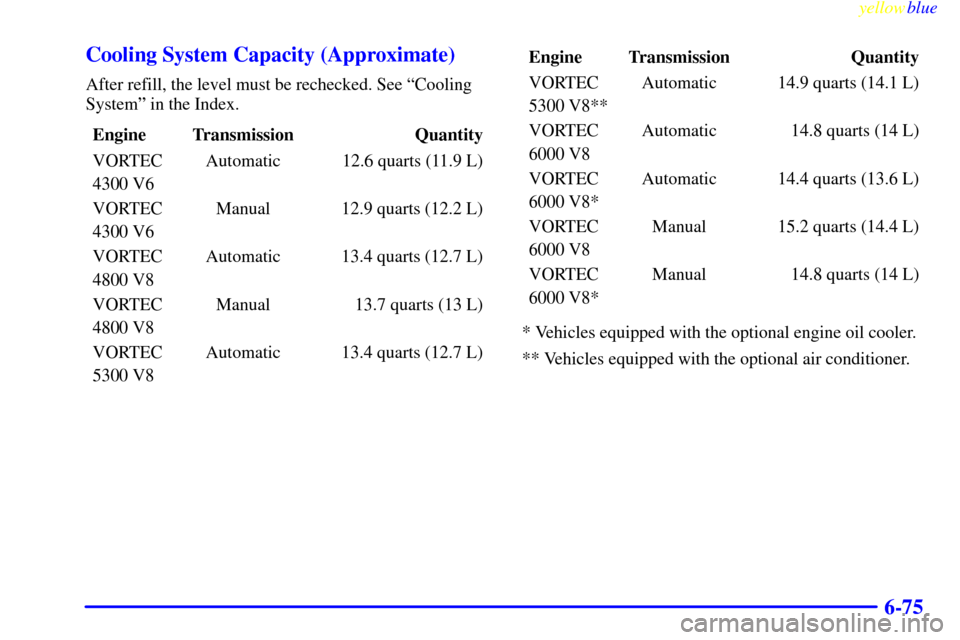
6-75 Cooling System Capacity (Approximate)
After refill, the level must be rechecked. See ªCooling
Systemº in the Index.
Engine Transmission Quantity
VORTEC
4300 V6Automatic 12.6 quarts (11.9 L)
VORTEC
4300 V6Manual 12.9 quarts (12.2 L)
VORTEC
4800 V8Automatic 13.4 quarts (12.7 L)
VORTEC
4800 V8Manual 13.7 quarts (13 L)
VORTEC
5300 V8Automatic 13.4 quarts (12.7 L)Engine Transmission Quantity
VORTEC
5300 V8**Automatic 14.9 quarts (14.1 L)
VORTEC
6000 V8Automatic 14.8 quarts (14 L)
VORTEC
6000 V8*Automatic 14.4 quarts (13.6 L)
VORTEC
6000 V8Manual 15.2 quarts (14.4 L)
VORTEC
6000 V8*Manual 14.8 quarts (14 L)
* Vehicles equipped with the optional engine oil cooler.
** Vehicles equipped with the optional air conditioner.
Page 374 of 432
yellowblue
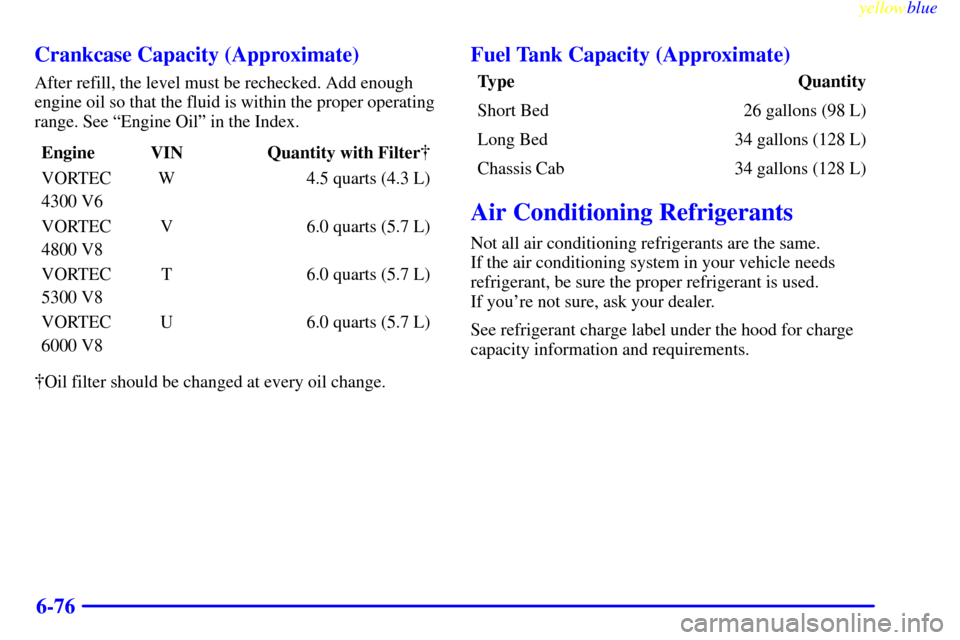
6-76 Crankcase Capacity (Approximate)
After refill, the level must be rechecked. Add enough
engine oil so that the fluid is within the proper operating
range. See ªEngine Oilº in the Index.
Engine VIN
Quantity with Filter�
VORTEC
4300 V6W 4.5 quarts (4.3 L)
VORTEC
4800 V8V 6.0 quarts (5.7 L)
VORTEC
5300 V8T 6.0 quarts (5.7 L)
VORTEC
6000 V8U 6.0 quarts (5.7 L)
�Oil filter should be changed at every oil change.
Fuel Tank Capacity (Approximate)
Type Quantity
Short Bed 26 gallons (98 L)
Long Bed 34 gallons (128 L)
Chassis Cab 34 gallons (128 L)
Air Conditioning Refrigerants
Not all air conditioning refrigerants are the same.
If the air conditioning system in your vehicle needs
refrigerant, be sure the proper refrigerant is used.
If you're not sure, ask your dealer.
See refrigerant charge label under the hood for charge
capacity information and requirements.