Page 260 of 384
yellowblue
6-22 When to Check and What to Use
Refer to the Maintenance Schedule, Owner Checks and
Services, to determine how often you should check the
fluid level in your clutch master cylinder reservoir and
for the proper fluid. See ªOwner Checks and Servicesº
and ªRecommended Fluids and Lubricantsº in
the Index.
How to Check
The proper fluid should be added if the level does not
reach the bottom of the diaphragm when it's in place in
the reservoir. See the instructions on the reservoir cap.
Rear Axle
When to Check and Change Lubricant
Refer to the Maintenance Schedule to determine how
often to check the lubricant and when to change it. See
ªScheduled Maintenance Servicesº in the Index.
Page 261 of 384
yellowblue
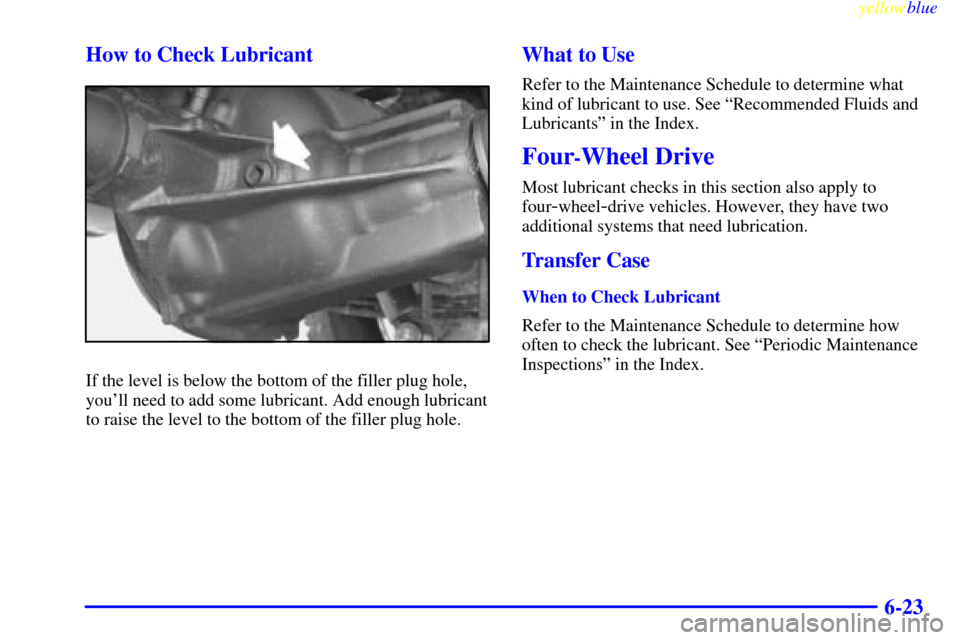
6-23 How to Check Lubricant
If the level is below the bottom of the filler plug hole,
you'll need to add some lubricant. Add enough lubricant
to raise the level to the bottom of the filler plug hole.
What to Use
Refer to the Maintenance Schedule to determine what
kind of lubricant to use. See ªRecommended Fluids and
Lubricantsº in the Index.
Four-Wheel Drive
Most lubricant checks in this section also apply to
four
-wheel-drive vehicles. However, they have two
additional systems that need lubrication.
Transfer Case
When to Check Lubricant
Refer to the Maintenance Schedule to determine how
often to check the lubricant. See ªPeriodic Maintenance
Inspectionsº in the Index.
Page 262 of 384
yellowblue
6-24
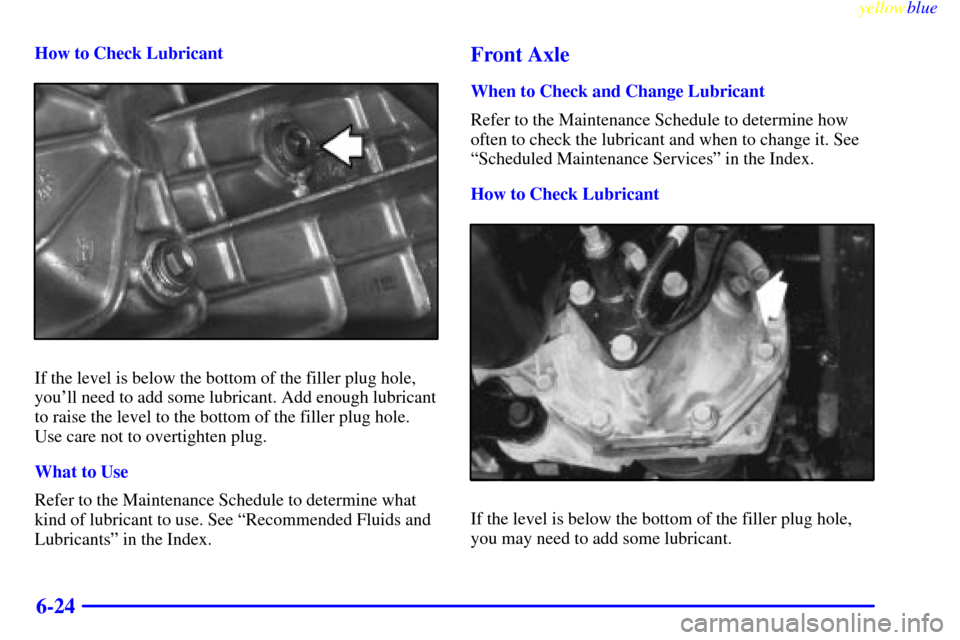
How to Check Lubricant
If the level is below the bottom of the filler plug hole,
you'll need to add some lubricant. Add enough lubricant
to raise the level to the bottom of the filler plug hole.
Use care not to overtighten plug.
What to Use
Refer to the Maintenance Schedule to determine what
kind of lubricant to use. See ªRecommended Fluids and
Lubricantsº in the Index.
Front Axle
When to Check and Change Lubricant
Refer to the Maintenance Schedule to determine how
often to check the lubricant and when to change it. See
ªScheduled Maintenance Servicesº in the Index.
How to Check Lubricant
If the level is below the bottom of the filler plug hole,
you may need to add some lubricant.
Page 263 of 384
yellowblue
6-25
When the differential is cold, add enough lubricant to
raise the level to 1/2 inch (12 mm) below the filler
plug hole.
When the differential is at operating temperature
(warm), add enough lubricant to raise the level to the
bottom of the filler plug hole.
What to Use
Refer to the Maintenance Schedule to determine what
kind of lubricant to use. See ªRecommended Fluids and
Lubricantsº in the Index.Radiator Pressure Cap
NOTICE:
Your radiator cap is a 15 psi (105 kPa)
pressure
-type cap and must be tightly installed to
prevent coolant loss and possible engine damage
from overheating. Be sure the arrows on the cap
line up with the overflow tube on the radiator
filler neck.
Page 269 of 384
yellowblue
6-31
Brakes
Brake Fluid
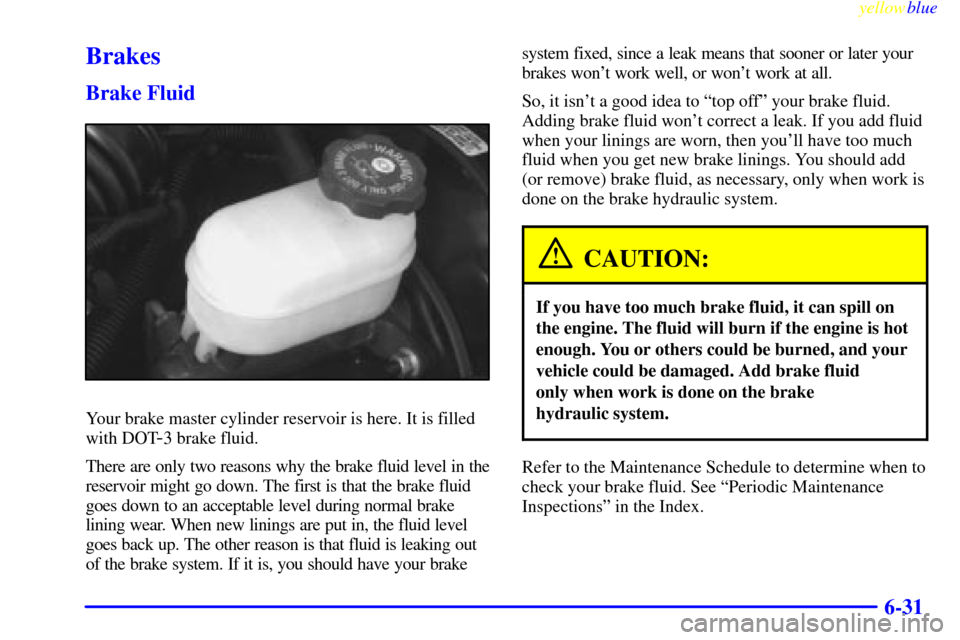
Your brake master cylinder reservoir is here. It is filled
with DOT
-3 brake fluid.
There are only two reasons why the brake fluid level in the
reservoir might go down. The first is that the brake fluid
goes down to an acceptable level during normal brake
lining wear. When new linings are put in, the fluid level
goes back up. The other reason is that fluid is leaking out
of the brake system. If it is, you should have your brakesystem fixed, since a leak means that sooner or later your
brakes won't work well, or won't work at all.
So, it isn't a good idea to ªtop offº your brake fluid.
Adding brake fluid won't correct a leak. If you add fluid
when your linings are worn, then you'll have too much
fluid when you get new brake linings. You should add
(or remove) brake fluid, as necessary, only when work is
done on the brake hydraulic system.
CAUTION:
If you have too much brake fluid, it can spill on
the engine. The fluid will burn if the engine is hot
enough. You or others could be burned, and your
vehicle could be damaged. Add brake fluid
only when work is done on the brake
hydraulic system.
Refer to the Maintenance Schedule to determine when to
check your brake fluid. See ªPeriodic Maintenance
Inspectionsº in the Index.
Page 283 of 384
yellowblue
6-45 Tire Inspection and Rotation
Tires should be rotated every 6,000 to 8,000 miles
(10 000 to 13 000 km). Any time you notice unusual
wear, rotate your tires as soon as possible and check
wheel alignment. Also check for damaged tires or
wheels. See ªWhen It's Time for New Tiresº and
ªWheel Replacementº later in this section for
more information.
The purpose of regular rotation is to achieve more
uniform wear for all tires on the vehicle. The first
rotation is the most important. See ªScheduled
Maintenance Servicesº in the Index for scheduled
rotation intervals.
When rotating your tires, always use one of the correct
rotation patterns shown here.
If your vehicle has a compact spare tire, don't include it
in your tire rotation.
After the tires have been rotated, adjust the front and
rear inflation pressures as shown on the
Certification/Tire label. Make certain that all wheel nuts
are properly tightened. See ªWheel Nut Torqueº in
the Index.
Page 309 of 384
7-
yellowblue
7-1
Section 7 Maintenance Schedule
This section covers the maintenance required for your vehicle. Your vehicle needs these services to retain its safety,
dependability and emission control performance.
7
-2 Introduction
7
-4 Part A: Scheduled Maintenance Services
7
-8 Short Trip/City Scheduled Maintenance
7
-29 Long Trip/Highway Scheduled Maintenance7
-42 Part B: Owner Checks and Services
7
-46 Part C: Periodic Maintenance Inspections
7
-48 Part D: Recommended Fluids and Lubricants
7
-51 Part E: Maintenance Record
Page 311 of 384
yellowblue
7-3 How This Section is Organized
This maintenance schedule is divided into five parts:
ªPart A: Scheduled Maintenance Servicesº shows
what to have done and how often. Some of these
services can be complex, so unless you are technically
qualified and have the necessary equipment, you should
let your dealer's service department or another qualified
service center do these jobs.
CAUTION:
Performing maintenance work on a vehicle can
be dangerous. In trying to do some jobs, you can
be seriously injured. Do your own maintenance
work only if you have the required know
-how
and the proper tools and equipment for the job.
If you have any doubt, have a qualified
technician do the work.
If you are skilled enough to do some work on your
vehicle, you will probably want to get the service
information. See ªService and Owner Publicationsº in
the Index.ªPart B: Owner Checks and Servicesº tells
you what should be checked and when. It also explains
what you can easily do to help keep your vehicle in
good condition.
ªPart C: Periodic Maintenance Inspectionsº
explains important inspections that your dealer's
service department or another qualified service center
should perform.
ªPart D: Recommended Fluids and Lubricantsº
lists some recommended products to help keep your
vehicle properly maintained. These products, or their
equivalents, should be used whether you do the work
yourself or have it done.
ªPart E: Maintenance Recordº provides a place for
you to record the maintenance performed on your
vehicle. Whenever any maintenance is performed, be
sure to write it down in this part. This will help you
determine when your next maintenance should be done.
In addition, it is a good idea to keep your maintenance
receipts. They may be needed to qualify your vehicle for
warranty repairs.