Page 26 of 384

yellowblue
1-20
The best way to protect the fetus is to protect the
mother. When a safety belt is worn properly, it's more
likely that the fetus won't be hurt in a crash. For
pregnant women, as for anyone, the key to making
safety belts effective is wearing them properly.
Right Front Passenger Position
To learn how to wear the right front passenger's
safety belt properly, see ªDriver Positionº earlier in
this section.
The right front passenger's safety belt works the same
way as the driver's safety belt
-- except for one thing.
If you ever pull the shoulder portion of the belt out all
the way, you will engage the child restraint locking
feature. If this happens, just let the belt go back all the
way and start again.
Air Bag System
This part explains the air bag system.
Your vehicle has ªNext Generationº frontal air
bags
-- one air bag for the driver and another
air bag for the right front passenger.
Next Generation frontal air bags are designed to help
reduce the risk of injury from the force of an inflating
air bag. But even these air bags must inflate very
quickly if they are to do their job and comply with
federal regulations.
Here are the most important things to know about the
air bag system:
Page 53 of 384
yellowblue
1-47
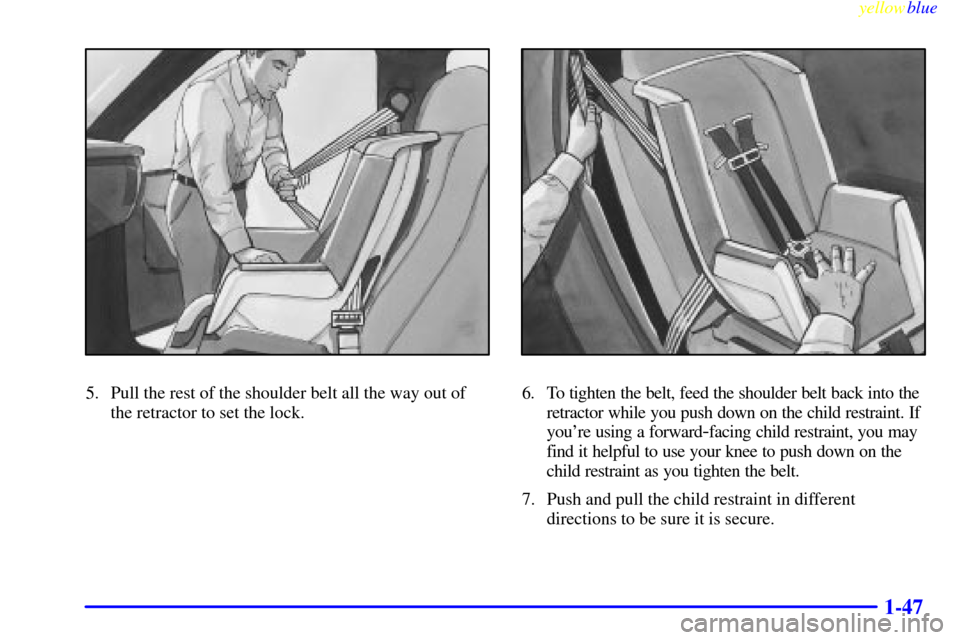
5. Pull the rest of the shoulder belt all the way out of
the retractor to set the lock.6. To tighten the belt, feed the shoulder belt back into the
retractor while you push down on the child restraint. If
you're using a forward
-facing child restraint, you may
find it helpful to use your knee to push down on the
child restraint as you tighten the belt.
7. Push and pull the child restraint in different
directions to be sure it is secure.
Page 59 of 384

2-
yellowblue
2-1
Section 2 Features and Controls
Here you can learn about the many standard and optional features on your vehicle, and information on starting,
shifting and braking. Also explained are the instrument panel and the warning systems that tell you if everything is
working properly
-- and what to do if you have a problem.
2
-2 Keys
2
-4 Door Locks
2
-5 Keyless Entry System (If Equipped)
2
-9 Tailgate
2
-9 Theft
2
-10 Content Theft-Deterrent (If Equipped)
2
-12 Passlock�
2-12 New Vehicle ªBreak-Inº
2
-13 Ignition Positions
2
-15 Starting Your Engine
2
-17 Engine Coolant Heater (If Equipped)
2
-18 Automatic Transmission Operation
2
-21 Manual Transmission Operation
2
-23 Four-Wheel Drive (If Equipped)
2
-26 Parking Brake
2
-27 Shifting Into PARK (P)
(Automatic Transmission Only)2
-29 Shifting Out of PARK (P)
(Automatic Transmission Only)
2
-30 Parking Over Things That Burn
2
-31 Engine Exhaust
2
-31 Running Your Engine While You're Parked
(Automatic Transmission)
2
-32 Locking Rear Axle
2
-32 Windows
2
-34 Tilt Wheel (If Equipped)
2
-35 Turn Signal/Multifunction Lever
2
-41 Exterior Lamps
2
-43 Interior Lamps
2
-45 Mirrors
2
-46 Storage Compartments
2
-49 Accessory Power Outlets (If Equipped)
2
-50 Instrument Panel
2
-52 Instrument Panel Cluster
2
-55 Warning Lights, Gages and Indicators
Page 61 of 384
yellowblue
2-3
This vehicle has one
double
-sided key for the
ignition and door locks. It
will fit with either side up.
When a new vehicle is delivered, the dealer provides
the owner with a pair of identical keys and a key
code number.
The key code number tells your dealer or a qualified
locksmith how to make extra keys. Keep this number in
a safe place. If you lose your keys, you'll be able to have
new ones made easily using this number. Your selling
dealer should also have this number.NOTICE:
Your vehicle has a number of features that can
help prevent theft. But you can have a lot of
trouble getting into your vehicle if you ever lock
your keys inside. You may even have to damage
your vehicle to get in. So be sure you have
extra keys.
Page 62 of 384
yellowblue
2-4
Door Locks
CAUTION:
Unlocked doors can be dangerous.
Passengers -- especially children -- can easily
open the doors and fall out. When a door is
locked, the inside handle won't open it.
Outsiders can easily enter through an unlocked
door when you slow down or stop your vehicle.
This may not be so obvious: You increase the
chance of being thrown out of the vehicle in a
crash if the doors aren't locked. Wear safety belts
properly, lock your doors, and you will be far
better off whenever you drive your vehicle.
There are several ways to lock and unlock your vehicle.
You can use the keyless entry system, if you have
this feature.
You can use your key to unlock your door from
the outside.
To lock your door from the inside, slide the lever on
your inside door down.
To unlock the door, slide the
lever on your inside door
up. You will see a red area
on the lever.
Page 63 of 384

yellowblue
2-5 Power Door Locks (If Equipped)
If your vehicle has power door locks, the switch is
located on the armrest. Remove the ignition key and
press LOCK to lock all the doors at once.
To unlock the doors, press the raised area next to the
key symbol.
Lockout Prevention
To protect you from locking your key in the vehicle, this
feature stops the power door locks from locking when
the keys are in the ignition and a door is open.
If the power lock switch is pressed when a door is open
and the key is in the ignition, all the doors will lock, and
the driver's door will unlock.
Leaving Your Vehicle
If you are leaving the vehicle, take your keys, open your
door and set the locks from inside. Then get out and
close the door.
Keyless Entry System (If Equipped)
If your vehicle has this option, you can lock and unlock
your doors from about 3 feet (1 m) up to 30 feet (9 m)
away using the remote keyless entry transmitter supplied
with your vehicle.
Your keyless entry system operates on a radio frequency
subject to Federal Communications Commission (FCC)
Rules and with Industry Canada.
Page 64 of 384

yellowblue
2-6
This device complies with Part 15 of the FCC Rules.
Operation is subject to the following two conditions:
(1) this device may not cause harmful interference, and
(2) this device must accept any interference received,
including interference that may cause
undesired operation.
This device complies with RSS
-210 of Industry Canada.
Operation is subject to the following two conditions:
(1) this device may not cause interference, and (2) this
device must accept any interference received, including
interference that may cause undesired operation of
the device.
Changes or modifications to this system by other than an
authorized service facility could void authorization to
use this equipment.
This system has a range of about 3 feet (1 m) up to
30 feet (9 m). At times you may notice a decrease in
range. This is normal for any remote keyless entry
system. If the transmitter does not work or if you have
to stand closer to your vehicle for the transmitter to
work, try this:
�Check to determine if battery replacement or
resynchronization is necessary. See the instructions
that follow.�Check the distance. You may be too far from your
vehicle. You may need to stand closer during rainy
or snowy weather.
�Check the location. Other vehicles or objects may be
blocking the signal. Take a few steps to the left or
right, hold the transmitter higher, and try again.
�If you're still having trouble, see your dealer or a
qualified technician for service.
Operation
UNLOCK: When you press UNLOCK, the driver's
door will unlock automatically, the parking lamps will
flash and the interior lights will go on. If you press
UNLOCK again within three seconds, the remaining
doors will unlock, the parking lamps will flash and the
interior lights will go on.
LOCK: Press LOCK to lock all the doors. Press LOCK
again within three seconds and the horn will chirp.
Remote Panic Alarm
When the button with the horn symbol on the key
transmitter is pressed, the horn will sound and the
headlamps and taillamps will flash for up to 30 seconds.
This can be turned off by pressing the horn button again,
waiting for 30 seconds, or starting the vehicle.
Page 65 of 384

yellowblue
2-7 Matching Transmitter(s) To Your Vehicle
Each remote keyless entry transmitter is coded to
prevent another transmitter from unlocking your vehicle.
If a transmitter is lost or stolen, a replacement can be
purchased through your dealer. Remember to bring any
remaining transmitters with you when you go to your
dealer. When the dealer matches the replacement
transmitter to your vehicle, any remaining transmitters
must also be matched. Once your dealer has coded the
new transmitter, the lost transmitter will not unlock your
vehicle. Each vehicle can have only four transmitters
matched to it.
Battery Replacement
Under normal use, the battery in your remote keyless
entry transmitter should last about two years.
You can tell the battery is weak if the transmitter won't
work at the normal range in any location. If you have to
get close to your vehicle before the transmitter works,
it's probably time to change the battery.
NOTICE:
When replacing the battery, use care not to touch
any of the circuitry. Static from your body
transferred to these surfaces may damage
the transmitter.
To replace the battery in the keyless entry transmitter: