Page 177 of 328
yellowblue
5-17
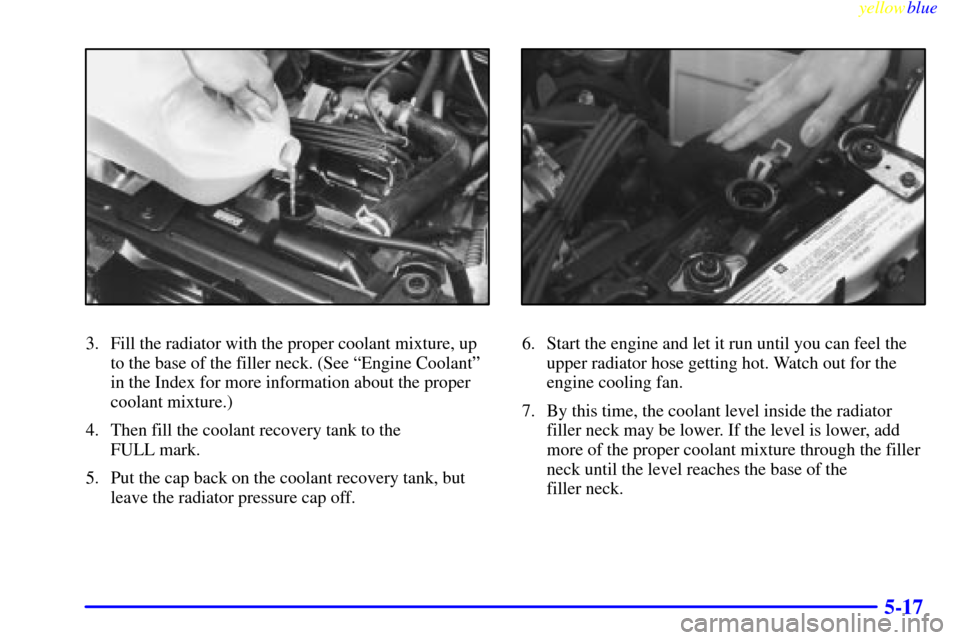
3. Fill the radiator with the proper coolant mixture, up
to the base of the filler neck. (See ªEngine Coolantº
in the Index for more information about the proper
coolant mixture.)
4. Then fill the coolant recovery tank to the
FULL mark.
5. Put the cap back on the coolant recovery tank, but
leave the radiator pressure cap off.6. Start the engine and let it run until you can feel the
upper radiator hose getting hot. Watch out for the
engine cooling fan.
7. By this time, the coolant level inside the radiator
filler neck may be lower. If the level is lower, add
more of the proper coolant mixture through the filler
neck until the level reaches the base of the
filler neck.
Page 193 of 328
6-
yellowblue
6-1
Section 6 Service and Appearance Care
Here you will find information about the care of your vehicle. This section begins with service and fuel information,
and then it shows how to check important fluid and lubricant levels. There is also technical information about your
vehicle, and a part devoted to its appearance care.
6
-2 Service
6
-3 Fuel
6
-5 Fuels in Foreign Countries
6
-5 Filling Your Tank
6
-8 Filling a Portable Fuel Container
6
-8 Checking Things Under the Hood
6
-13 Engine Oil
6
-17 Engine Air Cleaner/Filter
6
-20 Automatic Transaxle Fluid
6
-23 Manual Transaxle Fluid
6
-24 Clutch Adjustment
6
-24 Radiator Pressure Cap
6
-25 Thermostat
6
-25 Engine Coolant
6
-27 Power Steering Fluid
6
-28 Windshield Washer Fluid6
-29 Brakes
6
-33 Low Maintenance Battery
6
-34 Bulb Replacement
6
-35 Headlamp Aiming
6
-40 Tires
6
-48 Appearance Care
6
-48 Cleaning the Inside of Your Vehicle
6
-50 Care of the Safety Belts
6
-52 Cleaning the Outside of Your Vehicle
6
-54 Underbody Maintenance
6
-56 Vehicle Identification Number (VIN)
6
-57 Electrical System
6
-60 Replacement Bulbs
6
-60 Capacities and Specifications
6
-61 Air Conditioning Refrigerants
6
-61 Normal Maintenance Replacement Parts
Page 200 of 328
yellowblue
6-8
Filling a Portable Fuel Container
CAUTION:
Never fill a portable fuel container while it is in
your vehicle. Static electricity discharge from the
container can ignite the gasoline vapor. You can
be badly burned and your vehicle damaged if this
occurs. To help avoid injury to you and others:
�Dispense gasoline only into
approved containers.
�Do not fill a container while it is inside a
vehicle, in a vehicle's trunk, pickup bed or
on any surface other than the ground.
�Bring the fill nozzle in contact with the
inside of the fill opening before operating
the nozzle. Contact should be maintained
until the filling is complete.
�Don't smoke while pumping gasoline.
Checking Things Under the Hood
CAUTION:
An electric fan under the hood can start up and
injure you even when the engine is not running.
Keep hands, clothing and tools away from any
underhood electric fan.
CAUTION:
Things that burn can get on hot engine parts and
start a fire. These include liquids like gasoline,
oil, coolant, brake fluid, windshield washer and
other fluids, and plastic or rubber. You or others
could be burned. Be careful not to drop or spill
things that will burn onto a hot engine.
Page 203 of 328
yellowblue
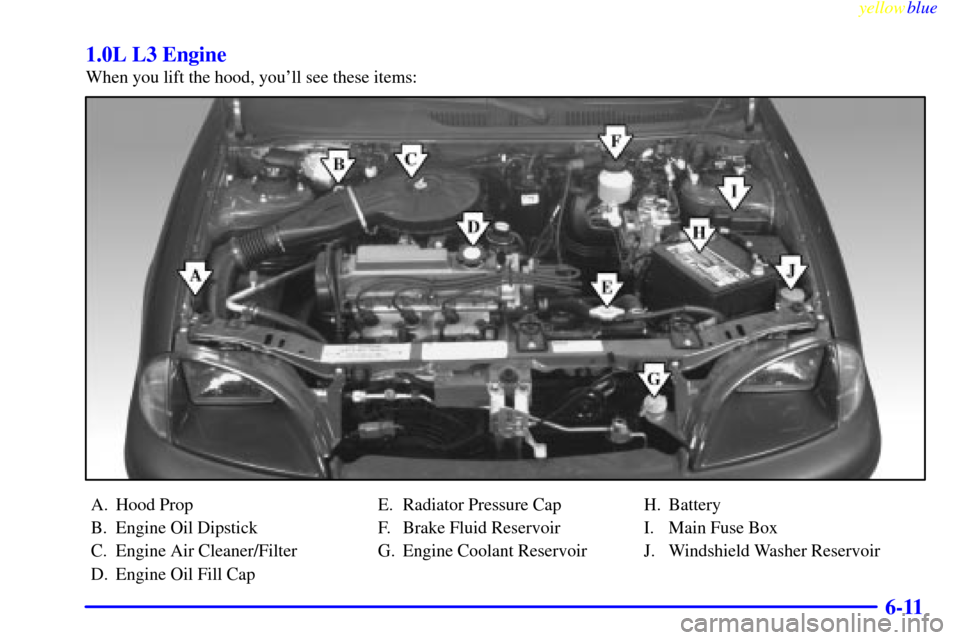
6-11 1.0L L3 Engine
When you lift the hood, you'll see these items:
A. Hood Prop
B. Engine Oil Dipstick
C. Engine Air Cleaner/Filter
D. Engine Oil Fill CapE. Radiator Pressure Cap
F. Brake Fluid Reservoir
G. Engine Coolant ReservoirH. Battery
I. Main Fuse Box
J. Windshield Washer Reservoir
Page 204 of 328
yellowblue
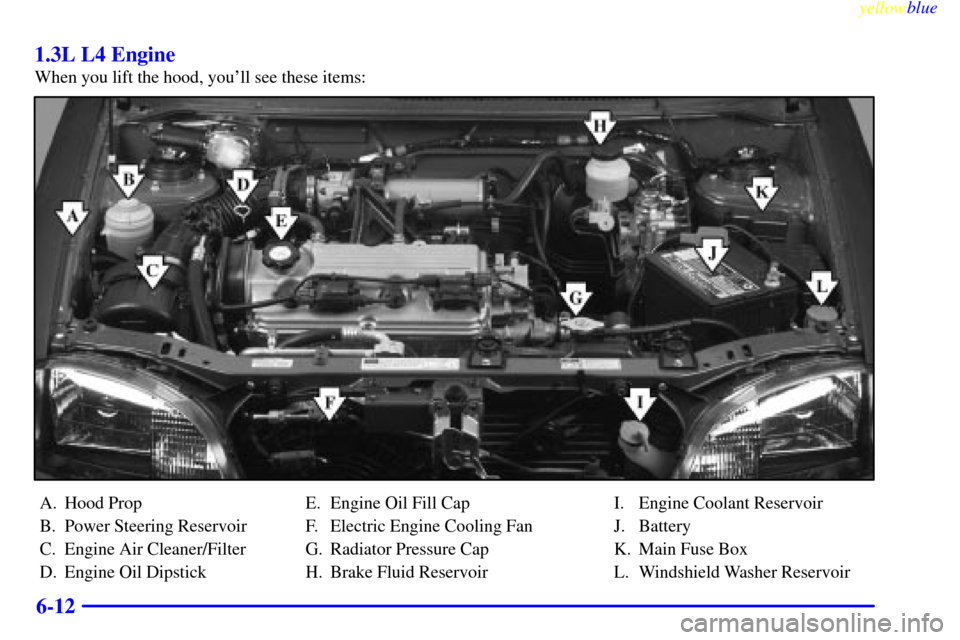
6-12 1.3L L4 Engine
When you lift the hood, you'll see these items:
A. Hood Prop
B. Power Steering Reservoir
C. Engine Air Cleaner/Filter
D. Engine Oil DipstickE. Engine Oil Fill Cap
F. Electric Engine Cooling Fan
G. Radiator Pressure Cap
H. Brake Fluid ReservoirI. Engine Coolant Reservoir
J. Battery
K. Main Fuse Box
L. Windshield Washer Reservoir
Page 216 of 328
yellowblue
6-24 How to Add Fluid
Here's how to add fluid. Refer to the Maintenance
Schedule to determine what kind of fluid to use. See
ªRecommended Fluids and Lubricantsº in the Index.
1. Remove the filler plug.
2. Add fluid at the filler plug hole. Add only enough
fluid to bring the fluid level up to the bottom of the
filler plug hole.
3. Install the filler plug. Be sure the plug is fully seated.
Clutch Adjustment
The clutch linkage in your vehicle should be checked as
recommended in your Maintenance Schedule. To check,
push the clutch pedal down with your hand until you
feel some resistance to the movement of the pedal. If the
pedal moves freely up to 5/8 to 3/4 of an inch (1.5 to 2.0
cm) or so before you feel resistance to the travel,
adjustment isn't needed.
If there is no free travel or very little (less than 5/8 of an
inch (1.5 cm)), see your dealer for adjustment.
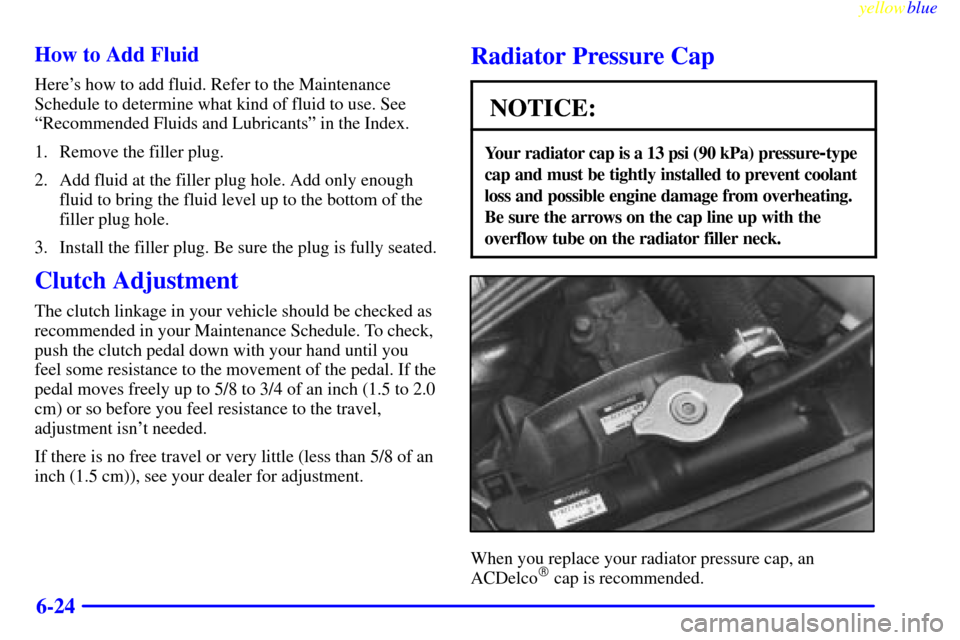
Radiator Pressure Cap
NOTICE:
Your radiator cap is a 13 psi (90 kPa) pressure-type
cap and must be tightly installed to prevent coolant
loss and possible engine damage from overheating.
Be sure the arrows on the cap line up with the
overflow tube on the radiator filler neck.
When you replace your radiator pressure cap, an
ACDelco� cap is recommended.
Page 217 of 328
yellowblue
6-25
Thermostat
Engine coolant temperature is controlled by a thermostat
in the engine coolant system. The thermostat stops the
flow of coolant through the radiator until the coolant
reaches a preset temperature.
When you replace your thermostat, an ACDelco
�
thermostat is recommended.
Engine Coolant
The following explains your cooling system and how to
add coolant when it is low. If you have a problem with
engine overheating, see ªEngine Overheatingº in
the Index.
A 50/50 mixture of clean, drinkable water and the
proper coolant will:
�Give freezing protection down to
-33�F (-36�C).
�Give boiling protection up to 258�F (125�C).
�Protect against rust and corrosion.
�Help keep the proper engine temperature.
�Let the warning lights and gages work as
they should.
What to Use
Use a mixture of one-half clean, drinkable water and
one
-half coolant that meets GM Specification 1825-M,
which won't damage aluminum parts. You can also use a
recycled coolant conforming to GM Specification
1825
-M with a complete coolant flush and refill. If
you use this coolant mixture, you don't need to add
anything else.
CAUTION:
Adding only plain water to your cooling system
can be dangerous. Plain water, or some other
liquid like alcohol, can boil before the proper
coolant mixture will. Your vehicle's coolant
warning system is set for the proper coolant
mixture. With plain water or the wrong mixture,
your engine could get too hot but you wouldn't
get the overheat warning. Your engine could
catch fire and you or others could be burned. Use
a 50/50 mixture of clean, drinkable water and the
proper coolant.
Page 218 of 328
yellowblue
6-26
NOTICE:
If you use an improper coolant mixture, your
engine could overheat and be badly damaged.
The repair cost wouldn't be covered by your
warranty. Too much water in the mixture can
freeze and crack the engine, radiator, heater core
and other parts.
If you have to add coolant more than four times a year,
have your dealer check your cooling system.
NOTICE:
If you use the proper coolant, you don't have to
add extra inhibitors or additives which claim to
improve the system. These can be harmful.
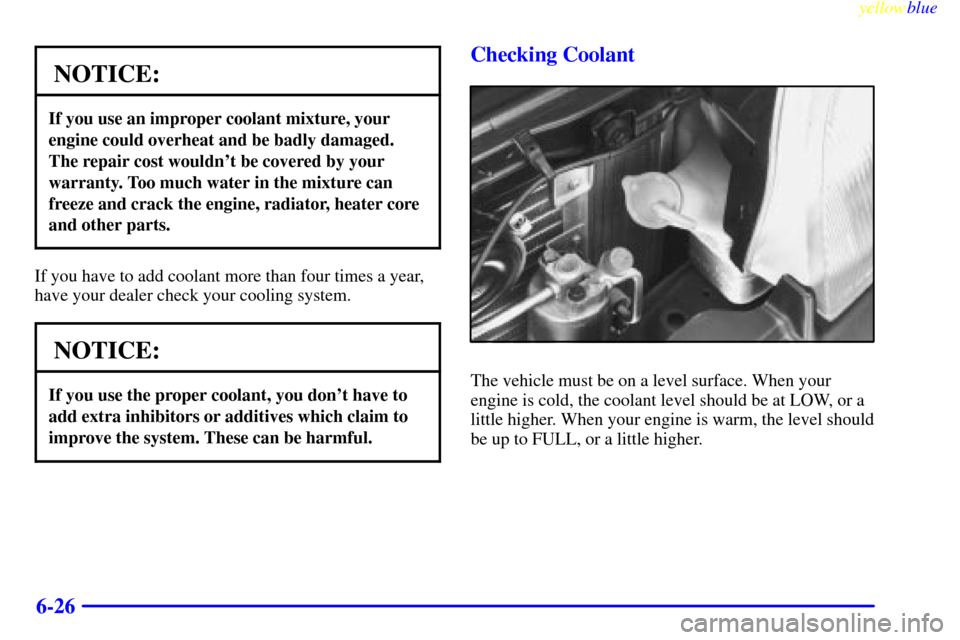
Checking Coolant
The vehicle must be on a level surface. When your
engine is cold, the coolant level should be at LOW, or a
little higher. When your engine is warm, the level should
be up to FULL, or a little higher.