Page 6 of 376
yellowblue
vi
How to Use this Manual
Many people read their owner's manual from beginning
to end when they first receive their new vehicle. If you
do this, it will help you learn about the features and
controls for your vehicle. In this manual, you'll find
that pictures and words work together to explain
things quickly.
Index
A good place to look for what you need is the Index in
back of the manual. It's an alphabetical list of what's in
the manual, and the page number where you'll find it.
Safety Warnings and Symbols
You will find a number of safety cautions in this book.
We use a box and the word CAUTION to tell you
about things that could hurt you if you were to ignore
the warning.
CAUTION:
These mean there is something that could hurt
you or other people.
In the caution area, we tell you what the hazard is. Then
we tell you what to do to help avoid or reduce the
hazard. Please read these cautions. If you don't, you or
others could be hurt.
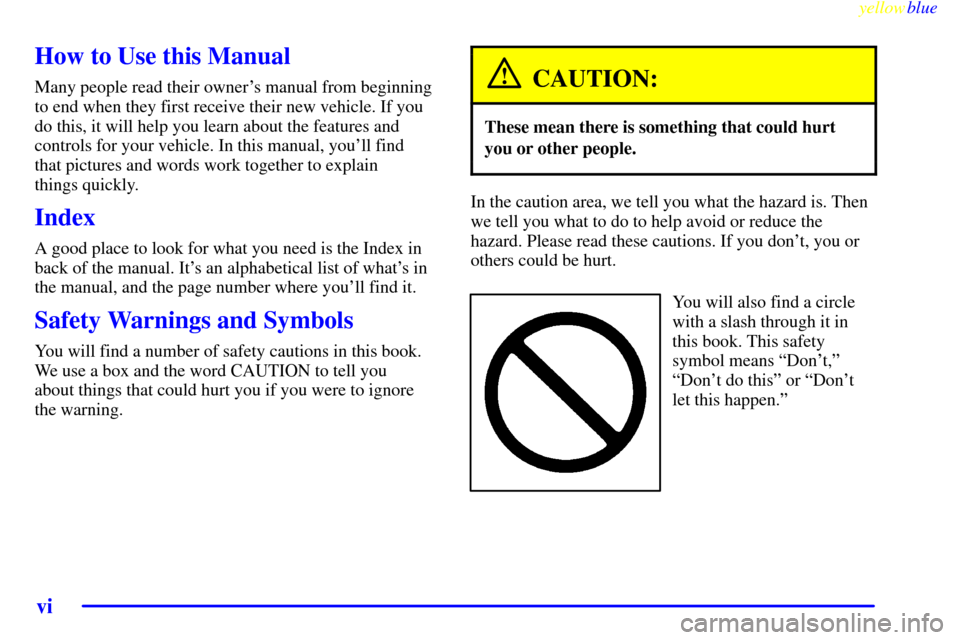
You will also find a circle
with a slash through it in
this book. This safety
symbol means ªDon't,º
ªDon't do thisº or ªDon't
let this happen.º
Page 7 of 376
yellowblue
vii
Vehicle Damage Warnings
Also, in this book you will find these notices:
NOTICE:
These mean there is something that could
damage your vehicle.
In the notice area, we tell you about something that
can damage your vehicle. Many times, this damage
would not be covered by your warranty, and it could
be costly. But the notice will tell you what to do to help
avoid the damage.
When you read other manuals, you might see
CAUTION and NOTICE warnings in different colors
or in different words.
You'll also see warning labels on your vehicle. They use
the same words, CAUTION or NOTICE.
Page 8 of 376
yellowblue
viii
For example,
these symbols
are used on an
original battery:
CAUTION
POSSIBLE
INJURY
PROTECT
EYES BY
SHIELDING
CAUSTIC
BATTERY
ACID COULD
CAUSE
BURNS
AVOID
SPARKS OR
FLAMES
SPARK OR
FLAME
COULD
EXPLODE
BATTERY
These symbols
are important
for you and
your passengers
whenever your
vehicle is
driven:
DOOR LOCK
UNLOCK
FASTEN
SEAT
BELTS
POWER
WINDOW
AIR BAG
These symbols
have to do with
your lamps:
MASTER
LIGHTING
SWITCH
TURN
SIGNALS
PARKING
LAMPS
HAZARD
WARNING
FLASHER
DAYTIME
RUNNING
LAMPS
FOG LAMPS
These symbols
are on some of
your controls:
WINDSHIELD
WIPER
WINDSHIELD
WASHER
WINDSHIELD
DEFROSTER
REAR
WINDOW
DEFOGGER
VENTILATING
FAN
These symbols
are used on
warning and
indicator lights:
ENGINE
COOLANT
TEMP
BATTERY
CHARGING
SYSTEM
BRAKE
COOLANT
ENGINE OIL
PRESSURE
ANTI-LOCK
BRAKES
Here are some
other symbols
you may see:
FUSE
LIGHTER
HORN
SPEAKER
FUEL
Vehicle Symbols
These are some of the symbols you may find on your vehicle.
Page 57 of 376

2-
yellowblue
2-1
Section 2 Features and Controls
Here you can learn about the many standard and optional features on your vehicle, and information on starting,
shifting and braking. Also explained are the instrument panel and the warning systems that tell you if everything is
working properly
-- and what to do if you have a problem.
2
-2 Keys
2
-4 Door Locks
2
-6 Keyless Entry System (If Equipped)
2
-11 Hatch
2
-12 Theft
2
-13 Content Theft-Deterrent/Alarm System
(Option)
2
-16 PASS-Key� II
2
-22 New Vehicle ªBreak-Inº
2
-23 Ignition Positions
2
-25 Starting Your Engine
2
-28 Engine Coolant Heater (Canada Only)
2
-29 Automatic Transmission Operation
2
-33 Manual Transmission Operation
2
-37 Parking Brake
2
-38 Shifting Into PARK (P)
(Automatic Transmission Only)
2
-39 Shifting Out of PARK (P)
(Automatic Transmission)2
-40 Parking Your Vehicle (Manual Transmission)
2
-40 Parking Over Things That Burn
2
-41 Engine Exhaust
2
-42 Limited-Slip Rear Axle
2
-42 Windows
2
-44 Tilt Wheel
2
-44 Turn Signal/Multifunction Lever
2
-50 Exterior Lamps
2
-52 Interior Lamps
2
-54 Mirrors
2
-55 Storage Compartments
2
-58 Twin Lift-Off Roof Panels (Option)
2
-65 Convertible Top (If Equipped)
2
-72 The Instrument Panel--Your
Information System
2
-76 Warning Lights, Gages and Indicators
Page 80 of 376

yellowblue
2-24
OFF (C): Unlocks the steering wheel, ignition and
automatic transmission, but does not send electrical
power to any accessories. Use this position if your
vehicle must be pushed or towed. A warning tone will
sound if you open the driver's door when the ignition is
in OFF and the key is in the ignition.
RUN (D): Position to which the switch returns after you
start your engine and release the switch. The switch
stays in RUN when the engine is running. But even
when the engine is not running, you can use RUN to
operate your electrical power accessories and to display
some instrument panel warning and indicator lights.
START (E): Starts the engine. When the engine starts,
release the key. The ignition will return to RUN for
normal driving.
Even if the engine is not running, ACC and RUN allows
you to operate your electrical accessories, such as the
radio and ventilation fan.
CAUTION:
On manual transmission vehicles, turning the key
to LOCK will lock the steering column and result
in a loss of ability to steer the vehicle. This could
cause a collision. If you need to turn the engine
off while the vehicle is moving, turn the key only
to OFF. Don't press the key release button while
the vehicle is moving.
NOTICE:
If your key seems stuck in LOCK and you can't
turn it, be sure you are using the correct key; if
so, is it all the way in? If it is, then turn the
steering wheel left and right while you turn the
key hard. But turn the key only with your hand.
Using a tool to force it could break the key or the
ignition switch. If none of this works, then your
vehicle needs service.
Page 93 of 376
yellowblue
2-37
Parking Brake
To set the parking brake, hold the brake pedal down and
pull up on the parking brake lever. If the ignition is on,
the brake system warning light will come on.
To release the parking brake, hold the brake pedal down.
Pull the parking brake lever up until you can push in the
release button. Hold the release button in as you move
the brake lever all the way down.
NOTICE:
Driving with the parking brake on can cause
your parking brakes to overheat. You may have
to replace them, and you could also damage other
parts of your vehicle.
Page 132 of 376

yellowblue
2-76 Tachometer
The tachometer displays the engine speed in thousands
of revolutions per minute (rpm).
NOTICE:
Do not operate the engine with the tachometer in
the red area, or engine damage may occur.
Warning Lights, Gages and Indicators
This part describes the warning lights and gages that
may be on your vehicle. The pictures will help you
locate them.
Warning lights and gages can signal that something is
wrong before it becomes serious enough to cause an
expensive repair or replacement. Paying attention to
your warning lights and gages could also save you or
others from injury.Warning lights come on when there may be or is a
problem with one of your vehicle's functions. As you
will see in the details on the next few pages, some
warning lights come on briefly when you start the
engine just to let you know they're working. If you are
familiar with this section, you should not be alarmed
when this happens.
Gages can indicate when there may be or is a problem
with one of your vehicle's functions. Often gages and
warning lights work together to let you know when
there's a problem with your vehicle.
When one of the warning lights comes on and stays on
when you are driving, or when one of the gages shows
there may be a problem, check the section that tells you
what to do about it. Please follow this manual's advice.
Waiting to do repairs can be costly
-- and even
dangerous. So please get to know your warning lights
and gages. They're a big help.
Page 134 of 376

yellowblue
2-78 Voltmeter
You can read battery
voltage on your voltmeter.
If it reads less than 11 volts
or more than 16 volts while
your engine is running, and
it stays there, you may have
a problem with the
electrical charging system.
Have it checked right away. Driving with the voltmeter
reading in a warning zone could drain your battery.
If you idle your engine for a while, the voltmeter
reading might move into the low voltage zone (indicated
by red dots). If the reading stays in the low voltage zone
while you are driving, you may have a problem with the
electrical charging system. Have it checked. While the
voltmeter reads in the low voltage zone, your battery
may not be able to power certain electrical accessories,
like ABS. (If this happens, your ABS INOP light will
come on. See ªAnti
-Lock Brake System Warning Lightº
in this section.)If you must drive a short distance with the voltmeter
reading in a warning zone, turn off all your accessories,
including your air conditioning system and
audio system.
Brake System Warning Light
Your vehicle's hydraulic brake system is divided into
two parts. If one part isn't working, the other part can
still work and stop you. For good braking, though, you
need both parts working well.
If the warning light comes on, there is a brake problem.
Have your brake system inspected right away.
This light should come on
briefly when you turn the
ignition key to RUN. If it
doesn't come on then, have
it fixed so it will be ready to
warn you if there's
a problem.