Page 5 of 376
yellowblue
v
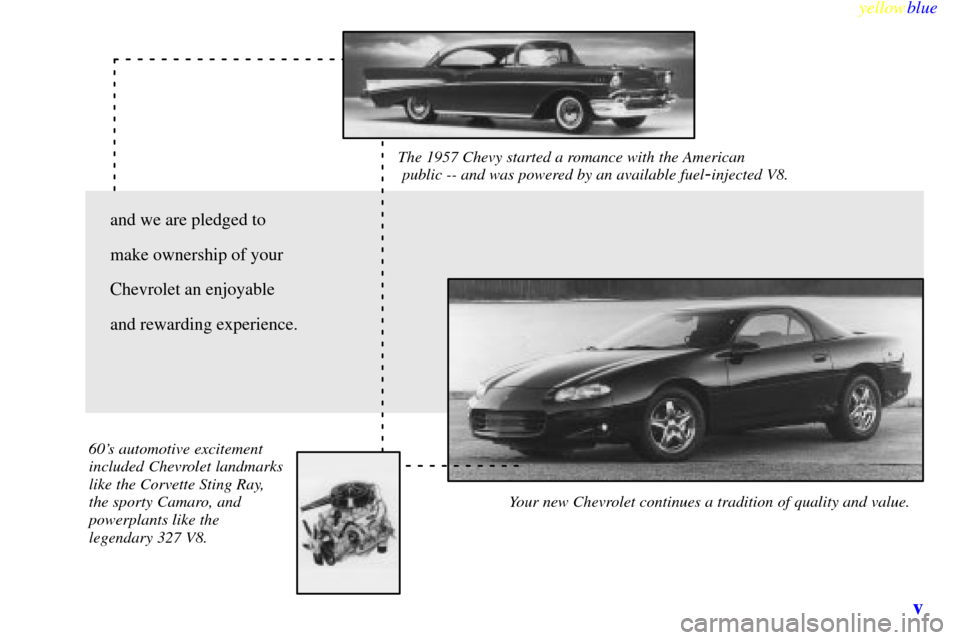
The 1957 Chevy started a romance with the American
public -- and was powered by an available fuel-injected V8.
Your new Chevrolet continues a tradition of quality and value. 60's automotive excitement
included Chevrolet landmarks
like the Corvette Sting Ray,
the sporty Camaro, and
powerplants like the
legendary 327 V8.
and we are pledged to
make ownership of your
Chevrolet an enjoyable
and rewarding experience.
Page 8 of 376
yellowblue
viii
For example,
these symbols
are used on an
original battery:
CAUTION
POSSIBLE
INJURY
PROTECT
EYES BY
SHIELDING
CAUSTIC
BATTERY
ACID COULD
CAUSE
BURNS
AVOID
SPARKS OR
FLAMES
SPARK OR
FLAME
COULD
EXPLODE
BATTERY
These symbols
are important
for you and
your passengers
whenever your
vehicle is
driven:
DOOR LOCK
UNLOCK
FASTEN
SEAT
BELTS
POWER
WINDOW
AIR BAG
These symbols
have to do with
your lamps:
MASTER
LIGHTING
SWITCH
TURN
SIGNALS
PARKING
LAMPS
HAZARD
WARNING
FLASHER
DAYTIME
RUNNING
LAMPS
FOG LAMPS
These symbols
are on some of
your controls:
WINDSHIELD
WIPER
WINDSHIELD
WASHER
WINDSHIELD
DEFROSTER
REAR
WINDOW
DEFOGGER
VENTILATING
FAN
These symbols
are used on
warning and
indicator lights:
ENGINE
COOLANT
TEMP
BATTERY
CHARGING
SYSTEM
BRAKE
COOLANT
ENGINE OIL
PRESSURE
ANTI-LOCK
BRAKES
Here are some
other symbols
you may see:
FUSE
LIGHTER
HORN
SPEAKER
FUEL
Vehicle Symbols
These are some of the symbols you may find on your vehicle.
Page 46 of 376
yellowblue
1-38 Top Strap
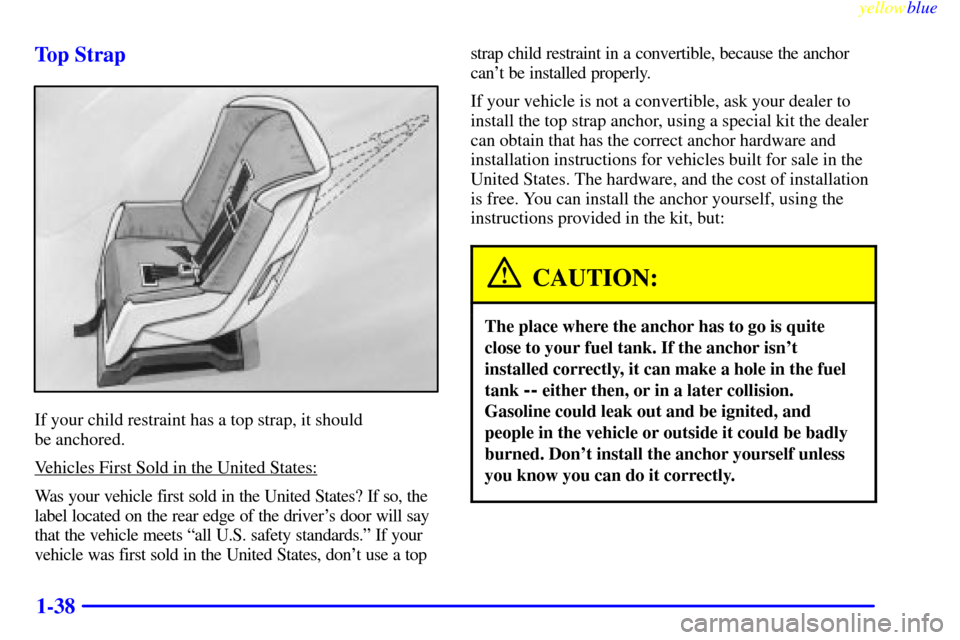
If your child restraint has a top strap, it should
be anchored.
Vehicles First Sold in the United States:
Was your vehicle first sold in the United States? If so, the
label located on the rear edge of the driver's door will say
that the vehicle meets ªall U.S. safety standards.º If your
vehicle was first sold in the United States, don't use a topstrap child restraint in a convertible, because the anchor
can't be installed properly.
If your vehicle is not a convertible, ask your dealer to
install the top strap anchor, using a special kit the dealer
can obtain that has the correct anchor hardware and
installation instructions for vehicles built for sale in the
United States. The hardware, and the cost of installation
is free. You can install the anchor yourself, using the
instructions provided in the kit, but:
CAUTION:
The place where the anchor has to go is quite
close to your fuel tank. If the anchor isn't
installed correctly, it can make a hole in the fuel
tank
-- either then, or in a later collision.
Gasoline could leak out and be ignited, and
people in the vehicle or outside it could be badly
burned. Don't install the anchor yourself unless
you know you can do it correctly.
Page 47 of 376
yellowblue
1-39
Vehicles First Sold in Canada:
If your vehicle was first sold in Canada, the label
located on the rear edge of the driver's door will say that
the vehicle meets ªall Canada safety standards.º
Canadian law requires that forward
-facing child
restraints have a top strap, and that the strap be
anchored. Cars first sold in Canada are built to accept a
top strap anchor, unless the vehicle is a convertible.
Don't use a top strap child restraint in a convertible,
because the anchor can't be installed properly.
If your vehicle is not a convertible, ask your dealer to
install the top strap anchor, using a special kit the dealer
can obtain that has the correct anchor hardware and
installation instructions. The hardware, and the cost of
installation, is free. You can install the anchor yourself,
using the instructions provided in the kit, but:
CAUTION:
The place where the anchor has to go is quite
close to your fuel tank. If the anchor isn't
installed correctly, it can make a hole in the fuel
tank
-- either then, or in a later collision.
Gasoline could leak out and be ignited, and
people in the vehicle or outside it could be badly
burned. Don't install the anchor yourself unless
you know you can do it correctly.
Canadian law requires that child restraints have a top
strap, and that the strap be anchored.
If your child restraint has a top strap, your dealer can
obtain a kit with anchor hardware and installation
instructions specifically designed for this vehicle.
The dealer can then install the anchor for you. This work
will be done for you free of charge. Or, you may install
the anchor yourself using the instructions provided in
the kit.
Page 72 of 376

yellowblue
2-16 Passive Arming
If the ignition was just turned off and a door was
opened, the system will arm six seconds after both doors
are closed, whether or not you lock them. In all other
cases, the system will wait 30 seconds after both doors
are closed before arming, allowing you time to get into
the vehicle and put the key in the ignition. The parking
lamps will flash when the system arms. Passive arming
is not enabled from the factory.
Disarming the System
There are two ways to disarm the system:
1. Press the UNLOCK button on the remote keyless
entry transmitter. If the horn chirps two or three
times when you unlock the car, the alarm sounded in
your absence. Two chirps means that the shock
sensor was set off and three chirps means that a door
or the hatch was opened.
2. Turn the ignition key to RUN.
For more information on customizing the features
mentioned here, see ªFeature Customizationº in
the Index.
PASS-Key� II
Your vehicle is equipped
with the PASS
-Key II
(Personalized Automotive
Security System)
theft
-deterrent system.
PASS
-Key II is a passive
theft
-deterrent system.
It works when you insert
or remove the key from
the ignition.
PASS
-Key II uses a resistor pellet in the ignition key
that matches a decoder in your vehicle.
When the PASS
-Key II system senses that someone is
using the wrong key, it shuts down the vehicle's starter
and fuel systems. For about three minutes, the starter
won't work and fuel won't go to the engine. If someone
tries to start your vehicle again or uses another key
during this time, the vehicle will not start. This
discourages someone from randomly trying different
keys with different resistor pellets in an attempt to make
a match.
Page 84 of 376
yellowblue
2-28
NOTICE:
Your engine is designed to work with the
electronics in your vehicle. If you add electrical
parts or accessories, you could change the way
the engine operates. Before adding electrical
equipment, check with your dealer. If you don't,
your engine might not perform properly.
If you ever have to have your vehicle towed, see
the part of this manual that tells how to do it
without damaging your vehicle. See ªTowing
Your Vehicleº in the Index.
Engine Coolant Heater
(Canada Only)
In very cold weather, 0�F (-18�C) or colder, the engine
coolant heater can help. You'll get easier starting and
better fuel economy during engine warm
-up. Usually,
the coolant heater should be plugged in a minimum of
four hours prior to starting your vehicle.
Page 87 of 376
yellowblue
2-31
NEUTRAL (N): In this position, your engine doesn't
connect with the wheels. To restart when you're already
moving, use NEUTRAL (N) only. Also, use
NEUTRAL (N) when your vehicle is being towed.
CAUTION:
Shifting out of PARK (P) or NEUTRAL (N) while
your engine is ªracingº (running at high speed) is
dangerous. Unless your foot is firmly on the
brake pedal, your vehicle could move very
rapidly. You could lose control and hit people or
objects. Don't shift out of PARK (P) or
NEUTRAL (N) while your engine is racing.
NOTICE:
Damage to your transmission caused by shifting
out of PARK (P) or NEUTRAL (N) with the
engine racing isn't covered by your warranty.
AUTOMATIC OVERDRIVE (�): This position is
for normal driving. If you need more power for passing,
and you're:
�Going less than about 35 mph (56 km/h), push your
accelerator pedal about halfway down.
�Going about 35 mph (56 km/h) or more, push the
accelerator all the way down.
You'll shift down to the next gear and have
more power.
DRIVE (D): This position is also used for normal
driving, however, it offers more power and lower fuel
economy than AUTOMATIC OVERDRIVE (�).
Here are some times you might choose DRIVE (D)
instead of AUTOMATIC OVERDRIVE (�):
�When driving on hilly, winding roads.
�When towing a trailer, so there is less shifting
between gears.
�When going down a steep hill.
SECOND (2): This position gives you more power but
lower fuel economy. You can use SECOND (2) on hills.
It can help control your speed as you go down steep
mountain roads, but then you would also want to use
your brakes off and on.
Page 88 of 376
yellowblue
2-32
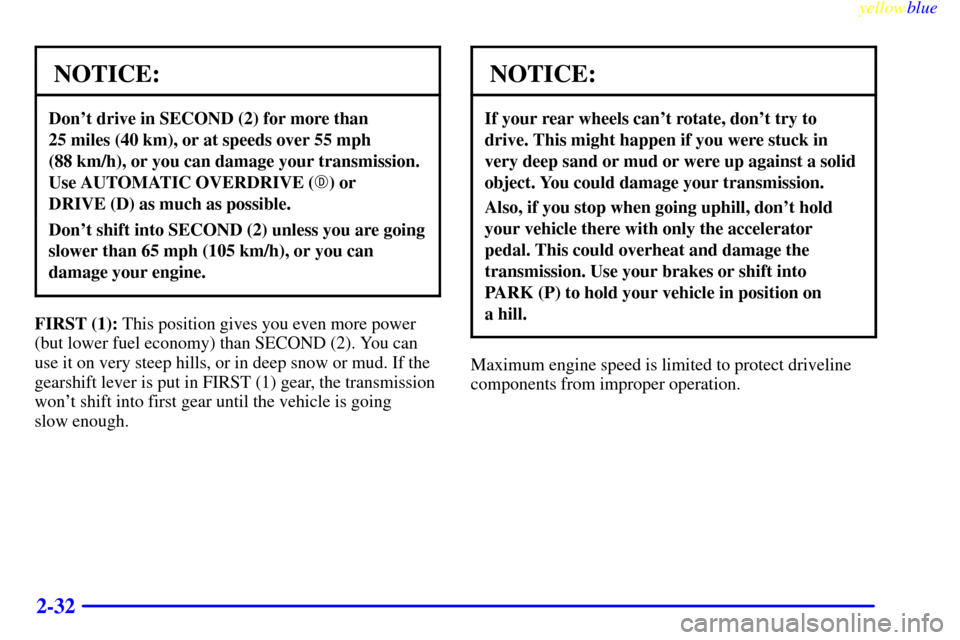
NOTICE:
Don't drive in SECOND (2) for more than
25 miles (40 km), or at speeds over 55 mph
(88 km/h), or you can damage your transmission.
Use AUTOMATIC OVERDRIVE (�) or
DRIVE (D) as much as possible.
Don't shift into SECOND (2) unless you are going
slower than 65 mph (105 km/h), or you can
damage your engine.
FIRST (1): This position gives you even more power
(but lower fuel economy) than SECOND (2). You can
use it on very steep hills, or in deep snow or mud. If the
gearshift lever is put in FIRST (1) gear, the transmission
won't shift into first gear until the vehicle is going
slow enough.
NOTICE:
If your rear wheels can't rotate, don't try to
drive. This might happen if you were stuck in
very deep sand or mud or were up against a solid
object. You could damage your transmission.
Also, if you stop when going uphill, don't hold
your vehicle there with only the accelerator
pedal. This could overheat and damage the
transmission. Use your brakes or shift into
PARK (P) to hold your vehicle in position on
a hill.
Maximum engine speed is limited to protect driveline
components from improper operation.