Page 137 of 376

yellowblue
2-81 Engine Coolant Temperature Gage
This gage shows the engine
coolant temperature. If the
gage pointer moves into the
red area, your engine is
approaching an
overheating condition.
If you have been operating your vehicle under normal
driving conditions, you should pull off the road, stop
your vehicle and turn off the engine as soon as possible.
See ªEngine Overheatingº in the Index.
Low Coolant Light ( 5.7L V8 Engine)
This warning light should
come on briefly while you
are starting your engine. If
the light doesn't come on,
have it repaired.
Your vehicle is equipped with a low coolant indicator
that is designed to detect when the coolant level drops
below the set limit. If the low coolant level sensor (on
the radiator) detects that the level drops while the engine
is running, the low coolant indicator will light and
remain lit until the ignition is turned to OFF. Check the
coolant level and add coolant as needed.
The low coolant light might stay on after filling the
radiator. Turn the ignition to OFF, then restart the engine
to verify that the low coolant light goes out. See ªEngine
Coolantº in the Index.
Page 138 of 376

yellowblue
2-82
NOTICE:
Driving with the low coolant light on could cause
your vehicle to overheat. See ªEngine Overheatingº
in the Index. Your vehicle could be damaged, and it
wouldn't be covered by your warranty.
Malfunction Indicator Lamp
(Service Engine Soon Light)
Your vehicle is equipped
with a computer which
monitors operation of the
fuel, ignition and emission
control systems.This system is called OBD II (On
-Board
Diagnostics
-Second Generation) and is intended to
assure that emissions are at acceptable levels for the life
of the vehicle, helping to produce a cleaner
environment. The SERVICE ENGINE SOON light
comes on to indicate that there is a problem and service
is required. Malfunctions often will be indicated by the
system before any problem is apparent. This may
prevent more serious damage to your vehicle. This
system is also designed to assist your service technician
in correctly diagnosing any malfunction.
NOTICE:
If you keep driving your vehicle with this light
on, after a while, your emission controls may not
work as well, your fuel economy may not be as
good and your engine may not run as smoothly.
This could lead to costly repairs that may not be
covered by your warranty.
Page 149 of 376

yellowblue
3-3
BI-LEVEL: Air is directed through the upper air
vents and the heater ducts.
VENT: Air flows through the upper air vents.
HEATER: This setting directs most of the air
through the heater ducts and some of the air through the
windshield defroster vents.
BLEND: Air is directed through the windshield
defroster vents and the heater ducts.
DEFROST: This setting directs most of the air
through the windshield defroster vents and some of the
air through the heater ducts.
Cooling
The air conditioner works best if you keep your
windows closed. On very hot days, open the windows
just long enough for the hot air to escape.
1. Turn the air control knob to A/C for normal cooling.
For faster cooling turn the knob to MAX.
2. Turn the temperature control knob to a
comfortable setting.
3. Turn the fan control knob to the desired speed.
Heating
The heater works best if you keep your windows closed
while using it.
1. Turn the air control knob to heater.
2. Turn the fan control knob to the desired speed.
3. Turn the temperature control knob to a
comfortable setting.
If your vehicle is equipped with an engine coolant
heater, you can use it in cold weather (around
20�F/
-8�C or lower) to improve heater performance
on initial start up. See ªEngine Coolant Heaterº in
the Index.
Bi-Level Heating
You may want to use Bi-Level heating on cool, but
sunny days. This setting directs cool air toward your
body and warmer air toward your feet.
1. Turn the air control knob to Bi
-Level.
2. Turn the temperature control knob to a
comfortable setting.
3. Turn the fan control knob to the desired speed.
Page 228 of 376
yellowblue
5-12
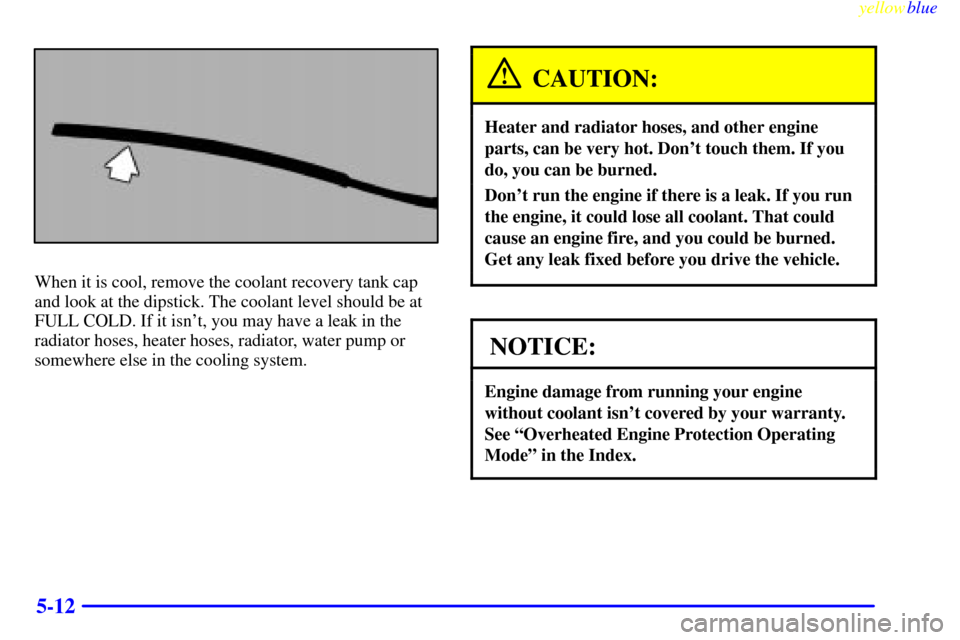
When it is cool, remove the coolant recovery tank cap
and look at the dipstick. The coolant level should be at
FULL COLD. If it isn't, you may have a leak in the
radiator hoses, heater hoses, radiator, water pump or
somewhere else in the cooling system.
CAUTION:
Heater and radiator hoses, and other engine
parts, can be very hot. Don't touch them. If you
do, you can be burned.
Don't run the engine if there is a leak. If you run
the engine, it could lose all coolant. That could
cause an engine fire, and you could be burned.
Get any leak fixed before you drive the vehicle.
NOTICE:
Engine damage from running your engine
without coolant isn't covered by your warranty.
See ªOverheated Engine Protection Operating
Modeº in the Index.
Page 229 of 376

yellowblue
5-13
NOTICE:
When adding coolant, it is important that you use
only DEX
-COOL� (silicate-free) coolant.
If coolant other than DEX-COOL is added to the
system, premature engine, heater core or
radiator corrosion may result. In addition, the
engine coolant will require change sooner
-- at
30,000 miles (50 000 km) or 24 months,
whichever occurs first. Damage caused by the use
of coolant other than DEX
-COOL� is not
covered by your new vehicle warranty.
If there seems to be no leak, with the engine on, check to
see if the electric engine cooling fans are running. If the
engine is overheating, both fans should be running.
If they aren't, your vehicle needs service.
How to Add Coolant to the Coolant
Recovery Tank
If you haven't found a problem yet, but the coolant level
isn't at the FULL COLD mark, add a 50/50 mixture of
clean, drinkable water and DEX
-COOL� engine
coolant at the coolant recovery tank. (See ªEngine
Coolantº in the Index for more information.)
CAUTION:
Adding only plain water to your cooling system
can be dangerous. Plain water, or some other
liquid like alcohol, can boil before the proper
coolant mixture will. Your vehicle's coolant
warning system is set for the proper coolant
mixture. With plain water or the wrong mixture,
your engine could get too hot but you wouldn't
get the overheat warning. Your engine could
catch fire and you or others could be burned.
Use a 50/50 mixture of clean, drinkable water
and DEX
-COOL� coolant.
Page 234 of 376
yellowblue
5-18
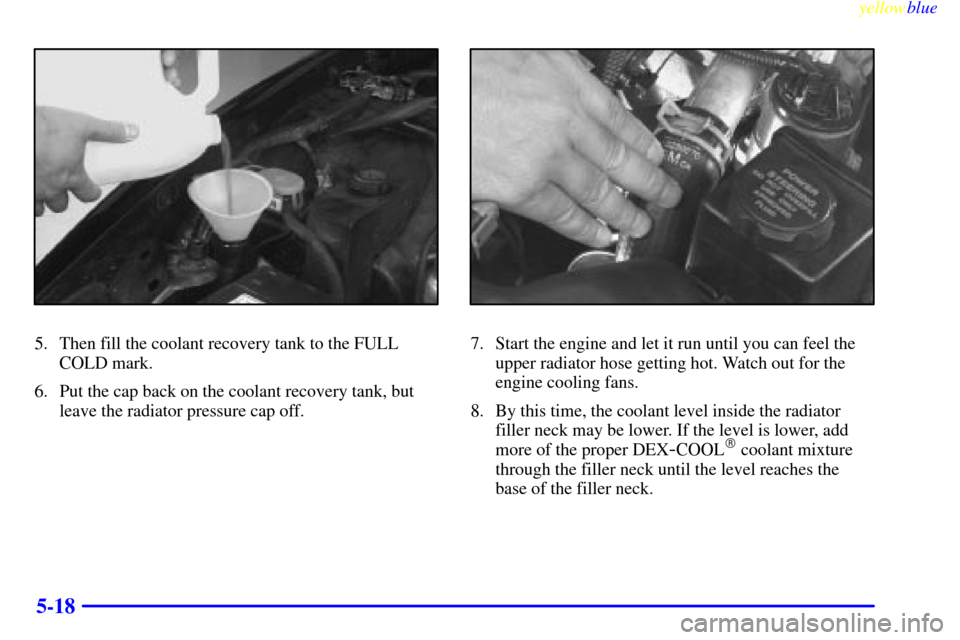
5. Then fill the coolant recovery tank to the FULL
COLD mark.
6. Put the cap back on the coolant recovery tank, but
leave the radiator pressure cap off.7. Start the engine and let it run until you can feel the
upper radiator hose getting hot. Watch out for the
engine cooling fans.
8. By this time, the coolant level inside the radiator
filler neck may be lower. If the level is lower, add
more of the proper DEX
-COOL� coolant mixture
through the filler neck until the level reaches the
base of the filler neck.
Page 236 of 376
yellowblue
5-20
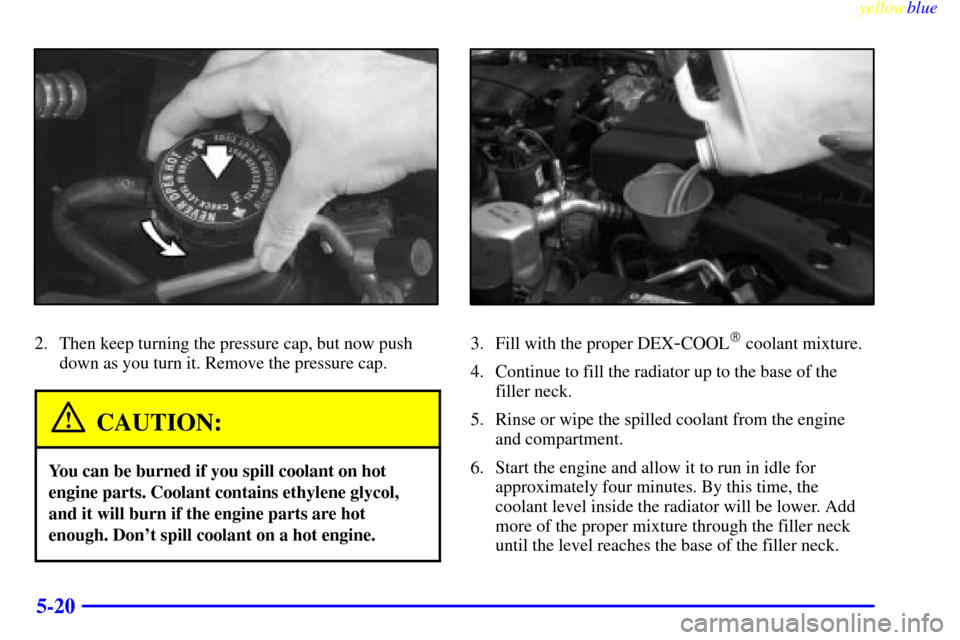
2. Then keep turning the pressure cap, but now push
down as you turn it. Remove the pressure cap.
CAUTION:
You can be burned if you spill coolant on hot
engine parts. Coolant contains ethylene glycol,
and it will burn if the engine parts are hot
enough. Don't spill coolant on a hot engine.
3. Fill with the proper DEX-COOL� coolant mixture.
4. Continue to fill the radiator up to the base of the
filler neck.
5. Rinse or wipe the spilled coolant from the engine
and compartment.
6. Start the engine and allow it to run in idle for
approximately four minutes. By this time, the
coolant level inside the radiator will be lower. Add
more of the proper mixture through the filler neck
until the level reaches the base of the filler neck.
Page 237 of 376
yellowblue
5-21
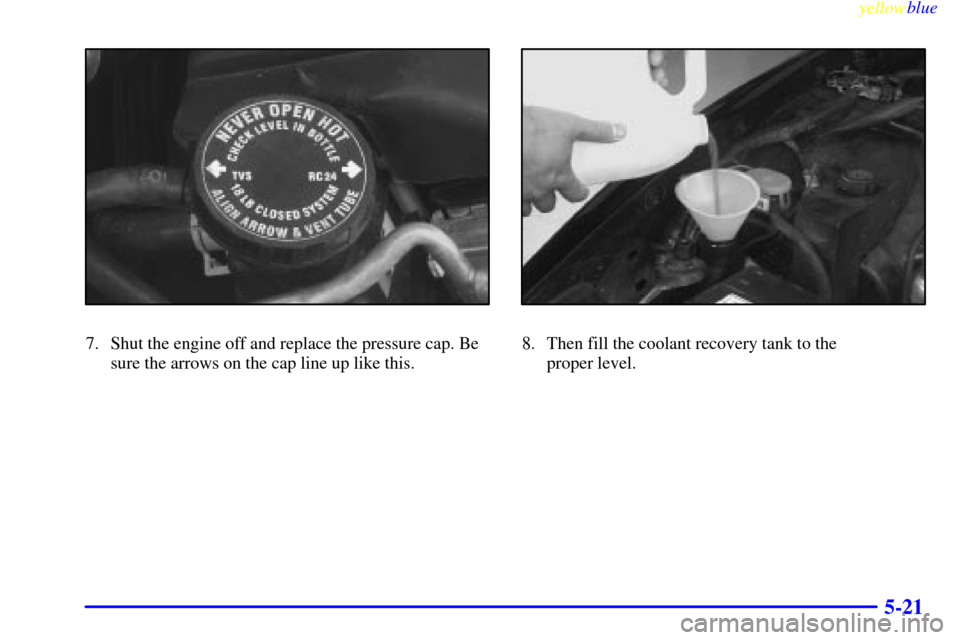
7. Shut the engine off and replace the pressure cap. Be
sure the arrows on the cap line up like this.8. Then fill the coolant recovery tank to the
proper level.