Page 87 of 352

yellowblue
2-23
OFF (C): This position lets you turn off the engine but
still turn the steering wheel. It doesn't lock the steering
wheel like LOCK. Use OFF if you must have your
vehicle in motion while the engine is off (for example, if
your vehicle is being pushed).
RUN (D): This is the position for driving.
START (E): This position starts your engine.
NOTICE:
If your key seems stuck in LOCK and you can't
turn it, be sure you are using the correct key; if
so, is it all the way in? If it is, then turn the
steering wheel left and right while you turn the
key hard. But turn the key only with your hand.
Using a tool to force it could break the key or the
ignition switch. If none of this works, then your
vehicle needs service.
Retained Accessory Power
Your vehicle is equipped with a Retained Accessory
Power (RAP) feature which will allow certain features
of your vehicle to continue to work up to 20 minutes
after the ignition key is turned to OFF.
Your audio system and power windows will work when
the ignition key is turned to RUN or ACCESSORY.
Once the key is turned from RUN to OFF, these features
will continue to work for up to 20 minutes or until a
door is opened.
Starting Your Engine
Move your shift lever to PARK (P) or NEUTRAL (N).
Your engine won't start in any other position
-- that's a
safety feature. To restart when you're already moving,
use NEUTRAL (N) only.
NOTICE:
Don't try to shift to PARK (P) if your vehicle is
moving. If you do, you could damage the
transmission. Shift to PARK (P) only when your
vehicle is stopped.
Page 90 of 352

yellowblue
2-26
Automatic Transmission Operation
There are several different positions for your shift lever.
Your vehicle features an electronic shift position
indicator within the instrument cluster. This display
must be powered anytime the shift lever is capable of
being moved out of PARK (P). This means that if your
key is in OFF, rather than LOCK, there will be a small
current drain on your battery which could discharge
your battery over a period of time. If you need to leave
your key in OFF for an extended period for any reason,
it is recommended that you disconnect the battery cable
from the battery to prevent discharging your battery.PARK (P): This locks your rear wheels. It's the best
position to use when you start your engine because your
vehicle can't move easily.
CAUTION:
It is dangerous to get out of your vehicle if the
shift lever is not fully in PARK (P) with the
parking brake firmly set. Your vehicle can roll.
Don't leave your vehicle when the engine is
running unless you have to. If you have left the
engine running, the vehicle can move suddenly.
You or others could be injured. To be sure your
vehicle won't move, even when you're on fairly
level ground, always set your parking brake and
move the shift lever to PARK (P).
See ªShifting Into PARK (P)º in the Index. If you
have four
-wheel drive, your vehicle will be free to
roll
-- even if your shift lever is in PARK (P) -- if
your transfer case is in NEUTRAL. So, be sure
the transfer case is in a drive gear
-- not in
NEUTRAL. See ªFour
-Wheel Drive (Automatic
Transfer Case)º in the Index. If you're pulling a
trailer, see ªTowing a Trailerº in the Index.
Page 93 of 352
yellowblue
2-29
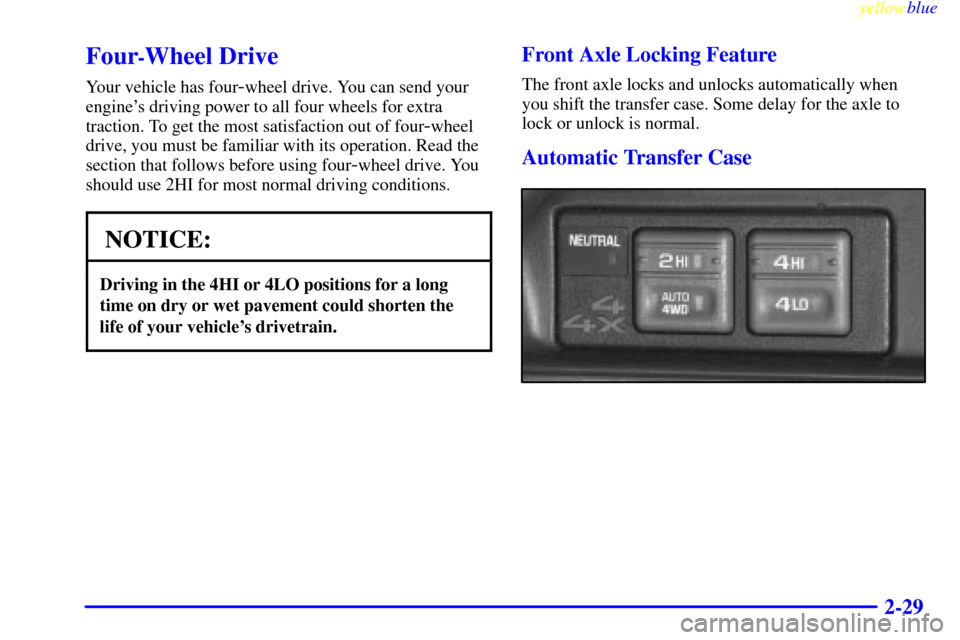
Four-Wheel Drive
Your vehicle has four-wheel drive. You can send your
engine's driving power to all four wheels for extra
traction. To get the most satisfaction out of four
-wheel
drive, you must be familiar with its operation. Read the
section that follows before using four
-wheel drive. You
should use 2HI for most normal driving conditions.
NOTICE:
Driving in the 4HI or 4LO positions for a long
time on dry or wet pavement could shorten the
life of your vehicle's drivetrain.
Front Axle Locking Feature
The front axle locks and unlocks automatically when
you shift the transfer case. Some delay for the axle to
lock or unlock is normal.
Automatic Transfer Case
Page 99 of 352
yellowblue
2-35
�Move the lever up as far as it will go.
3. Be sure the transfer case is in a drive gear
-- not
in NEUTRAL.
4. Turn the ignition key to LOCK.
5. Remove the key and take it with you. If you can
leave your vehicle with the ignition key in your
hand, your vehicle is in PARK (P).
Leaving Your Vehicle With the
Engine Running
CAUTION:
It can be dangerous to leave your vehicle with
the engine running. Your vehicle could move
suddenly if the shift lever is not fully in PARK (P)
with the parking brake firmly set. With
four
-wheel drive if your transfer case is in
NEUTRAL, your vehicle will be free to roll, even
if your shift lever is in PARK (P). So be sure
the transfer case is in a drive gear
-- not in
NEUTRAL. And, if you leave the vehicle with the
engine running, it could overheat and even catch
fire. You or others could be injured. Don't leave
your vehicle with the engine running unless you
have to.
Page 100 of 352

yellowblue
2-36
If you have to leave your vehicle with the engine
running, be sure your vehicle is in PARK (P) and the
parking brake is firmly set before you leave it. After you
move the shift lever into PARK (P), hold the regular
brake pedal down. Then, see if you can move the shift
lever away from PARK (P) without first pulling it
toward you. If you can, it means that the shift lever
wasn't fully locked into PARK (P).
Torque Lock
If you are parking on a hill and you don't shift your
transmission into PARK (P) properly, the weight of the
vehicle may put too much force on the parking pawl in
the transmission. You may find it difficult to pull the
shift lever out of PARK (P). This is called ªtorque lock.º
To prevent torque lock, set the parking brake and then
shift into PARK (P) properly before you leave the
driver's seat. To find out how, see ªShifting Into
PARK (P)º in the Index.
When you are ready to drive, move the shift lever out of
PARK (P) before you release the parking brake.
If torque lock does occur, you may need to have another
vehicle push yours a little uphill to take some of the
pressure from the parking pawl in the transmission, so
you can pull the shift lever out of PARK (P).
Shifting Out of PARK (P)
CAUTION:
Before shifting out of PARK (P) you must fully
apply your regular brakes. Your vehicle can roll.
If you have left the engine running, the vehicle
can move suddenly. You or others could
be injured.
If you're pulling a trailer, see ªTowing a Trailerº
in the Index.
Your vehicle has a Brake-Transmission Shift Interlock
(BTSI) system. You have to fully apply your regular
brakes before you can shift from PARK (P) when the
ignition is in RUN. See ªAutomatic Transmissionº in
the Index.
Page 103 of 352

yellowblue
2-39
CAUTION:
It can be dangerous to get out of your vehicle if
the shift lever is not fully in PARK (P) with the
parking brake firmly set. Your vehicle can roll.
Don't leave your vehicle when the engine is
running unless you have to. If you've left the
engine running, the vehicle can move suddenly.
You or others could be injured. To be sure your
vehicle won't move, even when you're on fairly
level ground, always set your parking brake and
move the shift lever to PARK (P).
Four-wheel drive vehicles with the transfer case
in NEUTRAL will allow the vehicle to roll, even if
your shift lever is in PARK (P). So, be sure the
transfer case is in a drive gear
-- not in
NEUTRAL. Always set your parking brake.
Follow the proper steps to be sure your vehicle won't
move. See ªShifting Into PARK (P)º in the Index.
If you're pulling a trailer, see ªTowing a Trailerº in
the Index.
Locking Rear Axle
Your locking rear axle can give you additional traction
on snow, mud, ice, sand or gravel. It works like a
standard axle most of the time, but when one of the rear
wheels has no traction and the other does, this feature
will allow the wheel with traction to move the vehicle.
Windows
Power Windows
The power window controls are located on each of the
side doors.
Page 104 of 352
yellowblue
2-40
The driver's door has a switch for the passenger
windows as well. Your power windows will work when
the ignition has been turned to ACCESSORY or RUN or
when Retained Accessory Power (RAP) is present. See
ªRetained Accessory Powerº in the Index.
Push the rear of the switch with the power window
symbol on it to lower the window.
Push the front of the switch with the power window
symbol on it to raise the window.
The driver's window switch has an express
-down
feature. Press and hold the side of the window switch
marked AUTO for one second to activate the
express
-down mode. The express-down mode can be
canceled at any time by pressing the opposite side of the
switch. To open the window partway, lightly tap the
switch until the window is at the desired position.
The power window switch has a lockout feature. This
feature prevents the passenger windows from operating
except from the driver's position, when the front
driver's side switch is in LOCK. When the switch is
moved to NORM, the passenger windows will
operate again.
Electric Tailgate Glass Release
(If Equipped)
Before operating your electric tailgate glass release, see
ªRear Doorsº in the the Index.
Your vehicle has the theft
-deterrent system. If it is
armed, use the transmitter, not the key to open the
tailgate or the alarm will sound. The hatch switch will
not work while the system is armed. See
ªTheft
-Deterrent Systemº in the Index.
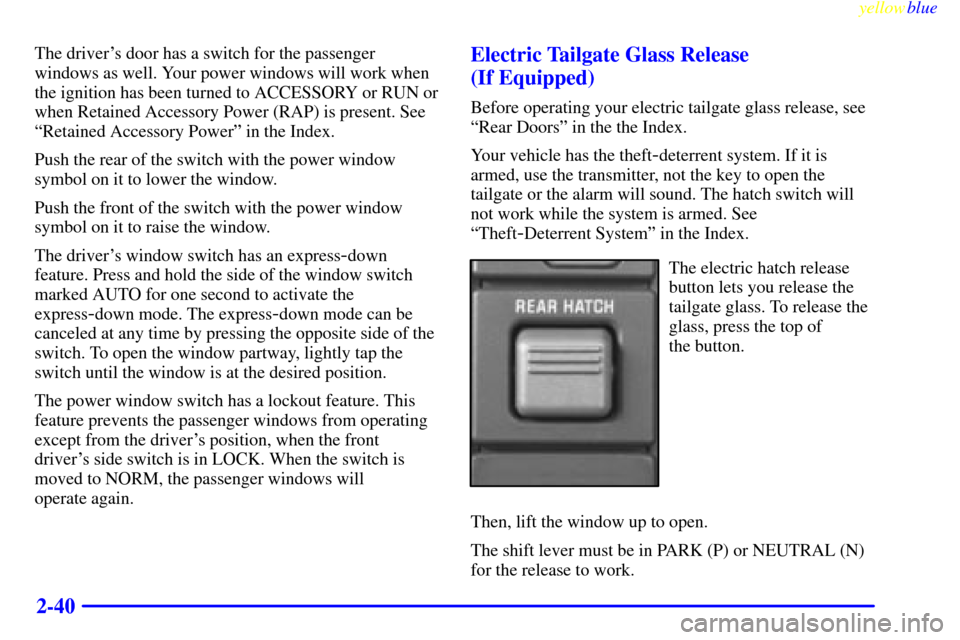
The electric hatch release
button lets you release the
tailgate glass. To release the
glass, press the top of
the button.
Then, lift the window up to open.
The shift lever must be in PARK (P) or NEUTRAL (N)
for the release to work.
Page 105 of 352
yellowblue
2-41
There is also a power door lock switch at the rear of the
vehicle which will allow you to lock or unlock all of the
doors. See ªPower Doors Locksº in the Index.
Horn
Press the center of the steering wheel to sound the horn.
Tilt Wheel
A tilt steering wheel allows
you to adjust the steering
wheel before you drive.
You can also raise it to the highest level to give your
legs more room when you enter and exit the vehicle.
To tilt the wheel, hold the steering wheel and pull the
lever. Move the steering wheel to a comfortable level,
then release the lever to lock the wheel in place.
Multifunction Lever
The lever on the left side of the steering column
includes your:
�Turn and Lane Change Signals
�Headlamp High/Low Beam Changer
�Windshield Wipers
�Windshield Washer
�Cruise Control