Page 268 of 352

yellowblue
6-8
Filling a Portable Fuel Container
CAUTION:
Never fill a portable fuel container while it is in
your vehicle. Static electricity discharge from the
container can ignite the gasoline vapor. You can
be badly burned and your vehicle damaged if this
occurs. To help avoid injury to you and others:
�Dispense gasoline only into
approved containers.
�Do not fill a container while it is inside a
vehicle, in a vehicle's trunk, pickup bed or
on any surface other than the ground.
�Bring the fill nozzle in contact with the
inside of the fill opening before operating
the nozzle. Contact should be maintained
until the filling is complete.
�Don't smoke while pumping gasoline.
Checking Things Under the Hood
CAUTION:
Things that burn can get on hot engine parts and
start a fire. These include liquids like gasoline,
oil, coolant, brake fluid, windshield washer and
other fluids, and plastic or rubber. You or others
could be burned. Be careful not to drop or spill
things that will burn onto a hot engine.
Page 271 of 352
yellowblue
6-11
Engine Oil
It's a good idea to check your engine oil every time you
get fuel. In order to get an accurate reading, the oil must
be warm and the vehicle must be on level ground.
The engine oil dipstick has a yellow ring handle and is
located on the passenger's side of the engine.Turn off the engine and give the oil several minutes to
drain back into the oil pan. If you don't, the oil dipstick
might not show the actual level.
Checking Engine Oil
Pull out the dipstick and clean it with a paper towel or
cloth, then push it back in all the way. Remove it again,
keeping the tip down, and check the level.
Page 292 of 352

yellowblue
6-32
Your rear drum brakes don't have wear indicators, but if
you ever hear a rear brake rubbing noise, have the rear
brake linings inspected immediately. Also, the rear
brake drums should be removed and inspected each time
the tires are removed for rotation or changing. When
you have the front brake pads replaced, have the rear
brakes inspected, too.
Brake linings should always be replaced as complete
axle sets.
See ªBrake System Inspectionº in the Maintenance
Schedule booklet under Part C ªPeriodic Maintenance
Inspections.º
Brake Pedal Travel
See your dealer if the brake pedal does not return to
normal height, or if there is a rapid increase in pedal
travel. This could be a sign of brake trouble.
Brake Adjustment
Every time you make a brake stop, your disc brakes
adjust for wear.
If your brake pedal goes down farther than normal, your
rear drum brakes may need adjustment. Adjust them by
backing up and firmly applying the brakes a few times.
Replacing Brake System Parts
The braking system on a vehicle is complex. Its many
parts have to be of top quality and work well together if
the vehicle is to have really good braking. Your vehicle
was designed and tested with top
-quality GM brake
parts. When you replace parts of your braking
system
-- for example, when your brake linings wear
down and you have to have new ones put in
-- be sure
you get new approved GM replacement parts. If you
don't, your brakes may no longer work properly. For
example, if someone puts in brake linings that are wrong
for your vehicle, the balance between your front and
rear brakes can change
-- for the worse. The braking
performance you've come to expect can change in many
other ways if someone puts in the wrong replacement
brake parts.
Fluid Leak Check
After the vehicle has been parked for awhile, inspect the
surface under the vehicle for water, oil, fuel or other fluids.
Water dripping from the air conditioning system after it
has been used is normal. If you notice fuel leaks or fumes,
the causes should be found and corrected at once.
Page 300 of 352
yellowblue
6-40
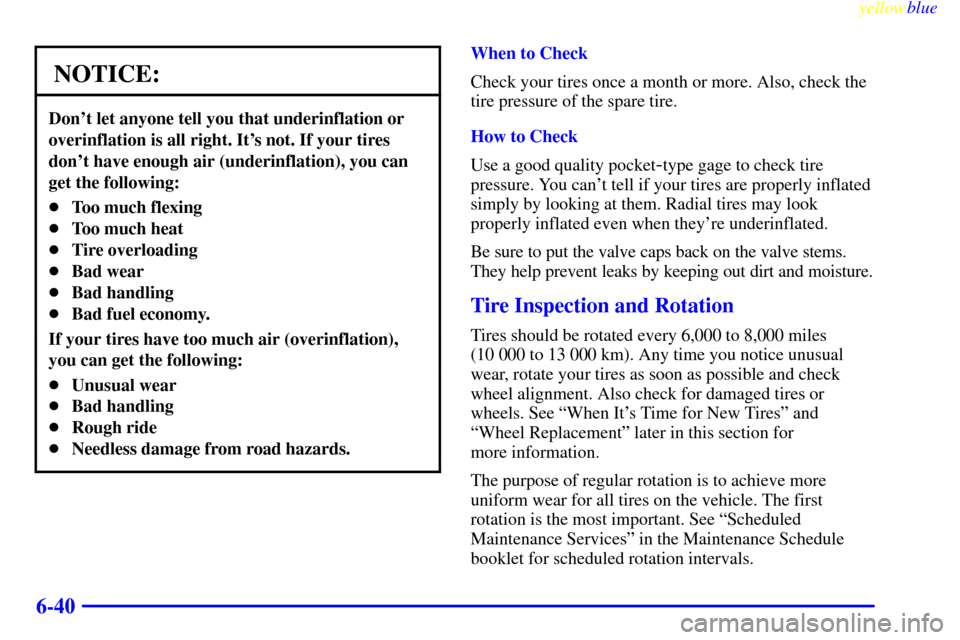
NOTICE:
Don't let anyone tell you that underinflation or
overinflation is all right. It's not. If your tires
don't have enough air (underinflation), you can
get the following:
�Too much flexing
�Too much heat
�Tire overloading
�Bad wear
�Bad handling
�Bad fuel economy.
If your tires have too much air (overinflation),
you can get the following:
�Unusual wear
�Bad handling
�Rough ride
�Needless damage from road hazards.
When to Check
Check your tires once a month or more. Also, check the
tire pressure of the spare tire.
How to Check
Use a good quality pocket
-type gage to check tire
pressure. You can't tell if your tires are properly inflated
simply by looking at them. Radial tires may look
properly inflated even when they're underinflated.
Be sure to put the valve caps back on the valve stems.
They help prevent leaks by keeping out dirt and moisture.
Tire Inspection and Rotation
Tires should be rotated every 6,000 to 8,000 miles
(10 000 to 13 000 km). Any time you notice unusual
wear, rotate your tires as soon as possible and check
wheel alignment. Also check for damaged tires or
wheels. See ªWhen It's Time for New Tiresº and
ªWheel Replacementº later in this section for
more information.
The purpose of regular rotation is to achieve more
uniform wear for all tires on the vehicle. The first
rotation is the most important. See ªScheduled
Maintenance Servicesº in the Maintenance Schedule
booklet for scheduled rotation intervals.
Page 313 of 352
yellowblue
6-53
Finish Damage
Any stone chips, fractures or deep scratches in the finish
should be repaired right away. Bare metal will corrode
quickly and may develop into a major repair expense.
Minor chips and scratches can be repaired with touch
-up
materials available from your dealer or other service
outlets. Larger areas of finish damage can be corrected
in your dealer's body and paint shop.
Underbody Maintenance
Chemicals used for ice and snow removal and dust control
can collect on the underbody. If these are not removed,
accelerated corrosion (rust) can occur on the underbody
parts such as fuel lines, frame, floor pan and exhaust
system even though they have corrosion protection.
At least every spring, flush these materials from the
underbody with plain water. Clean any areas where mud
and other debris can collect. Dirt packed in closed areas
of the frame should be loosened before being flushed.
Your dealer or an underbody car washing system can do
this for you.
Chemical Paint Spotting
Some weather and atmospheric conditions can create a
chemical fallout. Airborne pollutants can fall upon and
attack painted surfaces on your vehicle. This damage
can take two forms: blotchy, ringlet
-shaped
discolorations, and small irregular dark spots etched
into the paint surface.
Although no defect in the paint job causes this, Cadillac
will repair, at no charge to the owner, the surfaces of
new vehicles damaged by this fallout condition within
12 months or 12,000 miles (20 000 km) of purchase,
whichever occurs first.
Page 320 of 352
yellowblue
6-60
Underhood Fuse/Relay Center
The underhood fuse/relay center is located in the
rear of the engine compartment near the brake fluid
reservoir. Move the retainer clips for the cover to access
the fuse block.
You can remove fuses with a fuse extractor. The fuse
extractor is mounted to the interior fuse block. To
remove fuses if you don't have a fuse extractor, hold the
end of the fuse between your thumb and index finger
and pull straight out.Name Circuits Protected
ECM
-B Fuel Pump, PCM/VCM
RR DEFOG Rear Window Defogger
IGN
-E Auxiliary Fan Relay Coil,
A/C Compressor Relay,
Hot Fuel Module
FUEL SOL Not Used
Page 323 of 352
yellowblue
6-63
LAMP OR BULB TRADE NO. QTY
INTERIOR
Dome Lamps 211
-22
Reading Lamps 211
-24
Roof Console Lamps* 168 2
Door Courtesy Lamp 194 2
Instrument Panel Compartment Lamp 194 1
Ashtray Lamp 194 1
Sunshade Vanity Mirror 74 4
Capacities and Specifications
Please refer to ªRecommended Fluids and Lubricantsº
in the Maintenance Schedule booklet for
more information.
Engine Identification
EngineªVORTECº 5700
Type V8
RPO Code L31
VIN Code R
Fuel System SFI*
*Sequential Fuel Injection
Page 325 of 352

yellowblue
6-65 Fuel Tank Capacity (Approximate)
Quantity 30.0 Gallons (113.0 L)
Air Conditioning Refrigerants
Not all air conditioning refrigerants are the same.
If the air conditioning system in your vehicle needs
refrigerant, be sure the proper refrigerant is used.
If you're not sure, ask your dealer.
See refrigerant charge label under the hood for charge
capacity information and requirements.
Normal Maintenance
Replacement Parts
Replacement part numbers listed in this section are
based on the latest information available at the time of
printing, and are subject to change. If a part listed in this
manual is not the same as the part used in your vehicle
when it was built, or if you have any questions, please
contact your Cadillac dealer.
Oil Filter AC Type PF52
Engine Air
Cleaner/FilterAC Type A1300C�
Spark Plugs AC Type 41
-932Spark Plug Gap 0.060 in. (1.52 mm)
Fuel Filter AC Type GF626
Wiper Blades
(Front)GM Part No. 22154886
Wiper Blade
Type (Front)Trico
Wiper Blade
Length (Front)18.0 inches (45.0 cm)
Wiper Blade
(Rear)GM Part No. 22154396
Wiper Blade
Type (Rear)Trico
Wiper Blade
Length (Rear)14.0 inches (35.5 cm)
�A1301C high
-capacity air cleaner filter.


