Page 241 of 344
yellowblue
5-27
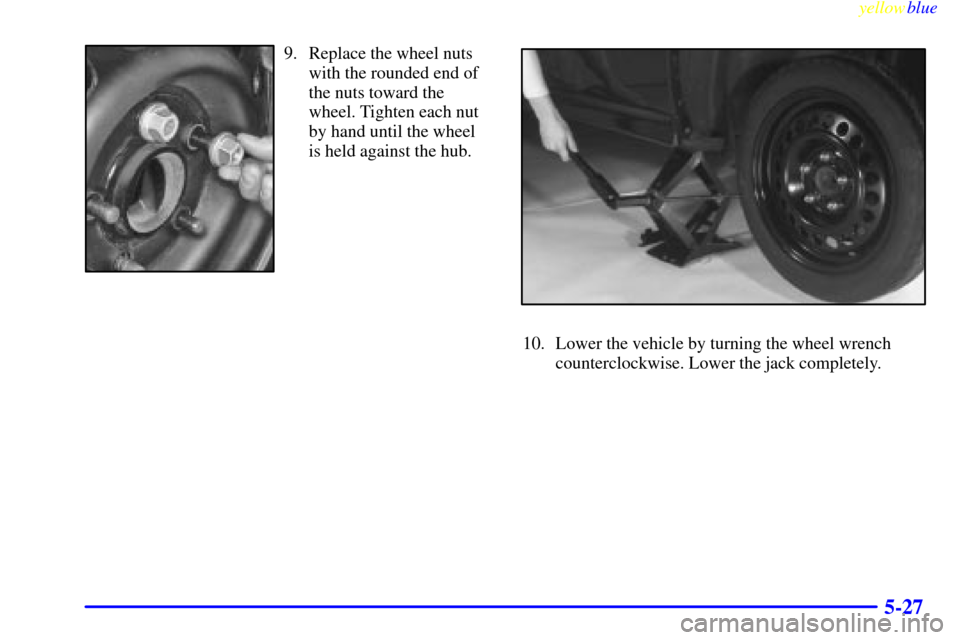
9. Replace the wheel nuts
with the rounded end of
the nuts toward the
wheel. Tighten each nut
by hand until the wheel
is held against the hub.
10. Lower the vehicle by turning the wheel wrench
counterclockwise. Lower the jack completely.
Page 252 of 344
yellowblue
6-6
CAUTION:
Gasoline vapor is highly flammable. It burns
violently, and that can cause very bad injuries.
Don't smoke if you're near gasoline or refueling
your vehicle. Keep sparks, flames and smoking
materials away from gasoline.
The fuel door release is
located above the radio on
the Driver Information
Center (DIC) and on the
Remote Keyless Entry
(RKE) transmitter.
This button works only when the shift lever is in
PARK (P) or NEUTRAL (N) and the VALET lockout
switch is in the OFF position.
An alternate fuel door
release is located inside of
the trunk on the driver's
side. Pull it to release the
fuel door.
While refueling, hang the cap by the tether from the
hook on the filler door.
Page 253 of 344

yellowblue
6-7
To remove the cap, turn it slowly to the left
(counterclockwise). The cap has a spring in it; if you let
go of the cap too soon, it will spring back to the right.
CAUTION:
If you get gasoline on yourself and then
something ignites it, you could be badly burned.
Gasoline can spray out on you if you open the
fuel filler cap too quickly. This spray can happen
if your tank is nearly full, and is more likely in
hot weather. Open the fuel filler cap slowly and
wait for any ªhissº noise to stop. Then unscrew
the cap all the way.
Be careful not to spill gasoline. Clean gasoline from
painted surfaces as soon as possible. See ªCleaning the
Outside of Your Vehicleº in the Index.When you put the cap back on, turn it to the right
(clockwise) until you hear a clicking sound. Make sure
you fully install the cap. The diagnostic system can
determine if the fuel cap has been left off or improperly
installed. This would allow fuel to evaporate into the
atmosphere. See ªMalfunction Indicator Lampº in
the Index.
NOTICE:
If you need a new cap, be sure to get the right
type. Your dealer can get one for you. If you get
the wrong type, it may not fit properly. This may
cause your malfunction indicator lamp to light
and your fuel tank and emissions system may be
damaged. See ªMalfunction Indicator Lampº in
the Index.
Page 258 of 344
yellowblue
6-12 Checking Engine Oil
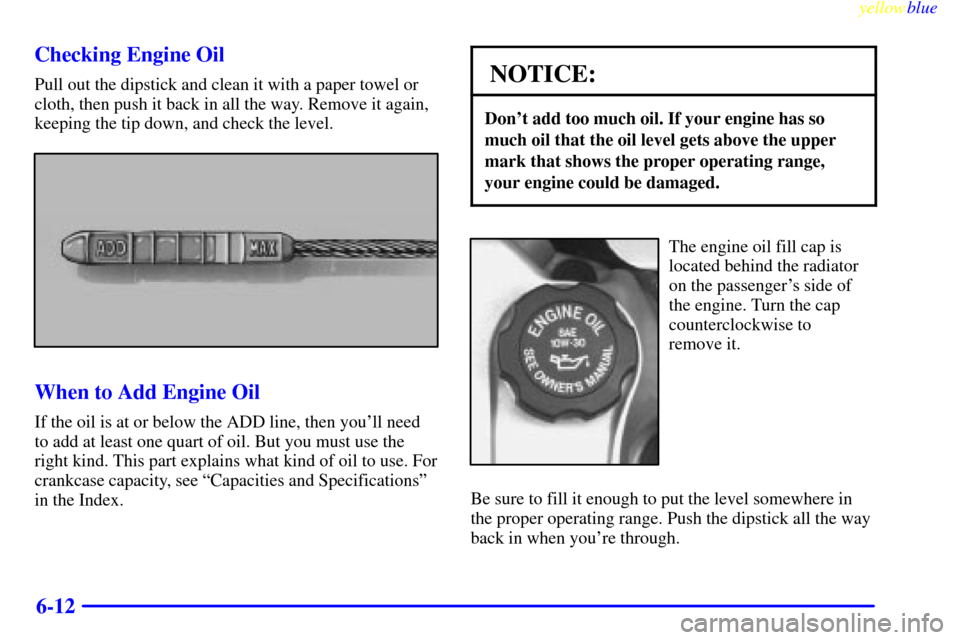
Pull out the dipstick and clean it with a paper towel or
cloth, then push it back in all the way. Remove it again,
keeping the tip down, and check the level.
When to Add Engine Oil
If the oil is at or below the ADD line, then you'll need
to add at least one quart of oil. But you must use the
right kind. This part explains what kind of oil to use. For
crankcase capacity, see ªCapacities and Specificationsº
in the Index.
NOTICE:
Don't add too much oil. If your engine has so
much oil that the oil level gets above the upper
mark that shows the proper operating range,
your engine could be damaged.
The engine oil fill cap is
located behind the radiator
on the passenger's side of
the engine. Turn the cap
counterclockwise to
remove it.
Be sure to fill it enough to put the level somewhere in
the proper operating range. Push the dipstick all the way
back in when you're through.
Page 271 of 344
yellowblue
6-25 Checking Coolant
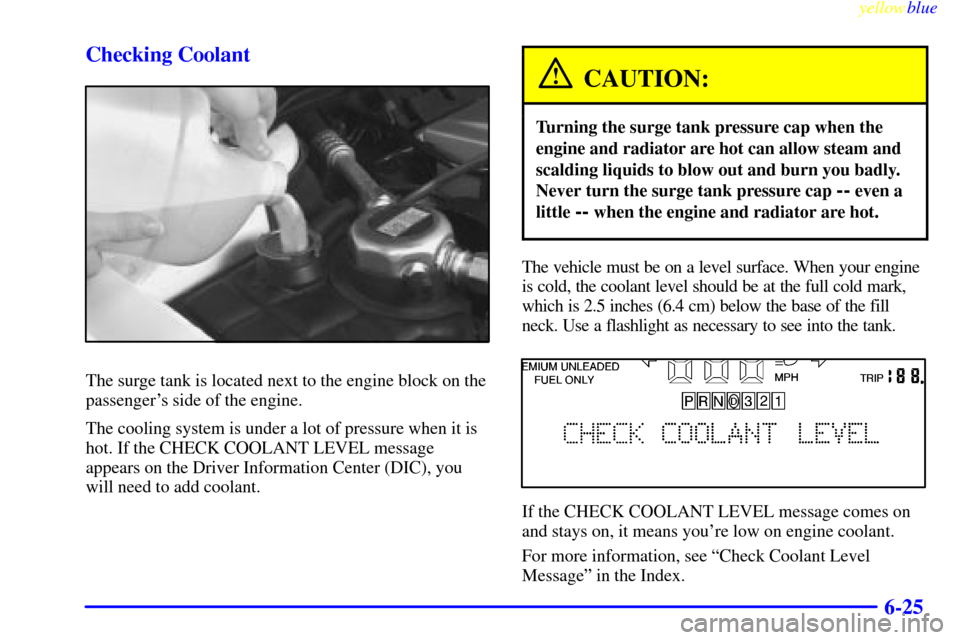
The surge tank is located next to the engine block on the
passenger's side of the engine.
The cooling system is under a lot of pressure when it is
hot. If the CHECK COOLANT LEVEL message
appears on the Driver Information Center (DIC), you
will need to add coolant.
CAUTION:
Turning the surge tank pressure cap when the
engine and radiator are hot can allow steam and
scalding liquids to blow out and burn you badly.
Never turn the surge tank pressure cap
-- even a
little
-- when the engine and radiator are hot.
The vehicle must be on a level surface. When your engine
is cold, the coolant level should be at the full cold mark,
which is 2.5 inches (6.4 cm) below the base of the fill
neck. Use a flashlight as necessary to see into the tank.
If the CHECK COOLANT LEVEL message comes on
and stays on, it means you're low on engine coolant.
For more information, see ªCheck Coolant Level
Messageº in the Index.
Page 279 of 344
yellowblue
6-33
Bulb Replacement
For the proper type of replacement bulb, see
ªReplacement Bulbsº in the Index.
For any bulb changing procedure not listed in this
section, contact your dealer's service department.
Halogen Bulbs
CAUTION:
Halogen bulbs have pressurized gas inside and
can burst if you drop or scratch the bulb. You or
others could be injured. Be sure to read and
follow the instructions on the bulb package.
Headlamps
1. To access the headlamps, turn the lock tabs in
the direction of the arrows as shown on the
headlamp cover.
Page 280 of 344
yellowblue
6-34
2. Lift off the cover as shown.3. Turn the headlamp housing socket counterclockwise
to unlock the socket from the lamp housing.
Page 282 of 344
yellowblue
6-36 Front Turn Signal Lamps
1. The turn signal lamps are located on the outboard
side of the headlamps. To access, turn the lock tabs
on the headlamp cover in the direction of the arrows
and then lift off the cover (see Steps 1 and 2 under
ªHeadlampsº listed previously).
2. Turn the housing socket clockwise to unlock the
socket from the lamp housing.
3. Remove the turn signal lamp housing socket and
replace the bulb.