Page 85 of 368
yellowblue
2-25
THIRD (3): This position is also used for normal
driving, but it offers more power and lower fuel
economy than AUTOMATIC OVERDRIVE (�).
Here are some times you might choose THIRD (3)
instead of AUTOMATIC OVERDRIVE (�):
�When driving on hilly, winding roads.
�When towing a trailer, so there is less shifting
between gears.
�When going down a steep hill.
�When driving in non
-highway scenarios (i.e. city
streets, etc.).SECOND (2): This position gives you more power but
lower fuel economy. You can use SECOND (2) on hills.
It can help control your speed as you go down steep
mountain roads, but then you would also want to use
your brakes off and on.
NOTICE:
Don't drive in SECOND (2) for more than
25 miles (40 km), or at speeds over 55 mph
(90 km/h), or you can damage your transaxle.
Use AUTOMATIC OVERDRIVE (�) or
THIRD (3) as much as possible.
Don't shift into SECOND (2) unless you are going
slower than 65 mph (105 km/h), or you can
damage your engine.
ProCarManuals.com
Page 87 of 368

yellowblue
2-27
Press the button again to return to normal shifting. The
PERF SHIFT light will turn off when in normal shifting
mode. The transaxle will then shift at lower engine
speeds, increasing fuel economy.
Parking Brake
To set the parking brake,
hold the regular brake pedal
down with your right foot.
Push down the parking
brake pedal with your
left foot.
To release the parking brake, hold the regular brake
pedal down with your right foot and push the parking
brake pedal with your left foot. When you lift your left
foot, the parking brake pedal will follow it to the
released position.A warning chime will sound if the parking brake is set,
the ignition is on and the shift lever is not in PARK (P)
or NEUTRAL (N).
NOTICE:
Driving with the parking brake on can cause
your rear brakes to overheat. You may have to
replace them, and you could also damage other
parts of your vehicle.
If you are towing a trailer and parking on any hill, see
ªTowing a Trailerº in the Index. That section shows
what to do first to keep the trailer from moving.
ProCarManuals.com
Page 88 of 368
yellowblue
2-28
Shifting Into PARK (P)
CAUTION:
It can be dangerous to get out of your vehicle if
the shift lever is not fully in PARK (P) with the
parking brake firmly set. Your vehicle can roll. If
you have left the engine running, the vehicle can
move suddenly. You or others could be injured.
To be sure your vehicle won't move, even when
you're on fairly level ground, use the steps that
follow. If you're pulling a trailer, see ªTowing a
Trailerº in the Index.
1. Hold the brake pedal down with your right foot and
set the parking brake with your left foot.
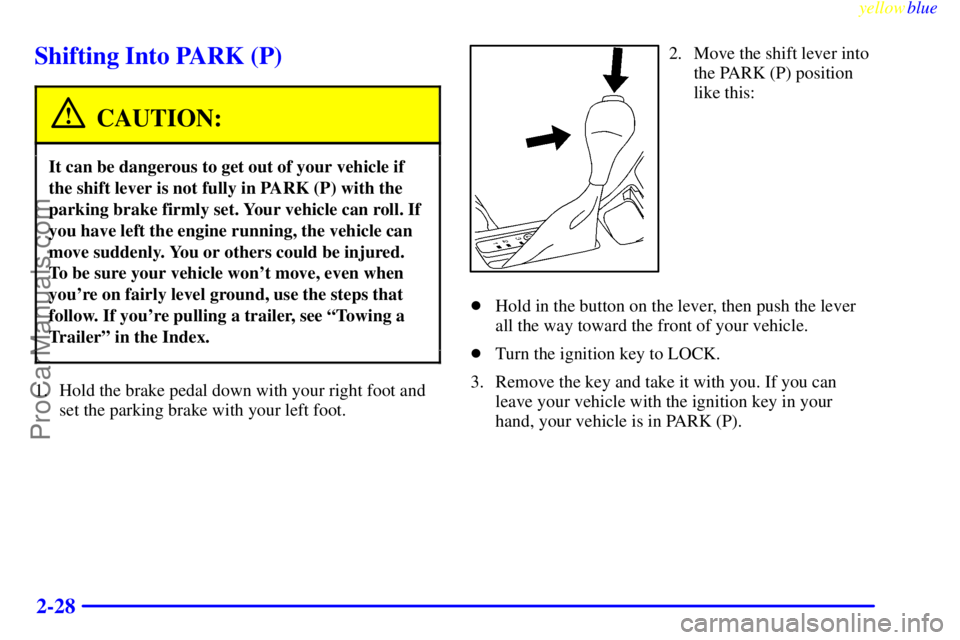
2. Move the shift lever into
the PARK (P) position
like this:
�Hold in the button on the lever, then push the lever
all the way toward the front of your vehicle.
�Turn the ignition key to LOCK.
3. Remove the key and take it with you. If you can
leave your vehicle with the ignition key in your
hand, your vehicle is in PARK (P).
ProCarManuals.com
Page 90 of 368
yellowblue
2-30
Shifting Out of PARK (P)
CAUTION:
Before shifting out of PARK (P) you must fully
apply your regular brakes. Your vehicle can roll.
If you have left the engine running, the vehicle
can move suddenly. You or others could be
injured. If you're pulling a trailer, see ªTowing a
Trailerº in the Index.
Your vehicle has a Brake-Transaxle Shift Interlock
(BTSI). You must fully apply your regular brakes before
you can shift from PARK (P) when the ignition is in
RUN. See ªAutomatic Transaxle Operationº in
the Index.If you cannot shift out of PARK (P), ease pressure on
the shift lever by pushing it all the way into PARK (P)
while keeping the brake pedal pushed down. Release the
shift lever button. Then move the shift lever out of
PARK (P).
If you ever hold the brake pedal down but still can't
shift out of PARK (P), try this:
1. Turn the ignition key to OFF.
2. Apply and hold the brake until the end of Step 4.
3. Shift to NEUTRAL (N).
4. Start the engine and shift to the drive gear you want.
5. Have the vehicle fixed as soon as you can.
ProCarManuals.com
Page 94 of 368
yellowblue
2-34
CAUTION:
It can be dangerous to get out of your vehicle if
the shift lever is not fully in PARK (P) with the
parking brake firmly set. Your vehicle can roll.
Don't leave your vehicle when the engine is
running unless you have to. If you've left the
engine running, the vehicle can move suddenly.
You or others could be injured. To be sure your
vehicle won't move, even when you're on fairly
level ground, always set your parking brake and
move the shift lever to PARK (P).
Follow the proper steps to be sure your vehicle won't
move. See ªShifting Into PARK (P)º in the Index.
If you are parking on a hill and if you're pulling a
trailer, also see ªTowing a Trailerº in the Index.
Windows
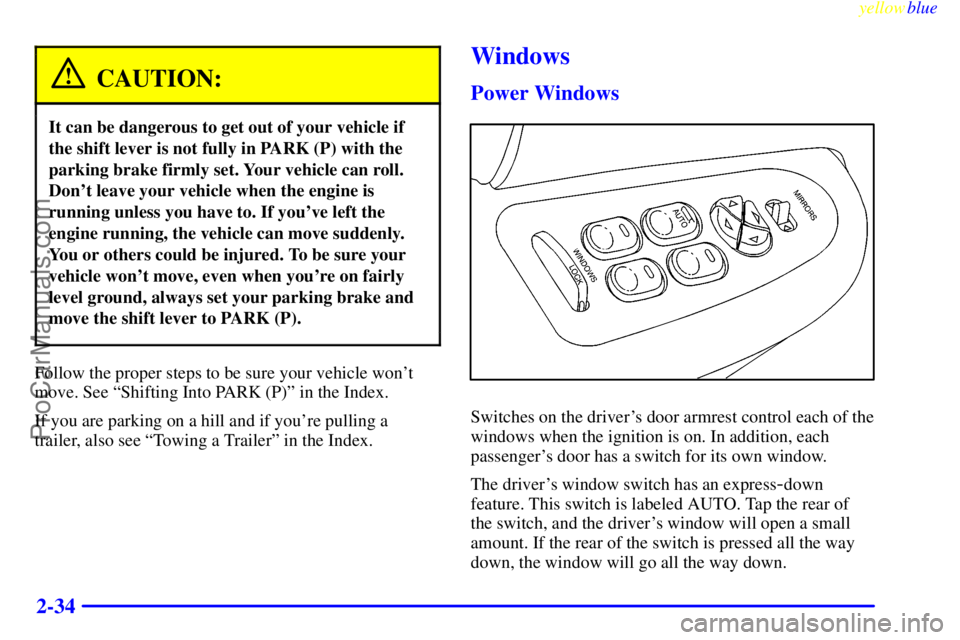
Power Windows
Switches on the driver's door armrest control each of the
windows when the ignition is on. In addition, each
passenger's door has a switch for its own window.
The driver's window switch has an express
-down
feature. This switch is labeled AUTO. Tap the rear of
the switch, and the driver's window will open a small
amount. If the rear of the switch is pressed all the way
down, the window will go all the way down.
ProCarManuals.com
Page 97 of 368

yellowblue
2-37
If a bulb is burned out, replace it to help avoid an
accident. If the arrows don't go on at all when you
signal a turn, check for burned
-out bulbs and then check
the fuse (see ªFuses and Circuit Breakersº in the Index).
A chime will sound if you leave your turn signal on for
more than 3/4 mile (1.2 km).
Headlamp High/Low Beam Changer
To change your headlamps
from low beams to high
beams, or high to low, pull
the multifunction lever all
the way toward you. Then
release it.
When the high beams are on, this light on the instrument
panel also will be on.
Flash-to-Pass Feature
This feature lets you use your high-beam headlamps to
signal the driver in front of you that you want to pass. It
works even if your headlamps are off.
To use it, pull the turn signal lever toward you a little,
but not so far that you hear a click.
If your headlamps are off or on low beam, your
high
-beam headlamps will turn on. They'll stay on as
long as you hold the lever toward you and the
high
-beam indicator on the dash will come on. Release
the lever to turn the high
-beam headlampsªflashº off.
ProCarManuals.com
Page 110 of 368
yellowblue
2-50 Convex Outside Mirror
Your passenger's side mirror is convex. A convex
mirror's surface is curved so you can see more from the
driver's seat.
CAUTION:
A convex mirror can make things (like other
vehicles) look farther away than they really are.
If you cut too sharply into the right lane, you
could hit a vehicle on your right. Check your
inside mirror or glance over your shoulder before
changing lanes.
Storage Compartments
Glove Box
Use the door key to lock and unlock the glove box. To
open, lift the latch.
Center Console
The console has cupholders, a cassette tape storage area
and a coinholder. To open the console's storage area,
press the latch located toward the front of the console lid
on the driver's side of the vehicle and pull up.
ProCarManuals.com
Page 111 of 368
yellowblue
2-51
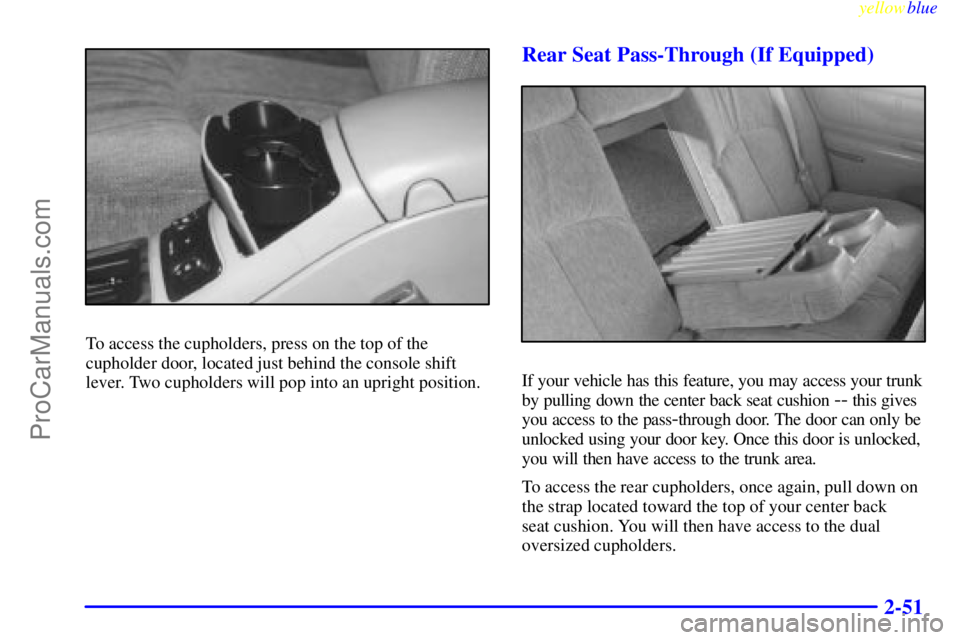
To access the cupholders, press on the top of the
cupholder door, located just behind the console shift
lever. Two cupholders will pop into an upright position.
Rear Seat Pass-Through (If Equipped)
If your vehicle has this feature, you may access your trunk
by pulling down the center back seat cushion
-- this gives
you access to the pass
-through door. The door can only be
unlocked using your door key. Once this door is unlocked,
you will then have access to the trunk area.
To access the rear cupholders, once again, pull down on
the strap located toward the top of your center back
seat cushion. You will then have access to the dual
oversized cupholders.
ProCarManuals.com