Page 250 of 368
yellowblue
6-10
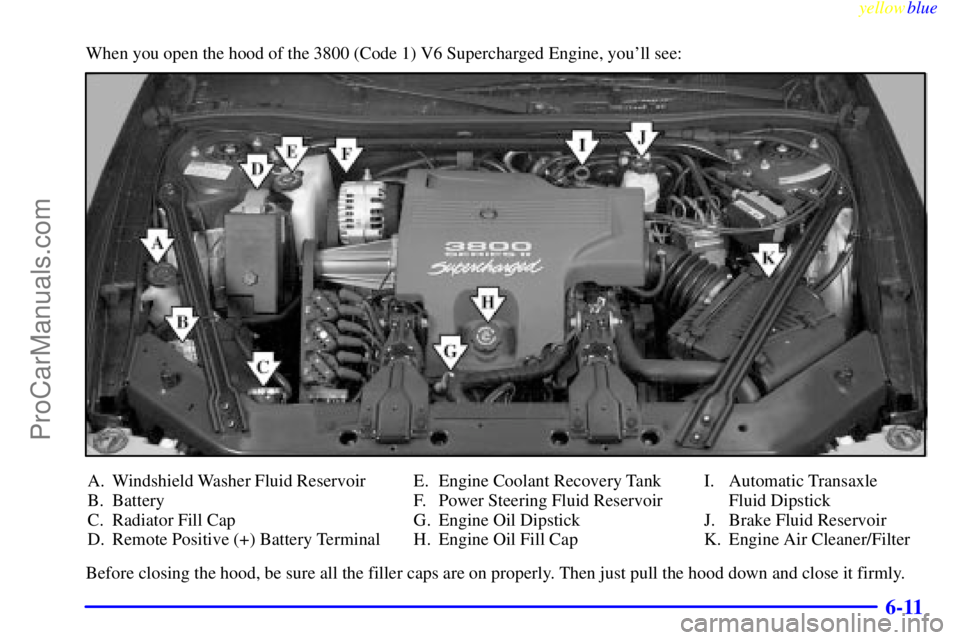
When you open the hood on the 3800 (Code K) V6 Engine, you'll see:
A. Windshield Washer Fluid Reservoir
B. Battery
C. Radiator Fill Cap
D. Remote Positive (+) Battery TerminalE. Engine Coolant Recovery Tank
F. Power Steering Fluid Reservoir
G. Engine Oil Dipstick
H. Engine Oil Fill CapI. Automatic Transaxle
Fluid Dipstick
J. Brake Fluid Reservoir
K. Engine Air Cleaner/Filter
ProCarManuals.com
Page 251 of 368
yellowblue
6-11
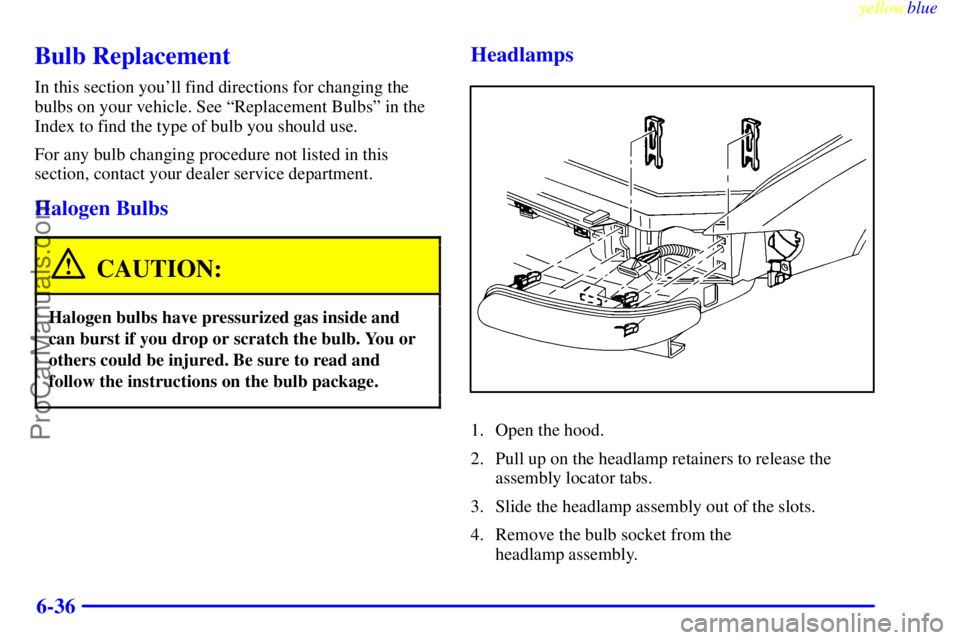
When you open the hood of the 3800 (Code 1) V6 Supercharged Engine, you'll see:
A. Windshield Washer Fluid Reservoir
B. Battery
C. Radiator Fill Cap
D. Remote Positive (+) Battery TerminalE. Engine Coolant Recovery Tank
F. Power Steering Fluid Reservoir
G. Engine Oil Dipstick
H. Engine Oil Fill CapI. Automatic Transaxle
Fluid Dipstick
J. Brake Fluid Reservoir
K. Engine Air Cleaner/Filter
Before closing the hood, be sure all the filler caps are on properly. Then just pull the hood down and close it firmly.
ProCarManuals.com
Page 276 of 368
yellowblue
6-36
Bulb Replacement
In this section you'll find directions for changing the
bulbs on your vehicle. See ªReplacement Bulbsº in the
Index to find the type of bulb you should use.
For any bulb changing procedure not listed in this
section, contact your dealer service department.
Halogen Bulbs
CAUTION:
Halogen bulbs have pressurized gas inside and
can burst if you drop or scratch the bulb. You or
others could be injured. Be sure to read and
follow the instructions on the bulb package.
Headlamps
1. Open the hood.
2. Pull up on the headlamp retainers to release the
assembly locator tabs.
3. Slide the headlamp assembly out of the slots.
4. Remove the bulb socket from the
headlamp assembly.
ProCarManuals.com
Page 278 of 368
yellowblue
6-38
The vehicle should be properly prepared as follows:
�The vehicle must have all four tires on a perfectly
level surface.
�If necessary, pads may be used on an uneven surface.
�The vehicle should not have any snow, ice or mud
attached to it.
�The vehicle should be fully assembled and all other
work stopped while headlamp aiming is being done.
�There should not be any cargo or loading of the
vehicle, except it should have a full tank of fuel and
one person or 160 lbs. (75 kg) on the driver's seat.
�Close all doors.
�Tires should be properly inflated.
�Rock the vehicle to stabilize the suspension.
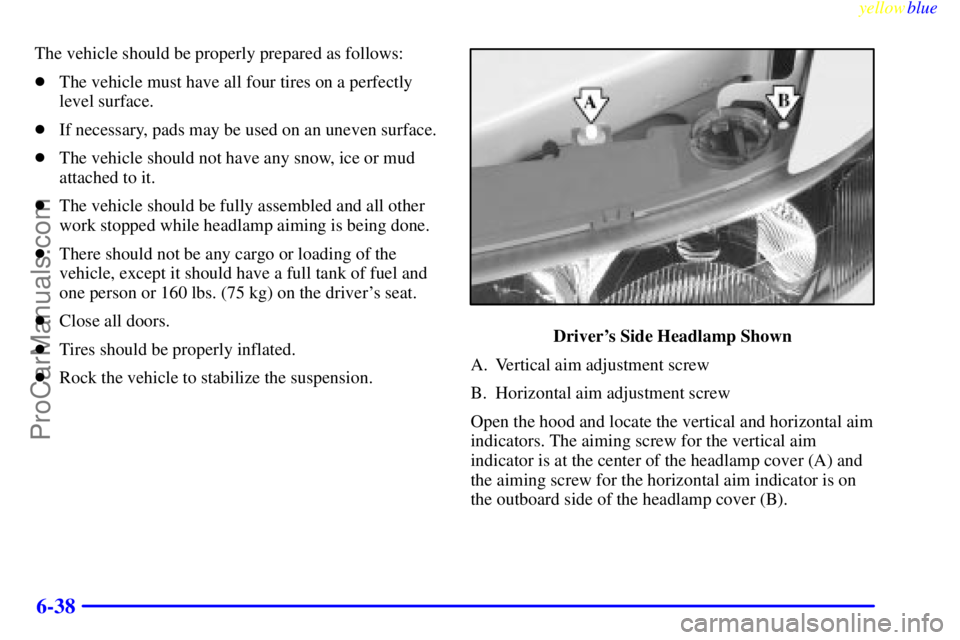
Driver's Side Headlamp Shown
A. Vertical aim adjustment screw
B. Horizontal aim adjustment screw
Open the hood and locate the vertical and horizontal aim
indicators. The aiming screw for the vertical aim
indicator is at the center of the headlamp cover (A) and
the aiming screw for the horizontal aim indicator is on
the outboard side of the headlamp cover (B).
ProCarManuals.com
Page 305 of 368

yellowblue
6-65
Electrical System
Add-On Electrical Equipment
NOTICE:
Don't add anything electrical to your vehicle
unless you check with your dealer first. Some
electrical equipment can damage your vehicle
and the damage wouldn't be covered by your
warranty. Some add
-on electrical equipment can
keep other components from working as
they should.
Your vehicle has an air bag system. Before attempting to
add anything electrical to your vehicle, see ªServicing
Your Air Bag
-Equipped Vehicleº in the Index.
Headlamp Wiring
The headlamp wiring is protected by a circuit breaker in
the underhood electrical center. An electrical overload
will cause the lamps to go on and off, or in some cases
to remain off. If this happens, have your headlamp
system checked right away.
Windshield Wipers
The windshield wiper motor is protected by a circuit
breaker and a fuse. If the motor overheats due to heavy
snow, etc., the wiper will stop until the motor cools. If
the overload is caused by some electrical problem, have
it fixed.
Power Windows and Other Power Options
Circuit breakers in the fuse panel protect the power
windows and other power accessories. When the current
load is too heavy, the circuit breaker opens and closes,
protecting the circuit until the problem is fixed.
ProCarManuals.com
Page 330 of 368

yellowblue
7-16 At Least Twice a Year
Restraint System Check
Make sure the safety belt reminder light and all your
belts, buckles, latch plates, retractors and anchorages are
working properly. Look for any other loose or damaged
safety belt system parts. If you see anything that might
keep a safety belt system from doing its job, have it
repaired. Have any torn or frayed safety belts replaced.
Also look for any opened or broken air bag coverings,
and have them repaired or replaced. (The air bag system
does not need regular maintenance.)
Wiper Blade Check
Inspect wiper blades for wear or cracking. Replace blade
inserts that appear worn or damaged or that streak or
miss areas of the windshield. Also see ªWiper Blades,
Cleaningº in the Index.
Weatherstrip Lubrication
Silicone grease on weatherstrips will make them last
longer, seal better, and not stick or squeak. Apply
silicone grease with a clean cloth. During very cold,
damp weather more frequent application may be
required. (See ªRecommended Fluids and Lubricantsº in
the Index.)Automatic Transaxle Check
Check the transaxle fluid level; add if needed. See
ªAutomatic Transaxle Fluidº in the Index. A fluid loss
may indicate a problem. Check the system and repair
if needed.
At Least Once a Year
Key Lock Cylinders Service
Lubricate the key lock cylinders with the lubricant
specified in Part D.
Body Lubrication Service
Lubricate all hinges and latches, including those for the
body doors, hood, secondary latch, pivots, spring
anchor, release pawl, rear compartment, glove box door,
console door and any folding seat hardware. Part D tells
you what to use. More frequent lubrication may be
required when exposed to a corrosive environment.
ProCarManuals.com