Page 304 of 400
yellowblue
6-46
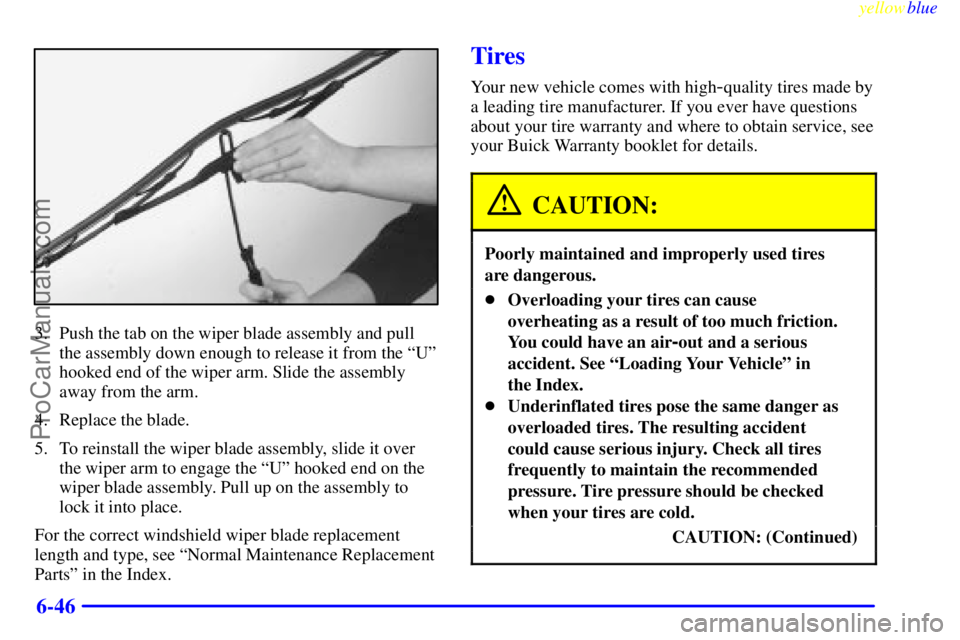
3. Push the tab on the wiper blade assembly and pull
the assembly down enough to release it from the ªUº
hooked end of the wiper arm. Slide the assembly
away from the arm.
4. Replace the blade.
5. To reinstall the wiper blade assembly, slide it over
the wiper arm to engage the ªUº hooked end on the
wiper blade assembly. Pull up on the assembly to
lock it into place.
For the correct windshield wiper blade replacement
length and type, see ªNormal Maintenance Replacement
Partsº in the Index.
Tires
Your new vehicle comes with high-quality tires made by
a leading tire manufacturer. If you ever have questions
about your tire warranty and where to obtain service, see
your Buick Warranty booklet for details.
CAUTION:
Poorly maintained and improperly used tires
are dangerous.
�Overloading your tires can cause
overheating as a result of too much friction.
You could have an air
-out and a serious
accident. See ªLoading Your Vehicleº in
the Index.
�Underinflated tires pose the same danger as
overloaded tires. The resulting accident
could cause serious injury. Check all tires
frequently to maintain the recommended
pressure. Tire pressure should be checked
when your tires are cold.
CAUTION: (Continued)
ProCarManuals.com
Page 306 of 400

yellowblue
6-48
When to Check
Check your tires once a month or more.
Don't forget your compact spare tire. It should be at
60 psi (420 kPa).
How to Check
Use a good quality pocket
-type gage to check tire
pressure. You can't tell if your tires are properly inflated
simply by looking at them. Radial tires may look
properly inflated even when they're underinflated.
Be sure to put the valve caps back on the valve
stems. They help prevent leaks by keeping out dirt
and moisture.
Check Tire Pressure System (If Equipped)
The check tire pressure system can alert you to a large
change in the pressure of one tire. The system won't alert
you before you drive that a tire is low or flat. You must
begin driving before the system will work properly.
The TIRE PRESSURE LOW: CHECK TIRES message
will appear on the Driver Information Center (DIC) if
pressure in one tire becomes at least 10 psi (69 kPa)
lower or higher than the other three tires. The check tire
pressure system won't alert you if more than one tire is
low or high, or if the system is not calibrated properly. It
also won't tell you which tire is low or high.
If the anti
-lock brake system warning light comes on,
the check tire pressure system may not be working
properly. See your dealer for service. (Also, see
ªAnti
-Lock Brake System Warning Lightº in the Index.)
The check tire pressure system detects differences in tire
rotation speeds that are caused by changes in tire pressure.
The system can alert you about a low tire
-- but it doesn't
replace normal tire maintenance. See ªTiresº in the Index.
ProCarManuals.com
Page 308 of 400

yellowblue
6-50 Tire Inspection and Rotation
Tires should be rotated every 6,000 to 8,000 miles (10 000 to
13 000 km). Any time you notice unusual wear, rotate your
tires as soon as possible and check wheel alignment. Also
check for damaged tires or wheels. See ªWhen It's Time for
New Tiresº and ªWheel Replacementº later in this section
for more information.
The purpose of regular rotation is to achieve more
uniform wear for all tires on the vehicle. The first
rotation is the most important. See ªScheduled
Maintenance Servicesº in the Index for scheduled
rotation intervals.
When rotating your tires, always use the correct rotation
pattern shown here.Don't include the compact spare tire in your
tire rotation.
After the tires have been rotated, adjust the front and
rear inflation pressures as shown on the Tire
-Loading
Information label. Make certain that all wheel nuts are
properly tightened. See ªWheel Nut Torqueº in
the Index.
CAUTION:
Rust or dirt on a wheel, or on the parts to which
it is fastened, can make wheel nuts become loose
after a time. The wheel could come off and cause
an accident. When you change a wheel, remove
any rust or dirt from places where the wheel
attaches to the vehicle. In an emergency, you can
use a cloth or a paper towel to do this; but be
sure to use a scraper or wire brush later, if you
need to, to get all the rust or dirt off. (See
ªChanging a Flat Tireº in the Index.)
ProCarManuals.com
Page 321 of 400

yellowblue
6-63
Underbody Maintenance
Chemicals used for ice and snow removal and dust
control can collect on the underbody. If these are not
removed, accelerated corrosion (rust) can occur on the
underbody parts such as fuel lines, frame, floor pan
and exhaust system even though they have
corrosion protection.
At least every spring, flush these materials from the
underbody with plain water. Clean any areas where mud
and other debris can collect. Dirt packed in closed areas
of the frame should be loosened before being flushed.
Your dealer or an underbody car washing system can do
this for you.
Chemical Paint Spotting
Some weather and atmospheric conditions can create a
chemical fallout. Airborne pollutants can fall upon and
attack painted surfaces on your vehicle. This damage
can take two forms: blotchy, ringlet
-shaped
discolorations, and small irregular dark spots etched into
the paint surface.
Although no defect in the paint job causes this, Buick
will repair, at no charge to the owner, the surfaces of
new vehicles damaged by this fallout condition within
12 months or 12,000 miles (20 000 km) of purchase,
whichever occurs first.
ProCarManuals.com
Page 335 of 400

yellowblue
6-77
Normal Maintenance
Replacement Parts
Air Cleaner Filter AC Type A-1096C . . . . . . . . . . . . .
Engine Oil Filter AC Type PF
-47 . . . . . . . . . . . . . . . .
Fuel Filter AC Type GF
-627 . . . . . . . . . . . . . . . . . . . .
Spark Plugs AC Type 41
-921* . . . . . . . . . . . . . . . . . .
Gap 0.060 inch (.152 cm)
*On 3800 Supercharged Engine (Code 1) only, this
replaces original spark plug NGK Type PTR4B
-15.
Windshield Wiper Blades
Type Hook Style. . . . . . . . . . . . . . . . . . . . . . . . . . . .
Length 22 inches (56 cm). . . . . . . . . . . . . . . . . . . . .
Passenger Compartment Air
Filter (HVAC air filter) GM Part No. 52472175. . . . .
Vehicle Dimensions
Length 206.8 inches (525.3 cm). . . . . . . . . . . . . . . . .
Width 74.7 inches (189.7 cm). . . . . . . . . . . . . . . . . . .
Height 58.1 inches (147.6 cm). . . . . . . . . . . . . . . . . . .
Wheelbase 113.8 inches (289.1 cm). . . . . . . . . . . . . .
Front Tread 62.7 inches (159.3 cm). . . . . . . . . . . . . . .
Rear Tread 62.3 inches (158.2 cm). . . . . . . . . . . . . . .
Engine Accessory Belt (L36)
The L36 engine uses an engine accessory belt. This
diagram shows the features connected and the routing.
See ªMaintenance Scheduleº in the Index for when to
check the belt.
A. Power Steering
B. Generator
C. Air ConditioningD. Crank
E. Coolant Pump
F. Tensioner
ProCarManuals.com
Page 337 of 400
7-
yellowblue
7-1
Section 7 Maintenance Schedule
This section covers the maintenance required for your vehicle. Your vehicle needs these services to retain its safety,
dependability and emission control performance.
7
-2 Introduction
7
-3 How This Section is Organized
7
-4 Part A: Scheduled Maintenance Services
7
-7 Short Trip/City Scheduled Maintenance
7
-22 Long Trip/Highway Scheduled Maintenance7
-31 Part B: Owner Checks and Services
7
-35 Part C: Periodic Maintenance Inspections
7
-37 Part D: Recommended Fluids and Lubricants
7
-39 Part E: Maintenance Record
ProCarManuals.com
Page 338 of 400
yellowblue
7-2
Have you purchased the GM Protection Plan? The Plan
supplements your new vehicle warranties. See your
Warranty and Owner Assistance booklet, or your dealer
for details.
Introduction
Your Vehicle and the Environment
Proper vehicle maintenance not only helps to keep your
vehicle in good working condition, but also helps the
environment. All recommended maintenance procedures
are important. Improper vehicle maintenance can even
affect the quality of the air we breathe. Improper fluid
levels or the wrong tire inflation can increase the level
of emissions from your vehicle. To help protect our
environment, and to keep your vehicle in good
condition, please maintain your vehicle properly.
ProCarManuals.com
Page 339 of 400

yellowblue
7-3 How This Section is Organized
This maintenance schedule is divided into five parts:
ªPart A: Scheduled Maintenance Servicesº shows
what to have done and how often. Some of these
services can be complex, so unless you are technically
qualified and have the necessary equipment, you should
let your dealer's service department or another qualified
service center do these jobs.
CAUTION:
Performing maintenance work on a vehicle can
be dangerous. In trying to do some jobs, you can
be seriously injured. Do your own maintenance
work only if you have the required know
-how
and the proper tools and equipment for the job.
If you have any doubt, have a qualified
technician do the work.
If you are skilled enough to do some work on your
vehicle, you will probably want to get the service
information. See ªService and Owner Publicationsº in
the Index.ªPart B: Owner Checks and Servicesº tells you
what should be checked and when. It also explains what
you can easily do to help keep your vehicle in
good condition.
ªPart C: Periodic Maintenance Inspectionsº
explains important inspections that your dealer's service
department or another qualified service center
should perform.
ªPart D: Recommended Fluids and Lubricantsº
lists some recommended products to help keep your
vehicle properly maintained. These products, or their
equivalents, should be used whether you do the work
yourself or have it done.
ªPart E: Maintenance Recordº provides a place
for you to record the maintenance performed on your
vehicle. Whenever any maintenance is performed, be
sure to write it down in this part. This will help you
determine when your next maintenance should be done.
In addition, it is a good idea to keep your maintenance
receipts. They may be needed to qualify your vehicle for
warranty repairs.
ProCarManuals.com

