Page 82 of 400
yellowblue
2-24 To Use the Engine Coolant Heater
1. Turn off the engine.
2. Open the hood and unwrap the electrical cord.
3. Plug it into a normal, grounded 110
-volt AC outlet.
CAUTION:
Plugging the cord into an ungrounded outlet
could cause an electrical shock. Also, the wrong
kind of extension cord could overheat and cause
a fire. You could be seriously injured. Plug the
cord into a properly grounded three
-prong
11 0
-volt AC outlet. If the cord won't reach, use a
heavy
-duty three-prong extension cord rated for
at least 15 amps.
4. Before starting the engine, be sure to unplug
and store the cord as it was before to keep it away
from moving engine parts. If you don't, it could
be damaged.How long should you keep the coolant heater plugged
in? The answer depends on the outside temperature, the
kind of oil you have, and some other things. Instead of
trying to list everything here, we ask that you contact
your dealer in the area where you'll be parking your
vehicle. The dealer can give you the best advice for that
particular area.
Automatic Transaxle Operation
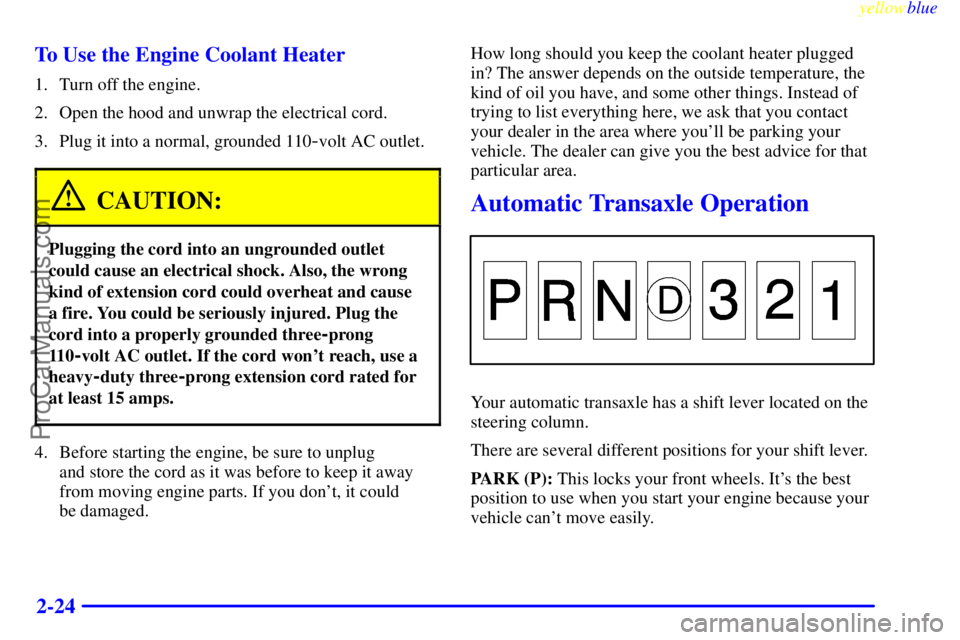
Your automatic transaxle has a shift lever located on the
steering column.
There are several different positions for your shift lever.
PARK (P): This locks your front wheels. It's the best
position to use when you start your engine because your
vehicle can't move easily.
ProCarManuals.com
Page 83 of 400
yellowblue
2-25
CAUTION:
It is dangerous to get out of your vehicle if the
shift lever is not fully in PARK (P) with the
parking brake firmly set. Your vehicle can roll.
Don't leave your vehicle when the engine is
running unless you have to. If you have left the
engine running, the vehicle can move suddenly.
You or others could be injured. To be sure your
vehicle won't move, even when you're on fairly
level ground, always set your parking brake and
move the shift lever to PARK (P).
See ªShifting Into PARK (P)º in the Index. If
you're pulling a trailer, see ªTowing a Trailerº in
the Index.
Ensure the shift lever is fully in PARK (P) before
starting the engine. Your vehicle has a brake
-transaxle
shift interlock. You have to fully apply your regular
brakes before you can shift from PARK (P) when the
ignition key is in RUN. If you cannot shift out of
PARK (P), ease pressure on the shift lever
-- push
the shift lever all the way into PARK (P) as youmaintain brake application. Then move the shift lever
into the gear you wish. See ªShifting Out of PARK (P)º
in the Index.
REVERSE (R): Use this gear to back up.
NOTICE:
Shifting to REVERSE (R) while your vehicle is
moving forward could damage your transaxle.
Shift to REVERSE (R) only after your vehicle
is stopped.
To rock your vehicle back and forth to get out of snow,
ice or sand without damaging your transaxle, see
ªStuck: In Sand, Mud, Ice or Snowº in the Index.
NEUTRAL (N): In this position, your engine
doesn't connect with the wheels. To restart when you're
already moving, use NEUTRAL (N) only. Also, use
NEUTRAL (N) when your vehicle is being towed.
ProCarManuals.com
Page 85 of 400
yellowblue
2-27
SECOND (2): This position gives you more power but
lower fuel economy. You can use SECOND (2) on hills.
It can help control your speed as you go down steep
mountain roads, but then you would also want to use
your brakes off and on.
NOTICE:
Don't drive in SECOND (2) for more than
5 miles (8 km), or at speeds over 55 mph
(88 km/h), or you can damage your transaxle.
Use AUTOMATIC OVERDRIVE (�) or
THIRD (3) as much as possible.
Don't shift into SECOND (2) unless you are going
slower than 65 mph (105 km/h), or you can
damage your engine.
FIRST (1): This position gives you even more
power (but lower fuel economy) than SECOND (2). You
can use it on very steep hills, or in deep snow or mud. If
the selector lever is put in FIRST (1), the transaxle
won't shift into first gear until the vehicle is going
slowly enough.
NOTICE:
If your front wheels can't rotate, don't try to
drive. This might happen if you were stuck in
very deep sand or mud or were up against a solid
object. You could damage your transaxle.
Also, if you stop when going uphill, don't hold
your vehicle there with only the accelerator
pedal. This could overheat and damage the
transaxle. Use your brakes or shift into PARK (P)
to hold your vehicle in position on a hill.
ProCarManuals.com
Page 86 of 400
yellowblue
2-28
Parking Brake
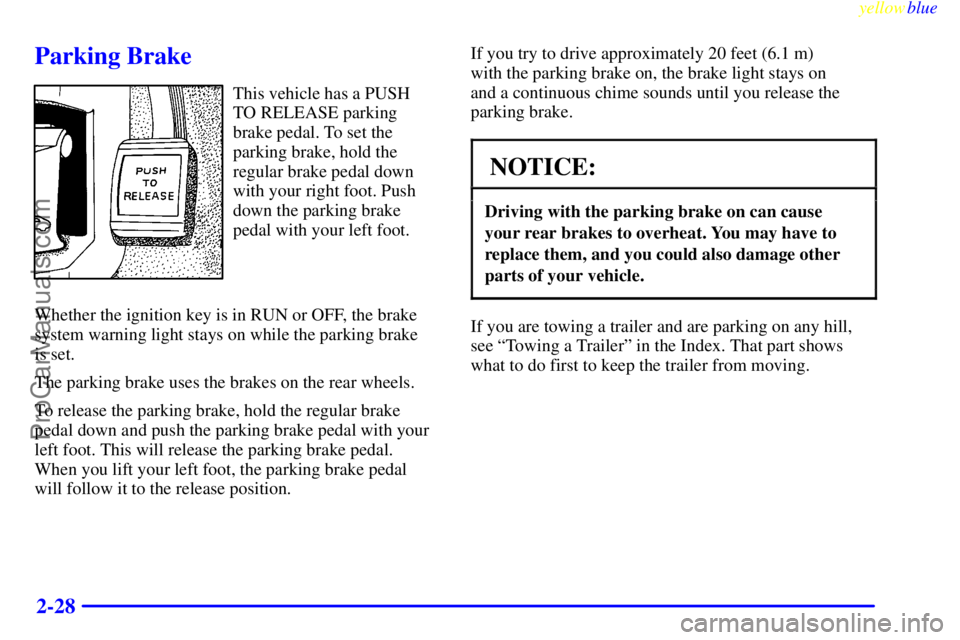
This vehicle has a PUSH
TO RELEASE parking
brake pedal. To set the
parking brake, hold the
regular brake pedal down
with your right foot. Push
down the parking brake
pedal with your left foot.
Whether the ignition key is in RUN or OFF, the brake
system warning light stays on while the parking brake
is set.
The parking brake uses the brakes on the rear wheels.
To release the parking brake, hold the regular brake
pedal down and push the parking brake pedal with your
left foot. This will release the parking brake pedal.
When you lift your left foot, the parking brake pedal
will follow it to the release position.If you try to drive approximately 20 feet (6.1 m)
with the parking brake on, the brake light stays on
and a continuous chime sounds until you release the
parking brake.
NOTICE:
Driving with the parking brake on can cause
your rear brakes to overheat. You may have to
replace them, and you could also damage other
parts of your vehicle.
If you are towing a trailer and are parking on any hill,
see ªTowing a Trailerº in the Index. That part shows
what to do first to keep the trailer from moving.
ProCarManuals.com
Page 93 of 400
yellowblue
2-35
Express-Down Window
The switch for the driver's window has an express
-down
feature. Pull the switch back all the way, release it and the
window will lower automatically. To stop the window
from lowering, pull the switch again. To partially open the
window, pull the switch back half way. When the switch is
released, the window will stop moving. To raise the
window, press and hold the switch forward.
Window Lock
Press the window lock switch on the driver's armrest to
disable all passenger window switches, or just the rear
passenger switches. The middle of the switch will light
to indicate the window lockout is active.
The driver's window controls will still be operable. This is
a useful feature when you have children as passengers.
Press the window lock switch a second time to allow
passengers to use their window controls again. The light
in the center of the switch will go off to indicate that the
feature is disabled.
Vehicles are delivered programmed to lock out all
passenger windows. If you have the optional DIC, you can
choose to lock out only the rear windows. See ªPersonal
Choice Featuresº or ªDriver Information Centerº in the
Index for programming instructions. If you do not have theDIC feature, see your dealer if you choose to have this
setting changed to lock out only the rear windows.
Horn
Nearly the entire surface of the center pad of the
steering wheel is an active horn switch. Press on the pad
near the horn symbols to sound the horn.
Tilt Wheel
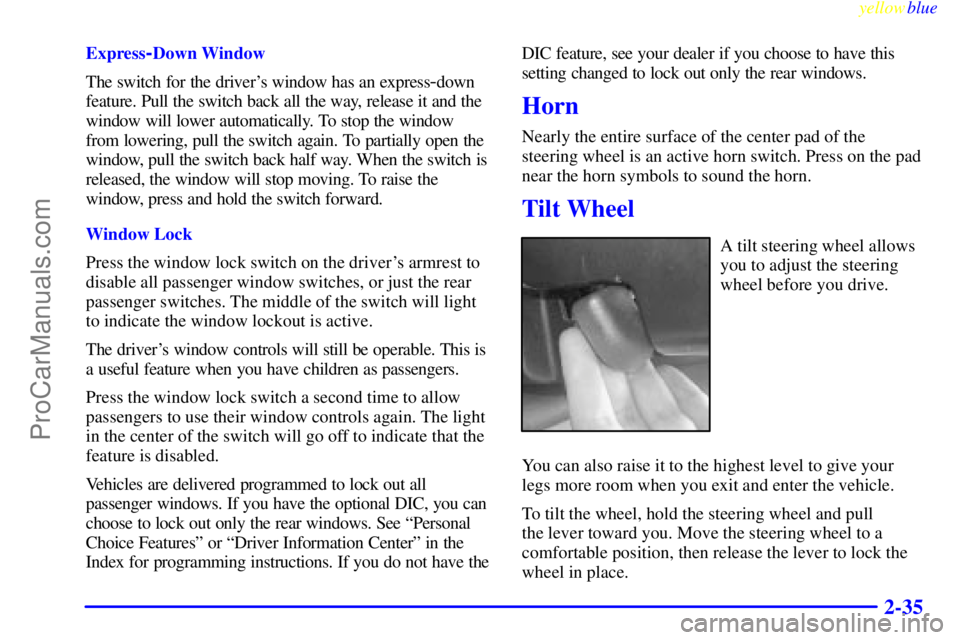
A tilt steering wheel allows
you to adjust the steering
wheel before you drive.
You can also raise it to the highest level to give your
legs more room when you exit and enter the vehicle.
To tilt the wheel, hold the steering wheel and pull
the lever toward you. Move the steering wheel to a
comfortable position, then release the lever to lock the
wheel in place.
ProCarManuals.com
Page 98 of 400
yellowblue
2-40
It is important to note that the moisture-sensing delay
wiping feature can be overridden at any time by
manually turning the wiper band to LO or HI speed.
If the windshield on your vehicle ever needs
replacement, make sure that the new windshield is
moisture
-sensing delay compatible.
Windshield Washer
At the top of the multifunction lever there is a paddle
with the word PUSH on it. For ªprogrammedº
operation, press and release the paddle. The washer will
provide a measured amount of fluid to the windshield
and the wiper will either stop or return to your original
wiping speed. For ªdemandº operation, press and hold
the paddle for at least two seconds. Release the paddle
when you have enough fluid and the wipers will either
stop or return to your original wiping speed.
CAUTION:
In freezing weather, don't use your washer until
the windshield is warmed. Otherwise the washer
fluid can form ice on the windshield, blocking
your vision.
If your vehicle is equipped with a DIC, a WINDSHIELD
WASHER FLUID LOW message will appear on the
display when the vehicle is low on washer fluid.
Cruise Control
With cruise control, you can maintain a speed of about
25 mph (40 km/h) or more without keeping your foot on
the accelerator. This can really help on long trips.
Cruise control does not work at speeds below about
25 mph (40 km/h).
When you apply your brakes, the cruise control shuts off.
CAUTION:
�Cruise control can be dangerous where you
can't drive safely at a steady speed. So,
don't use your cruise control on winding
roads or in heavy traffic.
�Cruise control can be dangerous on
slippery roads. On such roads, fast changes
in tire traction can cause needless wheel
spinning, and you could lose control. Don't
use cruise control on slippery roads.
ProCarManuals.com
Page 99 of 400
yellowblue
2-41
If your vehicle is in cruise control when the optional
traction control system begins to limit wheel spin, the
cruise control will automatically disengage. (See
ªTraction Control Systemº in the Index.) When road
conditions allow you to safely use it again, you may turn
the cruise control back on.
Setting Cruise Control
CAUTION:
If you leave your cruise control switch on when
you're not using cruise, you might hit a button
and go into cruise when you don't want to. You
could be startled and even lose control. Keep the
cruise control switch off until you want to use it.
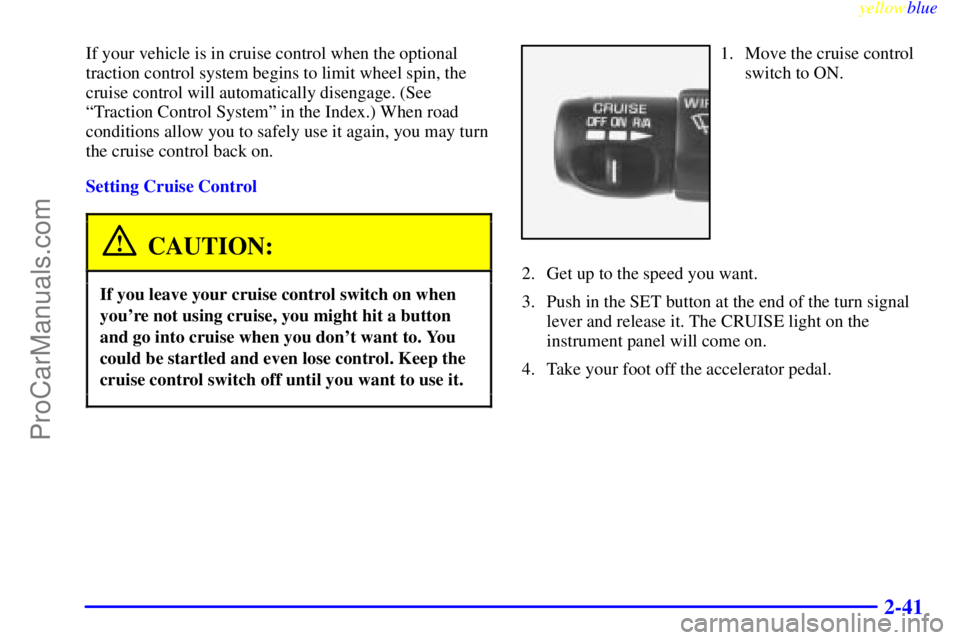
1. Move the cruise control
switch to ON.
2. Get up to the speed you want.
3. Push in the SET button at the end of the turn signal
lever and release it. The CRUISE light on the
instrument panel will come on.
4. Take your foot off the accelerator pedal.
ProCarManuals.com
Page 127 of 400
yellowblue
2-69
The main components of your instrument panel are:
A. Air Outlet
B. Headlamps/Parking Lamps Switch
C. Turn Signal/Multifunction Lever
D. Instrument Cluster/Gages
E. Hazard Warning Flasher Switch
F. Climate Control System and Audio Steering Wheel
Controls
G. Gearshift Lever
H. Audio System
I. Air OutletJ. Fuel Button
K. Trunk Release and Lockout Button
L. Hood Release
M. Audio System Steering Wheel Controls
N. Ignition Switch
O. Traction Control Switch
P. Ashtray and Cigarette Lighter
Q. Climate Control System
R. Glove Box
S. Passenger Climate Control
ProCarManuals.com